• Skip to primary navigation
  • Skip to main content
  • Skip to footer
Shady Grove Fertility
  • Become an Egg Donor
  • Referring Physicians
  • 1-888-761-1967
  • Schedule Appointment
  • Get Started
        • Get Started
          • Causes of Infertility
          • Fertility Tests
          • When to Seek Help
          • Find a Doctor
          • Preconception and prenatal vitamins 
          • Schedule an Appointment
        • Personalized Care For
          • Single Parents
          • LGBTQIA+ Family Building
          • People with Cancer
          • Known Genetic Diseases
          • Egg Donors
  • Treatments
        • Fertility
          • Timed Intercourse
          • Ovulation Induction
          • Intrauterine Insemination (IUI)
          • In Vitro Fertilization (IVF)
          • Frozen Embryo Transfer (FET)
        • Donation & Surrogacy
          • Donor Sperm
          • Donor Egg
          • Donor Embryo
          • Gestational Carrier
          • LGBTQIA+ Family Building
          • Single Parents
          • Find a Donor
        • More Treatments
          • Center for Male Fertility
          • Egg Freezing
          • OncoFertility
          • Preimplantation Genetic Testing
          • MIGS
          • All Fertility Treatments
  • Resources
    • Resource Library
    • Events Calendar
    • Patient Stories
    • Mental Health
    • Wellness Center
  • Insurance & Savings
    • Insurance & Benefits
    • Shared Risk 100% Refund Program
    • 100% Refund for Donor Egg
    • Discounts
    • Egg Freezing Costs
    • Financing & Grants
    • Clinical Trials
  • About
    • Find a Doctor
    • About SGF
    • Our Care Team
    • Advanced Practice Providers
    • Fertility Equity
    • Philanthropy
    • Newsroom
    • Careers
    • Contact Us
    • Voice Your Feedback
  • Locations
        • Find a Location
        • California
        • Colorado
        • Delaware
        • Florida
        • Georgia
        • Maryland
        • North Carolina
        • Pennsylvania
        • Texas
        • Virginia
        • Washington, D.C.
        • Chile
        • International & Out of State
        • SGF at Walter Reed National Military Medical Center
  • Patient Hub
    • Online Bill Pay
    • Patient Forms
    • Patient Portal
  • Call your care team
  • Become an egg donor
  • Referring physicians
  • search-icon
  • Schedule appointment 1-888-761-1967

Home / Diagnosing Infertility / Page 8

Diagnosing Infertility

January 31, 2017 by Shady Grove Fertility

As technology continues to advance and more men and women are talking about their struggles with infertility, couples are becoming more proactive about their reproductive health and seeking the expertise of a fertility specialist. On average, it will take a couple 5-7 months to conceive, so there’s no need to become concerned if it’s taking you more than a few months to get pregnant. But as more time passes without success, how do you know when it’s time to seek help?

Physicians often suggest seeking a complete fertility evaluation after 12 months of trying to conceive with no success when the female partner is under the age of 35, after 6 months when she is older than 35, and after 3 months if 40 and over. Beyond age, it is important to be aware of several medical conditions that indicate seeing a fertility specialist sooner. If any of the following conditions apply to you, it is probably time to make an appointment with a fertility specialist:

1. YOUR PERIOD IS IRREGULAR OR SOMETIMES DOESN’T COME AT ALL

Irregular periods usually mean irregular ovulation and no periods at all may mean ovulation is not taking place, making conception feel like an uphill battle. While there are many reasons why you may miss your period, ovulatory disorders are the leading cause of infertility for women.

“Ovulatory disorders broadly break down into two groups: no ovulation and oligo-ovulation (frequently due to PCOS), which is when ovulation occurs infrequently or irregularly,” explains Dr. Bromer. Medications such as Clomid and treatment options such as intrauterine insemination (IUI) can induce ovulation and help patients conceive faster. No matter your age, if ovulation is irregular or never occurring, seeking the help of a specialist can help get your reproductive system back on track.

2. YOU HAVE BEEN TRYING…..BUT NOT REALLY….

“During initial consultations with patients, I have many who say, ‘We haven’t used any forms of contraception in the past three years, but we have only really been trying to conceive for about six months.’ So what does ‘trying’ really mean?” asks Dr. Jason Bromer. “No matter if you have been actively trying or not, couples having unprotected sexual intercourse for more than 6 or 12 months, depending on age, should seek a fertility evaluation if they are not conceiving.”

“We can order specialized testing to detect subtle causes of infertility,” says Dr. Bromer. Based on the information learned through testing, fertility specialists can offer several low-tech treatment options to start, which are often covered by insurance.

3. YOU HAVEN’T HAD A COMPREHENSIVE FERTILITY WORK-UP….AND TREATMENT HASN’T BEEN SUCCESSFUL YET

At Shady Grove Fertility, the very first thing your fertility specialist will do is review your medical history and initiate fertility testing for both partners.  It is very important that each of the following tests be performed prior to initiating any kind of fertility treatment, because a complete evaluation of the male and female reproductive functions are required to determine the cause of infertility and identify the most effective course of treatment.

These basic tests include:

  • Day 3 bloodwork: tells you if your reproductive hormones are functioning normally.
  • Anti-Müllerian hormone (AMH) test: tells you how many eggs you have.
  • Hysterosalpingogram (HSG): tells you if your uterus is shaped normally and if your tubes are open.
  • Semen analysis: tells you if your partner has enough sperm and if they are healthy.

4. THE SEMEN ANALYSIS IN YOUR FERTILITY WORK-UP CAME BACK ABNORMAL

While often considered a female health concern, 40 percent of all infertility cases are in part due to male factor infertility. If you have received abnormal semen analysis results, you should see a fertility specialist right away. When the male partner’s sperm count is low or of poor quality, it can make conception significantly more difficult. Seeing a fertility specialist can help to determine the severity of a potential male factor diagnosis and offer a range of solutions to help you conceive. “The good news if you have a low sperm count is it only takes a single sperm to make a great embryo,” says Dr. Bromer. Modern reproductive technology like in vitro fertilization (IVF) and intracytoplasmic sperm injection (ICSI) can help patients with even the lowest sperm counts overcome infertility.

5. YOU HAVE EXPERIENCED TWO OR MORE MISCARRIAGES

It is a common misconception that women who have miscarriages are just fine because they are able to get pregnant. “In fact, having multiple miscarriages is a very specific type of fertility problem that affects 1-3 percent of all couples,” explains Dr. Bromer. “The majority of miscarriages can be attributed to genetic abnormalities in the embryo, while other causes include hormonal problems like diabetes, thyroid disease, undetected structural problems in the uterus, and advanced reproductive age.”  Anyone who has experienced two or more miscarriages should see a fertility specialist.

IT’S TIME TO SEE A FERTILITY SPECIALIST

Making the move to see a fertility specialist is a big step for many people. Patients often second-guess themselves about the need to see a specialist, or they worry that it won’t work or how will they afford it. It’s best to take it one step at a time. By scheduling a new patient consultation–which is covered by insurance in 90% of cases–you will get the answers you need to help you move forward. Shady Grove Fertility’s specially trained reproductive endocrinologists are among the best in the field and are dedicated to working with each patient to overcome their infertility.

Medical Contribution by: Jason Bromer, M.D., of Shady Grove Fertility’s Frederick, MD office. 

Schedule an Appointment

Early intervention offers the best chances of success, so let us help you get started. To learn more about our simple fertility evaluation or to schedule an appointment, please call our New Patient Center and one of our New Patient Liaisons will happily assist you. Please call 1-877-971-7755 or click to complete this simple form.

At Shady Grove Fertility, we’re here to give you the caring support you deserve as you start or grow your family. As a leading fertility and IVF center of excellence, we offer patients individualized care, innovative financial options, over 30 accepted insurance plans, and pregnancy rates among the highest of all national centers. We offer patients the convenience of 19 full-service and 6 satellite locations across Maryland, Pennsylvania, Virginia, and Washington, D.C. More than 1,700 physicians choose Shady Grove Fertility to refer their patients, and more than 96 percent of our patients say they would recommend Shady Grove Fertility’s 35+ physicians to a friend. With 10 Shady Grove Fertility babies born each day, your dream of starting or growing your family is within reach.

Filed Under: Diagnosing Infertility

November 30, 2016 by Shady Grove Fertility

When you’ve already had a successful pregnancy, it seems hard to believe that you may have difficulty getting pregnant again. But in the United States, nearly half of all cases of infertility are classified as secondary infertility. Secondary infertility is defined as the inability to become pregnant —despite engaging in unprotected intercourse—following the birth of one or more biological children who were born without the aid of fertility treatment or medications.

Causes of Secondary Infertility

Maternal Age
One of the leading causes of secondary infertility is the female partner’s age. As a woman gets older, the quality and quantity of her eggs decreases. While she may have had her first child without a problem, she could encounter a change in egg quality or quantity if she tries to conceive again several years later. While every individual woman is different, Shady Grove Fertility provides age-based recommendations for when you should see a fertility specialist if you are having difficulty conceiving.

Internal Complications
In some women, there may have been complications from their previous pregnancy and/or delivery that could have affected the uterus and the ability of an embryo to implant and grow. If an infection occurred and went untreated, adhesions may have developed within the uterus or around the Fallopian tubes.

Irregular or absent menstrual cycles can often reveal an underlying ovulation disorder, even if previous conception occurred.

Recurrent miscarriage, also known as recurrent pregnancy loss, is defined as two or more consecutive, spontaneous pregnancy losses. It is often unknown why miscarriages occur, even when a previous pregnancy has been successful.

Male Factor Infertility
As with women, male aging can have an effect on reproductive health, potentially affecting sperm quality and quantity. But while these changes may be due to age, they could also be due to new medications or lifestyle changes like weight gain or a new smoking habit (which can also affect female fertility). Learn how you can improve sperm quality.

Weight Gain
For both men and women, weight gain can have a significant impact on the ability to conceive, sometimes leading to ovulatory dysfunction in women or reduced sperm quality in men. However, weight loss can reverse these conditions. In many men and women with a body mass index (BMI) that is above normal, diet, exercise, and lifestyle changes have been shown to make a vast difference in fertility potential. Studies have shown that for women, losing as little as 5 to 10 percent of their body weight can improve the chances of pregnancy occurring.

Available Treatment Options

If you have had a successful pregnancy before and are now trying to conceive without success, we recommend making an appointment to see a fertility specialist.

After your physician establishes a diagnosis, he or she will discuss with you the recommended treatment approach. As with other types of infertility, many patients with secondary infertility are able to start with low-tech treatment like intrauterine insemination (IUI). In some instances though, secondary infertility may need to ultimately be treated with in vitro fertilization (IVF) or donor egg treatment.

Support System for Secondary Infertility 

“It can be shocking and surprising for women who were once able to become pregnant and have a child easily to find that when they want a second one they cannot. Learning to accept this and the feelings of guilt that may follow can be the first step in addressing the problem and working towards a resolution,” says Patricia Sachs, LCSW-C.

Many women who experience secondary infertility can feel surprised, alone, and not know how to share their feelings with their friends and family. You may experience unwelcomed reactions from your friends and family who may not understand why you’re so upset because you already have a child. It can be very difficult to make sense of these challenges and to stop feeling so distant from everyone around you. You are not alone though and there are support groups and resources available. Shady Grove Fertility has free support groups that meet regularly in the Mid-Atlantic region.

The most important thing to remember when you are experiencing secondary infertility is that you are not alone and that it can happen to anyone. A fertility specialist will be able to provide you with an accurate diagnosis and then create an individualized treatment plan to help you conceive.


Schedule an Appointment


Editors Note: This post was originally published in February 2015 and has been updated for accuracy and comprehensiveness as of November 20, 2016.

References:
Chandra, A., Ph.D., Copen, Casey E., Ph.D., & Stephen, Elizabeth Hervey, Ph.D. Infertility and Impaired Fecundity in the United States, 1982-2010: Data from the National Survey of Family Growth. National Health Statistics Report. August 2013. doi: http://www.cdc.gov/nchs/data/nhsr/nhsr067.pdf

Medical Contribution by: Dr. Shrui Malik of Shady Grove Fertility’s Fair Oaks and Woodbridge, VA offices.

For more information about secondary infertility or to schedule an appointment with a Shady Grove Fertility physician, please contact the New Patient Center at 877-971-7755.

Filed Under: Diagnosing Infertility Tagged With: Causes of infertility, Secondary infertility

September 20, 2016 by Shady Grove Fertility

As you enter into the journey of fertility treatments—whether it’s to conceive or to preserve your ability to conceive in the future through egg freezing—there are many tests that your doctor will order. One of these tests is to evaluate the number of eggs remaining within your ovaries, called your ovarian reserve. There are many tests that your doctor may use to help predict your ovarian reserve. One of these tests is your anti-Müllerian hormone (AMH) level.

Each egg in the ovary is housed in a follicle. The follicle is made up of cells that support egg maturation and produce hormones. The anti-Müllerian hormone is produced by the supporting cells of follicles—called granulosa cells. It’s from these granulosa (supporting) cells in follicles that recruit an egg from the dormant pool of resting follicles (but are not yet ready to be stimulated to ovulate) that AMH is produced. Because your AMH level is not influenced by where you are in your menstrual cycle, you can have your AMH level measured at anytime. While your AMH level is related to your ovarian reserve, and therefore your egg number, it does not necessarily provide information about your egg quality.

What does your AMH level reveal?

Studies show that physicians can use an AMH measurement to help predict the response to treatment, or the number of eggs expected to be retrieved. While it doesn’t predict the quality or potential of those eggs, the number of eggs retrieved is important because the greater the number of eggs, the higher the probability of pregnancy.

What does your AMH level say about egg quality? 

Unfortunately there is not a simple test for egg quality. As a woman ages, the size of her ovarian follicle pool decreases and her egg quality declines. Subsequently, the probability of a healthy pregnancy declines.

A woman’s AMH level decreases until it is undetectable at the time of menopause.

At Shady Grove Fertility, your doctor will use both your AMH level and your age to help predict your success with fertility treatment and determine which treatment options are good options for you. Similarly, if you’re considering egg freezing, your physician will test your AMH level to determine if you’re a good candidate for the process.

What is a normal AMH level?

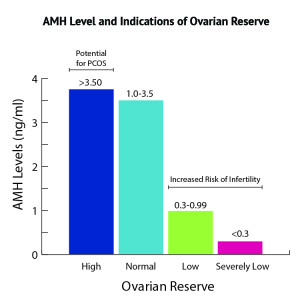
Although the test has been in routine use for many years, experts have yet to reach a consensus when it comes to what’s considered “normal.” The graph below has AMH interpretation guidelines:


While each woman is different in where her ovarian reserve starts and the rate of change that occurs, the one thing in common is that ovarian reserve naturally decreases as women age. This is largely genetically determined; however, there are environmental factors that play a role as well. Smoking is a well known environmental factor that can damage the eggs leading to an accelerated rate of decline in egg numbers and early menopause.

What medical conditions affect the AMH level in your body?

Women with polycystic ovary syndrome (PCOS) generally have a higher number of early antral follicles resulting in a higher baseline AMH level. Women who are older, or who have undergone medical treatments that are toxic to the ovaries (such as chemotherapy or radiation therapy) may have a lower number of eggs remaining and therefore a lower baseline AMH level.

The most important modifying factor of ovarian reserve is age. A younger patient (<35 years old) who has a decreased ovarian reserve may still have high egg quality because of her age. Age—in combination with an assessment of ovarian reserve and the other elements of your fertility—is important when considering egg freezing.

How do physicians test the AMH level?

Your primary care physician, OB/GYN, or reproductive endocrinologist can order AMH testing as part of ovarian reserve testing. The clear results provided through AMH testing—even better than follicle-stimulating hormone (FSH)—and its ability to identify a diminished ovarian reserve offers providers information earlier regarding a potentially serious fertility problem.

Schedule an Appointment

For more information about AMH testing and egg freezing, please speak with one of our New Patient Liaisons by calling 1-877-411-9292.
Medical contribution by Stephanie Beall, M.D., Ph.D., of the Shady Grove Fertility Columbia and Towson, Maryland offices.

Filed Under: Diagnosing Infertility

August 10, 2016 by Shady Grove Fertility

Paulette Brown, M.D.


One in four pregnancies results in a miscarriage. Dr. Paulette Browne, from the Shady Grove Fertility Fair Oaks, VA office, recently hosted a live,“Miscarriage, The Silent Fear” on the popular fertility app, Glow, to answer questions about the causes of miscarriage and what steps to take if you have experienced a miscarriage. Read the top five questions and answers about miscarriage.

  1. What are the most common causes of miscarriage?  Miscarriage can be caused by a variety of identifiable reasons including but not limited to hormonal issues, infection, or physical problems within the mother. These spontaneous “failures” as they may seem are hard to predict but can be explained scientifically. An anatomic miscarriage is one in which the uterus is partitioned by a septum or fibroid, which is a fluid-filled tube. These anomalies are derived from problems within the anatomy of the mother, and can be present from birth or acquired over time. Hormonal causes could be disease in the thyroid in which the thyroid hormone is not produced properly, impeding normal fetus development. The miscarriage may be immunologic, meaning failures within the immune system prohibit a successful pregnancy. Examples of this could be an anti-phospholipid antibody syndrome or thrombophilia, a blood clotting issue that prevents blood and nutrients from reaching the embryo or fetus.A chromosomal abnormality may also be the cause of miscarriage, in which the embryo either has too many or too few chromosomes.
  2. Can PCOS increase the likelihood of having a miscarriage?  Polycystic ovary syndrome (PCOS) has been proven to increase the rate of miscarriage in spontaneous conceptions, likely for hormonal reasons. By using fertility medicine to time your body’s natural processes better and straighten out your hormones, you can help reduce the probability of miscarriage. There is an over-the-counter supplement called Myoinsitol that assists with hormone regulation. You should always speak with your physician prior to beginning any supplement.
  3. “I had a miscarriage and haven’t been able to conceive again. What are the chances of getting pregnant and having a successful pregnancy?” Depending on how long you have been trying, your chances will vary. If it has been 6 to 12 months of trying with no avail, you should consider seeing a fertility specialist and having a fertility work-up. Your chances of a successful pregnancy are based on many factors that we can evaluate. If you have had two or more consecutive miscarriages, you may also want to have a work-up to evaluate recurrent pregnancy loss. About 60 pregnancy of women who have had two miscarriages go on to conceive successfully. SCHEDULE A CONSULT
  4. Does having one miscarriage make it more likely that you will have another? Having one miscarriage does not necessarily increase your risk of another as most are due to chromosomal abnormalities within the embryo, which is random based on the particular egg. However, if the problem is anatomic or based on a chromosomal problem in the parents, then the risk is still there.
  5. What are the chances of miscarriage at the point of pregnancy in which the baby is moving and measured on time? Once the pregnancy has reached the second trimester, the risk of miscarriage is significantly lowered. Once a heartbeat is seen via ultrasound, the risk comes down to about 7 percent.
Schedule an Appointment
  1. Does having one miscarriage make it more likely that you will have another? Having one miscarriage does not necessarily increase your risk of another as most are due to chromosomal abnormalities within the embryo, which is random based on the particular egg. However, if the problem is anatomic or based on a chromosomal problem in the parents, then the risk is still there.
  2. What are the chances of miscarriage at the point of pregnancy in which the baby is moving and measured on time? Once the pregnancy has reached the second trimester, the risk of miscarriage is significantly lowered. Once a heartbeat is seen via ultrasound, the risk comes down to about 7 percent.

Miscarriage at any stage of pregnancy can be devastating—and often a loss a woman or couple suffers alone. Read about how to overcome the emotional aspect of miscarriage.

Schedule an Appointment

If you have experienced two or more miscarriages, we recommend a consult to see a fertility specialist. To learn more, or to schedule an appointment, please call 1-877-971-7755.

To participate in the weekly Glow Q&A sessions, download the Glow app. See the full transcript from this Q&A.
 

Filed Under: Diagnosing Infertility Tagged With: Causes of infertility

July 21, 2016 by Shady Grove Fertility

When a woman is considering her family planning options—whether she’s actively trying to conceive or thinking of what her choices will be in few years—knowledge is power. Basic female infertility tests can provide valuable insight into a woman’s current fertility potential. Whether the infertility tests suggest reassuring results or paint a less than ideal picture, you will have information to make important decisions about your family planning.

Infertility Tests: AMH & FSH

For many women, the first step will be an appointment with their OB/GYN for blood tests to evaluate their hormone levels. One of the main goals when looking at a woman’s hormone levels is to predict the status of her ovarian reserve. Your ovarian reserve tells your physician roughly how many eggs you have remaining, which can give your physician an idea of how your fertility compares now relative to other similar aged women.

Physicians generally start with two hormone measurements to determine current ovarian reserve: follicle-stimulating hormone (FSH) and anti-Müllerian hormone (AMH). Together, FSH and AMH give your physician the greatest insight into your current ovarian reserve.

What is follicle-stimulating hormone (FSH)?

Follicle-stimulating hormone (FSH) is released by the pituitary gland and is responsible for recruiting and developing follicles in the ovary which usually contain an egg that’s released during ovulation. Traditionally, testing a woman’s FSH levels is one of the most common infertility tests performed.

As you age, the number of eggs you have remaining decrease, your pituitary gland needs to work harder to recruit a follicle. As a result, the pituitary gland produces a higher level of FSH, which is then seen in your day 3 bloodwork. This high level of FSH is correlated with infertility.

FSH levels fluctuate throughout your monthly cycle. To determine the most accurate FSH level, infertility tests are done on days 2, 3, or 4 of your menstrual cycle along with estradiol.

“While the FSH level is helpful for your physician, it certainly isn’t without limitations,” explains SGF reproductive endocrinologist, Jeanne O’Brien, M.D. (Rockville, MD). “For example, the level of FSH can vary from month to month. One month the level may be high where the next month it would fall into what we would consider to be a normal range for the patient’s age,” Dr. O’Brien adds. Your physician will obtain multiple assessments of your ovarian reserve as no single test is conclusive. A comprehensive picture is obtained by factoring your age, FSH, estradiol, AMH and antral follicle count on ultrasound.

What is anti-Müllerian hormone (AMH)?

In 2015, the American College of Obstetricians and Gynecologists (ACOG) issued new recommendations and criteria for ovarian reserve testing. While doctors only used FSH to determine ovarian reserve in years past, ACOG now recommends that doctors include AMH testing as well. Unlike FSH, which may vary day to day and month to month, AMH is more consistent and, when combined, AMH and FSH provide the best insights compared to FSH alone.

AMH is produced by the granulosa cells that line the tiny follicles within the ovaries. Your physician can test AMH at any time as the number of granulosa cells remains consistent throughout your menstrual cycle. As the number of available eggs in a woman’s ovarian reserve begins to decline so does the corresponding AMH level. AMH has been found to reflect the quantity of remaining eggs. A low level of AMH reflects a lower ovarian reserve where as a high level of AMH would indicate a higher ovarian reserve.

Beyond providing insights into a woman’s ovarian reserve, AMH also helps your physician determine the appropriate type of treatment and subsequent protocols. “Women with higher AMH values will likely respond more positively to ovarian stimulation and treatments such as egg freezing, intrauterine insemination (IUI), and in vitro fertilization (IVF),” explains Dr. O’Brien.

“We have found that women with lower AMH levels tend to require greater amounts of stimulation medication and produce smaller numbers of eggs. As a result, when AMH levels are lower than expected, your physician may recommend more advanced treatment options sooner such as IVF or IVF with donor egg,” explains Dr. O’Brien. For women interested in egg freezing this may indicate that additional cycles may be needed to achieve the desired number of mature eggs to freeze.

When should I transition from my OB/GYN to a fertility specialist?

Most recommendations for when to seek the help of a fertility specialist are based on the female partner’s age and how long the couple has been having unprotected intercourse. For example if you’re younger than 35 and have been having unprotected intercourse without conception for 1 year, it is appropriate to get a complete fertility evaluation, which includes a semen analysis for the male partner.

For women with decreased ovarian reserve, despite the female partner’s age and length of time trying to conceive, it is appropriate to complete infertility testing immediately since the window of opportunity may be smaller. In these situations we recommend seeking a complete fertility work-up from a fertility specialist. This saves patients time and gives them access to advanced fertility information and treatments that otherwise are not available at an OB/GYN’s office.
Women who are interested in egg freezing, should consult with a fertility specialist to assess their available options.

Schedule A Fertility Consult

Schedule An Egg Freezing Appointment

References:

American Society of Reproductive Medicine. (2015). Diagnostic testing for female infertility. Reproductive Fact Sheet. 

Ovarian reserve testing. Committee Opinion No. 618. American College of Obstetricians and Gynecologists. Obstet Gynecol 2015;125:268–73.

Wilkes, S., Hall, N., Crosland, A., Murdoch, A., Rubin, G.  (2009). Patient experience of infertility management in primary care: an in-depth interview study. Family Practice Advance Access. 26(4), 309-316. 

Filed Under: Diagnosing Infertility

March 22, 2016 by Shady Grove Fertility

Last fall, renowned urologist and male fertility specialist Paul R. Shin, M.D. joined the medical team here at Shady Grove Fertility and since then we’ve been constantly answering, “How important is healthy sperm when it comes to fertility?” As patients have become more educated about male fertility which makes up 40 to 50 percent of all causes of infertility, the attention on semen, which contains sperm, has increased. Along with our patients, SELF magazine was also curious about the topic of sperm and fertility and recently published “12 Fascinating Facts About Semen” featuring Dr. Shin, among other healthcare professionals. Dr. Shin answered several questions about sperm and fertility are related and described how “semen is actually one of those things that will probably make you marvel at how amazing the human body is.”

What’s the difference between semen and sperm?

The first thing to know is that semen and sperm are different. Semen is the material that is ejaculated, and sperm is carried in the semen. The sperm contains half the 23 pairs of chromosomes and the egg contains the other half. It’s the sperm that will fertilize the egg. Once fertilization occurs, the embryo will have a full set of chromosomes (46 or 23 pairs).

Although semen carries millions of sperm, it’s made up mostly of water. Dr. Shin explains that there’s only about 10 calories in each ejaculate. Besides water, Shin told SELF that semen contains, “sugars like fructose, prostate-produced proteins called prostaglandins, and enzymes.” Even though the amount of semen in each ejaculation is only about 1 to 1.5 milliliters, there is a lot of sperm in each ejaculation—about 15 million sperm.

How does sperm find the right egg?

With so many millions of sperm and only one egg to fertilize, one would assume it would be an easy task for one sperm to make its way to an egg. Unfortunately, the human body puts the sperm through many “obstacles” to find and fertilize an egg. First, the vagina could be considered an “inhospitable environment” for sperm. The vagina has a high acidic pH that doesn’t allow the more basic sperm pH to easily move through. The sperm must next navigate which fallopian tube to travel through, be in good enough shape to fertilize it, and then fertilize the egg.

Do lifestyle choices affect sperm?

Yes. Smoking, being overweight, using a hot tub multiple times a week, and spending a lot of time in front of a hot oven are all examples of ways sperm can be damaged. Still unproven scientifically is whether the heat from a laptop computer can negatively affect sperm. However, it’s probably best for men to keep laptops away from their actual laps.

What’s the main difference between sperm and egg production?

Unlike women who are born with a finite number of eggs, the majority of healthy men will produce 2 trillion sperm in their lifetime. While sperm production does decrease as men age, the decline isn’t as drastic and starts later in life.

What is the relationship between sperm and fertility and why is a semen analysis an important part of the infertility work-up?

While all these facts and figures are interesting, male factor infertility is the cause of up to 50 percent of all infertility cases. Having a baby is possible with low sperm count and decreased motility (movement of the sperm); however, the first step to treatment is diagnosis. At Shady Grove Fertility, both partners undergo simple diagnostic testing, which includes a semen analysis for men. The purpose of the semen analysis is to determine if any of the following factors are less than ideal, which could impair conception:

  • Sperm count (concentration)
  • Volume
  • pH (level of acidity)
  • Motility
  • Progression (motion and forward progression)
  • Semen viscosity (consistency)
  • Morphology (shape and appearance)
  • The presence or absence of white, red, blood cells or immature sperm

To learn more about sperm and fertility and how our reproductive endocrinologists and urologists diagnose male factor infertility, call 1-877-971-7755 or click to schedule an appointment.

Filed Under: Diagnosing Infertility Tagged With: Sperm production disorders

  • « Go to Previous Page
  • Page 1
  • Interim pages omitted …
  • Page 6
  • Page 7
  • Page 8
  • Page 9
  • Page 10
  • Interim pages omitted …
  • Page 21
  • Go to Next Page »

Company

  • About SGF
  • About US Fertility
  • Our Doctors
  • Fertility Equity
  • Careers
  • Newsroom
  • SGF College Scholarship
  • Contact Us
  • Voice Your Feedback

Treatments

  • Egg Freezing
  • Intrauterine Insemination (IUI)
  • In Vitro Fertilization (IVF)
  • Frozen Embryo Transfer (FET)
  • LGBTQIA+ Family Building
  • Shared Risk 100% Refund Program
  • All Treatments

Resources

  • Patient Portal
  • Online Bill Pay
  • Library
  • Support Groups & Events

Locations

  • California
  • Colorado
  • Delaware
  • Florida
  • Georgia
  • Maryland
  • North Carolina
  • Pennsylvania
  • Texas
  • Virginia
  • Washington, D.C.

2026 Shady Grove Fertility

  • Policies & Notices
Also of interest
  • In Vitro Fertilization IVF
  • Fertility Tests
  • Research Publications