• Skip to primary navigation
  • Skip to main content
  • Skip to footer
Shady Grove Fertility
  • Become an Egg Donor
  • Referring Physicians
  • 1-888-761-1967
  • Schedule Appointment
  • Get Started
        • Get Started
          • Causes of Infertility
          • Fertility Tests
          • When to Seek Help
          • Find a Doctor
          • Preconception and prenatal vitamins 
          • Schedule an Appointment
        • Personalized Care For
          • Single Parents
          • LGBTQIA+ Family Building
          • People with Cancer
          • Known Genetic Diseases
          • Egg Donors
  • Treatments
        • Fertility
          • Timed Intercourse
          • Ovulation Induction
          • Intrauterine Insemination (IUI)
          • In Vitro Fertilization (IVF)
          • Frozen Embryo Transfer (FET)
        • Donation & Surrogacy
          • Donor Sperm
          • Donor Egg
          • Donor Embryo
          • Gestational Carrier
          • LGBTQIA+ Family Building
          • Single Parents
          • Find a Donor
        • More Treatments
          • Center for Male Fertility
          • Egg Freezing
          • OncoFertility
          • Preimplantation Genetic Testing
          • MIGS
          • All Fertility Treatments
  • Resources
    • Resource Library
    • Events Calendar
    • Patient Stories
    • Mental Health
    • Wellness Center
  • Insurance & Savings
    • Insurance & Benefits
    • Shared Risk 100% Refund Program
    • 100% Refund for Donor Egg
    • Discounts
    • Egg Freezing Costs
    • Financing & Grants
    • Clinical Trials
  • About
    • Find a Doctor
    • About SGF
    • Our Care Team
    • Advanced Practice Providers
    • Fertility Equity
    • Philanthropy
    • Newsroom
    • Careers
    • Contact Us
    • Voice Your Feedback
  • Locations
        • Find a Location
        • California
        • Colorado
        • Delaware
        • Florida
        • Georgia
        • Maryland
        • North Carolina
        • Pennsylvania
        • Texas
        • Virginia
        • Washington, D.C.
        • Chile
        • International & Out of State
        • SGF at Walter Reed National Military Medical Center
  • Patient Hub
    • Online Bill Pay
    • Patient Forms
    • Patient Portal
  • Call your care team
  • Become an egg donor
  • Referring physicians
  • search-icon
  • Schedule appointment 1-888-761-1967

Home / Treatment / Page 14

Treatment

September 12, 2018 by Shady Grove Fertility

What is natural cycle IVF?

During natural cycle IVF the goal is to retrieve the one (and only) egg a woman produces a month. The regimen reduces the use of drugs to stimulate the ovaries as occurs in a traditional IVF cycle. A traditional IVF cycle utilizes a precise drug regimen of daily shots to stimulate the ovaries and produce as many healthy eggs as possible.

Is natural cycle IVF more natural?

Fertility injections are still required to trigger ovulation and sometimes prevent ovulation. Close monitoring—often with daily blood draws and vaginal ultrasounds—are still needed. An egg retrieval procedure under anesthesia is still required to remove the egg, posing potential surgical risks and requiring time off from work.

Is it easier and ultimately less expensive?

For any given patient undergoing IVF, we expect that not every egg will develop into an embryo. Success rates for natural cycle IVF are low because there is at least a 50 percent chance that there will not be an embryo for transfer. Many would argue that this high rate of cycle cancellation actually creates more stress, compounded by the psychological and financial tolls that occur from waiting and trying again month after month.

Schedule an Appointment

Is natural cycle a better option than stimulated IVF for older women?

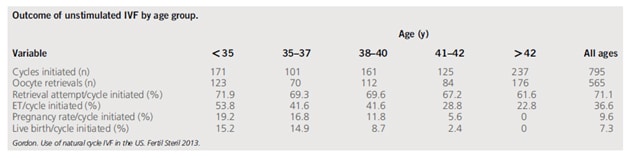
The simple answer is no. A study that looked at natural cycle IVF’s delivery rate found no live births in women age 42 and over and only a 2.4 percent delivery rate in women 41 to 42. For younger patients, the chance of success with natural cycle IVF is about the same as intrauterine insemination (IUI) while at a lower cost and avoiding a surgical procedure.

Outcome of unstimulated IVF by age group.
How should you decide between natural cycle IVF and traditional IVF?

It’s important to look at the following statistics to inform your decision.

  • Examine the delivery rates based on age and the chance of cycle cancellation.
  • Consider how many cycles may be necessary to achieve a healthy birth and the potential cumulative cost of treatment.
  • Consider whether having frozen embryos for another pregnancy at a later age is a priority.

Why does SGF recommend traditional IVF vs natural cycle IVF?

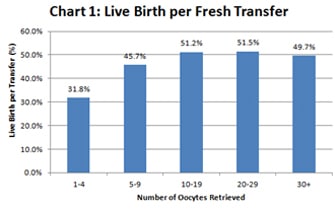
Traditional IVF offers higher success rates than natural cycle IVF. On average, there is a higher chance for pregnancy per cycle with one stimulated IVF cycle than with three or four cycles of natural cycle IVF. Furthermore, a recent study presented during the 2016 ASRM Conference & Expo by Shady Grove Fertility shows that there is a higher chance of live birth per fresh embryo transfer in cycles with more eggs retrieved (Chart 1).

Traditional IVF is more cost-effective and a better value than natural cycle IVF. While the cost of single natural cycle IVF may be less than a single standard IVF cycle, in the long-run, a standard IVF cycle may be more cost effective.
Traditional IVF offers the opportunity to freeze extra embryos; natural cycle IVF does not. Stimulated IVF gives patients the opportunity to achieve pregnancy and create frozen embryos for future siblings, thereby preserving a woman’s fertility and maximizing her chances of meeting her long-term family planning goals, all in one cycle.

Traditional IVF offers the opportunity to complete genetic testing of the embryos; natural cycle IVF does not. Identifying a genetically normal embryo out of a group of embryos will maximize the efficiency of an IVF cycle, by improving the chance of pregnancy, reducing the risk for miscarriage, and shortening the time to achieving pregnancy. Since the majority of natural IVF cycles do not produce an embryo, and the majority of embryos > 40y are genetically abnormal, the potential time required to identify a genetically normal embryo from natural cycle IVF could take months or years.

REFERENCES

Gordon JD, DiMattina M, Reh A, Botes A, Celia G, Payson M. Utilization and success rates of unstimulated in vitro fertilization in the United States: an analysis of the Society for Assisted Reproductive Technology database. Fertil Steril. 2013 Aug;100(2):392-5.

Retrieval of larger oocyte cohorts maximizes in vitro fertilization (IVF) birth rates per cycle M.T. Connell, K.S. Richter, M.J. Tucker, J. Graham, A. DeCherney, M.J. Hill, M. Levy Fertility and Sterility, Vol. 106, Issue 3, e34–e35 September 2016.

Chang FE1, Beall SA2, Cox JM3, Richter KS4, DeCherney AH3, Levy MJ4. Assessing the adequacy of gonadotropin-releasing hormone agonist leuprolide to trigger oocyte maturation and management of inadequate response. Fertil Steril. 2016 Oct;106(5):1093-1100.e3.

Schedule an Appointment

Updated for medical accuracy: September 2018.
Filed Under: Treatment

August 25, 2018 by Shady Grove Fertility

“You should definitely get a second opinion.”

Sound advice. Just take a look at the evidence.

In a 2017 study, Mayo Clinic researchers found that, for 88 percent of patients, getting a second opinion yielded a new or more detailed diagnosis.

When it comes to fertility treatment, however, patients often forego this step.

Though uncommon, seeking a second opinion before embarking on your fertility journey can make a difference in your path to pregnancy. And where you choose to seek that second opinion makes a difference, too.

Dr. Lauren Roth of our Frederick and Rockville offices recently had a patient who trusted her gut and got a second opinion at Shady Grove Fertility.

After becoming a patient of Dr. Roth’s, what she also got, was a baby.

One Patient’s Experience

Britney and Cory were hoping to expand their family and give their little boy a sibling, but after trying for a year and a half, they realized there must be a problem.

“We decided to seek out testing at a local hospital where it was discovered I had a blocked Fallopian tube and severely diminished ovarian reserve of 0.08 (extremely low egg supply) at just 28 years old,” Britney says.

The recommendation was in vitro fertilization, and quickly, as her biological clock was ticking.
“Something in our hearts told us we needed a second opinion so we decided to schedule a consultation at Shady Grove Fertility in Harrisburg, PA after a friend highly recommended we go there.”

“I was scared to death, felt defeated, and very alone as having a child was something I always took for granted.” Britney says adding, “I immediately fell in love with Dr. Roth who took the time to truly explain to us what was happening and what our options were.”

Britney and Cory decided to proceed with IVF and wanted to start the process as soon as possible with Shady Grove Fertility’s Shared Risk 100% Refund Program.

They went through three IVF cycles. Cycle #1 was cancelled due to no viable embryos and cycle #2 resulted in a negative pregnancy test, but cycle #3 was different.

“The third cycle yielded only two eggs at the retrieval. I felt so discouraged but also tried hard to remain optimistic. After all, it only takes one, right?”

“Miraculously, both eggs fertilized normally and continued to grow. On day 3, we transferred both embryos and 2 weeks later we got the positive pregnancy test we had been waiting on for 2 ½ years. And here he is. So perfect. So incredible. Our miracle child. And we owe it all to Shady Grove Fertility, Dr. Roth, Alyssa our RN, and the rest of the staff at Harrisburg and Rockville.”

Schedule an Appointment

The Difference a Quality Fertility Center Makes

Whether you are seeking a second opinion or making a first-time visit to a fertility center, figuring out where to go is a big decision. Take the following factors into consideration.

Comfort
The center you choose can determine the degree of comfort you experience as you move through the fertility process. By selecting a center where you don’t feel rushed, you do feel listened to, and your concerns are considered, you can likely improve the quality of your fertility treatment experience.

Success
The center you select may also have an impact on whether or not your conception attempts are successful. Not all centers have the same pregnancy success rates, and not all centers offer the same level of treatment and intervention.

Experience
As a new patient, you should inquire about a fertility center’s experience. While you don’t want to feel like you’re just a number, you do want to work with a physician who has ample experience with a wide array of procedures and conditions.

Communication
The fertility treatment process can be a complicated one—and communication is key. Consider how (and if) you can communicate with your doctor. At some centers, all communication goes through a nurse, while at others, patients can communicate directly with their doctors as frequently as necessary.

Special Features

Center-specific offerings can improve your experience.

For example, at Shady Grove Fertility, many patients receive the reassurance and financial support they need through enrollment in our Shared Risk 100% Refund Program. This program allows patients to attempt up to 6 IVF or donor egg cycles and any subsequent frozen embryo transfers (FETs) for a flat amount.

Participants in Shady Grove Fertility’s Shared Risk 100% Refund Program can discontinue treatment at any time and receive a refund (some exclusions apply).

Assessment Process

One of the key distinguishing factors between fertility centers is the assessment and prediction process.

At SGF, we strive to provide the most accurate and dependable predictions of success by conducting a thorough analysis of each and every patient.

When assessing new patients we consider:

  • Age of female partner
  • Ovarian reserve testing results
  • AMH level
  • Sperm count
  • Sperm motility
  • Sperm morphology
  • Prior reproductive history
  • Past treatment protocols

By analyzing these factors, and through the use of our Richter Predictor, which is uniquely based on data from 15,000+ SGF treatment cycles spanning 10,000+ patients since 2009, we can give dependable success rate predictions.

At Shady Grove Fertility, our doctors share these predictions with patients and discuss the best course of action before developing a very personalized treatment protocol. In doing so, we ensure that patients understand their options, feel informed, and are truly comfortable with the planned course of treatment.

Patient Self-Advocacy

Britney and her husband got exactly what they were hoping for—a beautiful and healthy baby boy. She now advises women to trust their guts and not to be afraid to ask questions.

Not all fertility centers are the same. And if a visit to one center just doesn’t feel right, move on.

Although doctors are medical experts, patients shouldn’t feel pushed into procedures that aren’t right for them or be afraid to ask about options that they feel might work.

Dr. Roth advises couples to educate themselves on both their condition and their options—with the support of their doctors. Ultimately, patients should feel confident in the abilities and intentions of their chosen doctor. If they don’t, it’s time to get a second opinion.

Schedule an Appointment

To learn more about the services provided at Shady Grove Fertility, please contact our New Patient Center. To schedule an appointment, call 1-877-971-7755 or click here to complete this brief online form. 

Editor’s Note: This post was originally published in June 2017, but was updated in August 2018. 

Filed Under: Treatment

July 23, 2018 by Shady Grove Fertility

Medical Contribution by Paulette Browne, M.D., Ph.D.

Dr. Paulette Browne, from our Fair Oaks, VA office responded to questions asked live during a recent Getting Started Webinar. From finding gestational carriers to boosting your fertility with natural methods, Dr. Browne provided answers to common fertility questions and important insight across many different forms of treatment at SGF.


Q: What can my partner and I do at home to boost our fertility naturally?

Dr. Browne: “Being healthy is always great! You want to make sure you’re not eating too many soy products, stay away from herbal therapy, reduce your caffeine intake, and avoid high mercury fish like tuna, shark, and swordfish. You can also track your fertility with ovulation predictor kits that you can get at the drugstore. These predict when you release the egg and when your (luteinizing hormone) LH levels begin to rise. The egg is released 2 days later so your most fertile time is after that LH surge. I’d recommend intercourse every other day at that time.”

Q: Is your practice LGBTQIA+-friendly?

Dr. Browne: “We certainly are! We offer treatment for all couples, as well as singles. We help our male couples find a gestational carrier and a donor egg, and for female couples we have a treatment plan called co-IVF. With co-IVF, one partner undergoes the egg retrieval and the other partner has the egg that we fertilize in her uterus.”

Visit the LGBTQIA+ Family Building page on our website to learn more about treatment options for all types of partnerships.

Q: Can multiple miscarriages be used as an appeal to IVF for an insurance company?

Dr. Browne: “We can always try. If we do an evaluation and we find a reason behind the miscarriages that could be fixed with IVF, such as chromosomal abnormalities or tubal factors, we can sometimes use that to appeal to an insurance company. With that said, some insurance companies are more flexible than others, but we are always willing to try, so coming in to meet with us and giving us the tools to create that appeal is worth it.”

Q: Do you help couples find a gestational carrier?

Dr. Browne: “We do! We work with attorneys and centers that recruit gestational carrier. The individuals and centers that we work with complete the actual recruiting, but we are very careful with reviewing the carriers’ medical records to ensure the carrier is suitable. We examine their pregnancy histories, social histories, and are very involved in terms of getting that carrier past the finish line.”

Q: My partner and I have already found an egg donor in California. Is it possible to ship her frozen eggs to your center in Atlanta?

Dr. Browne: “Yes, eggs can be shipped across the country. We have centers in California that we ship eggs between since they’re a part of our egg bank, so it’s even a possibility for you to use one of the centers we already have when it comes time to ship the frozen eggs.”

Q: What does a typical timeline look like for IVF treatment?

Dr. Browne: “Typically we put the patient on birth control pills for 18-21 days after day three of her period. The IVF cycle stimulation is about 9-14 days. Retrieval takes place 2 days later, and transfer is 5 days later. The pregnancy test is done about 2 weeks later. Overall it’s about a 2 month process. Three of the weeks don’t require much for the patient, and then 3 other weeks require you to be more active in the process. The last 2 weeks are just a matter of waiting for the pregnancy results. We can start treatment as soon as you get your menstrual cycle after all the blood tests have been conducted and you’ve made a treatment plan with your doctor.”

Schedule an Appointment

Q: How important is it to have your AMH and FSH tested on the third day of your cycle?

Dr. Browne: “AMH can be tested on any day of your cycle, but FSH needs to be tested on day 2, 3, or 4to be accurate. On day 10 of your cycle, the FSH is supposed to be a little higher because it’s actively trying to get the eggs going. In order to evaluate reserve, FSH does have to be tested within that window of time.”

Q: Are any of the common processes like IVF and IUI similar to what I’d expect for egg freezing?

Dr. Browne: “Yes, they’re actually very similar. For egg freezing, we forego the evaluation of the uterus until someone comes back to use their eggs. We do the evaluation of ovarian reserve, bloodwork, ultrasound, AMH level, and then you go through the IVF treatment with injections. After that, we retrieve the eggs and see how many we can use.

Shady Grove Fertility has a great deal of experience freezing and thawing eggs. We offer some great financial programs that ensure you have a certain amount of eggs frozen, and we also have the only published egg freezing success rates in the country.”

Q: How do I decide between choosing an SGF center near my home or one near my work?

Dr. Browne: “It’s really your choice! SGF allows you to pick a doctor in any one of the offices and see him/her for your initial consultation, and then do your monitoring at another Shady Grove Fertility office that offers full-service monitoring. Let’s say you came to see me at my office in Fairfax, VA, but you work downtown. You can still be close to work and visit our K Street office in D.C. to do your monitoring there. If you had an IUI monitoring appointment that needed to be done, but you had a trip to Atlanta already planned – you can still be my patient and have that appointment in Atlanta. I’d get the results back just the same. Definitely pick a doctor you’re comfortable with, but you’ll make more of a connection if you see him/her at each of your appointments.”

Q: What’s the correlation between the hormone to ovulate and the trigger injection?

Dr. Browne: “The trigger injection acts on the same receptors as the hormone you sent to ovulate. That hormone is LH, it comes from the pituitary gland and the trigger injection is usually HCG, which strongly binds to the LH receptors. The HCG is a pregnancy hormone but it works just the same as LH.”

Q: Is there any type of genetic testing before treatment?

Dr. Browne: “We offer all our patients genetic testing for recessive mutations. Recessive mutations are ones in which you carry a gene but no disease is present because you only have one of the genes. If you and your partner, or the sperm donor, or the egg donor carry the gene for the same thing, there’s a 25% chance that you give the baby the gene and the disease could be significant. If two people don’t carry the same gene it’s not a problem. If both do carry the same gene, we can still monitor the embryo during IVF and test the cells to see if both genes are present. We currently test for 175 recessive mutations.”

Schedule an Appointment

To schedule an appointment with Dr. Browne or any of our SGF physicians, please call our New Patient Center at 888-761-1967 or fill out this brief form.

Filed Under: Treatment Tagged With: Gestational carrier & surrogacy

July 17, 2018 by Shady Grove Fertility

Medical Contribution by Stephanie Beall, M.D., Ph.D.

Today, July 25th, marks the 40th birthday of the world’s first baby from IVF, Louise Brown. While previously thought impossible, IVF now helps hundreds of thousands of couples every year build the family they have been dreaming of for so long.

Today we take a look back to appreciate all the advances IVF treatment has had in the last 35 years.  From the first success in a town in Great Britain to over 8 million IVF babies born worldwide.

IVF – Improved Pregnancy Rates for More Patients

There have been many advances in fertility treatment since the first IVF success, all resulting in improved pregnancy and delivery rates and a decrease in twin and multiple pregnancy for IVF patients today. In 1993, Shady Grove Fertility had just recently started an IVF program, reporting a 32% delivery rate per embryo transfer for women under the age of 40. Two decades later, women under 35 see a delivery rate of 57%, and women 40 and under have on average a delivery rate of 43% per embryo transfer.

While the early IVF cases were for women with tubal issues, other diagnoses were often excluded.  Today, endometriosis, male factor, advanced reproductive age, ovulatory dysfunctions, and unexplained infertility can be overcome with the help of IVF. In the early 1990s, ICSI, or intracytoplasmic sperm injection, was introduced to provide treatment options for patients with severe male factor and fertilization failure rather than depending on donor sperm.

Schedule an Appointment

Improved Embryology Lab Techniques


Louise Brown and Dr. Robert Edward, a pioneer in IVF treatment who passed away earlier this year

After an egg retrieval, eggs are placed in a culture media which nourishes the embryo as it develops over the next few days. The culture media has been improved over time and originally, embryos didn’t have the assistance of this special culture media. We are now able to keep embryos in culture until they reach the blastocyst stage, the stage of embryo development just prior to implantation. By being able to see which embryos are able to develop to this stage, we have been able to decrease the number of embryos transferred while at the same time improving the overall implantation rate. By decreasing the number of embryos transferred, the multiple pregnancy rate has decreased. At Shady Grove over 70% of good prognosis patients undergo a single embryo transfer.

While patients today have embryos transferred directly into the uterus, that wasn’t always the case. Since early IVF was primarily to treat blocked tubes, embryos would be placed in the fallopian tubes.

One of the greatest recent advances has been in the field of genetic testing. Patients can now find piece of mind with preimplantation-genetic screening or disease testing. This screening process can identify embryos that carry a genetic disease, or aneuploidy, and indicate which embryos should be transferred back to the patient. This technology has improved the implantation rate and decreased the miscarriage rate per embryo transferred. Read our Genetic Screening Q&A.

Frozen Embryo Transfers

1997: Michael Tucker has first successful birth of child from a frozen egg in the United States.

Probably one of the greatest advances in fertility treatment has been the improved freezing technique of eggs and embryos. Vitrification – a fast freeze technique – has become standard in more fertility centers in the last few years and has helped increase the number of eggs and embryos that survive the freezing and thawing process.

In 1997, SGF’s Lab Director, Michael Tucker, was the first to freeze an egg and deliver a baby in the United States. Since then there has been efforts to improve the freezing and thawing process and the big breakthrough came a few years ago with vitrification.

Shady Grove Fertility began using the improved vitrification technique for embryos and eggs in 2009. As a result, success rates for frozen embryo transfers and utilization of eggs previously frozen have increased to a level that is now equal with fresh IVF cycles.

Schedule an Appointment

 Editor’s Note: This blog was originally published in July 2013 and has been updated for accuracy as of July 2018. 

Filed Under: Treatment Tagged With: In vitro fertilization (IVF)

June 19, 2018 by Shady Grove Fertility

Watch Shruti Malik, M.D., from Shady Grove Fertility’s Fair Oaks, VA office, discuss the advantages of egg freezing. Dr. Malik has been through the egg freezing process herself and truly knows the benefits.

Dr. Malik said that freezing her eggs was the best decision of her life. She expanded on that sentiment by saying:

Freezing my eggs has been a great benefit both personally and professionally.

I’ve enhanced my knowledge of the egg freezing procedure with personal experience. Sharing my story at Shady Grove Fertility helps put patients at ease. From the fertility drugs to the anxiety about test results, I know how it feels to be the patient rather than the doctor.

Fertility preservation has given me flexibility in family planning. I can decide when I’d like to become pregnant without rushing into a relationship to immediately start my family. I like being able to pursue my career and have time to find the right partner to move forward with.

Just like many of you reading this, I was anxious about the egg freezing process. But now I have no regrets about my decision. Understanding my test results and my options empowered me to make an investment in my future family. Hopefully my story can do the same for you.

Schedule An Egg Freezing Appointment 

To learn more about the advantages of egg freezing or to schedule an appointment, call 1-877-411-9292.

Editor’s Note: This blog was originally published in September 2017, but was updated for accuracy in June 2018. 

Filed Under: Treatment Tagged With: Egg freezing

June 13, 2018 by Shady Grove Fertility

An SGF egg freezing patient recently sat down with us to answer some questions about her egg freezing experience and offer advice for other women considering this option. She is a 40 year old attorney living in the D.C. area, where she also attended college and law school. At the age of 35, she made the decision to freeze her eggs at Shady Grove Fertility under the care of Dr. Joseph Doyle.

How did you learn about egg freezing?

I actually learned about egg freezing through a facility tour at Shady Grove Fertility. At the time, I was working on healthcare policy issues and I was able to tour SGF. During the tour, they were talking about treatment options and they brought up egg freezing. When describing the typical egg freezing patient, I couldn’t help but think, “That sounds like me!” They also talked about success rates being higher when you freeze at a younger age, as opposed to waiting. So, I spoke with one of the SGF clinicians to schedule my fertility testing and provide me with more information.

How was the process of getting your fertility tested?

The process was smooth and consisted of a simple blood test and ultrasound. I found it to be very informative and helpful. It really provided me with the right amount of information in order to make my decision.

Why did you personally decide to freeze your eggs?

I didn’t want to lose the opportunity to have children. Now I wasn’t 100% sure if I wanted kids, but it was nice to know I’d always have the option. I also have a very close friend of mine who got married at the age of 40, and she and her husband couldn’t get pregnant. They tried various treatments and it was so hard to watch them go through that hardship. That also impacted my decision to freeze my eggs.

Was paying for egg freezing something you were concerned with?

Yes, the financial aspect of egg freezing was something that concerned me. SGF worked with me and my income to make it more affordable.

How was the actual egg freezing cycle/process?

I did one egg freezing cycle and it was pretty easy to work into my day. Every night at 7pm, I would give myself my injections. My morning monitoring appointments were always at 8am, so I was never late for work. The appointments and the shots really just became part of my daily routine for 2 weeks.

What was the hardest part of the process?

The hardest part for me was getting over the initial shock of having to give myself injections in the belly. The first one was really difficult and I must have watched the informational video on how to inject yourself over 30 times! Once I got through the first few shots, it wasn’t so bad.

What for you has been the biggest benefit of freezing?

Peace of mind! I am proud that I did this for myself. I often get “kudos” from my other doctors and women for being proactive and freezing my eggs. It is such a liberating thing not to have to worry about my biological clock. I don’t have to worry about having a baby, just because I’m getting older. I can make that decision when and if the time is right.

Were you in a relationship when you made the decision to freeze your eggs?

Yes, I had a serious boyfriend through the whole process. Many people thought that I should just try and have a baby with my boyfriend first, but freezing my eggs wasn’t about him. Relationships shouldn’t be based on a “timeline” that society sets for women. You should have a baby when you’re ready and with the right person. Not because you’re at a certain age and happen to be in a relationship. Egg freezing is a personal decision and even now allows me the opportunity to have a baby on my own if I’m not in a relationship.

What advice would you give to other women considering egg freezing?

It’s normal to think about your career! My career is important to me and that’s not a bad thing. I can decide to have children when it’s the right time and not put my career on hold.

You need to view egg freezing as insurance and I’ve never heard anyone say, “Oh I wish I hadn’t purchased insurance.” You’ll never regret the decision to buy this type of insurance. I’m so glad I have that insurance because my boyfriend and I found out we were pregnant in the winter. When the baby was 10 weeks, a large second growth was found in my uterus and doctors advised the safest decision was to end that pregnancy. That wasn’t my only chance at a baby though. I have healthy, younger frozen eggs ready to use when the time is right.

Also, remember from the moment you freeze your eggs, those eggs are younger than you are! You’ll be happier knowing you made a smart and safe choice for you and for your future baby. I’m now 40, but my frozen eggs will always be 35.

How was your experience with SGF and Dr. Doyle?

Fantastic! I’m always referring friends, colleagues, or anyone that will listen to me to Shady Grove Fertility. Dr. Doyle and I still keep in touch. He really cares about all his patients.

Schedule An Egg Freezing Appointment 

To learn more about egg freezing, call our New Patient Center at 1-877-971-7755 to schedule an appointment with a physician or complete our brief online form.

Filed Under: Treatment Tagged With: Egg freezing

  • « Go to Previous Page
  • Page 1
  • Interim pages omitted …
  • Page 12
  • Page 13
  • Page 14
  • Page 15
  • Page 16
  • Interim pages omitted …
  • Page 46
  • Go to Next Page »

Company

  • About SGF
  • About US Fertility
  • Our Doctors
  • Fertility Equity
  • Careers
  • Newsroom
  • SGF College Scholarship
  • Contact Us
  • Voice Your Feedback

Treatments

  • Egg Freezing
  • Intrauterine Insemination (IUI)
  • In Vitro Fertilization (IVF)
  • Frozen Embryo Transfer (FET)
  • LGBTQIA+ Family Building
  • Shared Risk 100% Refund Program
  • All Treatments

Resources

  • Patient Portal
  • Online Bill Pay
  • Library
  • Support Groups & Events

Locations

  • California
  • Colorado
  • Delaware
  • Florida
  • Georgia
  • Maryland
  • North Carolina
  • Pennsylvania
  • Texas
  • Virginia
  • Washington, D.C.

2026 Shady Grove Fertility

  • Policies & Notices
Also of interest
  • In Vitro Fertilization IVF
  • Fertility Tests
  • Research Publications