• Skip to primary navigation
  • Skip to main content
  • Skip to footer
Shady Grove Fertility
  • Become an Egg Donor
  • Referring Physicians
  • 1-888-761-1967
  • Schedule Appointment
  • Get Started
        • Get Started
          • Causes of Infertility
          • Fertility Tests
          • When to Seek Help
          • Find a Doctor
          • Preconception and prenatal vitamins 
          • Schedule an Appointment
        • Personalized Care For
          • Single Parents
          • LGBTQIA+ Family Building
          • People with Cancer
          • Known Genetic Diseases
          • Egg Donors
  • Treatments
        • Fertility
          • Timed Intercourse
          • Ovulation Induction
          • Intrauterine Insemination (IUI)
          • In Vitro Fertilization (IVF)
          • Frozen Embryo Transfer (FET)
        • Donation & Surrogacy
          • Donor Sperm
          • Donor Egg
          • Donor Embryo
          • Gestational Carrier
          • LGBTQIA+ Family Building
          • Single Parents
          • Find a Donor
        • More Treatments
          • Center for Male Fertility
          • Egg Freezing
          • OncoFertility
          • Preimplantation Genetic Testing
          • MIGS
          • All Fertility Treatments
  • Resources
    • Resource Library
    • Events Calendar
    • Patient Stories
    • Mental Health
    • Wellness Center
  • Insurance & Savings
    • Insurance & Benefits
    • Shared Risk 100% Refund Program
    • 100% Refund for Donor Egg
    • Discounts
    • Egg Freezing Costs
    • Financing & Grants
    • Clinical Trials
  • About
    • Find a Doctor
    • About SGF
    • Our Care Team
    • Advanced Practice Providers
    • Fertility Equity
    • Philanthropy
    • Newsroom
    • Careers
    • Contact Us
    • Voice Your Feedback
  • Locations
        • Find a Location
        • California
        • Colorado
        • Delaware
        • Florida
        • Georgia
        • Maryland
        • North Carolina
        • Pennsylvania
        • Texas
        • Virginia
        • Washington, D.C.
        • Chile
        • International & Out of State
        • SGF at Walter Reed National Military Medical Center
  • Patient Hub
    • Online Bill Pay
    • Patient Forms
    • Patient Portal
  • Call your care team
  • Become an egg donor
  • Referring physicians
  • search-icon
  • Schedule appointment 1-888-761-1967

Home / Treatment / Page 12

Treatment

April 30, 2019 by Shady Grove Fertility

For many people, the phrase “infertility treatment” sparks the instant thought of in vitro fertilization (IVF). However, in reality, around 50 percent of all treatment cycles performed at Shady Grove Fertility are considered more basic than IVF. These treatments are called “low-tech.” In fact, depending on the age and diagnosis of a patient, low-tech infertility treatments, such as intrauterine insemination (IUI), are often the first treatment approach.

Medical Contribution by Dr. Celso Silva

What low-tech infertility treatments are available?

Depending on your diagnosis and medical history, there are three low-tech infertility treatments available to patients:

  • Timed Intercourse
    The simplest treatment option available, timed intercourse helps a couple predict when the woman will be ovulating and the best time to conceive.
  • Ovulation Induction
    For women who may not ovulate regularly, oral medication is often prescribed to help stimulate the ovaries to produce eggs. Ovulation induction is often paired with timed intercourse or intrauterine insemination.
  • Intrauterine Insemination (IUI)
    IUI is the process whereby a concentrated sperm sample is placed inside the uterus. IUI is often recommended for patients who are using donor sperm or those diagnosed with mild male-factor infertility, irregular ovulation, a single blocked Fallopian tube, or unexplained infertility.

How successful is IUI?

In discussing the “typical” success rate for IUI treatment, it’s important to know what the average fertile couple’s chance of pregnancy is on any given month. For couples that do not have difficulty achieving a pregnancy and are engaging in regular intercourse without contraception, the chance of pregnancy per month of ovulation is largely dependent on the age of the woman. For women up to the early-30s, the natural pregnancy rate is about 20 to 25 percent per cycle. This declines significantly through the mid and later 30s, and by the early 40s, the chance of pregnancy is about 5 percent per cycle. This age-related decrease in the chance of a natural pregnancy is due primarily to a decline in the quality of the eggs within the ovaries.

The goal of IUI is to help patients achieve a pregnancy at rates that are closer to the rates experienced by patients in the same age group and that do not have infertility.

As the chance of pregnancy per IUI treatment cycle is modest, it may take more than one cycle of treatment in order to achieve a pregnancy. The chance of pregnancy with IUI declines slightly (by approximately 2 to 3 percent) with each consecutive unsuccessful treatment cycle. Therefore, if there has not been a pregnancy after 3 to 4 cycles of treatment, it may be advisable to move to more advanced treatments such as IVF.

Conversely, if a patient has conceived in the past with IUI treatment, her chances of conceiving again with IUI is much higher than average. Therefore, women who have had pregnancies with previous IUI attempts are generally good candidates for repeat IUI treatment.

Because the chance of pregnancy with IUI for women over the age of 40 is low, and because fertility is declining rapidly at this age, a physician may advise patients to move to IVF treatment earlier in the treatment timeline.

Schedule an Appointment

Low-Tech Infertility Treatments: Pregnancy Rates by Diagnosis
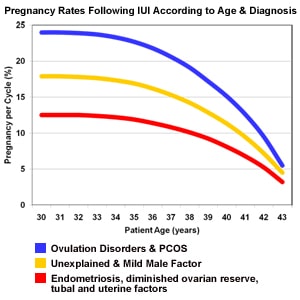

In addition to female reproductive age, a couple’s prognosis for success with IUI depends on their diagnosis. This treatment is most successful in couples where the primary cause for infertility is ovulatory dysfunction (or failure to regularly ovulate, as in women with PCOS). In these cases, the treatment comes closest to restoring the natural per cycle pregnancy rate.

IUI is also quite successful for the treatment of mild male factor or unexplained infertility, although the success rates are slightly lower for those couples where ovulatory dysfunction is the only problem.

IUI is less successful if the cause of infertility involves diseased Fallopian tubes, endometriosis, decreased egg quality, or uterine factors such as uterine fibroids as this treatment does not improve the quality of the eggs within the ovaries or correct any anatomical abnormalities.

Our philosophy at Shady Grove Fertility has always been to tailor our patients’ treatment to their specific diagnoses and circumstances. Our goal is to make sure our patients achieve the best possible chance of success with using the simplest and most cost-effective approach.

To watch our On-Demand Webinar on Low-Tech, click here. During this free, on-demand event, viewers will learn more about who is a good candidate for low-tech treatment, how ovulation induction (OI) and intrauterine insemination (IUI) work, and the success rates associated with these treatment options.

Schedule an Appointment

For more information on low-tech infertility treatments, or to schedule an appointment with one of our physicians, please speak with one of our friendly New Patient Liaisons by calling 877-971-7755.

Editor’s Note: This post was originally published in October 2014 and has been updated for accuracy and comprehensiveness as of April 2019.


Filed Under: Treatment

April 5, 2019 by Shady Grove Fertility

PennWatch recently interviewed Dr. Melissa Esposito, who sees patients in SGF’s Mechanicsburg, PA office, and Lesa and Brennan Brackbill. The Brackbills are former patients who went through IVF and genetic testing in order to have healthy babies after suffering the tragic loss of their daughter. Read the full story below:

In 2014, Lesa and Brennan Brackbill of Hershey, PA welcomed a healthy baby girl named Victoria. Everything was great then everything changed. Tori stopped smiling when she was five months old. Lesa said, “Victoria became increasingly irritable and regressed in all milestones including talking, laughing, playing, smiling. She couldn’t eat. She would vomit everything.” 

Victoria was diagnosed with Krabbe disease, a genetic disorder with no cure and little hope. In one fell swoop, the Brackbills got a double dose of horrible news. “They told us Krabbe was not treatable. That Victoria would pass away before she was 2 years old and, because it was genetic, we should not have more kids naturally. It was too much all at once. It was devastating because we had always planned to have more children,” said Lesa.

Then the Brackbills heard about new technology from other Krabbe parents. They could try to have more children with in vitro fertilization (IVF) and have the embryos genetically tested to avoid having another baby with Krabbe disease. The Brackbills found that Shady Grove Fertility offered genetic testing and tried it a few years after Victoria had passed away at 20 months. The screening is called PGT, short for Preimplantation Genetic Testing.

Heartbroken over the loss of their daughter, the Brackbills were overjoyed to hear IVF and the genetic testing worked. “I’ll never forget the day Dr. Esposito said we were having twins! The boys are healthy. Joy is the only word I can think of because they look like their sister. We see her in them every day.”

“I can’t even describe it without getting teary-eyed. Seeing these two healthy babies and knowing that I played a little part in it, it was just amazing,” said Dr. Esposito.

Dr. Esposito says doctors can now screen an embryo and test it for nearly 200 genetic diseases. She encourages all of her couples to undergo genetic testing and if they refuse, she has them sign a waiver.

“I tell my couples the testing doesn’t help their fertility, but it helps ensure that after going through all the heartache of infertility and all the treatments and the cost, this is another step we can take to ensure you get pregnant and have a healthy baby,” explained Dr. Esposito. “If you have the ability to possibly prevent a horrible disease in your baby, wouldn’t you want to do that?”

The Brackbills still have healthy embryos and plan to try for more children before the end of the year while never forgetting their little girl. “Victoria will always be a part of our lives. We have pictures of her everywhere. We are grateful for our 11-month-old twin boys and plan to tell them all about their big sister when they are older,” said Brackbill.

Schedule an Appointment

To learn more or to schedule an appointment with Dr. Esposito or another SGF physician, please call our New Patient Center at 1-877-971-7755 or complete our online form.

Filed Under: Treatment

April 5, 2019 by Shady Grove Fertility

SGF Atlanta’s Medical Director, Dr. Desireé McCarthy-Keith, recently sat down with the women of A Seat at the Table, an Emmy-nominated program that gives a voice to issues from diverse experiences, perspectives, and challenges. During the show, Dr. McCarthy-Keith stresses the importance of a woman’s age on her ability to conceive and explains the benefits of egg freezing. Her simple and easily comprehendible explanation lead to a moment of sudden insight and discovery among the talk show hosts, and undoubtedly to the viewers as well.

Watch the full clip here [skip ahead to 12:11 mark for egg freezing discussion] or read Dr. McCarthy-Keith’s quotes below.

“We do have a timeline with our fertility that is different than men. So, men make brand new sperm about every 72 days, and they usually do that until they’re 50, 60, sometimes 70.”

“For ladies, it’s the opposite. We have more eggs before we’re even born. Halfway through pregnancy when we’re about 5 months of gestation, we have six to seven million eggs in our little fetal ovaries. By the time we’re born, we have about one million left. From that birth point on, egg count starts to go down. By the time we’re in puberty, we have about 450,000 eggs left. The reason that the egg count is changing is because there is a whole wave of eggs that develop every cycle. It’s not that you lose one egg a month.”

“Every month, there’s a crop of eggs that start to grow. One goes on and ovulates and the rest just fall back, so you lose lots of eggs monthly and that starts in puberty. Regardless of whether you’re on birth control, pregnant, breastfeeding, anything, every month there’s a wave of eggs that we are losing. Once you get to your mid-30s, that decline picks up and becomes steeper toward 40, and then in menopause when your egg supply is depleted and there are no more eggs developing.”

“Our timeline is very important to think about. Egg freezing is a way for women to capitalize on that. You may not be ready professionally, you may be single, not ready to have a baby just yet, but if you collect and freeze your eggs at a younger age, those eggs are locked into that age. If you freeze your eggs at 30, you can come back at 40 or 45. If you thaw those eggs and fertilize them, your chance of getting pregnant is based on the age when you froze them, not the age when you use them.”

Thousands of women have decided to freeze their eggs, giving them the power to have children when the timing is right, not when their biological clock dictates they should have them. Given the advances made in egg freezing technology, Shady Grove Fertility has seen an 83% growth in their egg freezing program since 2013, and numbers of women choosing this viable option continue to rise. The popularity of egg freezing at SGF is largely contributed to continuous innovation that is increasing success rates; transparent, published success rates; and a variety of affordable financial programs.

Schedule an Appointment

To learn more about egg freezing or to schedule an appointment with Dr. McCarthy-Keith or another SGF physician, please contact the SGF New Patient Center at 1-877-411-9292 or complete this brief online form.

Filed Under: Treatment

March 25, 2019 by Shady Grove Fertility

At 42, Tammy Brown is financially secure, has a great career, and owns her own home.
“I was missing something in my life and wanted to have a child, so I looked into fertility treatments,” she explains.

After five rounds of various treatments, complications, and miscarriages, Tammy still wasn’t pregnant. She turned to Shady Grove Fertility and Dr. Kara Nguyen, and opted for embryo donation.

Watch the full ABC News segment here.

“The advances that we have seen recently—things that we’re talking to patients more about—are specifically much higher pregnancy rates with our embryo transfers because we can select the best embryos and most viable embryos,” notes Dr. Nguyen, who sees patients in SGF’s Lancaster, PA and Mechanicsburg, PA offices.

The technological advancements made in the last decade surrounding in vitro fertilization (IVF) has allowed thousands of patients to achieve their dreams of parenthood; however, increasing numbers of patients are facing the decision of what to do with their excess frozen embryo(s) once they have finished building their family.

“Patients may elect to choose to donate the embryos that they have from an IVF cycle because they’ve completed their family building and they don’t want to discard the embryos. They donate them so another patient may be able to use them for their family building, ” Dr. Nguyen adds.
“The couple that I chose, they wrote a very nice little message to me, saying they had the opportunity to have two children and wanted to share that joy with other people,” Tammy recalls. “It’s quite kind. It shows a lot about the families involved.”

Tammy utilized Shady Grove Fertility’s Shared Risk 100% Refund Program, a program that includes up to six in vitro fertilization (IVF) or donor egg cycles and any subsequent frozen embryo transfers (FETs) for one flat fee. In the event the attempts are unsuccessful, the patient may be eligible for a 100% refund. Now patients can pursue treatment without the worry of cost versus chances of success, and without sacrificing high-quality medical care. Of the total participants, 82 percent take home a baby.

Fortunately, Tammy will not be receiving a refund, as she is expecting a baby boy this Spring.

“It’s a boy. His name will be Maxton,” she explains excitedly. “I’m not quite sure what the middle name will be. I’m due May 4th.”

Tammy has this advice for young women delaying starting a family. “I was more career-oriented and trying to be independent on my own financially, and if someone would have had the conversation with me sooner about having children, I would have probably looked into taking my eggs and freezing them.”

Age is the biggest factor affecting a woman’s egg supply. The older you get, the fewer eggs you have, and your body does not produce more eggs, nor is there any available treatment to increase the quantity or quality of your egg supply. Egg freezing represents a way to suspend your fertility in time, preventing the decrease in quality and quantity that inevitably comes with age. You will, of course, still continue to age. But the eggs that you freeze will stay suspended in time at the quality you possessed at the time of the freeze. Learn more about egg freezing and read SGF’s Q&A with Dr. Roth as she answers the most commonly asked questions about the process.

Schedule an Appointment

To learn more or to schedule an appointment with an SGF physician, please call our New Patient Center at 1-877-971-7755 or complete our online form.

Filed Under: Treatment

March 13, 2019 by Shady Grove Fertility

Deciding whether or not to freeze your eggs is a big decision. Many women are unsure of the process, if egg freezing is right for them, and what to expect. To help alleviate some of these unknowns, Dr. Lauren Roth, SGF’s Medical Director, answers the most commonly asked questions from women just like you who are researching this opportunity.

How many eggs do I have?

“Generally, women are born with two ovaries, each containing resting eggs or follicles. Every woman is born with a set amount of eggs. At 20 weeks gestation, a woman has about 6 million eggs, the most eggs she will ever have in her lifetime. At birth, she will lose approximately half of her eggs, and by the time she reaches puberty, she has only about 200,000 left. During a menstrual cycle, one egg matures while the remaining eggs that are present that month die off. Testing is available to evaluate your ovarian reserve to measure the quantity of eggs (also called ovarian reserve) you have available.”

How do I know if egg freezing would work for me?

“A woman’s age along with simple ovarian reserve testing evaluates her fertility potential and if egg freezing is a viable option. In simple terms, we are evaluating both the quality and quantity of eggs available.

The ovarian reserve testing includes:

– A blood draw to measure a woman’s ovarian function, otherwise known as her egg quantity
– An intrauterine (internal, or transvaginal) ultrasound to measure a woman’s ovarian reserve

The combined results will provide a strong indication of your ovarian reserve. Based on that information you and your physician can discuss if egg freezing is right for you.”

How can I prepare my body for egg freezing?

“The main thing we would tell any of our patients is to maintain a healthy diet and lifestyle. Other factors that could hinder your fertility include: excessive caffeine, smoking, drugs, and alcohol. If you are a current smoker, we recommend quitting at least 3 months prior to starting a cycle.”

What are the side effects of hormone medications?

“The side effects of hormone medications are largely dependent on the patient. Some women may experience heightened symptoms similar to what is experienced during PMS, others might feel increased bloating and some discomfort related to the enlarged ovaries.”

Do you offer assistance with medication injections?

“Yes. While the injection needles are, for the most part, very small, we offer injection training classes and work with a company who offers at-home injection services.”

How many eggs (mature or immature) would you recommend freezing and is the number dependent on age?

“At Shady Grove Fertility, we only freeze mature eggs as only mature eggs can lead to a pregnancy. The number of eggs we recommend for women to freeze is dependent on her age and ovarian reserve test results. We recommend that women 37 or younger who have excellent ovarian function freeze between 15 to 20 mature eggs. For women over 38, or women at any age with diminished ovarian function, we recommend freezing 25 to 30 eggs. This provides you with multiple attempts to conceive if a cycle is unsuccessful.”

When coming back to use my frozen eggs, how many are thawed at a time? Will all of them be used at once?

“When you are ready to use your frozen eggs, either some or all of your eggs will be thawed and then fertilized using intracytoplasmic sperm injection (ICSI). ICSI is necessary as the coating that surrounds the egg is hardened when it’s frozen. Therefore, we need to select a single sperm and inject it into the egg in order for it to fertilize.”

If I come back to use my eggs at a later date, would I be go through in vitro fertilization (IVF)? What is the cost?

“No. When you freeze your eggs, you are doing the majority of the process involved with IVF upfront. Simply put, when you freeze you are essentially doing the “IV” and when you come back you do the “F,” or the fertilization process. Financial options are available for returning Shady Grove Fertility egg freezing patients when they are ready to conceive and need to use their frozen eggs.”

What are the pregnancy success rates using frozen eggs?

“Shady Grove Fertility is one of the only fertility centers in the U.S. with published egg freezing pregnancy data. In a recently published study, Shady Grove Fertility assessed the performance of 1,171 egg freezing cycles for 875 women. At the time of the study, 117 of these women had returned to undergo 128 egg thaw cycles, using a total of 1,283 frozen eggs. The results from these 128 egg thaw cycles included 51 viable pregnancies, resulting in 55 children and 8 more on the way at the time of the study (12 of the pregnancies were twins). In addition, 62 good quality blastocysts remain in storage from these warming cycles for future attempts.”

Does it matter how old I am when I decide to use my eggs?

“Yes. In general, we recommend women freeze their eggs between the ages of 30 and 40, with the ideal range being between 32 and 37. Freezing at a younger age typically produces better results. If you were to freeze your eggs at the age of 30 and use them at the age of 40, your chance of success and risk of miscarriage would be that of a 30 year old. You are “locking in” your success rates based on the age at which you froze. The nice thing about that is, as we age, our ovaries age but our uterus remains healthy until age 50 (approximately). As long as you are in good health, there should be no concerns if you come back to use your frozen eggs in your 40s.”

How can I be sure that my eggs are only used for me and are not used for other patients?

“Your eggs are your property. You know exactly how many eggs we have frozen and stored for you. They are kept completely separate from other stored eggs with many redundant quality controls and identity protocols in place for their protection and your peace of mind. Read more about our state-of-the-art embryology lab and the protocols used to ensure the safety of eggs.”


Given the advances made in egg freezing technology, Shady Grove Fertility has seen an 83% growth in their egg freezing program since 2013, and numbers of women choosing this viable option continue to rise. The popularity of egg freezing at Shady Grove Fertility is largely contributed to continuous innovation that is increasing success rates; transparent, published success rates; and a variety of affordable financial programs.

Medical contribution by Lauren Roth, M.D.

Lauren Roth, M.D., is the Medical Director of SGF, and board certified in obstetrics and gynecology and reproductive endocrinology and infertility. She has published research on a range of fertility topics including polycystic ovary syndrome (PCOS) and the impact of weight on reproductive hormones. Dr. Roth sees patients in SGF’s Rockville, Maryland office.

Editor’s Note: This post was originally published in July 2014 and has been updated for accuracy and comprehensiveness as of March 2019. 

Schedule An Egg Freezing Appointment 

To learn more about egg freezing and whether it is the right option for you, please schedule an appointment with our New Patient Center by calling 1-877-971-7755 or complete this brief online form. 

Filed Under: Treatment Tagged With: Dr. Lauren Roth, Egg freezing

March 11, 2019 by Shady Grove Fertility

Dr. Naveed Khan, who sees patients in SGF’s Leesburg, VA location, joined Fox 5’s Good Day DC, alongside lifestyle expert and SGF patient, Stacey Rusch, to open up the conversation surrounding secondary infertility and the treatment options available to patients.

Stacey begins by sharing her fertility journey thus far. “We were blessed to have a beautiful baby girl naturally. I had a healthy pregnancy, no complications, and a natural birth. I thought when we wanted to expand our family and have our second child, I would have another baby. Unfortunately, that wasn’t the case. We tried and tried, and eventually, I decided to seek help and that’s how I found Shady Grove Fertility and Dr. Khan.”

Secondary infertility is the inability to become pregnant—despite engaging in regular unprotected intercourse—following the birth of one or more biological children who were born without the aid of fertility treatment or medications.

Watch the Full Clip

Experiencing secondary infertility is more common than you might expect. “One in eight couples have problems with infertility, which translates to about 8 million couples, and about one-third to one-half of them have secondary infertility,” Dr. Khan explains. “A lot of people find that quite high, but it is one of the most common diagnoses we work with.”

What Causes Secondary Infertility?

Maternal Age: One of the leading causes of secondary infertility is the female partner’s age. As a woman gets older, the quality and quantity of her eggs decrease. While she may have had her first child without a problem, she could encounter a change in egg quality or quantity if she tries to conceive again several years later.

Internal Complications: In the span of time between the birth of a first child and attempt at conceiving baby number two, changes within a woman’s body may have occurred. Changes to the uterus, infections, or even Fallopian tube issues could make getting and staying pregnant more difficult.

Male Factor Infertility: As with women, male aging can have an effect on reproductive health, potentially affecting sperm quality and quantity. But while these changes may be due to age, they could also be due to new medications or lifestyle changes like weight gain or a new smoking habit (which can also affect female fertility).

Weight Gain: For both men and women, weight gain can have a significant impact on the ability to conceive, sometimes leading to ovulatory dysfunction in women or reduced sperm quality in men.
As with other types of infertility, many patients with secondary infertility are able to start with basic treatment options. In some instances, however, a couple may need IVF or donor egg treatment to overcome secondary infertility.

“I had two options when we weren’t conceiving,” Stacey recalls. “I could say that I already have a child and I’m not getting pregnant, so it’s just not meant to be. Or I could seek help, get information, and make an informed decision. My husband and I chose to proceed with IVF because with my diagnosis of secondary infertility and my medical history, my chances of getting pregnant unassisted are very low. So, we are pushing forward and we are choosing to use IVF to grow our family.”

Dr. Khan elaborates on some of the other treatment options available to those struggling with secondary infertility. “There are simple options–if you’re having problems with ovulation, there are medicines that can help you ovulate. There are basic treatments like intrauterine insemination (IUI). Basic principle is to get more eggs and more sperm together for a higher chance of becoming pregnant. And of course, like Stacey is undergoing, IVF is another option where you’re actually taking the eggs and sperm, and making the embryos in the lab. The amazing part is now you can do genetic testing of embryos, and only put back the embryos that are good, which increases your chances of getting pregnant and reduces miscarriage rate.”

Finding Emotional Support

Many people who experience secondary infertility can feel surprised, alone, and not know how to share their feelings with their friends and family. You may experience unwelcome reactions from your friends and family who may not understand why you’re so upset because you already have one or more children. It can be very difficult to make sense of these challenges and to stop feeling so distant from everyone around you.

You are not alone. Shady Grove Fertility has free support groups as well as a Facebook community that’s 27,000 members strong and counting. We encourage you to take advantage of the free resources in order to connect with others who are experiencing similar situations and feelings as you.

Patient Success Stories:
Priti & Saumil
Chrissy & Steve
Britney & Cory 

Schedule an Appointment

For more information about secondary infertility or to schedule an appointment, please call our New Patient Center at 1-877-971-7755 or click here to complete this brief online form.

Filed Under: Treatment

  • « Go to Previous Page
  • Page 1
  • Interim pages omitted …
  • Page 10
  • Page 11
  • Page 12
  • Page 13
  • Page 14
  • Interim pages omitted …
  • Page 46
  • Go to Next Page »

Company

  • About SGF
  • About US Fertility
  • Our Doctors
  • Fertility Equity
  • Careers
  • Newsroom
  • SGF College Scholarship
  • Contact Us
  • Voice Your Feedback

Treatments

  • Egg Freezing
  • Intrauterine Insemination (IUI)
  • In Vitro Fertilization (IVF)
  • Frozen Embryo Transfer (FET)
  • LGBTQIA+ Family Building
  • Shared Risk 100% Refund Program
  • All Treatments

Resources

  • Patient Portal
  • Online Bill Pay
  • Library
  • Support Groups & Events

Locations

  • California
  • Colorado
  • Delaware
  • Florida
  • Georgia
  • Maryland
  • North Carolina
  • Pennsylvania
  • Texas
  • Virginia
  • Washington, D.C.

2026 Shady Grove Fertility

  • Policies & Notices
Also of interest
  • In Vitro Fertilization IVF
  • Fertility Tests
  • Research Publications