• Skip to primary navigation
  • Skip to main content
  • Skip to footer
Shady Grove Fertility
  • Become an Egg Donor
  • Referring Physicians
  • 1-888-761-1967
  • Schedule Appointment
  • Get Started
        • Get Started
          • Causes of Infertility
          • Fertility Tests
          • When to Seek Help
          • Find a Doctor
          • Preconception and prenatal vitamins 
          • Schedule an Appointment
        • Personalized Care For
          • Single Parents
          • LGBTQIA+ Family Building
          • People with Cancer
          • Known Genetic Diseases
          • Egg Donors
  • Treatments
        • Fertility
          • Timed Intercourse
          • Ovulation Induction
          • Intrauterine Insemination (IUI)
          • In Vitro Fertilization (IVF)
          • Frozen Embryo Transfer (FET)
        • Donation & Surrogacy
          • Donor Sperm
          • Donor Egg
          • Donor Embryo
          • Gestational Carrier
          • LGBTQIA+ Family Building
          • Single Parents
          • Find a Donor
        • More Treatments
          • Center for Male Fertility
          • Egg Freezing
          • OncoFertility
          • Preimplantation Genetic Testing
          • MIGS
          • All Fertility Treatments
  • Resources
    • Resource Library
    • Events Calendar
    • Patient Stories
    • Mental Health
    • Wellness Center
  • Insurance & Savings
    • Insurance & Benefits
    • Shared Risk 100% Refund Program
    • 100% Refund for Donor Egg
    • Discounts
    • Egg Freezing Costs
    • Financing & Grants
    • Clinical Trials
  • About
    • Find a Doctor
    • About SGF
    • Our Care Team
    • Advanced Practice Providers
    • Fertility Equity
    • Philanthropy
    • Newsroom
    • Careers
    • Contact Us
    • Voice Your Feedback
  • Locations
        • Find a Location
        • California
        • Colorado
        • Delaware
        • Florida
        • Georgia
        • Maryland
        • North Carolina
        • Pennsylvania
        • Texas
        • Virginia
        • Washington, D.C.
        • Chile
        • International & Out of State
        • SGF at Walter Reed National Military Medical Center
  • Patient Hub
    • Online Bill Pay
    • Patient Forms
    • Patient Portal
  • Call your care team
  • Become an egg donor
  • Referring physicians
  • search-icon
  • Schedule appointment 1-888-761-1967

Home / Egg freezing / Page 7

Egg freezing

July 3, 2017 by Shady Grove Fertility

Read the full article “Does health insurance cover egg freezing?” by Rachel Lustbader

Recently, Rachel Lustbader, writer for Healthcare.com, reach out to triple board certified reproductive endocrinologist, Kara D. Nguyen, M.D., M.P.H., of SGF’s Reading, PA and Harrisburg, PA offices, to learn the ins and outs of egg freezing: what is it, what does the process look like, is it safe, will health insurance cover it, and how much should you expect to spend.

Dr. Nguyen answered these egg freezing questions for all women who wish to have a baby someday and explained a key reason why egg freezing at SGF is unique.

Egg Freezing for Future Pregnancy

According to Lustbader, “as the average childbearing age continues to go up, it’s important for women to consider fertility treatments such as egg freezing that can increase the chance of a successful pregnancy later in life.”

Egg freezing is the fertility treatment process in which a patient’s ovaries are stimulated and eggs are retrieved and frozen to be used at a later time. As women age, their egg quality decreases along with the quantity. Therefore, freezing eggs give women the time that their biology won’t. Many describe egg freezing as a unique form of insurance—should they have trouble conceiving later in life, their frozen eggs are available.


Learn more about egg freezing success rates.

Two Common Reasons Women Freeze Their Eggs

Under what circumstances would a woman decide to freeze her eggs? According to Dr. Nguyen, the two most common reasons women decide to freeze their eggs are:

  1. Elective fertility preservation (they may be focusing on their careers, going through grad school, traveling, waiting for the right partner, waiting to be in the right financial situation, etc.)
  2. Fertility preservation in the face of a medical condition (as in the case where cancer treatments may affect ovarian reserve and reproductive potential)

At Shady Grove Fertility, while women can freeze their eggs for elective purposes in their 30s to early-40s, the majority of our patients are 37. Our recommendation is for women considering to freeze, to do so in their early- to mid-30s while their fertility is still near its peak. However, each woman’s fertility is unique and each woman’s family building goals and situations are unique.

Dr. Kara Nguyen Explains Egg Freezing Testing at SGF

To help women decide if and when to freeze, Dr. Kara Nguyen explains the critical importance of the initial step of the SGF egg freezing process:

“We first test the patient’s fertility to evaluate her current status and if egg freezing is a good choice for her right now. Following testing, there is an extensive discussion with a reproductive endocrinologist to determine if egg freezing is the right choice, with clear expectations of possible benefits, limitations, and alternatives to family building.”

Each woman’s fertility is unique. While the average age a woman’s fertility begins to decline is 35, some women’s fertility decline will start earlier and some may start later. We also encourage women to consider their family building goals and the timing of their educational and career goals as they evaluate their future reproductive plans.

Schedule An Egg Freezing Appointment 

Read the full story to learn more about egg freezing benefits. To learn more about egg freezing in Pennsylvania, to better understand the process, or for more information about Shady Grove Fertility’s exclusive egg freezing financial programs, call 1-877-411-9292 to speak with one of our New Patient Center Liaisons. You may also fill out this form to schedule an appointment or register for one of our upcoming patient educational events.
Filed Under: Treatment Tagged With: Egg freezing

June 23, 2017 by Shady Grove Fertility

What is Anti-Müllerian Hormone (AMH)?

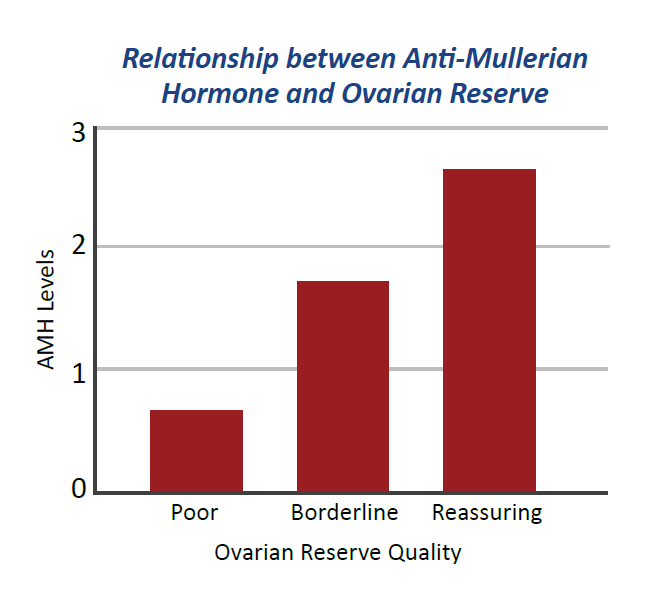
Anti-Müllerian hormone (AMH) is a hormone produced by the cells that support the dormant pool of eggs in the ovaries. Therefore, a higher level of AMH suggests a larger pool of eggs (or a greater ovarian reserve). “This is a very useful test for us because it doesn’t tend to fluctuate as much as follicle-stimulating hormone (FSH) levels and it gives us another angle to assess the ovarian reserve. As it pertains to an individual’s fertility, the higher the level, the better,” says Dr. Joseph Doyle, of Shady Grove Fertility’s Rockville, MD office.

Did you know: an AMH level greater than 1 suggests a good ovarian reserve? 

AMH levels are determined through a blood test and unlike other hormones, levels do not vary significantly through the menstrual cycle. This means that you can check it on any day of the cycle and it doesn’t tend to vary from cycle to cycle like FSH levels can. Another benefit of AMH is that it provides insight into the estimated number of eggs that could be retrieved during an IVF or egg freezing cycle as well as how much medication will be required for ovarian stimulation during a treatment cycle.

The anti-Müllerian Hormone (AMH): Part of the Initial Fertility Evaluation

Measuring the anti-Müllerian hormone level is now a part of the initial fertility evaluation along with:

  • Ultrasound of ovaries to determine antral follicle count (AFC)
  • Bloodwork to evaluate reproductive hormones: FSH, estradiol, and luteinizing hormone (LH)
  • Hysterosalpingogram (HSG) to check for any blockages of the Fallopian tubes
  • Semen analysis to test quality and quantity of sperm in the male partner

These tests, along with your medical, reproductive, and family histories will help your fertility specialist determine the treatment best suited for you. Patients who wish to preserve their current fertility and freeze eggs would not complete the HSG or semen analysis

What is good ovarian reserve vs. decreased ovarian reserve?

The ovarian reserve is the quality and number of oocytes (female eggs) a woman has. A good ovarian reserve means you have a high number of oocytes of good quality, while a poor ovarian reserve would mean you have a lower number of oocytes with decreased quality. The quantity of eggs can be measured through ovarian reserve testing, which evaluates your reproductive hormone levels, including AMH, as well as an ultrasound to evaluate your AFC.

The ovarian reserve steadily and naturally decreases as a woman ages until around the age of 35 when the decline begins to increase until finally reaching menopause. Each woman’s fertility is unique and the quantity of eggs at the time of puberty and the rate of change from puberty to time of menopause varies from woman to woman. This rate of change is partially predetermined by your genetics. Women with a family medical history of early menopause have a higher chance to begin the fertility decline at a younger age.

Age Matters Most

While family medical history is important, the most important modifying factor of a good ovarian reserve is age. Decreased ovarian reserve in a younger patient (<35 years of age) is not necessarily the same as decreased ovarian reserve in an older patient. A younger woman may have decreased ovarian reserve and though the number of eggs present may be decreased, because of her age, the egg quality may still be high. Age, in conjunction with an assessment of ovarian reserve and the other elements of your fertility evaluation and family building goals, will determine your treatment path.

Editors Note: This post was originally published in December 2012 and has been updated for comprehensiveness as of January 2018.

Schedule An Egg Freezing Appointment 
Schedule an Appointment

SCHEDULE AN APPOINTMENT 

For more information or to schedule an appointment with one of our physicians, please speak with one of our New Patient Liaisons by calling 877-971-7755.

Filed Under: Diagnosing Infertility Tagged With: Egg freezing

June 17, 2017 by Shady Grove Fertility

“When am I going to have kids?” A question asked by married couples and single women alike. For some, there are a variety of barriers: no partner, starting an intense graduate program, or just not feeling ready, which happens to be the category I fall in.

I have this overwhelming feeling like I should already have a baby, like I am moving too slow, and with every passing year I have less of a chance to have a baby, grow our family, fulfill our dream.

What if we wait too long?
As a woman who works at SGF, I know a lot about female fertility and infertility, so my awareness of how hard it can be to have children is ever-present. Not every couple faces infertility, but for the 1 in 8 who need the assistance of fertility treatment, it’s incredibly emotional, challenging, and it’s not something they ever imagined they would need to grow their family.

I Want Kids…But Not Yet.

“When do we want to start having kids?” I imagine all couples have had this conversation at some point. We had a simplified version of this conversion before getting married and clarified that we wanted three kids. But it became real after we got married and the details of one conversation still remain very clear:

We were sitting outside eating tacos and drinking ciders during happy hour at a restaurant that was within walking distance of our over-priced, highly convenient, two-bedroom apartment in Gaithersburg, MD. We were having the conversation “if we want three kids spaced 3 years apart, how old will we be when we have the last one? And how old would we be when the last one graduates college?” We realized that our vision of a perfect little family meant we would basically need to start trying that night. We hadn’t even been married 6 months at that point…no thank you.

At that point, we knew we wanted kids but not yet. But what we didn’t and don’t know is, when we are ready, will we even be able to have them? Because what if sex doesn’t work for us?

3 Reasons to Be Proactive and Test My Fertility: 

  1. Fertility declines: With each passing year I’ve worried about the decline in my fertility. Female fertility is largely based on our age because as we age both the quantity and quality of our eggs declines and at different rates for different women. Typically, our fertility starts to more drastically decline starting at 35, but it can start much, much earlier than that and there are no warning signs.
  2. Who saves money to get pregnant? We are planners. As we became much more aware of our finances and started to aggressively pay off our debt and save for a home and retirement, we then realized: you save for a house, you save for retirement, but you don’t save for fertility treatment. Sure, everyone knows children are expensive, but you expect getting pregnant to be free. For many couples, it’s not.
  3. To unveil a looming secret: Testing my fertility meant unveiling a looming secret – am I OK? Can I have a baby right now if I wanted to? Because that’s the fear, right? If my fertility is low, I’d be kicking me for waiting and making it harder on my husband and me to have a baby.

I knew it was time to take matters into my own hands and to get my fertility tested. If my fertility was low, we could start trying for baby #1 and start saving for possible fertility treatment.

Testing Was Easy and Worth It

It was truly very simple. Despite knowing how the process works I was still incredibly nervous about what would happen and unsure when in my cycle I should schedule the appointment. Luckily, the Egg Freezing Program at SGF is set up in a way that you don’t have to worry because they take care of these details.

The Fertility Testing Process

I first had my blood drawn to measure my reproductive hormone levels, and I went back to test my antral follicle count (AFC). It felt weird going in during my cycle (it’s a transvaginal ultrasound during your period), but I just had to remind myself that the ultrasound technicians do ultrasounds every single day and, honestly, it was so quick it didn’t bother me as much as I thought it would. Typically these two tests are complete in just one visit.

Lastly, Dr. Jeanne O’Brien of the SGF Rockville office reviewed my results with me, which was the most valuable part of the process.

Dr. O’Brien cared about what I cared about 

I’ve worked with Dr. O’Brien on a professional level, but becoming her patient was a different experience. Knowing how busy she is and how many other patients she has (that are, in my opinion, more important than me) made me feel a little guilty, but I trusted her to tell me exactly what I needed to know. What I valued most was that she took all things into consideration. What do I mean by that?  She didn’t just look at the numbers and tell me how my fertility was, she had a conversation with me. She cared about what I cared about.

Fertility Testing Results

According to my results of the Ovarian Assessment Report, I fell into the “Good” category for my age. Dr. O’Brien said my anti-Müllerian hormone (AMH) level was a little low but because my AFC was so good she said my fertility was excellent and assured me I had nothing to worry about. She also talked with me about how many children we wanted. If we wanted three or four children she recommended we start trying within the next year.

What do we do if we don’t start trying after a year? She said I could come back in and get tested just to make sure my fertility is still good. It was as simple as that.

Now that I have clarity, results, and reassurance, I feel like a nagging worry has been lifted off my shoulders.

Schedule An Egg Freezing Appointment 

To get started with egg freezing, call 1-877-411-9292 to schedule a consultation and fertility testing with one of our physicians. To learn more, attend one of the upcoming egg freezing online or in-person events.

At Shady Grove Fertility, we’re here to give you the caring support you deserve as you start or grow your family. As a leading fertility and IVF center of excellence, we offer patients individualized care, innovative financial options, over 30 accepted insurance plans, and pregnancy rates among the highest of all national centers. We offer patients the convenience of 19 full-service and 6 satellite locations across Maryland, Pennsylvania, Virginia, and Washington, D.C. More than 1,700 physicians choose Shady Grove Fertility to refer their patients, and more than 96 percent of our patients say they would recommend Shady Grove Fertility’s 35+ physicians to a friend. With 10 Shady Grove Fertility babies born each day, your dream of starting or growing your family are within reach.

Filed Under: Treatment Tagged With: Egg freezing

March 31, 2017 by Shady Grove Fertility

Bachelorette fans, if you haven’t heard already, you’re in for a treat! Former star of the Bachelorette, Kaitlyn Bristowe, is changing the conversation about egg freezing. If you aren’t a fan of the Bachelorette, or haven’t been keeping up with the former Bachelorette and her now fiancé, Shawn Booth, Bristowe has been excitedly sharing about her experience with egg freezing. Last week, Bristowe spoke to Good Morning America why she decided to freeze her eggs.

Her story has since hit online new outlets aplenty including articles in Today.com and Romper—all of which have featured Bristowe’s story, her advice, as well as success rates using frozen eggs from SGF.

3 Reasons Bristowe Shared Why Egg Freezing is Valuable

Bristowe shared that she is looking at egg freezing as a backup plan and there is nothing wrong with her health. As shared on Romper, Twitter, and a former interview with People, these are three reasons Bristowe finds egg freezing valuable:

  • To take control of your future
    “As a woman there’s always pressure to have babies, and this puts my mind at ease for when I’m ”
  • To give yourself the freedom to change your mind
    As shared on Romper, “The idea of family is more exciting to us than planning a wedding…we know we’re going to get married, but we’re really pumped to start a family! I don’t feel like there is a specific order we have to go in.”
  • To take the pressure off to have kids before you are ready
    “I think a lot of women feel pressure to have kids, especially when you get engaged—‘When’s the wedding?’ and ‘When are you gonna have babies?’ And for me, I’m like, I don’t want that pressure on myself.”

How many babies can you have using frozen eggs?

At Shady Grove Fertility, we discuss family building goals with each patient—that is, how many children you want, and when. Before that conversation can happen for women who are freezing their eggs, though, the first step is to test their current fertility. The information provided from fertility testing allows you to have a meaningful conversation with your fertility specialist to set realistic expectations and goals to determine how many eggs you should freeze depending on how many children you may want.

A woman’s age, her medical history, and her current fertility (evaluated through fertility testing) determines the number of eggs she should freeze to have one, two, or three children. A recent SGF study published in Fertility and Sterility outlined the number of eggs needed based on a woman’s age.

If you freeze 30 eggs at Shady Grove Fertility, what is the chance you will take home two babies?

Women ages 30 to 34 have above a 90 percent chance of taking home one baby, a 70 percent chance of taking home two babies, and about a 40 percent chance of taking home three babies.

Women ages 35 to 37 have just under a 90 percent chance of taking home one baby, about a 65 percent chance of taking home two babies, and just under a 40 percent chance of taking home three babies.

Read more about the study published in Fertility and Sterility.

Schedule An Egg Freezing Appointment

To learn more about egg freezing at Shady Grove Fertility, call 1.877.411.9292 or attend one of the upcoming webinars.

At Shady Grove Fertility, we’re here to give you the caring support you deserve as you start or grow your family. As a leading fertility and IVF center of excellence, we offer patients individualized care, innovative financial options, over 30 accepted insurance plans, and pregnancy rates among the highest of all national centers. We offer patients the convenience of 19 full-service and 6 satellite locations across Maryland, Pennsylvania, Virginia, and Washington, D.C. More than 1,700 physicians choose Shady Grove Fertility to refer their patients, and more than 96 percent of our patients say they would recommend Shady Grove Fertility’s 39 physicians to a friend. With 10 Shady Grove Fertility babies born each day, your dream of starting or growing your family is within reach.

Filed Under: Treatment Tagged With: Egg freezing

March 30, 2017 by Shady Grove Fertility

Recently, Sarah Elizabeth Richards, a trusted voice and thought leader when it comes to egg freezing, interviewed Dr. Joseph Doyle of the SGF Rockville, MD office about egg freezing for an article on Pregnantish: How Many Eggs to Freeze? There IS a Magic Number.

A Brief History of Egg Freezing

Egg freezing at Shady Grove Fertility has been available in one form or another since 2009. It was first used by women who needed to preserve their fertility prior to cancer treatment and was timed with the adoption of vitrification technology, the best technology available to freeze eggs. It was also used to freeze the eggs of egg donors. With the large amount of data from our egg donors and therefore the experience we had using vitrification for eggs, we introduced the SGF Egg Freezing Program.

In 2011, ASRM (the American Society for Reproductive Medicine) lifted the experimental label on egg freezing and it became a standard option in the fertility community. It wasn’t until October 2014 when Apple and Facebook announced they would cover the cost of freezing eggs for female employees, however, that egg freezing really took off.

Changes in Egg Freezing

Initially, there were many unknowns associated with egg freezing. The first, as mentioned by Richards, was how many eggs to freeze. Many factors are evaluated to mathematically determine a healthy number. As the largest fertility center in the nation, with years of data to support our recommendation, there is a “magic” number.

But first, why does the number of eggs to freeze matter? And how much does it cost?

Freeze Enough Eggs to Have a Baby

You want to freeze enough eggs to ensure you are able to use those eggs to have a baby in the future, but how much is enough? For women under 35, saving 20 eggs gives an 85 percent cumulative chance of bringing home one baby. It’s an 80 percent chance for women ages 35 to 37. Dr. Doyle also explained that women 38 to 40 should bank 30 eggs to have a 75 percent chance of giving birth to one baby.

But it’s important to think of your frozen eggs as your backup plan. According to Dr. Doyle, “I tell my patients ‘Once you have frozen eggs, don’t put family-building completely on the back burner. They’re supposed to be Plan B. But if you wait until you’re 45, that’s Plan A.”

More Financial Options

Originally, there weren’t many choices for women to freeze their eggs. Now, at SGF, women have two options to pay for egg freezing—a single cycle and flat-fee option that guarantees a certain number of eggs or cycles, whichever comes first. However, at SGF, women also have the option to schedule monthly payments with our exclusive partner, Fertility Finance. For example, if a woman wishes to finance the cost of a single egg freezing cycle, the estimated cost with 10% interest would be $195/month.

Schedule An Egg Freezing Appointment

Call 1.877.411.9292 to schedule an appointment with Dr. Joseph Doyle or one of our 39 fertility specialists.

About Sarah Elizabeth Richards

Often sharing her experience and latest news about egg freezing in The New York Times, Marie Claire, Bloomberg Businessweek, and Today.com. Sarah Elizabeth Richards also authored the book Motherhood, Rescheduled: The New Frontier of Egg Freezing and the Women Who Tried It, which chronicles the accounts of four women who elect egg freezing, and examines how life might change if a woman could stop the biological clock.

Filed Under: Treatment Tagged With: Egg freezing

March 13, 2017 by Shady Grove Fertility

Ever heard the term “social egg freezing?” It sounds like it may involve a party or perhaps social media.

Shruti Malik, M.D.

Could it also mean women discussing egg freezing with other women? Or maybe it’s what Dr. Shruti Malik, a fertility specialist at Shady Grove Fertility’s Fairfax and Woodbridge, VA offices, did when she froze her eggs—she invited a group of friends to freeze their eggs at the same time.

Before you announce “I’m freezing my eggs” on your social media page, here’s what social egg freezing actually is: it’s when a woman freezes her eggs (also known as egg cryopreservation) to preserve her fertility for elective reasons. Dr. Malik began to consider her fertility and future plans during her professional training in reproductive endocrinology, as she met patients who were having difficulty conceiving for medical and elective (or non-medical) reasons, including but not limited to age, cancer treatment, or early menopause.

Here, Dr. Malik gets personal about why she decided to have her eggs frozen.

Because I wasn’t ready to start a family.

Freezing my eggs is “fertility insurance” for me—an investment in my ability to start my family when I’m ready. The truth is, I don’t want to feel pressured to find a partner because my biological clock is ticking. Having frozen eggs means that when I find the right person, I’ll be entering the relationship without feeling rushed into pregnancy.

Because donor eggs may not be available.

The importance of family has been ingrained in my life since I was young, as family values are strong in the Indian culture in which I grew up. I maintain a close relationship with my parents, and it’s understandable that they are excited about the possibility of grandchildren.

But despite their desire to have grandchildren sooner rather than later, relationships and babies don’t grow on trees.

Frankly, I’d like to wait until the timing is right to start my family. But I know that my ability to conceive naturally will grow slim with time, as my ovaries age and egg quality decreases.

Women in similar situations sometimes opt to use donor eggs. But the reality is, I want my children to share my heritage, and most egg donors are Caucasian. Freezing my eggs ensures that I will have biological children to raise in my family’s values.

Because I was concerned about my ovarian function.

I’ve found that many women are nervous about freezing their eggs because they’re afraid of what their test results will reveal. Admittedly, I was scared of fertility testing as well. But when a friend of mine got tested and found that her ovarian reserve was low, she decided to pursue egg cryopreservation immediately.

If my friend had not been proactive, she might not have discovered that her ovarian function was low for several years, making it even harder to achieve successful pregnancy when she was ready. She inspired me to get a group of my friends together so we could go through ovarian reserve testing together. In doing so, my test results also revealed that my ovarian reserve was low for my age. Because I was single and not planning to try to conceive in the near future, I immediately froze my eggs.

I encourage women who are trying to conceive or want to conceive in the future to have their ovarian reserve assessed. Many women are hesitant because they think testing is expensive, painful, and time-consuming. Although some women do experience discomfort after the procedure, egg freezing is more affordable and simple than you might think.

Egg freezing is similar to the first part of the in-vitro fertilization (IVF) procedure. During IVF, a physician retrieves one or more unfertilized eggs from the ovarian tissue, then fertilizes the eggs with sperm in an embryology lab to create embryos. Prior to the egg retrieval process, the ovaries must be stimulated to produce many mature eggs, which is the stimulation phase of an IVF cycle. The difference between IVF and egg freezing is that with egg freezing those eggs retrieved are immediately frozen and transferred to long-term storage rather than fertilized and implanted in a woman’s uterus right away. When a woman is ready to use her frozen eggs, the eggs must be thawed first.

IVF is the most successful treatment a woman can undergo using her own eggs and sperm (or donor sperm). The success rates of IVF using frozen eggs are encouraging—women who freeze the recommended number of eggs have a 65 to 80 percent chance of conceiving successfully, depending on age.

While it’s not a well-known fact, the first phase of the egg freezing process—which involves bloodwork and an ultrasound—is usually covered by health insurance. Most Shady Grove Fertility patients can conveniently schedule assessments before work and still go to work on the same day.
In the second phase of the egg freezing process, women are advised to take 1 day off of work for the egg retrieval portion of the freezing process, since it’s a surgical procedure. And the cost of this procedure can be financed with an affordable payment plan.

Because it was the best decision of my life.

Freezing my eggs has been a great benefit both personally and professionally.

I’ve enhanced my knowledge of the egg freezing procedure with personal experience. Sharing my story at Shady Grove Fertility helps put patients at ease. From the fertility drugs to the anxiety about test results, I know how it feels to be the patient rather than the doctor.

Fertility preservation has given me flexibility in family planning. I can decide when I’d like to become pregnant without rushing into a relationship to immediately start my family. I like being able to pursue my career and have time to find the right partner to move forward with.

Just like many of you reading this, I was anxious about the egg freezing process. But now I have no regrets about my decision. Understanding my test results and my options empowered me to make an investment in my future family. Hopefully my story can do the same for you.

Schedule An Egg Freezing Appointment 

Call 1-877-411-9292 to schedule an egg freezing appointment with Dr. Malik or one of our other 38 fertility specialists.  

Filed Under: Treatment Tagged With: Egg freezing

  • « Go to Previous Page
  • Page 1
  • Interim pages omitted …
  • Page 5
  • Page 6
  • Page 7
  • Page 8
  • Page 9
  • Interim pages omitted …
  • Page 22
  • Go to Next Page »

Company

  • About SGF
  • About US Fertility
  • Our Doctors
  • Fertility Equity
  • Careers
  • Newsroom
  • SGF College Scholarship
  • Contact Us
  • Voice Your Feedback

Treatments

  • Egg Freezing
  • Intrauterine Insemination (IUI)
  • In Vitro Fertilization (IVF)
  • Frozen Embryo Transfer (FET)
  • LGBTQIA+ Family Building
  • Shared Risk 100% Refund Program
  • All Treatments

Resources

  • Patient Portal
  • Online Bill Pay
  • Library
  • Support Groups & Events

Locations

  • California
  • Colorado
  • Delaware
  • Florida
  • Georgia
  • Maryland
  • North Carolina
  • Pennsylvania
  • Texas
  • Virginia
  • Washington, D.C.

2026 Shady Grove Fertility

  • Policies & Notices
Also of interest
  • In Vitro Fertilization IVF
  • Fertility Tests
  • Research Publications