• Skip to primary navigation
  • Skip to main content
  • Skip to footer
Shady Grove Fertility
  • Become an Egg Donor
  • Referring Physicians
  • 1-888-761-1967
  • Schedule Appointment
  • Get Started
        • Get Started
          • Causes of Infertility
          • Fertility Tests
          • When to Seek Help
          • Find a Doctor
          • Preconception and prenatal vitamins 
          • Schedule an Appointment
        • Personalized Care For
          • Single Parents
          • LGBTQIA+ Family Building
          • People with Cancer
          • Known Genetic Diseases
          • Egg Donors
  • Treatments
        • Fertility
          • Timed Intercourse
          • Ovulation Induction
          • Intrauterine Insemination (IUI)
          • In Vitro Fertilization (IVF)
          • Frozen Embryo Transfer (FET)
        • Donation & Surrogacy
          • Donor Sperm
          • Donor Egg
          • Donor Embryo
          • Gestational Carrier
          • LGBTQIA+ Family Building
          • Single Parents
          • Find a Donor
        • More Treatments
          • Center for Male Fertility
          • Egg Freezing
          • OncoFertility
          • Preimplantation Genetic Testing
          • MIGS
          • All Fertility Treatments
  • Resources
    • Resource Library
    • Events Calendar
    • Patient Stories
    • Mental Health
    • Wellness Center
  • Insurance & Savings
    • Insurance & Benefits
    • Shared Risk 100% Refund Program
    • 100% Refund for Donor Egg
    • Discounts
    • Egg Freezing Costs
    • Financing & Grants
    • Clinical Trials
  • About
    • Find a Doctor
    • About SGF
    • Our Care Team
    • Advanced Practice Providers
    • Fertility Equity
    • Philanthropy
    • Newsroom
    • Careers
    • Contact Us
    • Voice Your Feedback
  • Locations
        • Find a Location
        • California
        • Colorado
        • Delaware
        • Florida
        • Georgia
        • Maryland
        • North Carolina
        • Pennsylvania
        • Texas
        • Virginia
        • Washington, D.C.
        • Chile
        • International & Out of State
        • SGF at Walter Reed National Military Medical Center
  • Patient Hub
    • Online Bill Pay
    • Patient Forms
    • Patient Portal
  • Call your care team
  • Become an egg donor
  • Referring physicians
  • search-icon
  • Schedule appointment 1-888-761-1967

Home / Get Started / Page 9

Get Started

March 29, 2019 by Shady Grove Fertility

Atlanta Best Self Magazine recently turned to SGF Atlanta’s Dr. Natalie Stentz to answer common questions surrounding the topic of infertility, revealing what she wants both men and women to know when struggling to conceive. Read the full Q&A below for more information on causes of infertility, how to improve your fertility, treatment options, and finding emotional support throughout the process.

Causes of Infertility

Q: What are the key facts people should know regarding the causes of infertility?
Dr. Stentz: Approximately 40% of infertility is caused by male factors, 40% is caused by female factors, and the remaining 20% is a combination of male and female factors or unexplained infertility.

Q: What are some of the common myths regarding the causes of infertility?
Dr. Stentz: Contrary to a popular myth, birth control has no negative impact on fertility. However, it is easy to understand why there are myths about birth control pills causing infertility as some women experience a delay in resuming ovulation and menses following prolonged birth control use. For some women it may take months after stopping birth control for their menses to return.

Another popular myth is the boxers vs. briefs debate. The real concern regarding sperm is if the temperature is too high within the testicles, it can affect sperm production and motility, or movement. Patients have expressed the concern that if a man wears briefs instead of boxers, their scrotal temperature will increase, which can impact their fertility. This is an old wives’ tale. It has not been shown that either boxers or briefs make any particular difference.

Q: What are the most common medical causes of infertility?
Dr. Stentz:

  • Ovulatory dysfunction (PCOS, hypothalamic amenorrhea)
  • Endometriosis
  • Blocked Fallopian tubes
  • Increased age (fertility rates sharply decline after the age of 35)
  • Structural problems with the female reproductive tract (fibroids, polyps, scarring)
  • Male factor (low sperm number, low sperm motility, abnormal sperm shapes)

How to Improve Your Fertility

Q: What are some of the common myths about improving your fertility?
Dr. Stentz: There are many things that we can do to improve our overall health including exercise, diet, taking multivitamins, and meditating. Unfortunately, none of these healthy habits stop the clock on ovarian aging, which is a primary contributor to infertility and accelerates after the age of 35.

Q: What are the key facts you want men and women to know about improving their fertility?
Dr. Stentz: Maintain a normal body mass index (18.5-24.9). This is important for both male and female partners. Fertility treatment is not as successful in underweight or overweight individuals.

Do not smoke. The rate of infertility is approximately twice as high in male and female tobacco smokers. Marijuana also impacts both sperm and egg quality.

Use a condom and get regular screening for sexually treated infections (STI). Especially before you are in a monogamous relationship in which you intend to conceive, protect yourself against STIs, which can contribute to both blocked Fallopian tubes and male factor infertility.

Come for fertility evaluation early. Schedule an appointment with a reproductive endocrinologist if you have been having unprotected intercourse for 1 year without becoming pregnant if you are under the age of 35, or after 6 months if you are over 35, or after 3 months or immediately if you are 40 or older. You should also consult a reproductive endocrinologist if you would like to learn more about fertility preservation, particularly for women in their early- to mid-30s.

Treating Infertility

Q: What are today’s most common treatments for infertility?
Dr. Stentz: There are three primary treatments for infertility. First is cycle awareness in which a woman closely follows her ovulation and works to time ovulation with intercourse. Second is ovulation induction with or without insemination in which we typically give oral medications to stimulate egg development and time ovulation with an in-office insemination of concentrated sperm. Finally, in vitro fertilization, or IVF, in which injectable medications are given to stimulate egg development and eggs are collected and fertilized outside the body (in vitro) before replacing the embryo in the uterus.

Q: What do you want people to know about IVF?
Dr. Stentz: IVF is a process that takes approximately 2 weeks. After a short course of birth control pills, we start daily injectable fertility medications with a very small needle (like insulin). During this time period, you come for approximately 6-9 ultrasound appointments before your eggs are ready to be collected in an outpatient procedure during which you are fully asleep. The eggs are then frozen or inseminated to create embryos that may then either be replaced into the uterus or frozen for later use.

Q: What do you want people to know about surgery as a treatment option?
Dr. Stentz: Historically the field of reproductive endocrinology and infertility relied largely upon surgical treatment. Now, with the advent of IVF, most infertility treatment includes medications and small procedures reserving surgery for those women with extensive endometriosis or uterine fibroids.

Q: What do you want people to know about hormone treatments?
Dr. Stentz: Oral fertility medications work by helping your body increase its own production of the hormones that tell your ovaries to develop eggs. Injectable fertility medications contain the same hormones that your body makes to develop eggs but delivered in concentrated doses. It is important to know that studies have shown that fertility medications do not increase a woman’s risk of cancer.

Q: What steps are LGBTQIA+ individuals and couples taking to build their families?
Dr. Stentz: We often work with the LGBTQIA+ community to help individuals and couples create the families they desire. For lesbian couples, we help coordinate donor sperm insemination and also do cCo-IVF in which embryos are created from the eggs from one female partner and are transferred into the other female partner to carry the pregnancy.

We work with male couples to coordinate IVF with their sperm and a donor egg, then transfer the embryo into a gestational carrier.

Finally, we work with the transgender community to assist with fertility preservation of eggs or sperm prior to gender transitioning and help with assisted reproduction after gender transitioning.

Finding Emotional Support throughout Infertility

Q: What are the most common tough topics surrounding infertility? Is blaming one partner for being the cause prevalent? If so, how can they overcome this?
Dr. Stentz: Many people with infertility struggle with self-blame, feelings of hopelessness, depression, anxiety, and sexual difficulties. Please know that in addition to seeking fertility care there are several reproductive mental health specialists who can provide great help to those in need. You can learn more about SGF’s patient support program here.

Q: How can couples navigate the pressure and questions from loved ones as they struggle to conceive?
Dr. Stentz: You are not alone—more than one in eight couples have struggled with infertility. It is likely that many of your family or friends have dealt with similar issues, but due to social pressures they have not disclosed their struggles. Rely upon your inner circle of friends and family and remember that you do not owe anyone an explanation.

Q: What is the number one piece of information you want couples dealing with infertility to remember?
Dr. Stentz: While the path to parenthood may not always be straightforward, there is always hope. Some couples conceive on their own, some with fertility treatment, others with donor eggs or embryos, and others adopt to create their family. As fertility specialists, we are here to help every step of the way. Read our inspiring patient success stories here.

Q: What is the number one takeaway you want people to know about fertility and infertility?
Dr. Stentz: It is never too early to be evaluated by a fertility specialist, even if you are single! The hardest thing to overcome with fertility treatment is age. Family planning is not just about contraception, it is about having a plan in place in advance to create the family you want in the future.

Schedule an Appointment

Dr. Natalie Stentz sees patients in SGF’s Marietta, Buckhead – Piedmont, and Atlanta – Northside offices. To learn more or to schedule an appointment with Dr. Stentz or any other SGF physician, please call our New Patient Center at 1-877-971-7755 or complete our online form.

Filed Under: Get Started

March 28, 2019 by Shady Grove Fertility

Sara Walsh, Emmy Award Winning sportscaster and former ESPN anchor, opened up to Pregnantish about her struggles to start a family with husband, former Arizona Diamondbacks pitcher Matt Buschmann. After years of pregnancy losses and failed treatments, the couple was thrilled to welcome twins via IVF in February 2017. Dr. Ryan Martin, who sees patients in Shady Grove Fertility’s Warrington, PA office, was Sara and Matt’s doctor throughout their fertility journey.

When Sara spoke at a NICU Benefit event last year, she invited Dr. Martin as a guest and admitted to feeling overwhelmed with gratitude.

“He had no idea I’d be speaking about him. I had no idea how scared I’d be, because I was certain nothing I could say could ever adequately express what this man means to me.”

“He treated me as a friend, not a patient, put up with me bringing in People magazines, pointing out every older celeb who could seemingly get pregnant so easy when I couldn’t. He called me when I was no longer his patient, but heard I’d received devastating news. He swore to me he’d find a way to make it all work. When I lost hope, he never once did. He fought for the only two good eggs I had just as hard as I did and convinced me to put them in when I was frozen by fear it wouldn’t work. On the morning of my last attempt at any of this, the last thing he said to me was this would work. He was right. About everything.”

“And as difficult as my journey was, it pales in comparison to the adversity Ryan himself has overcome. A senseless act of violence left him paralyzed at a young age. What did he do next? He became a national champion at tennis, played at the White House, won a US Open. Then decided to be a doctor, becoming the first wheelchair-bound student to graduate Yale Medical. He never mentioned any of this when I was in his office complaining about how hard I had it. Google told me later. The life he’d led puts Forest Gump to shame, and I’ve already called dibs on writing his Hollywood story. (No, seriously I asked.)”

“After I spoke the other night, I was nervous to go back to his table. He leaned over and said, ‘I hope you know that what you’re saying now matters more than anything you could’ve said on SportsCenter.’ I could’ve cried.”

“He’s not just great at his job, he’s great at being a human being. The world needs more Dr. Martins. I can never repay him, but here’s hoping a lifetime of gratitude will somehow suffice. #2goodeggs”

Read Pregnantish’s Full Q&A with Sara Walsh:

Q: How did you meet your husband? Did you always know you wanted to have kids together?
A: I originally met Matt when I was a sports reporter in Nashville and he was playing baseball for Vanderbilt University. I had to interview him for a story, a meeting we still actually have on tape. Six years later, I was hosting SportsCenter, doing an interview with a former Vandy teammate of his from those days, and he brought Matt’s name up. We got reconnected through his teammate and the rest is history. I had been so focused on my career, having kids wasn’t really on my radar. But once I met Matt, my mindset completely changed, and having children mattered to me in a way it never had before.

Q: What’s your fertility/infertility story, in a nutshell?
A: I was 36 when I first got pregnant. I had concerns about my age, but every day we’re inundated with success stories of people my age or older who seemingly have no issues having a baby. People told me it would be simple. It wasn’t. We lost that baby. People would tell me how common it was to have a miscarriage. They’d say that it happened to them, and they were fine the next time around. I wasn’t fine. I lost the next baby. We went down the road of IUI and lost another baby. Clearly I could get pregnant, but I had sadly learned that that didn’t mean I could have a baby. At this point we knew we needed to genetically test the eggs because something was wrong.

During IVF we learned there really weren’t many eggs to work with. We could only come up with two eggs after multiple cycles, some of which were cancelled in the middle of the process because it just wouldn’t work. After accepting we couldn’t do much more in terms of retrieving eggs we decided to take our last shot and transfer the only two embryos that we had frozen. After a long road, filled with plenty of devastating news, we finally had something to celebrate. We had twins.

After having the twins, I got pregnant one more time without medical help, but again we would lose that baby. We realize that despite the many losses, we are incredibly fortunate to have what we do.

Q: Can you describe being on air, and broadcasting during Mother’s Day, after experiencing losses? What do you wish people knew then about what you were going through?
A: The first time I realized I was having a miscarriage I was actually on-air and far from home. I was in Alabama hosting SportsCenter on the road in front of a huge crowd of screaming college kids. I knew I needed to get to a hospital, but I was scared and I didn’t feel there was anyone on set I could tell. I worked with all guys, in a male-dominated industry. My mindset at the time was I didn’t want to be known as someone who was bringing their “female problems” to work. Every commercial break my husband was texting me hospital options in Alabama, trying to logistically coordinate medical help while being more than a thousand miles away, helplessly watching this unfold on television. It was just the beginning of what would become a nightmare couple of years for us…

I don’t believe anyone watching that day would have had any idea what was going on. I prided myself in putting my job first. And looking back, I was wrong in doing that. If you’re having a serious medical problem, you should speak up, no matter how worried you are about the consequences at work. I realize now having a miscarriage isn’t a female problem – it’s a human problem. It affects far more people that any of us think, and it affects the men we know because they are husbands and fathers and brothers and friends.

I was always anchoring on Mother’s Day, and year after year I would be standing there knowing a due date had come and gone with nothing to celebrate. I felt like I had let Matt down, and then I’d stand there and do a show, talk to athletes about what it meant to be a mom, while feeling like a failure. It was just a blatant reminder of all that had gone wrong.

Q: What do you wish people knew about what you were going through then?
A: I wish people knew how hard I worked just to be at work. Keeping it together professionally while everything fell apart personally was the toughest part of my journey.

I hid appointments, pregnancies, miscarriages, and surgeries. I’d have surgery one day, the doctor would tell me to be out of work for a week, and I’d go back on air the next morning. Nobody knew. One day on SportsCenter I got a text completely out of the blue from a friend that said, “When are you going to have a baby?” I had lost a baby that week. I plastered a smile on my face and kept doing the show, trying to blink back tears. At my lowest, I thought about suicide more often than I want to admit. I clung to the idea that I was fooling people and seemed fine. I wasn’t. Every single day was a struggle.

Q: How did you keep faith or hope to keep going, despite so many losses and setbacks?
A: With twins here now, it’s so easy to say I just kept the faith. That’d be a lie. I had lost hope many times throughout the journey. When you’ve gotten nothing but bad news at every turn, it’s really hard to believe the good news. My husband, and my brilliant IVF doctor (Dr. Ryan Martin of Shady Grove Fertility in Philadelphia) are the ones who never lost faith, who believed it would work out long after I had given up. Looking back now, I wish I had let more people in. The situation is really hard, and I made it significantly more taxing trying to hide everything, worried about what others would think. When you lose hope, surround yourself with people who never will.

Q: Anything else you want to add for those reading who are feeling overwhelmed or hopeless as they try to build their families?
A: You are not alone. If you need help – from a friend, a coworker, a boss – ask for it. I didn’t. But I know now that people genuinely want to help one another.

Fertility struggles are a sensitive topic, but more often than we know, the person next to you could be going through the very same thing. You don’t have to fight your battles alone. I thought I did. It wasn’t until after I had the twins that I finally went public with my experience. I was completely blown away by the number of people that reached out and said, “If we’d only known….” Or “This happened to me…” People can’t help you if they don’t know you need help.

They say it takes a village to raise a child. Sometimes it takes a village to have a child.

Schedule an Appointment

To learn more or to schedule an appointment with Dr. Martin, please call our New Patient Center at 1-877-971-7755 or complete our online form.
Filed Under: Get Started

February 28, 2019 by Shady Grove Fertility

Anna Victoria, a certified personal trainer and Instagram star, recently got candid with her followers about her struggles with infertility. Known for her cheery demeanor and bubbly personality, Anna tears up on camera as she talks about her personal and emotional journey to starting a family.

One of seven children, she thought getting pregnant would be easy. Victoria, 30, and her husband, Luca, 31, started trying to get pregnant in January 2018. After months of hopeful signs and “symptom spotting,” there was still no pregnancy.

“I never thought I would be struggling with conceiving.” Victoria continues, “It’s been a really hard 2018. For those of you who know me, I’m a personal trainer, I’m a fitness professional, I lead a very healthy lifestyle, but also a very balanced lifestyle.”

When trying to conceive, it is important to maintain a healthy body weight, get active, kick bad habits, and eat a balanced diet. For Victoria, all of these boxes were already checked. For someone who is so healthy, how could she be struggling with infertility?


Although it is important to make positive lifestyle choices and take control of your health before trying to conceive, there could be underlying causes of infertility beyond the things you can control.

Read More: Common Causes of Male and Female Infertility

“I think a lot of people stereotype those with fertility issues as though they’re unhealthy.” Victoria explains, “Working out and eating healthy absolutely does increase your chances of conceiving, but it’s not everything.”

After a year of trying, Victoria and her husband sought the help of a fertility specialist, who diagnosed her with unexplained infertility. Making up approximately 10 percent of diagnoses, unexplained infertility is the failure to determine a cause of infertility after a thorough evaluation of both the male and female partner.

The couple decided to move forward with intrauterine insemination (IUI), a “low-tech” treatment option with a goal to increase the number of sperm that reach the Fallopian tube and subsequently increase the chance of fertilization.

IUI Patient Success Stories:
Devin & Christopher
Melissa & Paul
Tracy & Anthony

Infertility doesn’t discriminate, no matter your race, religion, sexuality, economic status, or even if you’re in perfect health. We wish Anna Victoria and her husband Luca the best of luck as they continue their infertility journey. We commend their proactiveness in seeking help after a year of trying—the standard guideline for those under 35 years old with regular cycles, having unprotected intercourse, and no pregnancy. (If you’re 35 to 39 with regular cycles, having unprotected intercourse and no pregnancy, seek a fertility evaluation after 6 months. If you’re 40 or over with regular cycles, having unprotected intercourse and no pregnancy, seek help after 3 months or right away.)

The importance of seeking fertility help early cannot be underestimated. In a previous article, Dr. Jason Bromer, who sees patients out of SGF’s Frederick, MD and Hagerstown, MD offices, explained that maternal age is the single most important indicator of fertility potential. “As you get older, getting pregnant becomes more difficult. As a result, the amount of time you should try conceiving on your own before seeking a fertility consultation depends on your age.”

Dr. Bromer adds, “No matter your age, if you’ve been trying to conceive on your own for a year or more but haven’t been successful, you have less than a 2 percent chance of success each month if you don’t reach out for support.”

Amongst age as a major factor, there are emotional, financial, and physical advantages to early intervention.

While nothing can entirely eliminate the emotional sting associated with infertility, many couples find some relief in getting answers. They’re able to identify underlying problems possibly preventing conception and can get on a path to parenthood. After all, knowledge is power, and a fertility specialist can provide it.

Another benefit of early intervention is reduced cost. Once you discover you may face challenges becoming pregnant, the sooner you explore your options the less expensive the process is likely to be.

For those interested in egg freezing, Dr. Bromer has some words of advice.

“If you delay seeking fertility help, you don’t just miss your window for conception, you also miss your window to potentially preserve your fertility for later by freezing your eggs. So even if you’re not ready to become a parent right now, you can still benefit from seeking fertility help by freezing your eggs. Doing so means the likelihood of achieving the goal of parenthood will become greater if and when you decide you’re ready,” Dr. Bromer advises.

Schedule an Appointment

To learn more or to schedule an appointment with an SGF physician, please call our New Patient Center at 1-877-971-7755 or complete our online form.
Filed Under: Get Started

November 14, 2018 by Shady Grove Fertility

SGF Atlanta’s own Dr. Desireé McCarthy-Keith joined NPR’s morning radio news program, “The Takeaway,” to discuss Michelle Obama’s new memoir and her recent admissions of struggling with infertility.

Listen to the full interview here:

Host: “Michelle Obama has a new memoir and in it, she opens up about a subject most people wouldn’t expect a former First Lady to talk about: infertility.”

“I felt lost and alone and I felt like I failed because I didn’t know how common miscarriages were because we don’t talk about them. We sit in our own pain thinking that somehow we’re broken.” That’s Obama from this weekend with ABC’s Robin Roberts. Obama continues, “The biological clock is real because egg production is limited, and I realized that as I was 34 and 35, we had to do IVF. I think it’s the worst thing that we do to each other as women … not share the truth about our bodies and how they work and how they don’t work.”

“Obama speaking openly about her miscarriage and her fertility treatment resonated with millions of American women across the country. If we want to talk about the truth, well the truth is 10 percent of women in the United States, ages 15 to 44, have difficulty getting pregnant or staying pregnant according to the CDC. And for women of color, the numbers are even higher. Married black women are nearly twice as likely to have infertility problems as married white women. So, what’s behind this fertility gap and why aren’t we talking about it more? Dr. Desireé McCarthy-Keith is a board-certified reproductive endocrinologist with Shady Grove Fertility in Georgia.”

Dr. McCarthy-Keith: “Well, we know that black women have a higher incidence of uterine fibroids and by the time a black woman is 50 years old, about 80 percent of us will be diagnosed with fibroids and, depending on the size and location of the fibroid that can definitely impact a woman’s fertility. It can increase her risk of miscarriage and pregnancy complications so that’s one factor that we have.

There’s also a higher incidence of obesity and being overweight in the African-American community and for black women, when you look at the statistics on obesity in our community, they are truly alarming. The most recent statistics show that about 55 percent of black women are obese in this country, and if you combine that with obese and overweight, it’s almost two-thirds of us and that is just a striking number of women who are in that category. Again, overweight and obesity can increase the risk for chronic diseases and can also lower a woman’s fertility and increase her risk of pregnancy complications. When we look at studies of women who go through fertility treatments, we see that African-American women are more likely to wait longer or have longer durations of infertility before they even seek evaluation, and so by the time they come in for treatment, often they are older, which is also a factor that can lower their chance of success once they get to the fertility treatments.”

Host: “Then let’s talk about what’s happening in the doctor’s office because this was something that came up a few years ago when I looked at this issue. There are some cultural differences that happen among women of color. As a woman of color, I know speaking about infertility can be culturally difficult sometimes, culturally challenging. What happens when I go to the doctor’s office? Are doctors more likely or less likely to talk about women of color’s infertility options?”

Dr. McCarthy-Keith: “Well, this really begins when we look at when we first started doing fertility treatments in this country 30+ years ago, the initial campaigns for infertility awareness and treatment did not reflect women of color. The campaigns and the ads usually contained middle-class white women, and so we weren’t even included in the conversation when the treatments were being promoted or presented. And so, if you did not see yourself in those advertisements, you didn’t feel like those treatments were for you. You didn’t feel like they were targeted to you or catered to you.

I’ve seen several articles where women going through fertility treatments comment that when they’re in a fertility office, sometimes they don’t see other women of color in the office, so again, they feel isolated or if they see pictures of success stories and babies in some of these fertility offices, they don’t always see brown babies on the walls. They feel like maybe women of color don’t do these treatments or maybe we’re just not successful and that’s why we don’t see ourselves reflected in these images that we see in the office.”

Host: “I also recall talking to other reproductive endocrinologists and realizing that we also don’t see each other reflected as reproductive endocrinologists or as reproductive specialists, right? I’m assuming the number of black and brown reproductive endocrinologists in the United States is quite low.”

Dr. McCarthy-Keith: “Right. We are also underrepresented in that area. You know, it’s interesting. There was a survey study that was published several years ago where physicians were actually polled and were given different scenarios of different women – a middle-class woman, women of different incomes, lower income women, a woman of color, and the physicians were asked which of these women do you think is more likely to have infertility. The majority of the physicians—and these were internal medicine and OB/GYNs, and family practice physicians—chose the middle-class white woman as the one who is most likely to have infertility, even though we know that the women of color are more likely to be the ones. So, it starts with how physicians and providers perceive infertility in our patients. That can be reflected in our referral patterns, how we counsel patients, and how quickly we would refer them. If we think that women of color are less likely to be infertile, then we may tell her to try longer before she sees a specialist; whereas if we think that middle-class white women are more likely to have infertility, we may tell them sooner to go ahead and see a fertility specialist.”

Host: “Let’s talk a little bit about the cultural elements here because I think that has a lot to do with this sort of over the surface. What might be some of the cultural limitations for women of color ourselves and talking about this issue? Should we be thinking about it differently? Should we be less ashamed? I mean, what was your reaction, for example, to seeing former First Lady Michelle Obama talk about her own struggles? I wonder if culturally that’s opening a door for us. We’ve also seen Gabrielle Union, the actress, talking about these issues, so it seems like more black and brown women are having this conversation.”

Dr. McCarthy-Keith: “Absolutely. For Michelle Obama to speak about that in her book was so refreshing and empowering for all of us. When she made those statements and started promoting that last week, I received so many texts and calls from people who said, ‘Did you know that Michelle Obama did IVF? And we think it’s so great and so cool that she’s talking about it.’ We have traditionally in our community not discussed these types of things. Even though we’ve had infertility in our community, the same as others, we have not discussed that, which leads to a feeling of isolation, of shame, and just loneliness for the women who are going through it. Going back to the perceptions and the stereotypes of women and fertility in our country, while the campaigns for infertility focused on women who didn’t look like us, we were often stereotyped to be hyper-fertile, to have multiple children, and to need birth control more than we would need fertility services.

Many women in the community have internalized those stereotypes, so that if she does have trouble getting pregnant, she feels like black women can have babies. It must just be me. There’s something wrong with me. I feel broken. Then, they become even more ashamed and more closed about their journey. So, I think that when we have prominent people like Michelle Obama and Gabrielle Union, who can speak on that, it gives a face and a voice to it and it takes some of that stigma and that shame away. When we see women who are highly successful, accomplished, and who share that, it really just equalizes and shows us that infertility does not discriminate based on age, ethnicity, status, anything. It can affect us all. It’s really refreshing to have this conversation that’s kind of brought to the forefront now.”

Related Articles:

Read: Oprah Magazine and Women’s Health: How Infertility Impacts African-American Women

Read: Michelle Obama Opens Up about Her Struggle with Infertility, Going through IVF

Read: Why African-American Women Experience Lower Pregnancy Rates Associated with IVF as Compared with Caucasian Women

Read: Dr. McCarthy-Keith Confronts the Stigma of Infertility in African-American Women

Schedule an Appointment

To schedule an appointment with Dr. McCarthy-Keith or another SGF physician, please contact the SGF New Patient Center at 1-877-971-7755 or complete this brief online form.

Filed Under: Get Started

November 9, 2018 by Shady Grove Fertility

In a recent Good Morning America interview, Former First Lady, Michelle Obama, spoke candidly about her new book, “Becoming.” What fills the pages are candid confessions and stories of personal struggles she’s encountered in life, including her arduous journey to motherhood.

Michelle Obama opened up to GMA anchor Robin Roberts about feeling “lost and alone” after suffering a miscarriage about 20 years ago.

“I felt like I failed because I didn’t know how common miscarriages were because we don’t talk about them,” Obama said. “We sit in our own pain, thinking that somehow we’re broken.”

She added, “That’s one of the reasons why I think it’s important to talk to young mothers about the fact that miscarriages happen.”

A single miscarriage is very common, occurring in nearly 25 percent of all pregnancies. Recurrent miscarriage—defined as two or more consecutive miscarriages— is seen less frequently. According to the American Society for Reproductive Medicine (ASRM), less than 5 percent of women will experience two consecutive miscarriages, and only 1 percent will experience three or more. If a woman has had two or more miscarriages, consulting with a fertility specialist and determining the underlying cause becomes necessary.

While miscarriage happens within the woman’s body, the emotional pain happens to both partners. It is important to know you are not alone when it comes to miscarriage or recurrent pregnancy loss. SGF patients—men and women alike—find support via online communities like our Facebook page, patient stories, and free local support groups.

Obama went on to reveal she underwent in vitro fertilization (IVF) treatment to have her daughters, Malia and Sasha, and how at ages 34 and 35, it hit her that “the biological clock is real” and “egg production is limited.”

“I think it’s the worst thing that we do to each other as women, not share the truth about our bodies and how they work,” Obama told Roberts.

After Years of Infertility, Gabrielle Union Welcomes First Child

Another woman in the public eye who has candidly spoken about her infertility struggles is Gabrielle Union, who just welcomed her first child with Dwayne Wade via gestational carrier.

[Related: More information on Gestational Carriers]

The actress, 46, and the NBA star, 36, shared their exciting baby news on Instagram, posting a series of photos with their daughter. “We are sleepless and delirious but so excited to share that our miracle baby arrived last night via surrogate and 11/7 will forever be etched in our hearts as the most lovely of all the lovely days,” Union captioned the sweet post. “Welcome to the party sweet girl! #onelastdance #skintoskin.”


View this post on Instagram

When I wake up in the mornin’ love And the sunlight hurts my eyes And there’s something without warning, love Bears heavy on my mind Then I look at you And the world’s alright with me Just one look at you And I know its gonna be A lovely day A lovely day A LOVELY DAY We are sleepless and delirious but so excited to share that our miracle baby arrived last night via surrogate and 11/7 will forever be etched in our hearts as the most loveliest of all the lovely days. Welcome to the party sweet girl! #onelastdance #skintoskin @dwyanewade ❤ by @awesomeedd

A post shared by Gabrielle Union-Wade (@gabunion) on Nov 8, 2018 at 12:51pm PST

Previously, Union appeared on an episode of The Dr. Oz Show to discuss her difficult infertility journey.

“Initially I didn’t know what the issue was, I got off birth control, I got married, and I was ready to start a family…and I didn’t think there was gonna be any problem, and there was,” Union explained. “So I was always having these early miscarriages, some from IVF and some just naturally happening on our own.”

When asked how many miscarriages she had, Union replied, “I lost track, it’s somewhere eight or nine, give or take.”

Over the summer, Union opened up about her adenomyosis diagnosis, “Towards the end of my fertility journey I finally got some answers, because everyone said, ‘You’re a career woman, you’ve prioritized your career, you waited too long and now you’re just too old to have a kid — and that’s on you for wanting a career. The reality is I actually have adenomyosis. The gag is I had it in my early 20s, and instead of someone diagnosing me they were like ‘Oh you have periods that last 9 or 10 days and you’re bleeding through overnight pads? Not a mere inconvenience perhaps there’s something more there.'”

She later told Hoda Kotb on Today, “Fertility is an issue, period, and having a career is not the price you pay for any ill. I think TV shows and films kind of make [out that] the frigid, single-focused career woman, that her career is the root of all problems in her life…and that’s just not the case.”

SCHEDULE AN APPOINTMENT

African-American Women Experience Lower Pregnancy Rates Associated with IVF as Compared with Caucasian Women

Shedding some much needed light on stories like Michelle Obama’s and Gabriel Union’s, Shady Grove Fertility’s very active research department set out to investigate. What were the reasons behind the different reproductive outcomes of African-American women undergoing IVF and Caucasian women undergoing the same treatment protocol? The findings from two of the SGF studies that sought to better understand the known health disparities affecting reproductive outcomes of African-American women compared with Caucasian women were presented during the American Society for Reproductive Medicine’s (ASRM’s) 2018 Scientific Congress in Denver, CO last month.

  • Study 1: Aimed to Identify Reasons Why African Americans Experience Reduced Pregnancy, Higher Pregnancy Loss, and Lower Live Births from IVF Despite Producing More Eggs and Transferring Higher Quality Embryos as Compared with Caucasian Women.
  • Study 2: Aimed to Identify the Reasons Why African Americans Experience Lower Gestational Age and Increased Risk of Preterm Birth Associated with Singleton Pregnancies from IVF Compared with Caucasian Women.

What is the biggest takeaway from both studies?
Given uterine conditions are more prevalent among African-American women, SGF physicians recommend that when infertility or recurrent pregnancy loss occur, patients should consult with a fertility specialist right away. One in eight couples experience infertility, and SGF reminds early intervention offers the best chances of success.


SGF Atlanta’s own Desireé McCarthy-Keith, M.D. recently teamed up with Oprah Magazine and Women’s Health Magazine to discuss how infertility impacts African-American women and the perception of infertility among the African-American community.

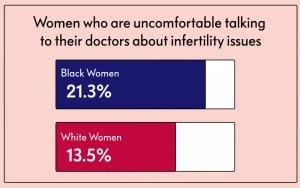
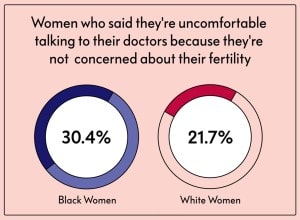
The divide is clear on how women of different races not only talk about infertility but on IF they seek treatment. 15 percent of White women seek medical help to get pregnant, compared with just 8 percent of Black women.
 

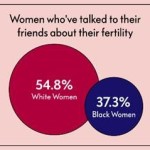
“Many Black women are seeking to end the silence around infertility in their communities, creating groups for women of color having access to resources, inspiration, and encouragement,” says McCarthy-Keith, who further states that this type of sisterhood is “invaluable.”

“It’s about having a support system in place because if you feel like ‘Everyone around me is having babies except for me,’ seeking those successes is very helpful for visibility,” adds McCarthy-Keith.


How to Talk to Your Doctor about Fertility

“There are specific factors that affect African-American or Black women disproportionately,” says McCarthy-Keith. Uterine fibroids and obesity, for example, are conditions that can negatively impact fertility—and Black women are affected by higher rates of both.

“If you’ve had unprotected intercourse for at least 12 straight months, and you’re under 35 years old, it’s time to see a fertility doctor,” says McCarthy-Keith. “If you’re 35 or older, after six months unprotected, see a fertility doctor.”

Schedule an Appointment

To learn more or to schedule an appointment, please contact the SGF New Patient Center at 1-877-971-7755 or complete this brief online form.

Filed Under: Get Started

October 18, 2018 by Shady Grove Fertility

While the benefits of yoga on fertility treatment outcomes are still being studied, what’s certain is yoga can help you manage the stress that often surrounds infertility treatment. This is one of the reasons Shady Grove Fertility’s Wellness Center offers yoga to their patients and why SGF was featured in Today.com’s Health & Wellness article about yoga for fertility.

“You place your feet on that mat and you automatically get this calmness in your body, and just focus on yourself and your breathing,” says one SGF patient who took advantage of SGF’s yoga classes.

Trying to get pregnant is no easy feat—and for women struggling with infertility, the process can create stress, anxiety, or a feeling of failure. Recent research has shown that practicing yoga can help women cope with these emotions by lowering their stress levels.

“That connection with other women going through similar experiences is a major part of why my yoga practice has been so beneficial,” adds an SGF patient.

The yoga services offered at SGF are intended to create a sense of community and bring together women who were experiencing many of the same feelings and going through similar steps in their journey, serving as a reminder that you are never alone. The program is unlike any other yoga class, because the postures, breath work, class exercises, and discussions are all specifically designed to support fertility.

“Yoga for fertility with Robyn [at SGF} has been great! I think I’ve generally had a positive attitude and approach to fertility treatment at SGF, but when I saw a yoga class was being offered through the Wellness Center, I thought, why not give it a shot? It’s been years since I’ve done any yoga, and was only a beginner then, but that definitely has not been a problem! Robyn has been a great instructor. She provides excellent guidance through the physical moves. Also, there is never any pressure; she poses different movements as suggestions, not commands. I really enjoy the balanced approach she takes towards each class. Robyn definitely comes in with a plan, but she is also really flexible and makes adjustments on the fly that best suit our class that evening. In addition, each class presents a different layer to focus on for the week, including concepts like being more mindful, deep breathing, and bringing in positive energy. I have found these tools can be applied not just to fertility but any aspect of your life that may cause stress, be it work, family, etc,” shares one SGF patient.

“The benefit of yoga for fertility is that it not only lowers stress levels for patients going through treatment, but it can help re-energize the mind, body, and spirit, which can be beneficial for patients who have had unsuccessful cycles and are trying to move forward with treatment,” says Dr. Melissa Esposito, M.D.

Another SGF patient shared, “I was someone who laughed at people saying yoga changed their lives… but in fact I was the one to be laughed at for not believing in it. This class changed my life! And being in the class with woman who are going through the same pain and struggle was the best part! It was like going to counseling but there wasn’t a couch to sit on, there were yoga mats! We expressed what/how we felt, and where we were in our journey, and to top it off, we did relaxation yoga. For those who are going through a lot … this is the best decision you can make in your life and make sure it’s with Robyn!”

Dr. Esposito adds “For those patients that don’t like yoga, Shady Grove Fertility’s Wellness Center offers other complementary therapies such as massage and acupuncture designed specifically for fertility.”

Our Wellness Center services do not replace advanced reproductive technology but rather support patients during their fertility journey. Our holistic practitioners are specially trained by infertility experts so that their approach to treatment addresses each patient’s individual needs.

Schedule an Appointment

Filed Under: Get Started

  • « Go to Previous Page
  • Page 1
  • Interim pages omitted …
  • Page 7
  • Page 8
  • Page 9
  • Page 10
  • Page 11
  • Interim pages omitted …
  • Page 16
  • Go to Next Page »

Company

  • About SGF
  • About US Fertility
  • Our Doctors
  • Fertility Equity
  • Careers
  • Newsroom
  • SGF College Scholarship
  • Contact Us
  • Voice Your Feedback

Treatments

  • Egg Freezing
  • Intrauterine Insemination (IUI)
  • In Vitro Fertilization (IVF)
  • Frozen Embryo Transfer (FET)
  • LGBTQIA+ Family Building
  • Shared Risk 100% Refund Program
  • All Treatments

Resources

  • Patient Portal
  • Online Bill Pay
  • Library
  • Support Groups & Events

Locations

  • California
  • Colorado
  • Delaware
  • Florida
  • Georgia
  • Maryland
  • North Carolina
  • Pennsylvania
  • Texas
  • Virginia
  • Washington, D.C.

2026 Shady Grove Fertility

  • Policies & Notices
Also of interest
  • In Vitro Fertilization IVF
  • Fertility Tests
  • Research Publications