
• Skip to primary navigation
  • Skip to main content
  • Skip to footer
Shady Grove Fertility
  • Become an Egg Donor
  • Referring Physicians
  • 1-888-761-1967
  • Schedule Appointment
  • Get Started
        • Get Started
          • Causes of Infertility
          • Fertility Tests
          • When to Seek Help
          • Find a Doctor
          • Preconception and prenatal vitamins 
          • Schedule an Appointment
        • Personalized Care For
          • Single Parents
          • LGBTQIA+ Family Building
          • People with Cancer
          • Known Genetic Diseases
          • Egg Donors
  • Treatments
        • Fertility
          • Timed Intercourse
          • Ovulation Induction
          • Intrauterine Insemination (IUI)
          • In Vitro Fertilization (IVF)
          • Frozen Embryo Transfer (FET)
        • Donation & Surrogacy
          • Donor Sperm
          • Donor Egg
          • Donor Embryo
          • Gestational Carrier
          • LGBTQIA+ Family Building
          • Single Parents
          • Find a Donor
        • More Treatments
          • Center for Male Fertility
          • Egg Freezing
          • OncoFertility
          • Preimplantation Genetic Testing
          • MIGS
          • All Fertility Treatments
  • Resources
    • Resource Library
    • Events Calendar
    • Patient Stories
    • Mental Health
    • Wellness Center
  • Insurance & Savings
    • Insurance & Benefits
    • Shared Risk 100% Refund Program
    • 100% Refund for Donor Egg
    • Discounts
    • Egg Freezing Costs
    • Financing & Grants
    • Clinical Trials
  • About
    • Find a Doctor
    • About SGF
    • Our Care Team
    • Advanced Practice Providers
    • Fertility Equity
    • Philanthropy
    • Newsroom
    • Careers
    • Contact Us
    • Voice Your Feedback
  • Locations
        • Find a Location
        • California
        • Colorado
        • Delaware
        • Florida
        • Georgia
        • Maryland
        • North Carolina
        • Pennsylvania
        • Texas
        • Virginia
        • Washington, D.C.
        • Chile
        • International & Out of State
        • SGF at Walter Reed National Military Medical Center
  • Patient Hub
    • Online Bill Pay
    • Patient Forms
    • Patient Portal
  • Call your care team
  • Become an egg donor
  • Referring physicians
  • search-icon
  • Schedule appointment 1-888-761-1967

Home / Diagnosing Infertility / Page 4

Diagnosing Infertility

December 14, 2020 by Shady Grove Fertility

Medical contribution by Jason G. Bromer, M.D.

Jason G. Bromer, M.D., is board certified in obstetrics and gynecology and reproductive endocrinology and infertility. He has been involved in cutting-edge research in fertility preservation for cancer patients, pregnancy implantation, and methods of embryo selection for in vitro fertilization. 

When beginning the infertility treatment process, diagnostic testing will be the first step you take before your clinical plan can be created. Infertility is diagnosed based on the results of three main tests: day 3 hormone bloodwork and a hysterosalpingogram (HSG) for the female partner, and a semen analysis for the male partner. Each test looks at a different component significant to conception:

  • Day 3 hormone bloodwork: FSH (Follicle-Stimulating Hormone) and AMH (Anti-Müllerian Hormone) provide insight about egg quantity, while estrogen and LH (Luteinizing Hormone) levels can indicate information about the maturation of follicles.
  • Hysterosalpingogram (HSG): Determines the condition of the fallopian tubes and uterus.
  • Semen analysis: Evaluates the quantity and quality of the male partner’s sperm, specifically looking at parameters such as sperm count, morphology (size and shape), and motility (the number moving in a forward progression).


Prior to starting diagnostic testing, many patients have already had their blood drawn and know what to expect regarding hormone evaluation. Most patients, though, have not experienced a hysterosalpingogram (HSG).

Fear of the unknown can make many patients nervous or apprehensive about this aspect of their diagnostic work-up. However, learning all that SGF does to make the test more manageable is hopefully reassuring.

Why do I need a hysterosalpingogram (HSG)?

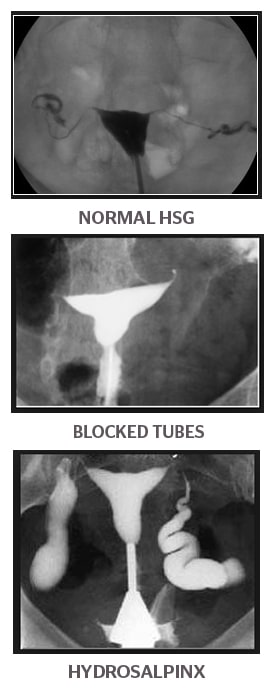
After ovulation, a current in the body pushes the egg into the fallopian tubes where the sperm and egg will meet and fertilization can occur. Once an egg is fertilized, an embryo will develop and continue through the fallopian tubes until it reaches the uterus, where it will implant into the uterine lining. The hysterosalpingogram is performed routinely for patients having difficulty conceiving because it is an excellent test that not only can confirm that a woman’s fallopian tubes are open, but can also assess whether the uterus has a normal shape. It can also make sure the cavity is not affected by fibroids, polyps or scar tissue.

The HSG procedure
Prior to starting the HSG, the patient must produce a urine sample. This is an important step as it allows the practitioner to be sure that the patient is not unknowingly pregnant prior to starting the HSG. Should a patient be pregnant, the contrast used to fill the uterus can harm or displace the growing fetus, resulting in an increased risk of miscarriage.

At the start of the procedure, a speculum is inserted into the vagina in order to view the cervix, similar to a Pap smear. The cervix is cleaned with an antiseptic solution; then, a thin, plastic catheter, generally about the size of the tip of a pen, is placed inside the cervix. Once placed, a small amount of contrast, usually two to three teaspoons, is passed through the catheter into the cervix, filling the uterus and fallopian tubes. Contrast is used, as opposed to dye, which is a colored substance that cannot be seen on an x-ray, whereas contrast can.

While lying flat on the table, a special type of X-ray imaging technology called fluoroscopy is used to provide a “live” X-ray that allows the practitioner to watch as the contrast fills the uterus and travels into the tubes. The tubes are considered open when the contrast is able to move completely through the length of the tube, spilling the contrast out on the other side. This indicates that the tubes are open and available to “pick up” an egg post-ovulation. Immediately following the HSG test, patients will receive preliminary results from their practitioner. The images taken throughout the procedure are then sent to the ordering physician, along with the practitioner’s findings.

Side effects and risks

There are several fairly common side effects associated with HSG tests: abdominal pain and/or discomfort, feeling crampy or achy, and vaginal spotting and/or watery discharge. When spotting or discharge occurs, we encourage patients to use sanitary napkins or pads as opposed to tampons. We also encourage our patients to speak with their physician about taking some over-the-counter pain reliever following the test to reducing any cramps or discomfort.

While uncommon, a risk associated with HSG is infection. Patients that have a diagnosed or suspected problem with their fallopian tubes – such as a history of ectopic pregnancies or a hydrosalpinx – will likely be prescribed an antibiotic to be taken in advance. An HSG will not bring on menses, so if you experience a full menstrual flow, develop a fever, or continue to feel pain for more than a few days, you should speak with your physician. If it is after hours, you should call Shady Grove Fertility’s answering service.

Why choose SGF for your HSG?

Shady Grove Fertility places high value on patient safety and comfort and goes out of our way to minimize discomfort. Here’s how:

We encourage taking a pain reliever 30 to 60 minutes prior. Many women feel some cramping for about 2 minutes when the contrast is filling the uterus. Therefore, we strongly encourage taking an over-the-counter pain reliever (such as ibuprofen) 30 to 60 minutes before the test to reduce feelings of pain or discomfort. This will help tremendously.

Also, speak with your doctor about taking pain medicine 30 to 60 minutes before the procedure especially if you have a history of ectopic pregnancies or a hydrosalpinx.

We have very experienced clinicians who perform HSGs. The clinicians at our practice who perform HSGs perform thousands each year and have the experience and expertise to help make your experience as comfortable as possible.

We encourage communication. We encourage you, if you are feeling any discomfort during the test, to communicate with your clinician performing the test, let us know if it hurts, and we may be able to make some adjustments to make you more comfortable.

We are selective about contrast and instrument type. We select a contrast that is known to cause the least amount of cramping and an instrument that is known to cause the least amount of discomfort.

We care about your comfort. We perform this procedure on a GYN table, which makes patients more comfortable, compared with a hospital table common in other locations.

We don’t tell our patients the procedure will be 100% painless but we reassure that we will do everything in our power to make the test more comfortable.

Here’s what our patients are saying:

  • “After reading all that horror stories on internet, I was so nervous! It was nothing at all. Like a regular OB exam, but a little bit longer.” – Tanya
  • “I had my HSG done a few months ago and I did have some pretty intense cramping during mine. I have endometriosis, so I’m used to intense cramps, but I was pretty uncomfortable through the procedure, but it was quick, and it wasn’t anything that I couldn’t bare.” – Stacy
  • “It was not at all painfully except for 2-4 seconds of our very known menstrual pain which occurred when they filled with the contrast dye.” – Ranuak
  • “My HSG went very smoothly. I only felt a little pinch when they inserted and inflated the catheter. When they injected the dye it just felt like a very dull menstrual cramp and then it was over before I knew it!” – Jennifer

Common patient questions about HSGs

How long does an HSG take? While the actual procedure takes about 5 minutes, you should plan to arrive for your HSG 30 minutes prior to your scheduled appointment. You can also expect to be with us for 30-45 minutes after the scheduled HSG start time.

Is it okay to drive home by myself after the test? The standard operating procedure for an HSG does not call for sedation. You are unlikely to have pain following the procedure, but you may feel crampy or achy. The majority of our patients are able to drive after an HSG and even immediately return to work.

When is the best time during my cycle to schedule the HSG? The test should be scheduled after your period ends, but before you expect to ovulate – usually between days 5 to 12 of your menstrual cycle. To figure out the days of your cycle, count day 1 as the day your period begins.

Where can HSGs be performed? HSGs can be completed in many healthcare environments, including hospitals, radiology labs, or other free-standing centers. Shady Grove Fertility has two free-standing HSG suites located in Rockville, MD and Towson, MD.

Do I have to complete my HSG at a Shady Grove Fertility facility? No, Shady Grove Fertility physicians routinely make diagnostic and treatment decisions based on HSGs performed at facilities other than our own. Occasionally, however, the information on an HSG done at an outside facility may be inconclusive or not provide all of the information needed for the best medical recommendation. In these situations, your Shady Grove Fertility physician may recommend repeating the HSG to obtain necessary information.

Because we take great pride in the lengths to which we are able to go to make sure women are as comfortable as possible during an HSG, many physicians refer their patients to SGF for an HSG.

Who can administer an HSG? HSGs can be performed by infertility specialists, obstetrician-gynecologists, radiologists, physician assistants and other health care providers. Health care providers performing HSGs should be trained in performing pelvic exams and be technically proficient with the HSG technique. They should also be able to evaluate its findings and report them comprehensively.

Will I have insurance coverage for my HSG? Most – but not all – insurance policies will cover the expense of an HSG completed at Shady Grove Fertility. The choice to have the HSG performed at Shady Grove Fertility versus another facility is ultimately up to you. Patients whose insurance policy does not extend HSG benefits at Shady Grove Fertility will incur a charge for the procedure and will be responsible for its payment. The cost versus the benefits can be discussed with your primary Shady Grove Fertility physician, as well as other questions you may have about the HSG.

How soon after the HSG can I resume intercourse? Generally, we want patients to abstain from intercourse until after vaginal spotting or discharge stops, usually 1 to 2 days after the HSG.

So much of the infertility treatment process is about narrowing down the cause(s) of an individual’s infertility. The HSG, though not commonly known, is a beneficial way that your physician can determine the best path to help you on your journey to reproductive success.

Schedule an Appointment


To schedule a virtual consultation with an SGF physician, please call our New Patient Center at 1-888-761-1967 or submit this brief form.


Editor’s Note: This post was originally published in August 2014 and has been updated for accuracy and comprehensiveness as of December 2020.

Filed Under: Diagnosing Infertility Tagged With: Hysterosalpingogram (HSG)

June 17, 2019 by Shady Grove Fertility

An Anonymous Patient’s Perspective on Secondary Infertility

My husband and I originally wanted four children. Once we had our son and felt ready for kiddo number two, we conceived once again.

Then, we had a miscarriage.

None of my friends or family had experienced a miscarriage, so I felt like I had no one to turn to.
We waited almost a year before attempting to get pregnant again. But our delight soon transformed to sadness when we miscarried for the second time.

After the second miscarriage, I sought the help of a perinatologist. I wanted to understand why I kept miscarrying and figure out how to fix the problem. Even though the doctors performed a lot of tests, they were never able to pinpoint a cause.

We attempted a third time, and I was able to conceive.

Unfortunately, this pregnancy also ended with a miscarriage.

At this point, we turned to Shady Grove Fertility where Dr. Esposito identified the likely cause of my miscarriages.

When I got pregnant again; this time it was with twins. I remember calling Dr. Esposito and telling her not to close my file because I didn’t have a good feeling about it. I felt a lot of anxiety and fear, and at 9 weeks I was told that neither sac was functional and that there were no heartbeats.

I was shattered.

While it was difficult to retain hope of a happy outcome through this all, we persisted. Using IVF with preimplantation genetic diagnosis (PGD), we retrieved 12 eggs and two fertilized normally. The attempt was successful. I was pregnant.

But pregnancy didn’t settle my nerves. I had proven I could get pregnant, but staying pregnant was the issue. So I was on edge—and I stayed on edge until the day when my newborn daughter was placed in my arms.

Getting pregnant is like riding a bike, right?

You’ve gotten pregnant before, so surely you can have a successful pregnancy again.
Well, not necessarily. While some women find getting pregnant with baby two…or three…or four…no more challenging than conceiving their first bundles of joy; others have a decidedly different experience.

In fact, experiencing difficulty conceiving a baby after you’ve already had one successful pregnancy, also known as secondary infertility, is more common than you might expect. According to the Centers for Disease Control (CDC), more than 3.5 million American women experience secondary infertility. At Shady Grove Fertility, approximately 50 percent of the patients we see are seeking support as a result of secondary infertility.

Statistics suggest that the frequency of secondary infertility is on the rise. According to the same data source, just more than 2.5 million American women experienced secondary infertility in 1982, meaning the number of women affected has increased by 1 million in the span of 30 years.
Although this problem may seem perplexing and paradoxical, there are some logical reasons why secondary infertility is presenting an increasing challenge for couples who want to expand their families.

What factors contribute to secondary fertility?

The answer to the question, “Why am I having a hard time having a baby now when I didn’t have difficulty before?” isn’t always the same for every woman.

Upon exploring the underlying causes of secondary infertility, some women find that they have a fertility-related issue—such as PCOS—that, by all accounts, should have prevented them from having their first child.

For other women, however, something has changed between the birth of the first child and their attempt at conceiving and carrying another.

Some common change factors that cause difficulty conceiving a second child include:

Maternal age

You are older when you have baby number two than you were when you had baby number one. Because fertility declines with age, having that second or third child becomes more difficult.

Internal issues

In the span of time between the birth of your first child and your attempt at conceiving baby number two, changes within your body may have occurred. Changes to your uterus, infections, or even Fallopian tube issues could make getting and staying pregnant more difficult.

Male-factor infertility

If you’re attempting to have your second child with a different partner than your first, male factor infertility could be contributing to your struggle.

Weight gain

Many people gain weight as they get older. Being overweight or obese can cause fertility-related struggles, making conception more challenging.

Schedule an Appointment

When facing secondary fertility, is it normal to…

Feel out of place among fertility patients? Yes.

As you sit in the waiting room for your appointment, you might feel like you don’t belong in a fertility center. You’ve been pregnant. You’ve had a baby. Is it even right for you to be considering such medical measures?

Having one child doesn’t necessarily make dealing with infertility any easier. You still have a right to feel a longing to have another child, and a right to pursue treatment.

Also, remember that about half of our patients deal with secondary infertility. So in a waiting room of 10, five likely have a child at home.

Feel pressure from existing children? Yes.

Many kids ask for siblings. They see their friends with brothers and sisters, and they want one, too.
If your child is old enough, you may feel comfortable having a discussion with him or her about the challenges and feelings surrounding bringing another baby home. You can tell your child that you would like to have another child but aren’t able to right now.

If a conversation doesn’t feel appropriate, you can remind your child that you love him or her and your family of three.

Feel guilty? Yes.

Despite the fact that secondary infertility isn’t your fault, mothers commonly feel that if they had tried to add a second child earlier, their attempts would have been successful.
The only way to overcome this emotion is to remind yourself—often repeatedly—that secondary fertility is not your fault.

Feel relief? Yes.

You want a second baby… you really do… so why do you feel a tinge of relief?

Having a baby—especially a second one—can cause a wide array of fears and emotions. Many people experience equal parts excitement and trepidation about having another child.
How would an additional child change your existing family? Because there is no way to tell, you may feel relief at not having to face this uncertainty.

Feeling relief doesn’t mean you’ve done something wrong or that there is anything wrong with you.

Where can I get support?

Secondary infertility can be a difficult topic to discuss with those who haven’t faced this challenge before.

Friends and family may dispense well-intentioned but ill-informed advice like, “Just enjoy the child you do have,” or “Relax. It will happen when you least expect it.”

While some people can wrap their heads around the emotions that accompany secondary infertility on their own, others benefit from discussing their experience with those who have been or are going through secondary infertility.

If you have a friend or family member you can turn to, you should do so to the degree that you feel comfortable. If you don’t—or if you would feel more comfortable talking to someone else—seek out a free Shady Grove Fertility support group led by one of our social workers.

And remember, speak to your doctor about the emotions you are experiencing as you go through the fertility process. Fertility care professionals can provide you with support directly or point you in the direction of the confidant you seek.

Schedule an Appointment

For more information about secondary infertility or to schedule an appointment, please call our New Patient Center at 1-877-971-7755 or click here to complete this brief online form.

Filed Under: Diagnosing Infertility Tagged With: Causes of infertility, Secondary infertility

May 15, 2019 by Shady Grove Fertility

Dr. Celso Silva, who sees patients in SGF’s Tampa, FL location, joined The Morning Blend to explain when to see a fertility specialist and the three basic tests used to determine a patient’s diagnosis and treatment plan. Watch the full segment: here.

Q: How common is infertility?
Dr. Silva: “Infertility is a very common condition and does not discriminate. Anyone—independent of their sex, religion, or socioeconomic background—can be affected by this condition. 1 in 8 couples struggle with infertility and there’s some data starting to show that the condition may be increasing in frequency because women are delaying childbearing. They want to have a career and end up postponing their dreams of having a child.”

[Read more about how egg freezing provides women with family building options.]

Q: When is the right time to see a fertility specialist?
Dr. Silva: “Age is a very important factor as we talk about infertility. We use age as a criteria to indicate when a patient should come to see a specialist. For women who are less than 35 years old and have been trying to conceive for a year without success, it’s probably time for them to come and see us. For a woman between the ages of 35 and 40, 6 months of unprotected sexual intercourse without success is a sign that they should come to see a specialist. If a woman is above the age of 40, we think they should come and see us immediately because age is such an important predictor of the success patients will have with fertility treatment.”

Q: Are there certain conditions that warrant seeking a fertility consult earlier?
Dr. Silva: “There are certain conditions that if a woman knows that she has, she should come and see us early. For example, endometriosis, if you have a history of recurrent pregnancy loss, or if you have a history of a prior tubal ligation. These are conditions that if you know you have them, it makes more sense for you to come and see a specialist sooner rather than later.”

Q: What can patients expect during fertility testing?
Dr. Silva: “When a patient comes to our office, there are three basic tests. There’s bloodwork and an ultrasound, an x-ray called an hysterosalpingogram (HSG), and a semen analysis. These are the basic infertility tests that give us a very broad idea about the patient’s reproductive status. We like to do the work-up for the couple. As an infertility specialist, the couple is our patient. It’s not only the male and it’s not only the female.”

Q: What are the most common causes of infertility?
Dr. Silva: “We can tell a lot from the test results. For the vast majority of our patients, after these basic tests, we will know and understand what’s preventing them from getting pregnant. Probably the two most common diagnoses nowadays are egg-related infertility, which is caused by advancing (maternal) age and a decline in egg quality and quantity. The second one is Fallopian tube obstructions. Those are probably the two most common diagnoses we see in the office.”

Q: How does SGF approach fertility care?
Dr. Silva: We strive to always do what’s in the best interest for our patients. This means utilizing an individualized approach to care, recommending patients begin with the simplest, most effective treatment options first based on your medical history, diagnosis, and personal circumstances.

Many patients start with a more basic treatment, such as ovulation induction or superovulation, coupled with intrauterine insemination (IUI). In fact, approximately 25 percent of patients at Shady Grove Fertility achieve a pregnancy through simpler treatment options.

Schedule an Appointment

To learn more or to schedule an appointment with an SGF physician, please contact our New Patient Call Center at 1-877-971-7755 or complete this brief online form.

Filed Under: Diagnosing Infertility

April 5, 2019 by Shady Grove Fertility

While the infertility conversation often revolves around the female partner, the male partner’s role is just as important. Nearly half of all infertility cases are due—in part or in whole—to male factor infertility. Dr. Monica Best, who sees patients in SGF’s Atlanta-Northside and Buckhead-Piedmont locations, was recently an invited guest on an Atlanta radio show to discuss the causes of male factor and treatment options available to patients.

“The way I think about this simplistically is the 30:30:40 rule. 30 percent of the time, we often find a female factor, like blocked tubes, diminished ovarian reserve, fibroids, or PCOS where the woman isn’t making a mature egg each month,” Dr. Best explains. “30 percent is male whether or not it’s a sperm production issue or anatomic problem where sperm isn’t able to come out into the ejaculate properly. And in 40 percent of couples it’s both of them, so there’s some male and female factor that is combining and making it difficult for them to get pregnant.”

When asked about testing and seeking fertility care, Dr. Best notes, “It’s important to realize that couples are typically scared to come seek help because they’re afraid it’s going to be their fault or their partner’s fault. The reason for a comprehensive evaluation is so we don’t miss something on the female side, on the male side, or both.”

Male testing is simple and requires a semen analysis. Once the patient has provided a sample, there are several factors that are examined:

  • Volume – Besides sperm, semen contains amino acids, enzymes, and several other secretions made by the male reproductive system. If the volume of ejaculate is low, that can mean the sample may be lacking in these important secretions that aid in the fertilization process. It could also signal a blockage or other issue in the semen’s pathway.
  • Concentration – This is what people commonly refer to as the “sperm count.” A low concentration can signal a problem with the testicles or male hormones that is preventing the testicles from making enough sperm.
  • Motility – The movement of the sperm is another important factor. If it is low, it can affect the ability of the sperm to reach the female reproductive tract and find the egg.
  • Morphology – This item refers to the shape of the sperm in the sample. The head of the sperm is the part that penetrates and fertilizes the egg. If these are misshapen, it may mean they do not contain the proper enzymes or other materials that are necessary to complete fertilization.

Does a man’s age contribute to male factor infertility?

Dr. Best examines the difference between male and female fertility as it relates to age. “For men, they make new sperm every 3 months so technically, they have a rejuvenation of sperm. Whereas a woman’s eggs have been there even before she was born, and her egg supply continues to decrease over time. Also as a woman ages, over time, there’s some genetic injury to that pool of eggs, which increases risk of miscarriage.”

What causes male factor infertility?

“For some men, just like in women, there can be some unexplained issue where either the concentration of sperm or the motility of sperm is low. There can also be genetic reasons why men may not be creating enough sperm. The sperm counts are really low generally if there’s less than 1 million total motile sperm. We’re looking at their karyotype to see if their chromosomes are normal. Sometimes there can be a mutation on the Y chromosome, which is what makes someone male, and so that can be a reason for decreased sperm production,” states Dr. Best.

“The other thing is some people are born without what’s called a vas deferens, which is basically the tube that carries ejaculate from the testicle out through the penis and into the ejaculate. If there’s not a transport mechanism, they’re making sperm, but it can’t get out. Oftentimes that’s associated with a cystic fibrosis mutation, which can be more common in Caucasians, but we’ve also seen it in African-Americans, so that would be something that we would test. Also, some male children are born with undescended testes and if that’s not corrected right away after birth and it’s not identified until later, sometimes those men—because of the increased warming of the testicle inside of the body if it’s non descended—can cause low sperm counts later on.”

A man can overcome male factor infertility with a variety of treatment options. A diagnosis of male factor infertility is categorized as mild, moderate, or severe. The goal with any treatment is to get the sperm as close to the egg as possible. The severity of the case, the fertility status of the female partner, and comfort level of the couple together dictate the planned course of treatment. Luckily, this form of infertility is easily overcome with the right diagnosis, lifestyle choices, and treatment.
To watch our On-Demand Webinar on Male Fertility, click here. During this free on-demand event, viewers will learn about the simple tests used to evaluate male fertility, common causes of male factor infertility, lifestyle changes that can improve a man’s fertility, effective treatment options and treatment success rates.

Read these Male Factor Patient Success Stories:

Hannah and John
Amy and Brian
Aria and Scott

Schedule an Appointment

For more information about overcoming male factor infertility or to schedule an appointment with Dr. Best or another SGF physician, please contact our New Patient Call Center at 1-877-971-7755 or complete this brief online form.

Filed Under: Diagnosing Infertility

April 2, 2019 by Shady Grove Fertility

Hollywood Life recently turned to SGF’s Dr. Andrea Reh to weigh in on Halsey’s endometriosis diagnosis and possible causes of her multiple miscarriages.

The singer is only 24-years-old and tweeted, “I have endometriosis. I’ve had th miscarriages, 4 surgeries, pretty much in pain every day of my life.”

Endometriosis is a diagnosis common among girls and women in their reproductive years. It is a condition in which endometrial tissue (tissue that lines the inside of the uterus) grows outside the uterus and eventually sheds into the abdominal cavity. Inflammation occurs in the areas where the blood pools, forming scar tissue. When the endometrial tissue forms on other reproductive organs aside from the inside of the uterus, it interferes with ovulation, tubal transport, and embryo quality.

One of the most common signs of endometriosis is abnormally painful menstrual cramps. If you tend to feel extremely painful cramps, or pain with intercourse, it might be time to see a specialist to seek further information. However, some women experience no symptoms at all, and are only diagnosed when they struggle with conception.

“Endometriosis is associated with infertility. Many women who have endometriosis will have a harder time getting pregnant,” Dr. Reh continues. “Not every woman will have a hard time, but it is a risk factor. A history of endometriosis can make it much more difficult for a woman—even at a younger age—to get pregnant. It also depends on the degree of the endometriosis. Endometriosis can be mild or quite severe, which can also play a role in getting pregnant.”

Watch: SGF’s New On-Demand Webinar, Getting Pregnant with Endometriosis

Can Halsey attribute her miscarriages to endometriosis? “Endometriosis is one risk factor why women miscarry, but it would be hard to say that that’s the cause without excluding other reasons first,” Dr. Reh says. “There are other risk factors involved and most likely it may be genetic, meaning the embryo itself was abnormal.”

As for Halsey’s multiple miscarriages at such a young age, Dr. Reh explains “Any woman who has two or more miscarriages, we recommend them undergoing an evaluation with a specialist to rule out other causes such as genetic causes, the uterus itself, or hormonal causes.” More on recurrent miscarriage.

Getting Pregnant with Endometriosis

Every treatment plan at SGF is customized to fit the patient’s unique diagnosis. Getting pregnant with endometriosis is very possible for most women. While endometriosis may make it harder to conceive on your own, your chances of getting pregnant with endometriosis can be high, depending on the severity of your condition, your age, your overall health, and your treatment options.

With both basic and advanced treatments, pregnancy is possible. Since endometriosis can take many forms, and the success rates of treatments vary, your doctor will outline your best treatment options with an individual plan for you.

Looking for inspiration? Read these endometriosis patient success stories:

Steph and Mike
Heather and Salah
Melissa and Paul

Schedule an Appointment

To learn more or to schedule an appointment with Dr. Reh or another SGF physician, please call our New Patient Center at 1-877-971-7755 or complete our online form.

Filed Under: Diagnosing Infertility

March 6, 2019 by Shady Grove Fertility

Andrea Reh, M.D. from the Shady Grove Fertility Arlington office discusses endometriosis in this short video.

What is endometriosis?

Endometriosis is a common gynecological condition that affects many women during their reproductive years. To explain how endometriosis works, let me give you a little background. During a normal menstrual cycle, the lining of the uterus will grow and thicken in response to hormones. When a woman gets her period, the uterus sheds this lining that has built up over that past month. That’s a normal and important process to essentially restart the body before another cycle.

The difference, is that for women with endometriosis, the uterine lining doesn’t just grow INSIDE the uterus (where is it supposed to be growing every month), but it will ALSO grow and implant OUTSIDE the uterus in other parts of pelvis. That’s where the problems arise. These “implants” can then cause inflammation and scaring, which can lead to pain and/or infertility. Sometimes these implants will grow on the ovaries and form cysts that we call “endometriomas.”

How do you know if you have endometriosis?

The only way to truly know is to have surgery—for a gynecologist to look inside the pelvis, take a biopsy, and confirm it under the microscope. But naturally we don’t want to operate just to answer that question. So, we have to rely on other clues. Patients with this condition may have symptoms of pelvic pain, back or rectal pain, and/or very painful periods. Sometimes these women will have pain with intercourse. Mainly, we can get a pretty good idea of whether someone has endometriosis, at least the most severe forms, with a pelvic ultrasound. On ultrasound we often can see those cysts—or what we call endometriomas.

The tricky part is that there is no one-size-fits-all when it comes to this condition. Not all patients with endometriosis will have pain, and in fact some patients with very advanced endometriosis may have no pain whatsoever. And some patients with very minimal endometriosis will have horrible pain. Does that make sense? It doesn’t always make sense to us physicians either, which is why there is continuing research in this area of our field.

If you do have endometriosis, what do you do about it?

If you are experiencing pain and you are not trying to conceive, there are a variety of hormonal medications that can help alleviate the pain. If you are trying to conceive, do not panic. Having endometriosis does not mean that you will be infertile. That being said, endometriosis is associated with a higher risk of having infertility, and it can get worse over time, so it’s important to have a plan.

Watch: SGF’s New On-Demand Webinar, Getting Pregnant with Endometriosis

When should you see a fertility specialist?

In general, any patient that has been trying to conceive for over 1 year should seek a fertility evaluation. If you are over 35, we recommend testing after 6 months of trying. With a diagnosis of advanced endometriosis, we would recommend an evaluation regardless of your age, particularly if it has been more than 6 months of trying.

How will a fertility doctor help?

Your doctor will make a personalized treatment plan by taking into account your age, the stage of your endometriosis, and the duration of your infertility.

Whether or not to have surgery or more surgery is controversial and a case-by-case decision. Given more recent studies, we are no longer as apt to recommend surgery.  We realize now, that repeated surgery may be detrimental to a woman’s ovarian reserve, and does not necessarily lead to an improvement in fertility.

Women with infertility with advanced endometriosis are likely best served by fertility treatment to increase their odds of conceiving. These options include superovulation with intrauterine insemination (IUI) using oral or injectable medications; the highest chance of pregnancy per cycle results from in vitro fertilization (IVF).

Since endometriosis can take many forms, and the success rates of these treatments varies, your doctor will outline your best treatment options with an individual plan for you.

Editor’s Note: This post was originally published in December 2015 and has been updated for accuracy and comprehensiveness as of March 2019.

Schedule an Appointment

If you would like to learn more about endometriosis or schedule an appointment, please speak with one of our New Patient Liaisons at 877-971-7755 or fill out this brief form.

Filed Under: Diagnosing Infertility Tagged With: Endometriosis

  • « Go to Previous Page
  • Page 1
  • Page 2
  • Page 3
  • Page 4
  • Page 5
  • Page 6
  • Interim pages omitted …
  • Page 21
  • Go to Next Page »

Company

  • About SGF
  • About US Fertility
  • Our Doctors
  • Fertility Equity
  • Careers
  • Newsroom
  • SGF College Scholarship
  • Contact Us
  • Voice Your Feedback

Treatments

  • Egg Freezing
  • Intrauterine Insemination (IUI)
  • In Vitro Fertilization (IVF)
  • Frozen Embryo Transfer (FET)
  • LGBTQIA+ Family Building
  • Shared Risk 100% Refund Program
  • All Treatments

Resources

  • Patient Portal
  • Online Bill Pay
  • Library
  • Support Groups & Events

Locations

  • California
  • Colorado
  • Delaware
  • Florida
  • Georgia
  • Maryland
  • North Carolina
  • Pennsylvania
  • Texas
  • Virginia
  • Washington, D.C.

2026 Shady Grove Fertility

  • Policies & Notices
Also of interest
  • In Vitro Fertilization IVF
  • Fertility Tests
  • Research Publications