• Skip to primary navigation
  • Skip to main content
  • Skip to footer
Shady Grove Fertility
  • Become an Egg Donor
  • Referring Physicians
  • 1-888-761-1967
  • Schedule Appointment
  • Get Started
        • Get Started
          • Causes of Infertility
          • Fertility Tests
          • When to Seek Help
          • Find a Doctor
          • Preconception and prenatal vitamins 
          • Schedule an Appointment
        • Personalized Care For
          • Single Parents
          • LGBTQIA+ Family Building
          • People with Cancer
          • Known Genetic Diseases
          • Egg Donors
  • Treatments
        • Fertility
          • Timed Intercourse
          • Ovulation Induction
          • Intrauterine Insemination (IUI)
          • In Vitro Fertilization (IVF)
          • Frozen Embryo Transfer (FET)
        • Donation & Surrogacy
          • Donor Sperm
          • Donor Egg
          • Donor Embryo
          • Gestational Carrier
          • LGBTQIA+ Family Building
          • Single Parents
          • Find a Donor
        • More Treatments
          • Center for Male Fertility
          • Egg Freezing
          • OncoFertility
          • Preimplantation Genetic Testing
          • MIGS
          • All Fertility Treatments
  • Resources
    • Resource Library
    • Events Calendar
    • Patient Stories
    • Mental Health
    • Wellness Center
  • Insurance & Savings
    • Insurance & Benefits
    • Shared Risk 100% Refund Program
    • 100% Refund for Donor Egg
    • Discounts
    • Egg Freezing Costs
    • Financing & Grants
    • Clinical Trials
  • About
    • Find a Doctor
    • About SGF
    • Our Care Team
    • Advanced Practice Providers
    • Fertility Equity
    • Philanthropy
    • Newsroom
    • Careers
    • Contact Us
    • Voice Your Feedback
  • Locations
        • Find a Location
        • California
        • Colorado
        • Delaware
        • Florida
        • Georgia
        • Maryland
        • North Carolina
        • Pennsylvania
        • Texas
        • Virginia
        • Washington, D.C.
        • Chile
        • International & Out of State
        • SGF at Walter Reed National Military Medical Center
  • Patient Hub
    • Online Bill Pay
    • Patient Forms
    • Patient Portal
  • Call your care team
  • Become an egg donor
  • Referring physicians
  • search-icon
  • Schedule appointment 1-888-761-1967

Home / Diagnosing Infertility / Page 11

Diagnosing Infertility

July 28, 2015 by Shady Grove Fertility

Rachana V. Garde, M.D.

Written by Rachana V. Garde, M.D., of Shady Grove Fertility’s Woodbridge, VA, and Annandale, VA, offices


Endometriosis is a condition that occurs when tissue that lines the uterus—known as endometrial tissue—grows outside of that organ and attaches itself somewhere else, such as the ovaries or fallopian tubes. This tissue responds to your menstrual cycle hormones by swelling, thickening, and then shedding to mark the beginning of the next cycle. While the bloodshed from the uterus is discharged through the vagina during your period, the bloodshed from endometrial tissue that grows in the pelvis remains and can become scar tissue. This scar tissue can grow to block the fallopian tubes and interfere with ovulation. Additionally, endometrial tissue that spreads to and grows inside the ovaries may form a type of ovarian cyst called an endometrioma, which can potentially affect fertility.

If you have been diagnosed with or believe you may have endometriosis and are wondering whether you can get pregnant, the answer is yes for many women. While endometriosis may make it harder to conceive on your own, your chances of becoming pregnant can be high—depending on the severity of the condition, your age, overall health, and the treatment option you choose.

Diagnosing Endometriosis

“Endometriosis is not always easy to diagnose,” explains Rachana V. Garde, M.D. In some women there appears to be a genetic link, this is not the case for others. Some of the most frequently reported symptoms of endometriosis include:

  • Severe menstrual cramps
  • Chronic abdominal pain
  • Pain with intercourse
  • Excessive bleeding

While many of the symptoms listed above are common, it is important to know that about a third of women with endometriosis will not experience any symptoms. On the contrary, some women that experience similar symptoms will ultimately be found to not have this condition, says Dr. Garde.
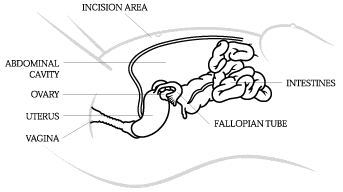
Laparoscopy is often used to diagnose endometriosis.


The only way to definitively diagnosis endometriosis is through an outpatient procedure called a laparoscopy. Historically, during this procedure the doctor would insert a thin scope near your navel to look for, and sometimes remove, endometrial tissue that is outside of your uterus. “As the medical literature continues to explore this type of surgery, it’s becoming less recommended for the purpose of diagnosis,” explains Dr. Garde. “Studies have found that surgery, especially on or around the ovaries, can damage the ovarian tissue, which can result in a decrease in ovarian reserve (egg supply). This decrease can ultimately make conception more difficult in the future.”

Dr. Garde suggests that women with the symptoms associated with endometriosis speak with a fertility specialist prior to initiating any exploratory surgery, in order to determine options and the appropriate next steps that will not compromise fertility potential.

Treatment Options for Women with Endometriosis

“For any woman that has or suspects endometriosis, the first step prior to treatment is to complete a full infertility work-up to identify any other potential challenges such as age or male fertility issues that the couple may experience when trying to conceive,” says Dr. Garde. A fertility specialist can help you rule out other health issues and determine which treatment options are best for you, depending on how far your endometriosis has progressed and if other factors may otherwise prevent conception. As you advance in age, your treatment options can become more limited—even if your condition is mild—so seeking help sooner rather than later is suggested.

Many women with endometriosis will start with a basic form of treatment called intrauterine insemination (IUI). During this treatment, the physician will prescribe medication to stimulate and grow one to two follicles containing an egg in the ovary. At the time of ovulation, the physician will perform the insemination, which involves placing a concentrated amount of sperm into the uterus. If these treatments don’t work over time, you have more severe endometriosis, or other factors that would impact the chances of success, your doctor may recommend moving to in vitro fertilization (IVF).

Waiting to Conceive

If you have endometriosis and do not have plans to conceive at this time or in the near future, preserving your fertility through egg freezing is recommended. While laparoscopic surgery can help to reduce the pain associated with endometriosis, it can also negatively affect your ovarian reserve. Therefore, freezing prior to surgery ensures you have options in the future.

If you have endometriosis and are trying to become pregnant—or think you may want to become pregnant in the future—don’t wait to speak with a fertility doctor. With proper counseling and care, endometriosis doesn’t have to stand between you and your dream of having a family.

If you would like to learn more about endometriosis or to schedule an appointment, please speak with one of our New Patient Liaisons at 877-971-7755.
Filed Under: Diagnosing Infertility Tagged With: Endometriosis

July 14, 2015 by Shady Grove Fertility

Eric D. Levens, M.D.

Written by Eric D. Levens, M.D., of Shady Grove Fertility’s Annandale, VA, office

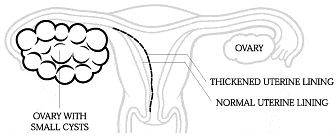
While there are many causes of female infertility, polycystic ovary syndrome, or PCOS, is very common. In fact, PCOS affects nearly 5 to 10 percent of reproductive age women and is the most common ovulatory disorder. Luckily, PCOS is also one of the more readily treated infertility conditions.

PCOS is caused by hormonal imbalances that curtail or prevent ovulation—the body’s process of producing and releasing eggs from the ovary. Essentially, women with PCOS have an inappropriate production of follicle-stimulating hormone (FSH) and luteinizing hormone (LH) that results in limited egg development and an increase in testosterone and other typically male hormones. These imbalances can cause the following signs and symptoms:

  • Irregular menstrual cycles—those that are 3 to 5 days shorter or longer than one’s typical cycle (a normal cycle ranges between 24 and 35 days)
  • Heavy or absent periods
  • Acne
  • Excess facial and body hair

Having these symptoms can indicate PCOS. For most women who are not trying to conceive, the diagnosis of PCOS occurs while under the care of a gynecologist. Treatment may consist of oral contraceptive pills for menstrual cycle control and improvement in acne and potential hair growth if pregnancy is not desired. However, because PCOS affects a woman’s ability to ovulate, fertility problems are commonly associated with this condition. Disorders of ovulation are some of the most common conditions treated at Shady Grove Fertility—and many of these women have PCOS.

Understanding What Causes PCOS 

The etiology, or cause, of PCOS is not completely understood. It is clear that there is a genetic basis to the condition, as a woman is more likely to develop the condition if her mother or sister has it. It is also known that disrupted signaling from the brain to the ovary affects ovarian hormone production, which further exacerbates, or worsens, the condition.

PCOS Can Affect Your Overall Health

Although being able to become pregnant is a common concern for women with PCOS, there are related health issues that also make diagnosing the condition important. For example, women with PCOS frequently demonstrate insulin resistance, which may lead to diabetes in the future. Insulin resistance often exacerbates the ovulation dysfunction. High blood pressure and high cholesterol, which can cause heart problems, are also related to PCOS. Moreover, women not having menstrual cycles for extended periods of time may also develop an overgrowth of the uterine lining, resulting in a greater risk of uterine cancers.

While PCOS is not preventable, women can work to manage related factors like obesity, which can compound the problem. If you have PCOS and are overweight, exercise and a healthy diet can improve ovulation, your response to fertility medications, and your chances of becoming pregnant. Studies have shown that losing just 5 percent of your body weight can help women restore their menstrual cycle and ovulate on their own. Losing weight also can reduce other symptoms of PCOS, such as hair growth and acne.

  • How Weight Affects Your Fertility

Finding Effective Treatment

If you’re having trouble getting pregnant and you have some or all of the symptoms common to PCOS, see your doctor. While there is no single diagnostic test available, he or she can confirm whether you have the condition—through tests that may include bloodwork to check your hormone levels or an ultrasound to detect cysts in the ovaries—and suggest treatment options.

Common fertility treatments include oral medications to help with ovulation such as Clomiphene citrate (Clomid) and letrozole (Femara). Your doctor may prescribe a second oral medicine, such as metformin, a diabetes drug, along with it that can help make the body more sensitive to insulin and lead to more regular ovulation.

Historically Clomid has been the first line of treatment for PCOS; however, letrozole use has been increasing due to a possible increase in pregnancy rates. However, it is important to note, if you have not conceived after three to four cycles of Clomid, you should consider a different course of treatment, such as intrauterine insemination (IUI) or in vitro fertilization (IVF).

While your gynecologist may provide initial fertility treatment, seeking the care of a fertility specialist sooner, rather than later, is a good idea. Fertility specialists have completed extensive subspecialty reproductive medicine and infertility training to properly and actively monitor all of your treatments to ensure the best outcome. With lifestyle changes and appropriate medical treatment, you can manage PCOS and have a very good prognosis for conception.

  • When is it time to see a fertility specialist?

If you would like to learn more or to schedule an appointment, please speak with one of our New Patient Liaisons at 877-971-7755.
Filed Under: Diagnosing Infertility

July 8, 2015 by Shady Grove Fertility

Most couples don’t ever expect that they will have trouble conceiving. But 1 in 8 couples will experience infertility, and an increasing number are using fertility treatment to help them conceive. The author of Frederick Magazine’s article “Fertile Hope,” interviewed Jason G. Bromer, M.D., and two Shady Grove Fertility patients about the effect of fertility treatment on their lives.

Jordan and Katharine’s Fertility Journeys

Jordan and her husband, Tim, came to Shady Grove Fertility after a long history of irregular menstrual cycles and a miscarriage. Jordan says, “I never thought my journey would be this way. I didn’t think I would have a hard time getting pregnant.” Jordan had polycystic ovary syndrome (PCOS) and was put on medication to regulate her hormone levels. With the regulation, she was able to have her son, Joel.

Katharine’s story is a little different. She and her high school sweetheart, Brandon, knew from a young age that they would have problems conceiving due to Katharine’s endometriosis. Despite having surgery to remove the endometriosis, they were still unable to conceive. They tried intrauterine insemination (IUI) four times without success. They eventually moved on to in vitro fertilization (IVF) and conceived their twins, Hunter and Alice, on the first attempt.

For many patients like Jordan and Katharine, becoming educated about fertility and knowing when to seek treatment is integral to success. If a woman is under the age of 35 and has tried unsuccessfully to conceive for 1 year or more, she should see a specialist. If a woman is over 35, she should see a specialist after 6 months of unsuccessfully trying to conceive, and if she is over 40, she should see a specialist after 3 months without conception.

Fertility Treatment Options to Help Couples Conceive

When a couple decides to come to Shady Grove Fertility for treatment, the health care team will walk each couple through a series of diagnostic tests (commonly known as the infertility work-up). These tests provide your physician with accurate insight into your reproductive hormones, your egg quantity, if your tubes are open, and if your partner has enough sperm and if they are healthy.

When the physician establishes the diagnosis, he/she will work together with the couple to determine the best treatment plan. Most of the time, patients will be able to start with basic treatment options like IUI. If the basic options do not help the couple to conceive, the physician may recommend more advanced options like IVF or donor egg treatment.

Another consideration for fertility patients beyond clinical treatment is the cost of treatment. “For the people who don’t have insurance benefits…one of the nice things about {Shady Grove Fertility] is that we have some of the most innovative financial programs in the world to help make fertility treatments affordable,” says Dr. Bromer.

  • Explore SGF’s unique financial programs for fertility treatment

It’s important to note that there are fertility treatments available to help almost every patient conceive. Maybe not the first time, but eventually they will find their own path to parenthood. Dr. Bromer says, “I’ve known since I was 5 years old that I was going to be a physician and I picked this field because it’s such a great field where we can make such a big impact.”

If you would like to learn more about fertility treatment or you’re ready to schedule an appointment, please speak with one of our New Patient Liaisons at 877-971-7755.

Filed Under: Diagnosing Infertility Tagged With: Endometriosis

June 26, 2015 by Shady Grove Fertility

By Naveed Khan, M.D., of Shady Grove Fertility’s Leesburg, VA, office
When a woman experiences a miscarriage, there are many feelings of loss and sadness, but there is also a need to know why. What’s important for women and their partners to know is that you are not to blame for miscarriage. Nearly 1 in 4 pregnancies end in miscarriage, regardless of the woman’s age, and in some cases before she even realizes she is pregnant. Sadly, miscarriage is a more common occurrence than people think, and one that is often difficult to understand.

Common Causes of Miscarriage

In about 50 percent of miscarriage cases, a cause can be determined. The cause usually falls into two categories:

  • Genetic abnormalities: Genetic abnormalities represent the most common cause of miscarriage. Sometimes the genetic syndrome is inherited from the parents, which we can test for through preimplantation genetic screening (PGS), and sometimes it occurs naturally within the embryo itself while it’s developing.
  • Uterine abnormalities: In these cases, there may be structural issues with the uterus, fibroids, endocrine issues, or immunological issues that can make a woman predisposed to miscarriage.

In either case, your physician will work with you to treat these diagnoses in order to help you have a healthy pregnancy.

For the other 50 percent of miscarriages, there is not an explanation unfortunately. This can understandably be very frustrating, but it should also be reassuring because it tells you that there isn’t anything majorly wrong, and that down the line you will likely be able to deliver a healthy baby.

Common Myths

While potential miscarriage causes were mentioned earlier, the internet is filled with information that is often incorrect regarding miscarriage. Far too many people believe that the following items led to their miscarriage:

  • Too much stress
  • Lifting heavy objects
  • History of sexually transmitted disease
  • Having used IUDs for birth control in the past
  • Engaging in intercourse while pregnant

It is important to note that none of the above reasons cause miscarriage.

Preventing Future Miscarriage

For women that have experienced recurrent pregnancy loss—two or more consecutive miscarriages—there is now an option to help prevent future loss. Preimplantation genetic diagnosis (PGD)—in which cells from the embryos are biopsied—can determine if chromosomal abnormalities are present. If embryos have chromosomal abnormalities, they will not be transferred back to the female partner. PGD has been proven to reduce the risk of miscarriage in women.

Finding Support

It is important that people who experience miscarriage get emotional support, whether it is from family, friends, or professional counselors or groups. This helps to counteract the feelings of isolation that come from pregnancy loss. The more you talk to people, the more you will realize that many others have been in the same situation and that you are not alone.

  • Pregnancy Loss: Healing the Invisible Loss
  • Free Support Groups

If you’ve experienced a miscarriage and you’d like to consult with a physician, please speak with one of our New Patient Liaisons at 877-971-7755 to schedule an appointment.

Filed Under: Diagnosing Infertility Tagged With: Causes of infertility

June 24, 2015 by Shady Grove Fertility

Whether you love them or hate them, when celebrities like Kim Kardashian share their experiences with infertility, it decreases the social stigma and increases the conversation about fertility treatment. Stephen J. Greenhouse, M.D., of Shady Grove Fertility’s Fair Oaks, VA, office joins FOX 5 to discuss why some couples struggle to conceive.

 The Struggle to Conceive: Age-Related Infertility

While women in their 30s and 40s may feel in the prime of their lives, biologically speaking, they have already passed their peak fertility years. For a woman, age is the number one predictor of her ability to conceive. “At the age of 35, the chances of getting pregnant per month is about 15 percent,” explains Dr. Greenhouse. As you age, the natural rate of conception, without any other fertility issues, continues to decline.

The Struggle to Conceive: Secondary Infertility

For couples who have already had a child, it may be hard to understand why baby number two or three is taking longer to conceive. This is known as secondary infertility, which may be caused by any number of underlying issues. For some, the years that have passed since their first child may have led to age-related infertility. For others, there could have always been some degree of infertility that has worsened with time, or there may have been complications with the earlier pregnancy that could be delaying conception.

Be Proactive: Egg Freezing

Women who are in their 30s have a unique opportunity that previous generations did not—egg freezing. Egg freezing allows women who don’t anticipate starting a family in the next several years to freeze their eggs and, in a sense, “lock in” their current fertility potential. “A woman in her late 20s, early 30s, or mid 30s—who isn’t trying to get pregnant at this time—may want to come in and have a discussion with a fertility specialist to discuss her options,” says Dr. Greenhouse. Taking a proactive approach to family building now may save someone the experience of not being able to conceive later.

When Should I Seek Help?

We all know the couples that say, “I’m trying but not really trying,” and for some, that stage may last for years.  The reality is, if you are having unprotected intercourse and have not conceived, you may be experiencing infertility. For women under the age of 35, we recommend you see a fertility specialist after 1 year of unprotected intercourse. For women 35 to 39, we recommend you see a fertility specialist after 6 months, and for women 40 and over, if you have been trying to conceive for just 2 to 3 months, we recommend you see a fertility specialist promptly.

  • 5 Sure Signs You Need to See a Reproductive Specialist Now

Take the First Step – And That Doesn’t Always Mean Treatment

If you are struggling to conceive, don’t hesitate to start the conversation. Whether you start to ask questions of your OB/GYN or you call upon the advice of a fertility specialist, like those at Shady Grove Fertility, getting your questions and concerns addressed is the first step. If you fall into the time frames for infertility indicated above, we recommend you schedule a consultation and fertility work-up with a fertility specialist. Finding out the cause of your infertility is the first step to overcoming it.

  • Watch Fox 5: Why Some Couples Struggle to Conceive

If you are struggling to conceive and would like to schedule an appointment, please speak with one of our New Patient Liaisons at 877-971-7755.

Filed Under: Diagnosing Infertility Tagged With: Advanced maternal age, Secondary infertility

May 14, 2015 by Shady Grove Fertility

By Simon Kipersztok, M.D.

Simon Kipersztok, M.D.

One of the most common questions infertile patients and couples ask is: will the treatment my physician recommends work? It is perhaps little known to many that the majority of infertility sub-specialists ask themselves a very similar question: what will the fertility treatment success rates be if I use different treatment options available to a specific patient or couple?

The Patient Predictor Using National Data

The Society for Assisted Reproductive Technology, or SART, recently published a Patient Predictor on their website. They base their predictions on information gathered from close to half a million assisted reproductive technology (ART) cycles (i.e., in vitro fertilization [IVF] and donor egg) from more than 320,000 women performed in the United States since 2006. To obtain a result, the patient must provide specific information, including:

  • age, height, weight
  • number of pregnancies and deliveries
  • diagnosis of their infertility
  • if she is seeking to conceive with her own eggs or with donated eggs

For patients interested in conceiving with their own eggs, the Patient Predictor produces the probability of achieving a live birth after one, two, or three ART treatment cycles. For those considering conceiving with donated eggs, the predictor will produce the probability of a live birth and compare it with the one that the patient would have if she were to use her own eggs.

Much like when predicting weather, the results from the Patient Predictor cannot be 100 percent accurate since such a perfect prediction must be based on many more parameters than the ones the patient is asked to provide. The resulting predictions are based on data from many patients with varying medical circumstances, not to mention varying protocols, laboratory techniques, and fertility treatment success rates that come with different infertility centers. Yet, in spite of the differences, the Patient Predictor gives a very good probability of live births within a relatively narrow scale of probabilities—for the majority of patients who fit the parameters required to make the calculations.

Shady Grove Fertility’s Unique Prediction Instrument

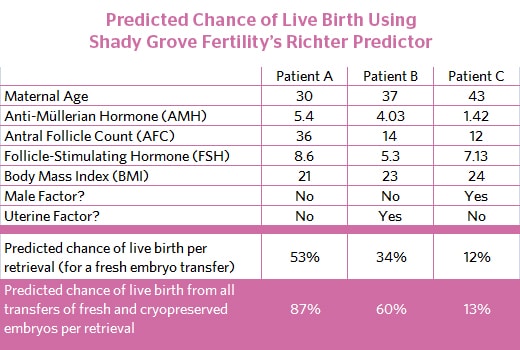
Many years ago, Shady Grove Fertility created its own predictor instrument, which is commonly known as the “Richter Predictor.” Named after Dr. Kevin Richter, Shady Grove Fertility’s Chief Statistician and Director of Research, the Richter Predictor is a more accurate predictor of success for SGF patients, specifically, not only because it leverages our own outcomes to determine probability, it also incorporates more clinically relevant parameters, such as:

  • antral follicle count
  • levels of anti-Müllerian hormone (AMH) and follicle-stimulating hormone (FSH)
  • the presence or absence of uterine and sperm abnormalities

Shady Grove Fertility’s research team used a few different patient populations for various components of our prediction models. Altogether, we based our modeling on analysis of nearly 15,000 treatment cycles from nearly 10,000 patients since 2009. Unlike the SART Patient Predictor, Shady Grove Fertility’s model also includes predictions of the likelihood of having good quality surplus embryos available for vitrification and subsequent frozen embryo transfer (FET), and the potential increase in live birth rates per egg retrieval that could be achieved by using these vitrified embryos.

For many patients seeking infertility therapy, it is now possible to predict with a high degree of probability a live birth after treatment with ART. When using other low-tech treatments such as ovulation induction or intrauterine insemination (IUI), it is reasonable to estimate that the probability of a live birth after one treatment cycle is between a fourth to a fifth of that of an ART treatment cycle.

Richter Predictor Offers Tremendous Value and Insight to Patients Faced with Difficult Decisions

This tool provides outstanding value to our patients. Navigating through the many decisions patients have to make along their journey can be challenging. It’s our philosophy to not only inform our patients but to also take an active role and strong, encouraging voice to help them navigate better in a pretty uncertain place.

We’ve invested tremendous resources to help patients feel more confident in their decision making and increase their baseline knowledge. In fact, Shady Grove Fertility is one of the few fertility centers in the country to employ a full-time dedicated research staff, under the leadership of Dr. Richter. As part of our ongoing commitment to excellence in patient care, we continuously analyze our statistics and devote significant resources in order to stay at the forefront on research to make sure our success rates are the best they can be.

  • Learn why SGF invests in research and how this benefits patients
  • SGF gives back to the research community through its published works

We encourage our patients to have a conversation with their physician about their own success probability. No prediction method can offer a guarantee, and conditions—especially female age if she’s using her own eggs—affect outcomes significantly. The advantage to patients at Shady Grove Fertility is, because of our vast experience having performed more than 65,000 ART treatment cycles (fresh autologous IVF, donor egg, FET) since our practice began in 1991, we can fine tune and personalize the treatment protocol with amazing precision to maximize effectiveness. It is advisable for each fertility center to assess their success rates the way that Dr. Richter has done to more accurately estimate the probability of success.

If you would like to learn more about Shady Grove Fertility or are ready to schedule an appointment, please speak with one of our New Patient Liaisons at 877-971-7755.

Filed Under: Diagnosing Infertility Tagged With: Causes of infertility, Unexplained infertility

  • « Go to Previous Page
  • Page 1
  • Interim pages omitted …
  • Page 9
  • Page 10
  • Page 11
  • Page 12
  • Page 13
  • Interim pages omitted …
  • Page 21
  • Go to Next Page »

Company

  • About SGF
  • About US Fertility
  • Our Doctors
  • Fertility Equity
  • Careers
  • Newsroom
  • SGF College Scholarship
  • Contact Us
  • Voice Your Feedback

Treatments

  • Egg Freezing
  • Intrauterine Insemination (IUI)
  • In Vitro Fertilization (IVF)
  • Frozen Embryo Transfer (FET)
  • LGBTQIA+ Family Building
  • Shared Risk 100% Refund Program
  • All Treatments

Resources

  • Patient Portal
  • Online Bill Pay
  • Library
  • Support Groups & Events

Locations

  • California
  • Colorado
  • Delaware
  • Florida
  • Georgia
  • Maryland
  • North Carolina
  • Pennsylvania
  • Texas
  • Virginia
  • Washington, D.C.

2026 Shady Grove Fertility

  • Policies & Notices
Also of interest
  • In Vitro Fertilization IVF
  • Fertility Tests
  • Research Publications