• Skip to primary navigation
  • Skip to main content
  • Skip to footer
Shady Grove Fertility
  • Become an Egg Donor
  • Referring Physicians
  • 1-888-761-1967
  • Schedule Appointment
  • Get Started
        • Get Started
          • Causes of Infertility
          • Fertility Tests
          • When to Seek Help
          • Find a Doctor
          • Preconception and prenatal vitamins 
          • Schedule an Appointment
        • Personalized Care For
          • Single Parents
          • LGBTQIA+ Family Building
          • People with Cancer
          • Known Genetic Diseases
          • Egg Donors
  • Treatments
        • Fertility
          • Timed Intercourse
          • Ovulation Induction
          • Intrauterine Insemination (IUI)
          • In Vitro Fertilization (IVF)
          • Frozen Embryo Transfer (FET)
        • Donation & Surrogacy
          • Donor Sperm
          • Donor Egg
          • Donor Embryo
          • Gestational Carrier
          • LGBTQIA+ Family Building
          • Single Parents
          • Find a Donor
        • More Treatments
          • Center for Male Fertility
          • Egg Freezing
          • OncoFertility
          • Preimplantation Genetic Testing
          • MIGS
          • All Fertility Treatments
  • Resources
    • Resource Library
    • Events Calendar
    • Patient Stories
    • Mental Health
    • Wellness Center
  • Insurance & Savings
    • Insurance & Benefits
    • Shared Risk 100% Refund Program
    • 100% Refund for Donor Egg
    • Discounts
    • Egg Freezing Costs
    • Financing & Grants
    • Clinical Trials
  • About
    • Find a Doctor
    • About SGF
    • Our Care Team
    • Advanced Practice Providers
    • Fertility Equity
    • Philanthropy
    • Newsroom
    • Careers
    • Contact Us
    • Voice Your Feedback
  • Locations
        • Find a Location
        • California
        • Colorado
        • Delaware
        • Florida
        • Georgia
        • Maryland
        • North Carolina
        • Pennsylvania
        • Texas
        • Virginia
        • Washington, D.C.
        • Chile
        • International & Out of State
        • SGF at Walter Reed National Military Medical Center
  • Patient Hub
    • Online Bill Pay
    • Patient Forms
    • Patient Portal
  • Call your care team
  • Become an egg donor
  • Referring physicians
  • search-icon
  • Schedule appointment 1-888-761-1967

Home / Donor egg / Page 3

Donor egg

October 26, 2017 by Shady Grove Fertility

When Cosmopolitan.com wanted to answer commonly asked questions about donor egg treatment, they looked to the experts, SGF’s own Kate Devine, M.D. and Michele Purcell, R.N.

SGF is the leading egg donation program in the country and our transparency with potential egg donors has garnered national attention. Our program works to attract women who are healthy, informed, altruistic, and dedicated.

What does SGF look for when screening potential egg donors?

SGF looks for all types of healthy women. While there is no “perfect” type of donor, each donor who applies is given equal consideration during evaluation and prescreening. By completing an Egg Donor Profile, the overall goal is to help people who need a donated egg to build a healthy family. SGF has a team of Donor Liaisons dedicated to evaluating potential donors and determining if they are the best candidate for donation.

There are basic criteria women need to meet in order to donate to protect her own health and adhere to the guidelines set forth by the FDA and American Society for Reproductive Medicine (ASRM) for egg donation; such as body mass index (BMI), recent travel, or sexually transmitted infection (STI) history. SGF’s program does allow for women to be deferred and re-apply when their BMI is within the accepted range. Similarly, women can re-apply if it’s been a year or more since their STI was successfully treated. We know that potential donor egg recipients want a healthy donor and we work to make sure all of our donors follow a healthy lifestyle before proceeding.

Is it all about the money?

No. While SGF does offer a generous compensation package for women who choose to donate their eggs, Dr. Devine said, “Appropriate compensation for eggs donors should be based on the local cost of living and should cover her lost wages, mileage, parking, and other expenses.” At SGF we are transparent about the time commitment associated with egg donation. We know that our donors’ time is valuable and we make sure to compensate them for all of their time with us as an egg donor. We have found that most of our donors do it for more than money. Michele Purcell said, “It’s kind of like when you go and donate blood and you leave thinking, ‘That feels really good. I hope someone was able to use it, and benefit from it,’ and I think our donors have that same type of feeling of being grateful for the experience.” Dr. Devine agreed, “The money helps, but the altruism is the driving factor.”

Why is prescreening important for donor egg treatment?

All egg donors in our program undergo an intensive prescreening process before being fully accepted into the program. From the very beginning of the egg donation process at SGF, egg donors are our patients too. Women go through a medical and psychological screening to help determine their eligibility to donate. Medically, we look for healthy ovaries and hormone levels. Psychologically, we want to check in and make sure donors understand how their generosity makes a tremendous impact on both their life and that of the recipients. Dr. Devine explained that the screening process for an egg donor is usually mutually beneficial. “This [info] may serve that egg donor very well, whether or not she’s ultimately accepted to donate her eggs, because she gets information on her own fertility and reproduction that she otherwise might not have.”

Why wouldn’t a possible donor be accepted to donate their eggs?

It’s important to keep in mind the requirements for egg donors are incredibly strict and not every woman applying will qualify to donate. SGF has a 3 to 4% acceptance rate for our program. Michele Purcell says that prospective donors may not meet the age requirements for donation, or sometimes they don’t live locally enough (a person from California applying for an East Coast based fertility clinic), or perhaps BMI requirements have not been met.

Learn more about SGF’s pre-screened egg donors and how donor egg treatment makes parenthood possible.

Schedule an Appointment

 To learn more about donor egg treatment or to schedule an appointment with one of our physicians, please contact our New Patient Center at 1-877-971-7755 or complete our brief online form.

Filed Under: Treatment Tagged With: Donor egg

October 4, 2017 by Shady Grove Fertility

For women who need donor egg treatment, our new portal offers enhanced search features of prescreened, ready-to-donate donors and a new reservation system that make finding a donor a simpler process. For our unidentified egg donors, our new state-of-the-art portal offers easier, faster prequalification in a mobile-friendly secure environment.

New SGF Portal Benefits Egg Donors

For egg donors, enhancements include a quick, online pre-application that sends immediate notification if you are prequalified to donate. In addition, we have streamlined and simplified the prescreening process thereby reducing the amount of time to donate—meaning donors are often matched quickly with recipients. This is especially important for women who donate more than once, which comprises 65 percent of donors here at SGF. “Most women who donate do so for altruistic reasons. This helps fulfill that desire faster,” says Michele Purcell, MHA, RN, Director of SGF’s Donor Egg Program.

New SGF Portal Benefits Those Who Need Donor Egg to Conceive

For those who need donor eggs to conceive, the new portal offers many cutting-edge features that make sorting through the finest details of our prescreened donors to match characteristics and find the right donor easier. Recipients can also search through personal and family medical history, genetic disease history, educational background, and personal interests. Essays are available to provide unique insight into the motivation and personality of each donor. Each donor provides childhood photos and many have consented to sharing their current adult photographs.

“It used to be you had to anxiously await a response once you’d found your perfect donor. Now recipients can scroll in real time 24/7 on any mobile device, choose a donor, and know that she’s confirmed,” adds Purcell.

“We are excited to launch this new platform and believe it’s the best in class for our egg donors and our recipients,” says Michael J. Levy, M.D., SGF Co-Founder. “People come to us from all over the United States, the UK, Canada, and 35 countries around the world. We believe they value our unique donor egg sharing program combined with a 100% treatment guarantee that they will take home a baby or receive their money back. These solutions help ease the financial burden associated with donor egg treatment,” adds Levy.

The launch of this new platform enables us to stay ahead of the increasing volume the practice has seen in its egg donor program. Last year alone, we performed close to 1,000 donor egg treatment cycles, with 85 percent of the women who need an egg donor selecting a donor who was recruited and carefully screened by our very own clinical team.

Before a donor is ever added to our database, she must undergo our stringent medical, genetic, and psychological screening. This new database will allow for a swifter screening process, which means more qualified donors becoming readily available to our recipients,” adds Dr. Levy.

For donor egg recipients who elect our signature Shared Donor Egg Program, which offers tremendous advantage by way of cost savings, access to a larger pool of donors and a significant reduction in wait time to select a donor, and a more efficient use of the eggs so the recipient doesn’t end up with many used embryos—not to mention similar success rates as those seen among recipients who do not share a donor—our new portal now provides 24/7 updates regarding how many other donor matches are needed for match completion.

o learn more about eligibility to become an egg donor or how SGF compensates donors for their time and effort, or to learn more about SGF’s Donor Egg Treatment Program, call and speak with a Patient Liaison or submit this brief online form.

Filed Under: About SGF Tagged With: Donor egg

June 1, 2017 by Shady Grove Fertility

For many patients, the most daunting part of donor egg treatment is selecting a donor. While it can be a complex and emotional task, it can also be an exciting time. Here at SGF we encourage you to look at choosing your donor to be an opportunity.

What gift do you want to give your child?

Gilbert Mottla, M.D., of SGF’s Annapolis, MD and Rockville, MD offices, has a truly wonderful take on choosing an egg donor. He says, “Choosing an egg donor is a truly unique life opportunity. You as the recipient have the chance to potentially give your child a gift that you may have not been able to give otherwise. Most couples look for a donor with similar physical characteristics, but there may be opportunity to pass along aptitudes or abilities possessed by your donor. If you are athletically challenged or math challenged, you have the ability to choose a donor that may have those attributes in their DNA. Choose an engineer, choose an athlete, choose a musician. Try to find that gift you want to give your child and your choice of donors may just do that. ”

All our egg donors are required to write essays about themselves so that you, as the recipient, can truly understand their identity. Our Donor Recruitment Specialist, Joanna, always tells potential donors to
“Be your most authentic self when writing your essays. You never know if a recipient is looking for someone who can juggle, likes mint chocolate chip ice cream, makes pottery, or enjoys a good mystery novel. This is the best time for you to express yourself and allow the recipients to get to know you.”

Quality Egg Donors

Due to our excellent reputation and high standards, Shady Grove Fertility has nearly 16,000 applicants each year but only 3 percent of women pass our screening to become an egg donor. Our egg donors are required to complete two written applications where they provide details about their education, careers, goals, and family history before advancing to medical screening. “We look carefully at a prospective donor’s medical history, family history, ovarian reserve, drug screening, infectious disease testing, autosomal recessive gene testing (a panel of 100 tests), and psychological screening—via an individual professional counseling session as well as with an objective mental health instrument, the Minnesota Multiphasic Personality Inventory (MMPI). In return, we encourage our recipients to be equally selective about the donor that they are comfortable with. There is no pressure on them to pick a donor,” explains Michael J. Levy, M.D., of SGF’s Rockville, MD office .

At the heart of our program is the desire to help you to build your family, and we will be with you every step of the way. Finding a donor doesn’t have to be an intimidating experience. It’s a chance to give your child a truly special gift.

Schedule an Appointment

To learn more about donor egg treatment or to schedule an appointment with one of our physicians, please contact our New Patient Center at 1-877-971-7755 or complete our brief online form. 
At Shady Grove Fertility, we’re here to give you the caring support you deserve as you start or grow your family. As a leading fertility and IVF center of excellence, we offer patients individualized care, innovative financial options, over 30 accepted insurance plans, and pregnancy rates among the highest of all national centers. We offer patients the convenience of 19 full-service and 6 satellite locations across Maryland, Pennsylvania, Virginia, and Washington, D.C. More than 1,700 physicians choose Shady Grove Fertility to refer their patients, and more than 96 percent of our patients say they would recommend Shady Grove Fertility’s 35+ physicians to a friend. With 10 Shady Grove Fertility babies born each day, your dream of starting or growing your family are within reach.

Filed Under: Treatment Tagged With: Donor egg

May 12, 2016 by Shady Grove Fertility

Last week, pop star Janet Jackson announced she was pregnant for the first time . While news of any celebrity baby seems to be cause for headlines these days, Jackson’s was especially noteworthy because she is just weeks away from her 50th birthday. When celebrities make announcements like this, the general public often wonders how possible is pregnancy after 40. On Friday, May 6th, reproductive endocrinologist Kate Devine, M.D. from Shady Grove Fertility’s Washington, D.C. – K Street office explained it all on ABC7 – WJLA Good Morning Washington.

  • Watch Dr. Kate Devine on Good Morning Washington

Conception and Pregnancy After 40

Women have never had more opportunities than they do today. But can they really have it all? When it comes to family planning, it is important to understand your own biology. According to the American Society for Reproductive Medicine (ASRM), a woman’s natural rate of conception at 40 is just 5 percent per month.1 Typically, by the time a woman gets to about 35 her egg quality and quantity will diminish until she reaches menopause. These natural changes not only make it more difficult for women to conceive using their own eggs but these changes also cause an increased likelihood of miscarriage and genetic abnormalities.

Shady Grove Fertility provides patients with treatment options; including in vitro fertilization (IVF) with either a woman’s own eggs or donor eggs, as well as elective egg freezing—all options that make it possible for women who are beyond their peak reproductive years to have a child later in life.

Benefits of Donor Egg Treatment

In the case of a woman in her late-40s, like Janet Jackson, “No one can say for certain why and how Janet Jackson became pregnant, that said, the most likely explanation is that she used a donor’s eggs, the eggs of a younger woman,” explains Dr. Devine. This process of using donor egg is the same IVF procedure except the egg is from a young, healthy, often anonymous, egg donor. Donor egg treatment is “a safe, wonderful opportunity for women to start families later in life.”

Exploring the Possibility of Egg Freezing

It’s certainly possible that Janet Jackson used frozen eggs of her own but 20 years ago, while still in her 30s; however, the advanced egg freezing technology used today did not exist. Since 2012, vitrification, or “flash freezing,” better preserved the integrity of a woman’s eggs during the freezing process, ultimately leading to greater chances of pregnancy from those eggs. Egg freezing can essentially suspend a woman’s fertility potential before it starts to decline until a point in time when she is ready to have a baby.

When to See a Specialist

For women who are currently trying to conceive, it is recommended to speak with a reproductive endocrinologist if you are:

  • Younger than 35, after trying to conceive for 1 year
  • Ages 35 to 39, after trying to conceive for 6 months
  • Age 40 or older, right away

Indicators that you should see a specialist sooner include:

  • Endometriosis
  • Irregular or no periods
  • Recurrent pregnancy loss (two or more consecutive miscarriages)
  • Family history of early menopause
  • Male partner had abnormal semen analysis results

For women interested in preserving her eggs, a reproductive endocrinologist will be able to quickly assess if you are a good candidate for egg freezing with a few simple tests. Egg freezing is most often recommended for women who:

  • Are ages 30 to 40
  • Have endometriosis
  • Have a family history of early menopause
  • Have been recently diagnosed with cancer

To learn more about pregnancy after 40, the benefits of egg freezing, or fertility treatment success rates, call our new patient center at 977-971-7755 to schedule an appointment.


References:

  1. American Society for Reproductive Medicine. 2012. Age and Fertility: A Guide for Patients. Retrieved May 11, 2016. https://www.asrm.org/uploadedFiles/ASRM_Content/Resources/Patient_Resources/Fact_Sheets_and_Info_Booklets/agefertility.pdf

Filed Under: Treatment Tagged With: Donor egg, Egg freezing

November 13, 2015 by Shady Grove Fertility

Last week ABC News’ Nightline addressed the sensitive topic of donor egg treatment. Cameras followed a woman through the donation process, interviewed another who operates an egg donation agency, and spoke to a third woman in her late 40s who successfully used donor egg to conceive her twins. Donor egg treatment, which involves eggs from one woman being inseminated and transferred into another woman who has been unable to conceive using her own eggs, is one of the most successful fertility treatments available. While patients using this treatment find comfort in the hope of having a baby from the high success rates, there is a lot to consider, including a higher cost compared with other fertility treatment options.

The American Society for Reproductive Medicine (ASRM), the governing body for reproductive medicine standards and protocols, has issued strict guidelines regarding donor egg treatment that are designed to protect the health and safety of both the egg donor and recipient. Specifically, the ASRM has published guidelines that speak specifically to egg donor compensation, screening, and how many times a woman can donate her eggs.

Who Needs Donor Eggs

Women require donor egg treatment for a variety of reasons: advanced age, premature ovarian failure, genetic abnormalities, and lowered ovarian function. For the vast majority of these patients, donor egg is the last opportunity to carry a child to term. While maternal age is the leading indicator of a couple’s ability to conceive, many may assume those needing donor eggs are only women in their late-40s and older; however, the reality is that women of all ages may have non-age related conditions that have lowered their ability to conceive with their own eggs. In addition to this subset of women, same sex male couples who are looking to build a family will need to work with both an egg donor and gestational carrier.

Typically, women over 40 have a less than 5 percent chance of conceiving naturally each month, while the  (American Society of Reproductive Medicine, 2012) average fertile 30-year-old women has a 20 percent chance each month. With donor egg treatment at Shady Grove Fertility, the chance of conception is 60 percent per embryo transfer, regardless of the age of the patient.

The Cost of Using Donor Egg Treatment

While the higher success rates are attractive to many patients, the traditionally higher price tag associated with treatment can prevent some from accessing the care they need to conceive. As discussed in the Nightline story, one of the major factors influencing the cost of treatment is the compensation to the egg donor for her time. In addition, egg donor recipients are not only paying for their own treatment cycle, but also the treatment of their egg donor.

To help limit the cost for recipients using donor egg treatment, Shady Grove Fertility offers several financial programs, including our signature Shared Risk 100% Refund Program. This exclusive program provides patients with the opportunity to pay a fixed amount for up to six fresh IVF or donor egg cycles and any subsequent frozen embryo transfers (FETs). In the event the patient does not take home a baby, SGF provides a full refund (exclusions may apply). A patient may also pair the Shared Risk 100% Refund Program with the Shared Donor Egg Program where recipients split the cost of using an egg donor by sharing her eggs among up to three recipients.

Compensation Guidelines for Egg Donors

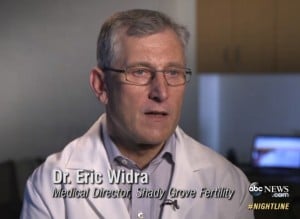
Eric A. Widra, M.D. discussing the importance of the ASRM guidelines.

As shared on Nightline, donor compensation can vary greatly. In order to protect young women from being coerced into egg donation, ASRM has developed strict guidelines for donor compensation. It is made clear that donors are compensated for their time and efforts, not for their eggs. In addition, donors are limited to donating their eggs just six times in a lifetime. Most fertility practices across the country follow these guidelines when compensating egg donors. However, some organizations and agencies go against these guidelines and offer lower or higher compensation to egg donors, and some accept donors who have donated more than 6 times. While the compensation may be enticing to some donors, there are many other factors to consider when selecting where to donate eggs including: the medical care provided throughout the donation process and the wait time to be selected as a donor.

The Egg Donation Program at Shady Grove Fertility is an anonymous egg donation program where donors undergo medical, psychological, and rigorous genetic screening. Many donors at Shady Grove Fertility are already mothers themselves and want to help women who are unable to use their own eggs. Each donor is limited to the amount of times she is permitted to undergo the donation process to minimize her health risks. Shady Grove Fertility donors receive financial compensation in line with the ASRM guidelines in all cases. Dr. Eric Widra, Shady Grove Fertility’s Medical Director, explained the reason on Nightline:

We worry that we are exposing them [the donors] to risk just because the price is right. And we worry that creates additional incentives to be untruthful about their history or unrealistic about their expectations going through treatment.

Addressing the Psychological Aspects of Donor Egg Treatment

The process of using donor egg treatment and being a donor can be psychologically taxing. Therefore, at Shady Grove Fertility, one of the most crucial roles is that of the social worker/psychologist who will work with both women (the recipient and donor) from the first consultation through the beginning stages of pregnancy.

For almost every couple the road to parenthood takes many twists and turns. Most begin the process without any knowledge of donor egg treatment. It’s important for both donors and recipients to look beyond the headlines in this sensitive topic to see how egg donation is helping so many build their families. According to what donor egg recipient, Michelle Badder told ABC Nightline, using egg donor gave her the dream of becoming a mom:I’m a mom. Finally a mom. Like, it happened. I am going to say, that’s my son.

That’s my daughter. Somebody is going to call me mom… [And] if I could help somebody out their story or be comfortable with their situation then I want to help that. It [donor egg] doesn’t need to be taboo.

ABC Breaking News | Latest News Videos

To become an egg donor at Shady Grove Fertility, please fill out the initial application  or call (888) 312-4499 for more information.

If you would like to learn more about donor egg treatment or schedule an appointment with a fertility specialist, please speak with one of our New Patient Liaisons at 877-971-7755. 

Source: American Society of Reproductive Medicine. (2012). Age and Fertility: a Guide for Patients. Retrieved from ASRM : Age and Fertility: A Guide for Patients 

Filed Under: Treatment Tagged With: Donor egg

August 6, 2015 by Shady Grove Fertility

With over 1,000 initiated fresh and frozen donor egg cycles, Shady Grove Fertility’s Donor Egg Program continues to grow and produce the highest success rates for patients of all treatment types. While many patients may not need donor egg treatment, if you are considering it, it’s important to understand the success rates and their impact on your fertility treatment. Read the FAQs about our Donor Egg Program.

What is the difference between IVF and donor egg treatment?

While both in vitro fertilization (IVF) and donor egg treatment are very similar and use the same medical processes, the source of the eggs used is the differentiating factor between the two treatments. Generally, when a patient undergoes IVF treatment, the intent is to use her own eggs—this is known as autologous IVF. For others, especially women whose infertility is caused by a decrease in ovarian reserve and function, using eggs that another woman donated is an effective form of treatment. Decreased ovarian reserve is a problem that can occur at any age, but is much more common in women in their late 30s and 40s. Fortunately, for women unable to conceive using their own eggs, donor egg treatment offers the highest pregnancy and delivery rates of any fertility treatment and still allows the woman to carry a child.

How do donor egg treatment success rates compare to IVF success rates?

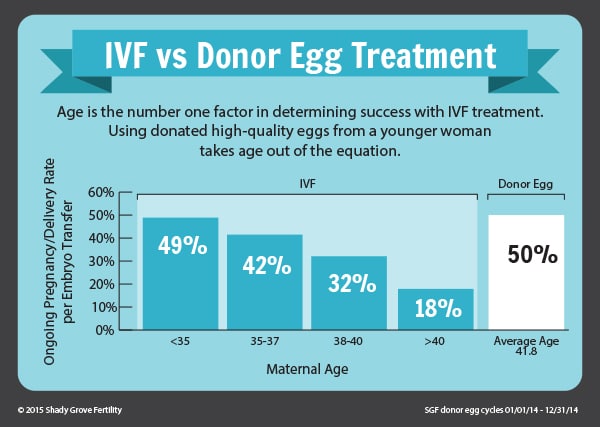
Depending on your age, the difference in success between autologous IVF and IVF using donated eggs can be significant. The chart below shows the ongoing pregnancy per embryo transfer (ET) rate by age (this is a pregnancy reaching 20 weeks gestation or delivery). It is typical to see a continual decrease in ongoing pregnancy as a woman ages.

Using donor eggs from an egg donor (ages 21 to 32) takes your age essentially out of the equation and increases your chances of success. As a result, in 2014, women late in their reproductive years (older than 40 years) experienced a 50 percent ongoing pregnancy per embryo transfer rate versus an 18 percent success rate when using their own eggs.

What is Shady Grove Fertility’s exclusive Shared Donor Egg Program and how does it impact my chances of getting pregnant?

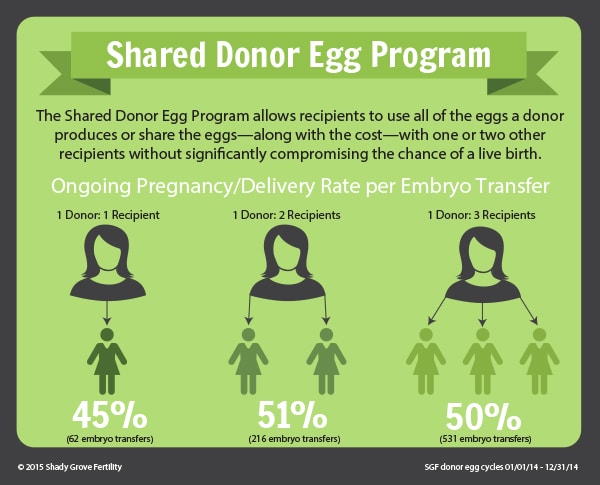
Shady Grove Fertility’s Shared Donor Egg Program significantly increases the number of patients that are able to access donor egg treatment by reducing the cost of treatment by nearly 50 percent for patients who participate in the 1:3 program. After reviewing traditional donor egg treatment cycles—in which one donor donated her eggs to one recipient—the data demonstrated that donors developed more mature eggs than one recipient would ever be able to use. With donors producing 18 eggs on average, we recognized that recipients could share the eggs from a single donor—this program changed the playing field and made conception with donor egg treatment affordable for many more of our patients.

With the Shared Donor Egg Program, recipients can opt to share the eggs a donor produces, as well as the cost with one or two other couples.

One of the many questions patients considering the Shared Donor Egg program have is, “If I share donated eggs with another couple, will it decrease my chances of taking home a baby?” We assure our patients that success rates for this program remain very similar with traditional donor egg treatment.

How does Shady Grove Fertility’s Shared RISK 100% Risk 100% Refund Program work with donor egg treatment?

Unfortunately, many insurance companies do not cover the cost of this expensive, yet highly successful, treatment option. To help ease the financial burden for patients, our Shared Risk 100% Refund Program allows the patient to undergo up to 6 cycles of donor egg treatment as well as any subsequent frozen embryo transfer (FET) cycles. Should you not deliver a baby or you opt to leave the program which you can do at any point, we will issue a 100 percent refund (some exclusions apply). You may combine the Shared Risk 100% Refund Program with the Shared Donor Egg Program for additional savings. For those patients actively serving in the U.S. military, the Shady Grove Fertility Military Discount can also be used for greater savings.

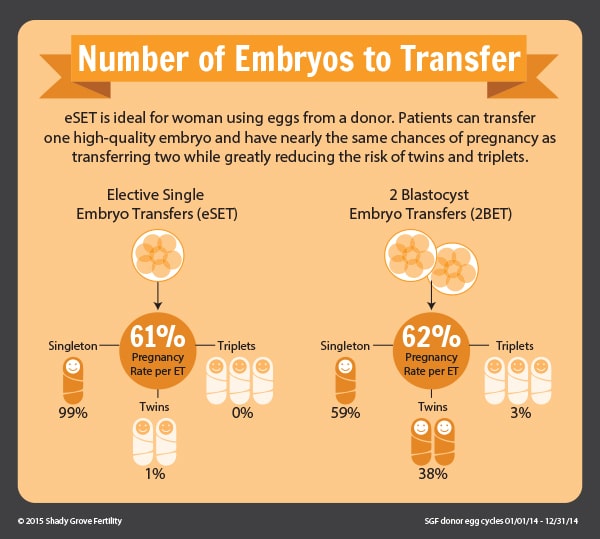
How many embryos should I transfer? Will transferring two or more increase my chances of taking home a baby?

Shady Grove Fertility’s Donor Egg Program requires donors to be between the ages of 21 and 32, a population that experiences the highest pregnancy and live birth rates. For many women using donated eggs, our physicians will recommend transferring a single blastocyst-stage embryo, also called elective single embryo transfer (eSET). This is in contrast, perhaps, to transferring two or more embryos that may have been typical for women over 36 years of age when using their own eggs. Deciding to transfer only one embryo may feel very risky, however, because recipients are using high-quality eggs from a younger donor, the data has shown that transferring more than one high-quality embryo increases the chance of high-risk multiples, and only has a slight increase in pregnancy rates.

Deciding to move to donor egg treatment may not be easy. However, we encourage you to consider this treatment approach from all angles and take into consideration the high success rates as part of your decision-making process. Being well informed will help you make the decision that is right for you.

  • View Shady Grove Fertility’s complete donor egg success rates, including the use of frozen donor eggs and a gestational carrier.

To learn more about Shady Grove Fertility’s Donor Egg Program or to schedule a new patient appointment, please call our New Patient Center at 877-971-7755.

Filed Under: Treatment Tagged With: Donor egg

  • « Go to Previous Page
  • Page 1
  • Page 2
  • Page 3
  • Page 4
  • Page 5
  • Interim pages omitted …
  • Page 9
  • Go to Next Page »

Company

  • About SGF
  • About US Fertility
  • Our Doctors
  • Fertility Equity
  • Careers
  • Newsroom
  • SGF College Scholarship
  • Contact Us
  • Voice Your Feedback

Treatments

  • Egg Freezing
  • Intrauterine Insemination (IUI)
  • In Vitro Fertilization (IVF)
  • Frozen Embryo Transfer (FET)
  • LGBTQIA+ Family Building
  • Shared Risk 100% Refund Program
  • All Treatments

Resources

  • Patient Portal
  • Online Bill Pay
  • Library
  • Support Groups & Events

Locations

  • California
  • Colorado
  • Delaware
  • Florida
  • Georgia
  • Maryland
  • North Carolina
  • Pennsylvania
  • Texas
  • Virginia
  • Washington, D.C.

2026 Shady Grove Fertility

  • Policies & Notices
Also of interest
  • In Vitro Fertilization IVF
  • Fertility Tests
  • Research Publications