• Skip to primary navigation
  • Skip to main content
  • Skip to footer
Shady Grove Fertility
  • Become an Egg Donor
  • Referring Physicians
  • 1-888-761-1967
  • Schedule Appointment
  • Get Started
        • Get Started
          • Causes of Infertility
          • Fertility Tests
          • When to Seek Help
          • Find a Doctor
          • Preconception and prenatal vitamins 
          • Schedule an Appointment
        • Personalized Care For
          • Single Parents
          • LGBTQIA+ Family Building
          • People with Cancer
          • Known Genetic Diseases
          • Egg Donors
  • Treatments
        • Fertility
          • Timed Intercourse
          • Ovulation Induction
          • Intrauterine Insemination (IUI)
          • In Vitro Fertilization (IVF)
          • Frozen Embryo Transfer (FET)
        • Donation & Surrogacy
          • Donor Sperm
          • Donor Egg
          • Donor Embryo
          • Gestational Carrier
          • LGBTQIA+ Family Building
          • Single Parents
          • Find a Donor
        • More Treatments
          • Center for Male Fertility
          • Egg Freezing
          • OncoFertility
          • Preimplantation Genetic Testing
          • MIGS
          • All Fertility Treatments
  • Resources
    • Resource Library
    • Events Calendar
    • Patient Stories
    • Mental Health
    • Wellness Center
  • Insurance & Savings
    • Insurance & Benefits
    • Shared Risk 100% Refund Program
    • 100% Refund for Donor Egg
    • Discounts
    • Egg Freezing Costs
    • Financing & Grants
    • Clinical Trials
  • About
    • Find a Doctor
    • About SGF
    • Our Care Team
    • Advanced Practice Providers
    • Fertility Equity
    • Philanthropy
    • Newsroom
    • Careers
    • Contact Us
    • Voice Your Feedback
  • Locations
        • Find a Location
        • California
        • Colorado
        • Delaware
        • Florida
        • Georgia
        • Maryland
        • North Carolina
        • Pennsylvania
        • Texas
        • Virginia
        • Washington, D.C.
        • Chile
        • International & Out of State
        • SGF at Walter Reed National Military Medical Center
  • Patient Hub
    • Online Bill Pay
    • Patient Forms
    • Patient Portal
  • Call your care team
  • Become an egg donor
  • Referring physicians
  • search-icon
  • Schedule appointment 1-888-761-1967

Home / Donor egg / Page 5

Donor egg

November 13, 2013 by Shady Grove Fertility

Why More Women Are Donating Their Eggs
Real women tell Women’s Health what it was like to give their DNA to a couple in need. Shady Grove Fertility Egg Donor, Abby shares her experience with egg donation.

What is Egg Donation?

Egg donation is the process whereby a woman, after medical and psychological pre-screening, is given medications to help her develop multiple ovarian follicles, containing eggs (oocytes). Normally, a woman matures one egg a month but with medication, several follicles can be induced to grow and mature. Next, while the donor is under gentle sedation the eggs are painlessly retrieved. The eggs retrieved are then donated to a recipient. The egg donation process, beginning with an in-depth screening process, being selected by a recipient, and finishing after undergoing IVF treatment, can take anywhere from 3-6 months.

More about the egg donation process

Do We Need Egg Donors?

Donor egg is a necessary and very effective treatment when a woman’s own fertility is compromised due to poor egg quality. Shady Grove Fertility has strict standards for the women eligible to become an egg donor. “We only accept about 3% of applicants, so about 97% of women that apply are not going to qualify,” says Donor Egg & Gestation Carrier Program Manager, Michele Purcell, RN, BSN.

According to the Journal of American Medical Association, the number of egg donors has increased by about 70% from 2000 to 2010. This growth could be the result of improved IVF technologies, but it could also be the result of more women and couples needing donor egg to achieve pregnancy, increasing the demand for egg donors.

Who Are the Egg Donors, and Why Do They Donate?

Some argue that the compensation egg donors receive for their time and commitment to the program may be the influencing factor for women who choose to donate their eggs. At Shady Grove Fertility, an egg donor receives $7,000 after completing 1 cycle of donation. However, for Abby, a Shady Grove Fertility Egg Donor, donating just for compensation, was not the case.

At the age of 20, back during her college years, Abby had heard about egg donation and initially was interested in a little cash, but ultimately realized that she wouldn’t be doing it for the right reasons. According to Abby, egg donation is a decision that shouldn’t be taken lightly. She views egg donation as an enormous gift that she is lucky to give. Like many of our egg donors, Abby believes the reward of helping someone achieve the dream of starting a family outweighs the idea of undergoing a medical procedure. Now at the age of 27 and out of college, Abby has completed the egg donation process 3 times at Shady Grove Fertility.

Read the full Women’s Health article: Why More Women Are Donating Their Eggs

Women interested in becoming an egg donor, click here or please call 301-545-1316 to learn more.


Filed Under: Treatment Tagged With: Donor egg

October 15, 2013 by Shady Grove Fertility

Shady Grove Fertility, the nation’s leading fertility center, performs more IVF treatment cycles using donor egg than any fertility center in the United States. 

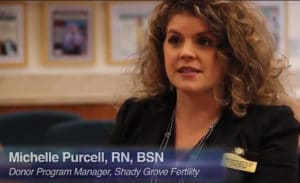
Michele Purcell, RN describes the egg donation process.

Donor egg is a necessary and very effective treatment when a woman’s own fertility is compromised due to poor egg quality. Shady Grove Fertility has strict standards for the women eligible to become an egg donor. “We only accept about 3% of applicants, so about 97% of women that apply are not going to qualify,” says Donor Egg & Gestation Carrier Program Manager, Michele Purcell, RN, BSN.

Egg donor are between 21-31 years of age, normal weight range, a non-smoker, and preferably a college student or graduates. Candidates must go through a psychological assessment as well as be tested for their potential fertility prior to being put on the donor egg database.

“It was unbelievable to hear the words ‘not only are you pregnant but this really looks like a viable pregnancy,'” said donor egg recipient, Heidi. “It was an answered prayer. We had waited so long, I didn’t believe it could really happen, and then it happened.”

“I know how much I want to have kids when I am ready, so I can’t imagine how painful it must be when you want kids so badly but you can’t,” explained a Shady Grove Fertility egg donor. “I figured it would so worth it to go through a little inconvenience on my side to help someone with something like that.”

Shady Grove Fertility’s egg donation program quality control standards, egg donor selection criteria and egg donation qualifying process, follows the strict medical guidelines as established by the Food and Drug Administration and the American Society for Reproductive Medicine.

Watch “Inside Egg Donation”

Women who are interesting in learning more about egg donation may call (888)- 312-4499 or go directly online to complete a pre-qualifying questionnaire.
If you have been trying to conceive without success and would like to learn more about donor egg or other fertility treatment options, schedule an appointment at Shady Grove Fertility,  or speak with one of our New Patient Liaisons at 877-971-7755.

Filed Under: Treatment Tagged With: Donor egg

August 22, 2013 by Shady Grove Fertility

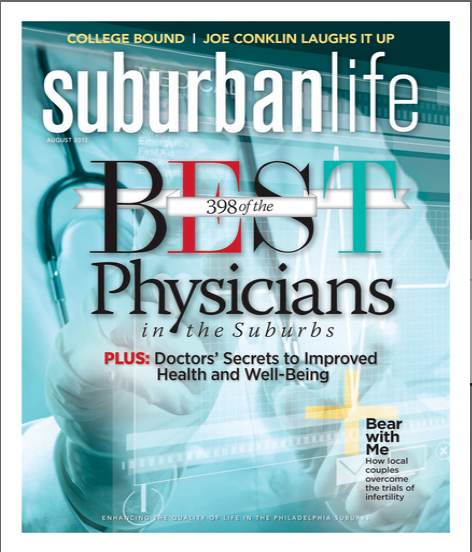
This month, Suburban Life magazine in Philadelphia, released their “Best Physicians” edition featuring an article highlighting the newest Philadelphia fertility center – Shady Grove Fertility.

  • Read the complete article from Suburban Life

Expanded Fertility Services in Philadelphia

In the year that Shady Grove Fertility has been in the Philadelphia area, it has expanded the fertility services and financial options available to the region.

The Shared Risk 100% Refund Guarantee for IVF and Donor Egg Treatment offers qualified patients 6 rounds of fresh (or stimulated) treatment as well as all the subsequent frozen embryo transfers for one flat fee. Patients will deliver a baby or receive a 100% refund – it’s that simple. More on Shared Risk >

While donor egg treatment is becoming more widely available, Shady Grove Fertility offers patients the Shared Donor Egg Program, which makes donor egg treatment more affordable. By splitting the eggs of one donor between 2 or 3 recipients, the costs of treatment can be cut in half. More on Shared Donor Egg >

Also available at the Chesterbrook IVF Center (the regional IVF and Donor Egg Center for the Philadelphia area) is the EmbryoScope. Only a dozen centers across the United States currently have access to this technology which allows the medical team to monitor embryos via video, helping them to select the strongest one for transfer. More on the EmbryoScope >

  • VIDEO from CBS3: EmbryoScope Helps Local Couples Get Pregnant

Philadelphia Fertility Center

Last summer, Shady Grove Fertility opened the doors to new offices in Pennsylvania, including Chesterbrook (Philadelphia suburb) and Reading. This year, SGF has opened another office in Bala Cynwyd, PA and expanded services in Harrisburg, PA.

Isaac E. Sasson, MD, PhD, a Yale Medical School graduate who performed his clinical fellowship for reproductive endocrinology and infertility at University of Pennsylvania, is available to see new patients at the Bala Cynwyd and Chesterbook locations.

Abraham K. Munabi, MD, a long time member of the Philadelphia fertility community, built a thriving practice prior to joining Shady Grove Fertility. Dr. Munabi is available for new patient consultations in Chesterbrook, Reading, and Harrisburg.

Also available for consultations in Harrisburg are Dr. Melissa Esposito and Dr. Jason Bromer, who also each see patients in Frederick, MD.

  • Read the complete article from Suburban Life

If you would like to schedule an appointment to discuss your fertility treatment options, please speak with one of our New Patient Liaisons at
877-985-2266.

Filed Under: Treatment Tagged With: Donor egg, Dr. Jason Bromer, In vitro fertilization (IVF), Shared Risk 100% IVF Refund Program

August 21, 2013 by Shady Grove Fertility

Dr. Ricardo Yazigi

Every month, Shady Grove Fertility hosts a series of live webcasts to discuss topics such as Getting Started at SGF, Financial Programs, and Inside the IVF Lab. Last night, Dr. Eric Levens presented information about the Donor Egg Program. Here are some of the top audience questions from the presentation.

  • View an archived Donor Egg Program Webcast

Are you able to see pictures of the donors?

Yes, recipients are able to view childhood photos of all available donors as well as their adult photographs, if consented by the donor.

For the Shared Donor Egg Program, how are the eggs divided?

In the Shared Donor Egg Program, Shady Grove Fertility will divide the eggs between all of the recipients equally. For example, if you are the tertiary position in 1:3 match, you will receive the same amount and quality of eggs as the recipients in the primary and secondary positions. It is the goal for each recipient to receive at least four mature eggs per cycle.

Does every recipient in all of the three programs (1:1, 1:2 and 1:3) view all of the same donors in the database or does it depend on the program that you select?

Once you complete your pre-screening and select your program, you will then receive an access code to review and select your donor.
Some recipients want their donor to choose their program for them. Meaning, they will view all the available donors and when they find the donor that they like, whichever program the donor is in, that will be the program that they move forward with.
Otherwise, depending on the program you select, you could be looking at different donors. I have listed the breakdown below.

  • 1:1 Program: Views all donors in all of the 1:1, 1:2 and 1:3 program with the exception of any donors that have been selected by another recipient in the Shared Donor Egg Program
  • 1:2 Program: View donors in the 1:2 and 1:3 program with the exception of the donors in the 1:3 program that have already been reserved by a recipient in the 1:3 program
  • 1:3 Program: View all of the donors in the 1:3 program

How do you prioritize recipients for their positions in the 1:2 and 1:3 programs?

The recipients are placed in their match positions based on their history at Shady Grove Fertility. For example, if the following recipients are in a 1:3 match together:

  • Patient A has done two unsuccessful donor egg cycles with Shady Grove Fertility
  • Patient B is brand new to Shady Grove Fertility
  • Patient C has done one unsuccessful IUI cycle

Therefore, in this case, Patient A would be primary, secondary would be Patient C and tertiary would be Patient B since Patient B has not done any treatment at SGF.
If you are brand new to the Practice and starting the Shared Donor Egg Program, you should prepare yourself to be in the tertiary position. Again, the eggs are divided evenly and all three recipients are provided with the same quality eggs. The only downside to being the tertiary recipient is that you would be the first recipient to be cancelled if the donor does not produce enough eggs.

  • Sign up for a webcast!

If you would like to schedule an appointment to discuss your fertility treatment options, please speak with one of our New Patient Liaisons at 877-971-7755.

Filed Under: Treatment Tagged With: Donor egg, Shared donor egg

August 16, 2013 by Shady Grove Fertility

CNN Story Recap: A family from Iowa was looking to grow their family through adoption when they heard about embryo adoption. Intrigued, they looked into the process, and found that embryo adoption would be a perfect match. Knowing that not all the embryos might result in a healthy pregnancy, the couple decided to put back two embryos. Today, the happy couple is pregnant with triplets.

What is embryo adoption?

In some cases, men and women that have gone through the IVF or donor egg process, might have unused embryos after treatment. In which case, there is a decision to make: freeze and save the embryos for future use, discard the embryos, or donate them.

Is embryo adoption really adoption?

No. In most states, adoption only refers to the placement of a child after birth. Legal agreements are established to oversee the process of embryo donation to help protect the recipient parent’s relationship with the child. However, according to Dr. Paulette Browne of Shady Grove Fertility’s Fair Oaks, VA office, “this is solely dependent on the family law and family judges in each state. This could potentially leave the intended parents unprotected if the genetic parents change their minds in the future.”

Does Shady Grove Fertility allow for embryo adoption?

SGF patients that have unused embryos are welcome to donate them if they no longer would like to store them and do not want to discard the embryos.

SGF does not accept the use of adopted embryos in our laboratories. In addition to the potential legal matters, there is significant screening necessary to use donated/adopted eggs, sperm and embryos. Often times, genetic parents won’t go through the appropriate screening because at the point in time in which the embryos were created, they themselves were the intended parents.

Egg donors and sperm donors go through extensive screening to ensure the health of any resulting child as well as the woman carrying the pregnancy.  This screening is required by law.

Would you like to learn more about embryo adoption?

If you are interested in placing your embryos for adoption, please contact the National Embryo Donation Center or Night Light’s Snowflakes® Program.

If you would like to schedule an appointment to discuss your fertility treatment options, please speak with one of our New Patient Liaisons at 877-971-7755.

Filed Under: General Tagged With: Donor egg, Donor embryo, Donor sperm, Dr. Paulette Browne, In vitro fertilization (IVF)

June 25, 2013 by Shady Grove Fertility

Shady Grove Fertility’s Donor Egg Program continues to grow and produce high success rates for patients. It is important to understand donor egg success rates and the implications it might have on your fertility treatment. Read the FAQs about our donor egg success rates.

What is the difference between the donor egg success rates and IVF success rates?

Depending on your age, the difference in success between the In Vitro Fertilization (IVF) and Donor Egg Program can be significant. In order to understand why the success rates are different it is important to understand how each treatment works.

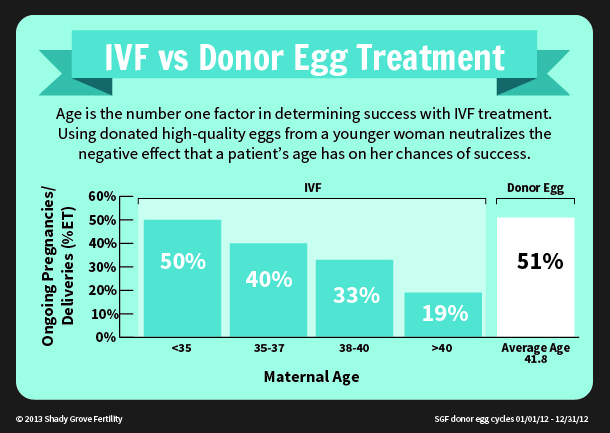
IVF uses the intended parents own eggs which are stimulated and matured through treatment. As a woman ages so do her eggs and with age we see decreased egg quality and quantity. A woman’s fertility potential decreases steadily from her mid 30s onward. The chart below shows a continual decrease in ongoing pregnancy and delivery rates after this point in a woman’s reproductive life. In 2012, a woman over the age of 40 had a 19% live birth rate with IVF treatment.

Donor egg treatment however, relies on the donated eggs from another woman between the ages of 21-32. Using the eggs from a younger woman cancels out the effect that a patient’s age has on her chances of success, explaining the overall absolute increase of 32%. Last year, women of all ages achieved a 51% live birth rate when using donor egg treatment.

What is the Shared Donor Egg Program and how does it impact my chances of getting pregnant?

Over the past 6 years, the Shared Donor Egg Program has significantly reduced the cost of donor egg treatment. Since its introduction, this program has increased the availability of donors, reduced the cost of treatment, and when paired with the Shared Risk 100% Refund Program brought an affordable guarantee of either a baby or a full refund.

After reviewing traditional donor egg treatment cycles – one donor to one recipient – the data began to show donors developed more mature eggs than one recipient would ever be able to use. With donors producing 18 eggs on average, there was recognition that recipients could share the eggs from a single donor.


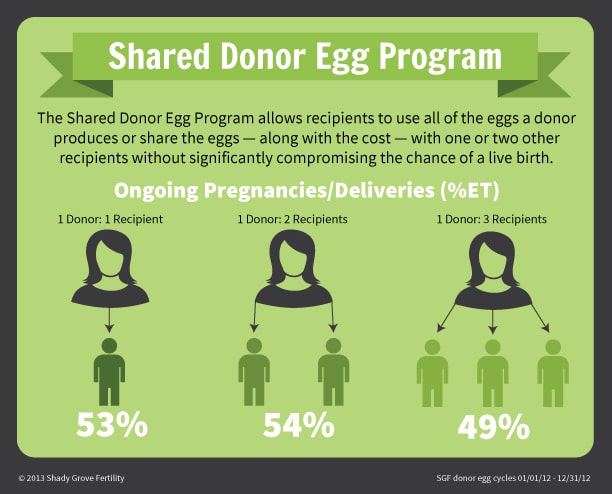
With the Shared Donor Egg Program recipients can either use all of the eggs a donor produces or share them along with significant cost savings between one or two other couples.

One of the many questions patients considering the Shared Donor Egg program have is “If I share donated eggs with another couple, will it decrease my chances of taking home a baby?” Since the start of Shared Donor Egg Program in 2007, the rate of ongoing pregnancy or delivery, whether or not you are sharing a donor’s eggs have remained very similar. This new donor egg treatment option is increasing access to fertility treatment without compromising the chances of taking home a baby

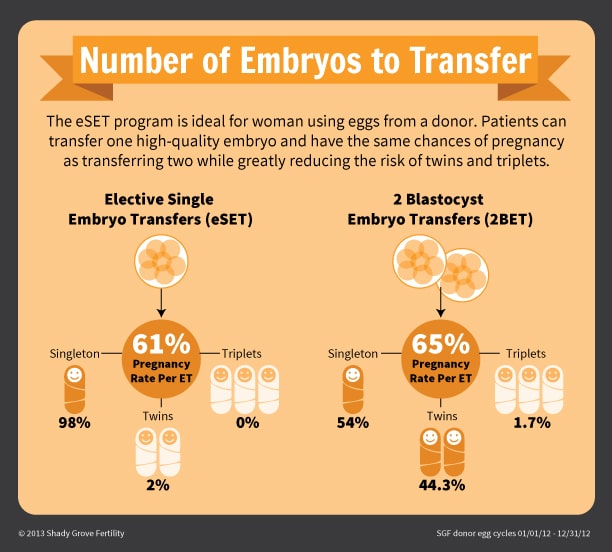
How many embryos should I transfer? Will transferring two or more increase my chances of taking home a baby?

Shady Grove Fertility’s Donor Egg Program requires donors to be between the age of 21-32. Many women using donated eggs will find their physician recommending the transfer of 1 blastocyst stage embryo, when you may be used to transferring 2, 3 or maybe even 4 when you were using your own eggs. Deciding to transfer only one may feel very conservative. For a women in her late 30’s and into her 40’s where egg quality has declined, transferring more embryos is often the best decision but since recipients are using the high quality eggs from a young donor the data has shown that transferring more than one high-quality embryo only increases the chance of high-risk multiples, and only has a slight increase in pregnancy rates.


Deciding to move to donor egg treatment is not usually an easy choice. It is important to carefully consider the psychological issues and be well aware of the increased success rates attained with egg donation. Being well informed will help you make the decision that is right for you.

  • View Shady Grove Fertility’s complete donor egg success rates, including the use of frozen donor eggs and a gestational carrier.

If you would like to learn more about donor egg and other fertility treatment options, please request a consultation or call 1-877-971-7755.

Filed Under: Treatment Tagged With: Donor egg, Shared donor egg

  • « Go to Previous Page
  • Page 1
  • Interim pages omitted …
  • Page 3
  • Page 4
  • Page 5
  • Page 6
  • Page 7
  • Interim pages omitted …
  • Page 9
  • Go to Next Page »

Company

  • About SGF
  • About US Fertility
  • Our Doctors
  • Fertility Equity
  • Careers
  • Newsroom
  • SGF College Scholarship
  • Contact Us
  • Voice Your Feedback

Treatments

  • Egg Freezing
  • Intrauterine Insemination (IUI)
  • In Vitro Fertilization (IVF)
  • Frozen Embryo Transfer (FET)
  • LGBTQIA+ Family Building
  • Shared Risk 100% Refund Program
  • All Treatments

Resources

  • Patient Portal
  • Online Bill Pay
  • Library
  • Support Groups & Events

Locations

  • California
  • Colorado
  • Delaware
  • Florida
  • Georgia
  • Maryland
  • North Carolina
  • Pennsylvania
  • Texas
  • Virginia
  • Washington, D.C.

2026 Shady Grove Fertility

  • Policies & Notices
Also of interest
  • In Vitro Fertilization IVF
  • Fertility Tests
  • Research Publications