• Skip to primary navigation
  • Skip to main content
  • Skip to footer
Shady Grove Fertility
  • Become an Egg Donor
  • Referring Physicians
  • 1-888-761-1967
  • Schedule Appointment
  • Get Started
        • Get Started
          • Causes of Infertility
          • Fertility Tests
          • When to Seek Help
          • Find a Doctor
          • Preconception and prenatal vitamins 
          • Schedule an Appointment
        • Personalized Care For
          • Single Parents
          • LGBTQIA+ Family Building
          • People with Cancer
          • Known Genetic Diseases
          • Egg Donors
  • Treatments
        • Fertility
          • Timed Intercourse
          • Ovulation Induction
          • Intrauterine Insemination (IUI)
          • In Vitro Fertilization (IVF)
          • Frozen Embryo Transfer (FET)
        • Donation & Surrogacy
          • Donor Sperm
          • Donor Egg
          • Donor Embryo
          • Gestational Carrier
          • LGBTQIA+ Family Building
          • Single Parents
          • Find a Donor
        • More Treatments
          • Center for Male Fertility
          • Egg Freezing
          • OncoFertility
          • Preimplantation Genetic Testing
          • MIGS
          • All Fertility Treatments
  • Resources
    • Resource Library
    • Events Calendar
    • Patient Stories
    • Mental Health
    • Wellness Center
  • Insurance & Savings
    • Insurance & Benefits
    • Shared Risk 100% Refund Program
    • 100% Refund for Donor Egg
    • Discounts
    • Egg Freezing Costs
    • Financing & Grants
    • Clinical Trials
  • About
    • Find a Doctor
    • About SGF
    • Our Care Team
    • Advanced Practice Providers
    • Fertility Equity
    • Philanthropy
    • Newsroom
    • Careers
    • Contact Us
    • Voice Your Feedback
  • Locations
        • Find a Location
        • California
        • Colorado
        • Delaware
        • Florida
        • Georgia
        • Maryland
        • North Carolina
        • Pennsylvania
        • Texas
        • Virginia
        • Washington, D.C.
        • Chile
        • International & Out of State
        • SGF at Walter Reed National Military Medical Center
  • Patient Hub
    • Online Bill Pay
    • Patient Forms
    • Patient Portal
  • Call your care team
  • Become an egg donor
  • Referring physicians
  • search-icon
  • Schedule appointment 1-888-761-1967

Home / About SGF / Page 9

About SGF

November 9, 2016 by Shady Grove Fertility

Shady Grove Fertility is proud to support those who have supported our country by hiring veterans. From physicians, nurses, clinical support staff, patient service representatives, and members of our business office, SGF supports the hard-working, disciplined, motivated, passionate men and women who have courageously served our country. At Shady Grove Fertility, we honor our nation’s veterans not just on Veteran’s Day, but every day.

View Open Positions at Shady Grove Fertility

Shady Grove Fertility Salutes Our Employees Who Have Served

Colleen Abell
Air Force- 3 years
Medical Assistant

Joy Aker, CRNA
Army – 10 years
Surgery Center

Vince Bogan, CRNA
Army – 23 years
Surgery Center

Jessica Buggs, RN
Air Force – 10 years
Nursing

Kim Castillo, RN
Navy – 3 years
Nursing

Natalie Camacho, RN
Navy – 6 years
Surgery Center

Wayne Caswell, CRNA
Army – 12 years
Surgery Center

Margaret Ann Connors, CRNP
Navy – 25 years
Donor Egg

Marsha DeWeese, RN
Navy – 26 years
Nursing

Heather Gaona
Army – 8 years
Laboratory

Ted Hall
Marine Corps – 3 years
Medical Asst/Surgery Center

Lou Heindel, CRNA
Navy – 30 years
Surgery Center

Chris Keary
Navy – 20 years
Rockville Office

Kristy Kunard, RN
Navy – 5 years
Nursing

Lori Martin, LPN
Air Force – 3 years
Nursing/Medical Assistant

Jeffrey McKeeby, M.D.
Navy – 14 years
Reproductive Endocrinologist

Bianca Meroe
Army – 12 years
Donor Egg Team

Rosanne Pepe, RN
Army – 8 years
Surgery Center

Kima Poindexter
Air Force Reserves – 5 years to present
Business Office

Ken Pulley, CRNA
Air Force – 34 years
Surgery Center

Gwendolyn A. (Rowe) Simmons
Army Reserves – 7 years
Business Office

Laura Stenger
Navy – 16 years
Business Office

Sherri Taylor, RN
Army – 4 years
Nursing

Asia Winger
Air Force – 4 years
Patient Services

Steven Zito, CRNA
Air Force – 8 years
Surgery Center

Jeanne Zito, RN
Air Force – 6 years
Nursing

Thank you to all of our staff for all you have done to support our country, and all that you do to support our practice and patients!

If you are a veteran and are interested in learning more about employment opportunities at Shady Grove Fertility, please click here. If you are interested in scheduling an appointment please call our New Patient Center at 1-877-971-7755 or click here. 
Filed Under: About SGF

November 8, 2016 by Shady Grove Fertility

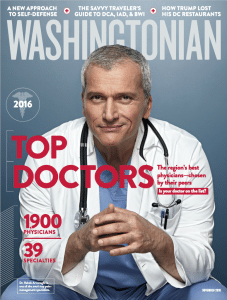
When choosing a reproductive endocrinologist in the greater Washington, D.C., Baltimore, and Philadelphia metro areas, how do you differentiate between the practice and physician? What do you look for in deciding who you can trust to help you achieve your dreams of a family? We’ve compiled 10 reasons our patients say SGF stands apart from the rest and why 10 of our physicians were named Washingtonian Top Doctors for Infertility in 2016.

1). Exceptional Fertility Care
We offer more than 300 years of combined reproductive medicine and infertility expertise. Each of our 35 physicians understand the importance of interpersonal connection and realize that trust must be earned and relationships must be nurtured. Our physicians make it a priority to understand patients’ concerns in order to tailor their approach to each patient’s unique needs.

2). Unmatched Compassion to our Patients
When skilled team members build caring, trusting, and collaborative relationships with patients, studies reveal more appropriate medical decisions, better patient adherence with treatment plans, and less costly healthcare outcomes result.

3). High Success Rates
According to the Society for Assisted Reproductive Technology (SART), our 2014 fresh IVF program resulted in more successful IVF cycles and more babies born than our next closest 20 fertility centers in the Mid-Atlantic region combined.

4). Transparent Communication
Not only do we place a high value on providing transparent information about our success, we also provide information for how best to decode and interpret success rates. Each year we publish an IVF Program Report, which highlights the practice’s in vitro fertilization (IVF) success rates as well as our center’s most notable milestones and accomplishments over the previous year.

5). 25 Years of Experience
Since we perform over 6,000 in vitro fertilization (IVF) cycles, including over 1,000 egg donation cycles, and an equal number of ovulation induction and intrauterine insemination (IUI) cycles annually, the quantity of data we can collect in a few months may take smaller centers years to gather. We view this as both a privilege and a responsibility—to make discoveries that benefit all patients struggling with infertility, not just our own.

6). State-of-the-Art Labs and Treatment Advances
Because of the remarkable advancements we made in our embryology lab and treatment protocols, we are able to help couples achieve pregnancy in less time and with more success, with pregnancies that result in healthier babies than ever before. Learn more about how innovations such as vitrification, frozen embryo transfers, and preimplantation genetic screening (PGS) are progressing reproductive technology.

7). Robust Research Program to Improve Treatment Outcomes
We are one of only a few private practice fertility centers in the country to employ a full-time dedicated research team who perform under the direction of Co-Directors of Research, Kevin S. Richter, Ph.D., in Biological Sciences, and Kate Devine, M.D., board certified reproductive endocrinologist. Our research enlightens us to refine our practices so that more patients can achieve the goal of successful pregnancy.

8). Convenient 19 Full-Service and 6 Satellite Locations
With patients coming to SGF from all 50 states and 38 countries around the world, early morning monitoring appointments, and concierge-level patient service, we are making access to world-class personalized infertility care more convenient.

9). Affordable Solutions with Financial Guarantee and Discount Programs
We offer patients a myriad of discount, guarantee, and multi-cycle treatment financial programs, as well as accept more than 30 insurance providers. Our financial counselors stand ready to help patients navigate through insurance and other financial options to more easily access the care that they need.


10). SGF Support Network
Our support networks are rich with resources and educational opportunities. Access to our SGF experts through monthly education events both online and in-person address concerns and answer questions about moving forward in your fertility journey. We encourage you to access the resources we provide to help you connect, engage, and become educated about infertility.

Congratulations to these Shady Grove Fertility

physicians who were named Washingtonian Top Docs for Infertility in 2016.

Frank E. Chang, M.D. – Rockville, MD
Michael J. Levy, M.D. – Rockville, MD
Jeanne E. O’Brien, M.D. – Rockville, MD
Arthur W. Sagoskin, M.D. – Rockville, MD
Paulette Browne, M.D. – Fair Oaks, VA
Stephen Greenhouse, M.D. – Fair Oaks, VA
Naveed Khan, M.D. – Leesburg, VA
David Saffan, M.D. – Annandale, VA
Anitha Nair, M.D. – Arlington, VA and Washington, D.C. – K Street
Eric A. Widra, M.D. – Washington, D.C .– K Street and Sibley Hospital Campus
Paul Shin – Washington, D.C .– K Street; Fair Oaks, VA; Woodbridge, VA; Frederick, MD

While all of these accolades and efforts are important they pale in comparison to the significance placed on the work each of our 35 physicians do with and for their patients every day. Our culture is different and it gives our practice a competitive advantage in that we do what’s right and we do it in all the ways it should be done.

It’s the reason we’ve had more babies born than any other fertility center in the country. It’s the reason we have a track record that can’t be disputed. It’s the reason we’ve earned the trust of so many people who look to us as thought leaders with a culture of continuous innovation, service, partnership, and community that helps make dreams a reality.

Schedule an Appointment

To learn more about Shady Grove Fertility’s exceptional fertility care or if you would like to schedule an appointment, please call our New Patient Center at 1-877-971-7755.


Filed Under: About SGF

October 20, 2016 by Shady Grove Fertility

For Shady Grove Fertility’s dedicated research team, the goal of their efforts is to improve the chances that individual couples going through fertility treatment will experience the joy of parenthood. Improved understanding of embryo growth and development and improved selection of embryos for in vitro fertilization (IVF) are central to this goal. This year, This year at the American Society of Reproductive Medicine’s 2016 Scientific Congress and Expo in Salt Lake City, October 15 to 19, the physician-scientists at Shady Grove Fertility, together with their collaborators, presented a retrospective study correlating the rate of development of 1,237 embryos with their chromosomal makeup, as assessed by embryo biopsy and pre-implantation genetic screening (PGS).

Embryo Growth Rate

During IVF, eggs are retrieved and inseminated in the laboratory by an embryologist. After fertilization occurs, the cells of the embryo divide and multiply until the blastocyst stage is reached, generally on either the fifth or sixth day of development. Historical data have shown that slower growing embryos, those that reach the blastocyst stage on the 6th day or even later, tend to be associated with poorer treatment outcomes.

Aneuploidy and Its Impact on Pregnancy

Aneuploidy is defined as an abnormal number of chromosomes. Occurring in a high proportion of embryos from women of advanced maternal age, aneuploidy accounts for many miscarriages.  Aneuploidy may also be responsible for many IVF cycles in which embryos fail to implant, and patients receive a negative pregnancy test result.

No Increased Rate of Aneuploidy Linked to Embryo Growth Rate

In this retrospective study, researchers looked at the relationship between delayed embryo development and chromosomal makeup. Physicians aimed to answer this important question: “Do embryos that are slower to reach the blastocyst stage have a higher incidence of aneuploidy?”

The study evaluated 1,237 embryos from 309 fresh autologous (non-donor egg) cycles undertaken by 267 women. On average, four embryos were biopsied from each patient and the average maternal age was 37 years.  537 biopsies were performed on Day 5 blastocysts, and 700 biopsies were performed on Day 6 blastocysts. Somewhat surprisingly, this results of this analysis were that aneuploidy rates did not differ between embryos biopsied on Day 5 versus Day 6. In other words, slower developing embryos did not have a higher rate of aneuploidy.

What This Means for Patients

These findings may provide reassurance to patients with slower developing embryos. Based on this study, embryos with a slower growth rate would not be expected to have a higher rate of chromosomal abnormalities.

About the 2016 ASRM Scientific Congress & Expo

The 2016 ASRM Scientific Congress & Expo is the premier scientific congress for reproductive medicine that will address state-of-the-art issues in reproductive medicine and science. Held from October 15 to 19, 2016, in Salt Lake City, UT, the theme of the 2016 Scientific Congress of the American Society for Reproductive Medicine is “Scaling New Heights in Reproductive Medicine.”  The program features scientific, postgraduate, and video presentations as well as plenary lectures addressing the most pressing clinical and basic-science issues in reproductive medicine.

Filed Under: About SGF Tagged With: Research program

October 20, 2016 by Shady Grove Fertility

Expanding knowledge to help more patients take home a baby is the primary motivation behind the robust research program at Shady Grove Fertility. This year at the American Society of Reproductive Medicine’s 2016 Scientific Congress and Expo in Salt Lake City, October 15 to 19, the physician-scientists at Shady Grove Fertility, together with their collaborators, presented a retrospective study looking at the relationship between a woman’s body mass index (BMI) and the chromosomal makeup of her embryos.

Chromosomally Abnormal Embryos on Treatment Outcomes

Aneuploidy is defined as an abnormal number of chromosomes and occurs more commonly in embryos from women of advanced maternal age. Chromosomal abnormalities account for a large proportion of miscarriages. Since several studies have found that obesity is also associated with an increased risk of miscarriage, researchers aimed to evaluate the relationship between obesity and aneuploidy.

Weight’s Effect on Conception and Miscarriage Rate

Physicians at Shady Grove Fertility may suggest that losing even a small amount of weight could potentially improve the chances of success among overweight women. High body mass index (BMI) has been associated with lower pregnancy and live birth rates and higher miscarriage rates. One potential explanation is the possibility of higher rates of chromosomal abnormalities (aneuploidy) among embryos from obese and overweight women. This retrospective review of data set out to answer that question “Do overweight or obese women have an increased occurrence of chromosomally abnormal embryos?”

No Increased Rate of Chromosomally Abnormal Embryos Found Based on Weight Classification

In this study, 1,237 fresh embryos from 267 women underwent preimplantation genetic screening (PGS) to determine their chromosomal makeup. Of the embryos in the study, 23 belonged to women classified as underweight, over 700 from women considered to be normal weight, 285 from overweight women, and 211 from obese women.

Within this sample, the rates of aneuploidy were similar for underweight, normal, and obese patients (between 60.7 percent and 59.1 percent for the three groups), and the rate for overweight women was slightly less at 55.8 percent. While the study was not able to pinpoint the exact cause for increased miscarriage rates among overweight and obese women, it suggests that aneuploidy likely does not account for it.

What this Means for Patients

For patients, these findings suggest that maternal weight does not increase the chance of chromosomally abnormal embryos. Rather, the study’s authors suggest other causes like the endometrial environment could be to blame for lower successful in vitro fertilization (IVF) outcomes for obese patients.


About the 2016 ASRM Scientific Congress & Expo
The 2016 ASRM Scientific Congress & Expo is the premier scientific congress for reproductive medicine that will address state-of-the-art issues in reproductive medicine and science. Held from October 15 to 19, 2016, in Salt Lake City, UT, the theme of the 2016 Scientific Congress of the American Society for Reproductive Medicine is “Scaling New Heights in Reproductive Medicine.”  The program features scientific, postgraduate, and video presentations as well as plenary lectures addressing the most pressing clinical and basic-science issues in reproductive medicine.

Schedule an Appointment

To learn more about whether BMI causes chromosomally abnormal embryos or to schedule an appointment, please call our New Patient Center at 1-877-971-7755. 

Filed Under: About SGF Tagged With: Research program

October 19, 2016 by Shady Grove Fertility

Shady Grove Fertility, a leader in reproductive medicine and clinical research, published a new study that identifies a promising new method for selecting better quality sperm, or the most functionally viable sperm, which shows promise for improving fertilization and embryo development for patients who need assisted reproductive technologies (ART).

Identifying the Most Viable Sperm for ICSI

For decades, male factor infertility was the most difficult form of infertility to successfully treat and overcome. That all changed in 1992 with the introduction of intracytoplasmic sperm injection (ICSI). While this breakthrough was able to successfully treat most cases of male factor infertility, there remain couples for whom poor sperm quality remains a barrier to treatment success. This year at the American Society of Reproductive Medicine’s 2016 Scientific Congress and Expo in Salt Lake City, October 15 to 19, Shady Grove Fertility scientist, Matteo Avella, Ph.D., presented a study that identifies a new sperm selection assay that helps select sperm of the best quality—those with a greater ability to bind and penetrate eggs—in the hopes of improving outcomes for these patients (Poster Number#: P–16, Sci. Transl. Med. 335: 336ra60, 2016). This method, which has recently been highlighted in top-ranking scientific journals (Nature; Nature Reviews Urology; Science News) as well as by the international media (Daily Mail; Telegraph) could prove useful in selecting the most viable sperm for intracytoplasmic sperm injection (ICSI).

IVF: Egg Fertilization

In vitro fertilization (IVF) is achieved in one of two ways: conventional insemination or ICSI. For conventional insemination, the embryologist simply combines eggs and semen in a dish, giving the sperm the opportunity to penetrate and fertilize the eggs.

With ICSI, instead of mixing thousands of sperm with the eggs, the embryologist selects a single sperm and injects it directly into each egg. The next day, each egg is checked for evidence of fertilization. While ICSI has dramatically improved treatment success rates in couples with severe male factor infertility, improved sperm selection holds potential to yield even better outcomes by improving chances of fertilization and development of the resulting embryos.

In this study, researchers generated special microscopic beads that mimic human eggs. These beads are coated of a protein called ZP2. In humans, ZP2 is found in the zona pellucida, the egg envelope that surrounds eggs. Sperm must bind specifically to this protein in order to fertilize the egg.  These ZP2-coated beads/mock eggs can attract ‘the best’ sperm and will be used for patients requiring ICSI.

What this Means for Patients

Given this research study identified a promising new method for selecting functionally viable sperm with superior ability to bind and penetrate the outer coating of the egg, use of sperm selected by this method may improve fertilization and embryo development for patients who need assisted reproductive technologies (ART). Researchers at Shady Grove Fertility are currently planning a larger randomized controlled trial to further evaluate the ability of this innovative technology to help patients.  This study is one of many examples of how Shady Grove Fertility’s researchers and physicians strive to give patients access to the most up-to-date and effective treatment options.

About the 2016 ASRM Scientific Congress & Expo

The 2016 ASRM Scientific Congress & Expo is the premier scientific congress for reproductive medicine that will address state-of-the-art issues in reproductive medicine and science. Held from October 15 to 19, 2016, in Salt Lake City, UT, the theme of the 2016 Scientific Congress of the American Society for Reproductive Medicine is “Scaling New Heights in Reproductive Medicine.”  The program features scientific, postgraduate, and video presentations as well as plenary lectures addressing the most pressing clinical and basic-science issues in reproductive medicine.

Schedule an Appointment

To learn more about sperm quality or to schedule an appointment, please call our New Patient Center at 1-877-971-7755. 

Filed Under: About SGF Tagged With: Research program

October 10, 2016 by Shady Grove Fertility

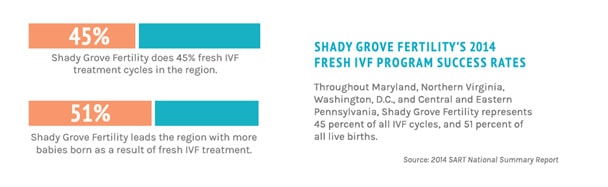
According to the Society for Assisted Reproductive Technology (SART)’s national data for 2014, our center remains a fertility care and IVF leader in the Mid-Atlantic. More than 45 percent of all fresh in vitro fertilization (IVF) treatment cycles and 51 percent of all babies born from IVF are from successful treatment performed at Shady Grove Fertility. Our center has had more successful IVF cycles and more babies born than the next 20 centers in the Maryland, Pennsylvania, Virginia, and Washington, D.C. region combined.

More Babies Born

SART, whose mission it is to establish and maintain quality standards for assisted reproductive technology (ART), represents more than 90 percent of ART centers in the U.S. and requires uniform annual IVF birth outcome reporting in order that patients can make more informed decisions about their infertility care. For their 2014 National Data Summary, SART culled data from 375 SART-affiliated fertility centers across the U.S.

 “At Shady Grove Fertility, one thing we decided long ago was that providing individualized care would be our priority. Despite our size, the number of doctors we have, and our large geographic footprint, we aim to treat each and every patient as if they were our only patient that day. Patients have continually told us that they can feel this personalized level of support while in our care. We’ve been fortunate that our patient satisfaction survey results support this, with 96 percent of our patients saying they would recommend Shady Grove Fertility to a friend or family member,” remarks Michael J. Levy, M.D. Co-founder of Shady Grove Fertility and Director of IVF.

Staying Cutting Edge

In addition to remaining committed to providing personalized care, we also remain committed to ongoing and rigorous research to stay at the cutting edge. In fact, we are one of only a few centers in the nation to employ a full-time dedicated research team and will be presenting data from more than a dozen studies at the October 15-19 American Society for Reproductive Medicine (ASRM) Scientific Congress and Expo in Salt Lake City, UT.

“One of the most important advancements in IVF in the last decade has been in oocyte and embryo vitrification, an ultra-rapid cryopreservation technology that allows for safer and more effective freezing. Vitrification now offers patients who find themselves with more embryos than they are able to transfer in a single cycle the option to choose a subsequent frozen embryo transfer (FET) cycle instead of another fresh IVF cycle—effectively resulting in more babies born per oocyte retrieval with less costs and fewer medications,” explains infertility specialist, Eric D. Levens, M.D., of SGF’s Annandale, VA, office.

“Vitrification has also advanced the practice of preimplantation genetic screening (PGS) offering patients the ability to effectively reduce the chances of chromosomal abnormalities and increase the likelihood of a healthy pregnancy,” adds Dr. Levens.

Schedule an Appointment

To learn more about our IVF success rates or to schedule an appointment, please call our New Patient Center at 1-877-971-7755. 

Filed Under: About SGF

  • « Go to Previous Page
  • Page 1
  • Interim pages omitted …
  • Page 7
  • Page 8
  • Page 9
  • Page 10
  • Page 11
  • Interim pages omitted …
  • Page 16
  • Go to Next Page »

Company

  • About SGF
  • About US Fertility
  • Our Doctors
  • Fertility Equity
  • Careers
  • Newsroom
  • SGF College Scholarship
  • Contact Us
  • Voice Your Feedback

Treatments

  • Egg Freezing
  • Intrauterine Insemination (IUI)
  • In Vitro Fertilization (IVF)
  • Frozen Embryo Transfer (FET)
  • LGBTQIA+ Family Building
  • Shared Risk 100% Refund Program
  • All Treatments

Resources

  • Patient Portal
  • Online Bill Pay
  • Library
  • Support Groups & Events

Locations

  • California
  • Colorado
  • Delaware
  • Florida
  • Georgia
  • Maryland
  • North Carolina
  • Pennsylvania
  • Texas
  • Virginia
  • Washington, D.C.

2026 Shady Grove Fertility

  • Policies & Notices
Also of interest
  • In Vitro Fertilization IVF
  • Fertility Tests
  • Research Publications