
• Skip to primary navigation
  • Skip to main content
  • Skip to footer
Shady Grove Fertility
  • Become an Egg Donor
  • Referring Physicians
  • 1-888-761-1967
  • Schedule Appointment
  • Get Started
        • Get Started
          • Causes of Infertility
          • Fertility Tests
          • When to Seek Help
          • Find a Doctor
          • Preconception and prenatal vitamins 
          • Schedule an Appointment
        • Personalized Care For
          • Single Parents
          • LGBTQIA+ Family Building
          • People with Cancer
          • Known Genetic Diseases
          • Egg Donors
  • Treatments
        • Fertility
          • Timed Intercourse
          • Ovulation Induction
          • Intrauterine Insemination (IUI)
          • In Vitro Fertilization (IVF)
          • Frozen Embryo Transfer (FET)
        • Donation & Surrogacy
          • Donor Sperm
          • Donor Egg
          • Donor Embryo
          • Gestational Carrier
          • LGBTQIA+ Family Building
          • Single Parents
          • Find a Donor
        • More Treatments
          • Center for Male Fertility
          • Egg Freezing
          • OncoFertility
          • Preimplantation Genetic Testing
          • MIGS
          • All Fertility Treatments
  • Resources
    • Resource Library
    • Events Calendar
    • Patient Stories
    • Mental Health
    • Wellness Center
  • Insurance & Savings
    • Insurance & Benefits
    • Shared Risk 100% Refund Program
    • 100% Refund for Donor Egg
    • Discounts
    • Egg Freezing Costs
    • Financing & Grants
    • Clinical Trials
  • About
    • Find a Doctor
    • About SGF
    • Our Care Team
    • Advanced Practice Providers
    • Fertility Equity
    • Philanthropy
    • Newsroom
    • Careers
    • Contact Us
    • Voice Your Feedback
  • Locations
        • Find a Location
        • California
        • Colorado
        • Delaware
        • Florida
        • Georgia
        • Maryland
        • North Carolina
        • Pennsylvania
        • Texas
        • Virginia
        • Washington, D.C.
        • Chile
        • International & Out of State
        • SGF at Walter Reed National Military Medical Center
  • Patient Hub
    • Online Bill Pay
    • Patient Forms
    • Patient Portal
  • Call your care team
  • Become an egg donor
  • Referring physicians
  • search-icon
  • Schedule appointment 1-888-761-1967

Home / Egg freezing / Page 10

Egg freezing

July 28, 2016 by Shady Grove Fertility

Understand the importance of women’s eggs and how it impacts her fertility. 

Medical Contribution: Stephen Greenhouse, M.D. (Fair Oaks, VA)

How does age affect the quality and quantity of women’s eggs?

We all know that a woman’s age plays a large role in your fertility success, in that older eggs contribute to a decline in egg quality and quantity, a lower pregnancy rate, a higher rate of pregnancy loss, and a higher rate of fetal chromosomal abnormalities … so what can we do about it?

As we dive into the facts of ovarian aging and what it means to have a low quantity of high quality eggs, we are able to provide some valuable insight that will help you, ideally, be proactive and take a step forward.

The truth of the matter is, you are born with all of the eggs you will ever have in your lifetime. Throughout your lifetime, you will eventually lose all of your potentially fertile eggs, initiating the start of menopause. At birth, you’re born with 1 to 2 million eggs in your ovaries, and by the time you reach puberty, you can expect only about 400,000 to remain. While this doesn’t seem like a significant problem, we must realize that at each menstrual cycle only one egg is prepped for fertilization and about 1,000 die off. Women only ovulate about 1 percent of their eggs.

Aging is inevitable, and so is the decrease in your egg supply

Each oocyte, or immature egg, can reveal a lot about the possibility of chromosomal abnormalities. To break down the science, the genetics and development of the egg is as follows: (1) Primary oocytes replicate the genetic material found in the cell and hold off on cell division until (2) the female begins her first menstrual cycle and meiosis is continued to complete meiotic division. Meiosis is the type of cell division that results in four “daughter cells,” each containing half of the number of chromosomes of the parent cell. The goal is equal chromosomal division among these daughter cells, but as we know, nothing is perfect. If the meiotic spindles that pull the chromosomes apart fail, chromosomal abnormalities will appear. A woman age 20-25 will have abnormal spindle appearance in about 17 percent of her eggs, while women age 40-45 see abnormal spindle appearance in as much as 79 percent of her eggs. It’s clear, with age comes a higher rate of genetic abnormalities, and we can expect the quantity of healthy eggs to decrease drastically.
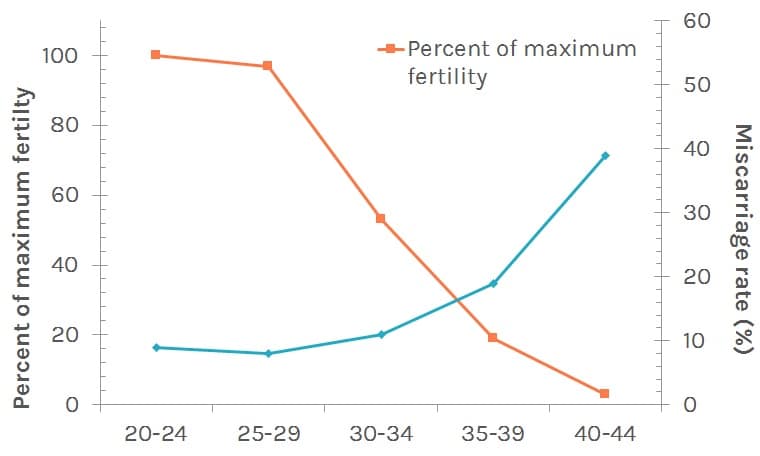
Age and Reproduction in Women


However, age is not the only factor in egg quality so it’s important to make healthy lifestyle choices, such as avoiding smoking, reducing stress, avoiding environmental contaminants, and maintaining proper nutrition, among other things.

Three Simple Tests Reveal Egg Supply

There are three simple tests to evaluate ovarian reserve: anti-Müllerian hormone (AMH), day 3 follicle stimulating hormone (FSH), and antral follicle count:

  1. AMH – These levels can be helpful in understanding what treatments may be necessary, as high AMH (>3.5) predicts a good response to medication, and low AMH (<1) reveals a lower expectation of response.
  2. Day 3 FSH – Follicle stimulating hormone (FSH) is the primary hormone responsible for the production of mature eggs in the ovaries and by measuring a woman’s FSH on day 3 of her cycle, we are able to determine if her baseline FSH is too high or too low.
  3. Antral Follicle Count – antral follicles, or small follicles that we can see in an ultrasound, is indicative of the number of immature follicles remaining in the ovary.

Generally speaking, hormone testing and antral follicle counts are better predictors of egg numbers while age is a better predictor of age quality. Age and FSH/AMH levels are independent, but combined reveal a woman’s ovarian reserve.

What Can I Do?

Shady Grove Fertility offers a multitude of options for women who wish to take preemptive measures through egg freezing, as well as options for women with a low ovarian reserve, whether you choose to remain trying naturally by expectant management, induce ovulation, use IUI, or assisted reproductive technologies like IVF. Schedule an appointment today to consult with one of our doctors and investigate your options.

Schedule an Appointment

Women’s eggs are a main factor of having a baby. If you’re interested in understanding how many eggs you have to better understand your fertility, please call 1-877-411-9292 to schedule an appointment and speak with a new patient liaison.

Filed Under: Treatment Tagged With: Egg freezing

July 14, 2016 by Shady Grove Fertility

Do you know the questions to ask before you freeze your eggs? U.S. News & World Report turned to SGF’s own Dr. Joseph Doyle to address the top 5 questions you should ask (and answer) before you freeze your eggs.

More and more women are hearing about egg freezing as a way to preserve their ability to build their families at a later date. Celebrities and starlets have openly talked about egg freezing, and giant companies like Facebook and Google offer egg freezing coverage to female employees. Statistics show that Americans are delaying marriage and family building into their 30s; however, the fact remains that the quality and quantity of eggs declines as a woman ages.

Taking all of this into account, U.S. News & World Report reached out to SGF’s own Dr. Joseph Doyle (Rockville, MD) to seek the answers to the critical questions women need to ask about egg freezing. Here are the top 5 questions.

Why am I doing this?

Just because your company is offering coverage, your friends are doing it, or your favorite celebrity is espousing the “liberating” aspect of freezing her eggs doesn’t mean it’s necessarily right for you. Dr. Doyle tells U.S. News & World Report that the decline in egg quality doesn’t occur “on a daily or even monthly basis,” so while women should be proactive in learning about their options and even get their fertility tested, in most cases, there is no reason to feel pressure to do it immediately.

When should I freeze my eggs?

Dr. Doyle likes to say that there’s a “sweet spot” in a women’s 30s that’s the best time to undergo egg freezing treatment. “Freeze your eggs too early and risk never needing them; freeze your eggs too late and risk needing to undergo more timely, costly, and potentially painful injection and retrieval cycles in order to acquire the same number of viable eggs–that’s the tradeoff,” says U.S News & World Report.

Where should I freeze my eggs?

Like everything else in life, all fertility centers are not created equally so taking the time to research centers in your area is as important as learning about the actual procedure. “To make an informed decision, ask clinics how many egg freezing cycles they’ve performed, how many times they’ve actually thawed eggs for women who are ready to use them, and, if the statistics are available, their success rates of pregnancy from frozen eggs,” explains Dr. Doyle.

How many eggs should I freeze?

Studies show that the more eggs you are able to freeze the more likely one will result in a successful pregnancy. At Shady Grove Fertility, we recommend women 37 and younger freeze approximately 15 to 20 eggs and for women over 37, 25 to 30.

How will I pay for it?

Realizing that many companies and insurance plans within the mid-Atlantic region do not provide coverage for the majority of the egg freezing process, Shady Grove Fertility has made it a priority to make egg freezing an accessible option that provides reassurance.

To do this, SGF created programs to ensure women freeze enough eggs and have options when it comes time to use their frozen eggs in the future.

Most recently, we created and launched the Shared Risk 100% Refund for Returning Egg Freezing Patients, a guarantee program exclusive to Shady Grove Fertility patients. This guarantees that women who return to use their frozen eggs either take home a baby, or get a full refund of the Shared Risk fees.

Making the decision to freeze your eggs comes with a lot of considerations. It’s important for women to accumulate as much information to make the best decision for themselves. The first step is the easiest, measure your current fertility to see if egg freezing is a good option for you.

Schedule an Appointment

 To learn more about freezing your eggs, call 1-877-411-9292 to speak with one of our New Patient Liaisons, or register for one of our upcoming patient educational events.

Filed Under: Treatment Tagged With: Egg freezing

June 28, 2016 by Shady Grove Fertility

Many women who consider egg freezing as an option to preserve their fertility ask, “can egg freezing cause early menopause?” Fortunately, that’s not the case.

Menopause is a point in time when menstrual cycles stop because of the natural depletion of a woman’s eggs as she ages. For women in the U.S., the average age of menopause is 51. This is predetermined and, excluding disease or surgery, will occur at a time dictated by genetics. When menopause occurs prior to the age of 40, it is termed primary ovarian insufficiency.

What causes early menopause?

The reality is, every woman is different, and the age at which they experience menopause will vary. Some women, even with no external factors, will experience early menopause. This phenomenon can be seen in families, and women with close female relatives who had premature menopause, also called primary ovarian insufficiency, are encouraged to have their fertility assessed at an earlier age. To prevent the premature loss of fertility, these women may want to consider egg freezing to protect their family building options.

Other women may experience primary ovarian insufficiency if both ovaries are removed a woman will experience primary ovarian insufficiency caused by surgical menopause. Chemotherapy and radiation treatment can also damage the ovaries, resulting in premature loss of function and infertility. Other causes of primary ovarian insufficiency include autoimmune disorders and the majority are unknown factors.

Can egg freezing cause primary ovarian insufficiency?

So can egg freezing cause early menopause? No. Every month a woman recruits a set number of eggs. During the egg freezing process, this is the cohort of eggs that are harvested. Egg freezing has no impact on the age of menopause. Overall, the risk of complications from the procedure is less than 2%. Therefore, assuming no complications, the process of ovarian stimulation and egg harvesting should have no long-term effects.

The Egg Freezing Process

After you complete ovarian reserve testing, consult with your physician, and decide to move forward with Shady Grove Fertility’s Egg Freezing Program, you can expect the entire process to take approximately 4-6 weeks.

At the end of the stimulation phase, you will get a trigger injection, which helps the eggs mature and signals the body to release the eggs.  The egg retrieval is timed to collect the eggs after they mature but before they ovulate. Typically the egg retrieval occurs 36 hours after the trigger.

Depending on your age and the number of mature eggs that were retrieved, your doctor may advise an additional cycle to obtain the recommended number of eggs. By freezing the recommended number of eggs, you are giving yourself the best possible chance of taking home a baby if/when you return to use your frozen eggs to start your family.

Schedule An Egg Freezing Appointment

 To learn more about our egg freezing success rates and Assure Fertility Financial Program to freeze your eggs, or for more information, call 1-877-411-9292 to speak with one of our New Patient Liaisons, or register for one of our upcoming patient educational events.

Medical contribution from Stephanie Beall, M.D., Ph.D of the Shady Grove Fertility Columbia and Towson Maryland offices.

Filed Under: Treatment Tagged With: Egg freezing

June 15, 2016 by Shady Grove Fertility

“Female fertility starts to decline in the early 20s, but conception rates are still really high even into their 30s,” explains Dr. Malik.

When should women start thinking about their fertility? For women in their 20s, the fertility discussion is typically focused on ways not to get pregnant, but as Dr. Shruti Malik of Shady Grove Fertility’s Fair Oaks, VA, points out in a recent interview with Business INSIDER, women should start seriously thinking about their fertility around the age of 30.

This isn’t to say that all women need to have children around this age; however, women are encouraged to be proactive about not only understanding their fertility but the options available to preserve their fertility.

Dr. Malik on the Best Age to Conceive

“The best chances for women to conceive are going to most often be in their 20s or potentially even their early 30s,” says Dr. Malik. “Female fertility starts to decline in the early 20s, but conception rates are still really high even into their 30s. So, it’s most notably the age of 35 that most women associate with that initial decline in fertility.”

For most women, the conversation about family planning should start with their OB/GYN around the age of 30. While the questions your physician may ask seem out of the blue, it’s a good opportunity for women to begin thinking about when they want to have children. A good tip is to consider how old you would like to be when you have your last child. Then work the math backwards to reveal the age when you should be starting your family.

For women who suffer from irregular periods or have a family history of early menopause, also known as premature ovarian failure, Dr. Malik suggests they consult their physician in their 20s. An OB/GYN should be able to determine if these or any other conditions, which may negatively impact their fertility, are present.

Identify a Potential Problem Early

Ovarian reserve testing is a valuable tool to help identify the number of eggs you currently have based on reproductive hormone levels. These hormone levels provide great insight and reveal if your fertility  potential is high, low, or normal based on your age.

With 90 percent of patients having insurance coverage for this testing and physician consultation, insights into your fertility are simple to obtain. Results provide both the patient and the physician with a reliable estimate of a woman’s fertility.

Take Steps to Protect Your Fertility

The best way to safeguard your ability to have your own child at a time of your choosing is through elective egg freezing. Since the experimental label on egg freezing was lifted in 2012, thousands of women have undergone this procedure and even more have taken proactive steps to learn about it. We now also know that women under the age 37 who freeze the recommended number of eggs have a 70 to 80 percent chance of taking home at least one baby.

Dr. Malik can speak to the benefits of egg freezing not only from a professional level as a reproductive endocrinologist but also from a personal level, as she elected to freeze her eggs a few years ago. She recounts her experience as very favorable and says she’s extremely glad she was proactive about this. “We’re definitely seeing a very big increase in the number of women who are considering egg freezing, and I think it’s great,” says Dr. Malik. “It really enables women to have the freedom to make plans for their future.”

Schedule An Egg Freezing Consultation

Schedule A Fertility Consultation

To learn more about egg freezing or to schedule a consultation with Dr. Malik, call 1-877-411-9292 or join one of our upcoming informational webcasts or seminars to learn more. 

Filed Under: Treatment Tagged With: Egg freezing

May 27, 2016 by Shady Grove Fertility

Many women who are considering egg freezing often ask if their eggs will be safe during the process of freezing and throughout an indefinite amount of time spent in storage. At Shady Grove Fertility, we take all appropriate preventive safety precautions for frozen eggs to preserve and protect them so that they are available to you when you decide to start a family.

Safety Precautions for Frozen Eggs: Lab Advances Ensure Egg Quality

During the early years of egg freezing, embryologists would use a slow-freeze method of cryopreservation. Eggs are the largest cells in your body and have high water content. As a result, the slow-freeze method would create ice crystals. When the eggs were thawed, those ice crystals would break and damage the egg, reducing the likelihood of that egg being able to form an embryo.

“When the ice crystals form, they lice the cell membrane, so there’s always going to be this freezer burn or cyro damage. In these cases, it becomes questionable whether the egg is going to recover post thaw,” says Shady Grove Fertility Embryology Laboratory Supervisor, Taer Han.

Over the past few years, however, Shady Grove Fertility has adopted a highly effective freezing process called vitrification, an ultra-rapid procedure with liquid nitrogen that inhibits ice crystals from forming within an egg. Vitrification is a very efficient method of freezing your eggs and it proves strong survival, fertilization, embryonic development, and ultimately pregnancy rates after you decide to have your frozen eggs thawed.

“Vitrification, because it’s cooled at such a rapid rate, allows us to leap frog that freeze point to -38 degrees; you never even give the liquid in the eggs a chance to [form ice crystals],” says Han.

Safety Precautions for Frozen Eggs: Storage Methods

Shady Grove Fertility’s Egg Freezing Program keeps women’s eggs stored in liquid nitrogen versus vapor. Liquid nitrogen is more expensive but maintains a more stable lower temperature for long-term storage. It also ensures that there is zero metabolism, or movement of water within the egg, and essentially no subsequent freezer burn.

Safety Precautions for Frozen Eggs: Lab Security and Chain of Custody

All of the tanks that Shady Grove Fertility uses to store frozen eggs are monitored with 24-hour alarm services. The storage units are also extensively labeled in terms of chain of custody, “From the retrieval, through the freeze process, through the storage process, all the identifiers, like the patient’s name, date of birth, and medical record are triple checked by multiple embryologists,” says Han. Patients also take an active role in the chain of custody protocol when they are asked to verify their identification verbally at several points throughout their procedures.

Shady Grove Fertility has been a part of many nationwide protocol changes to better ensure the safety of all of the frozen eggs and embryos stored and used here. Furthermore, should a known, highly-damaging event be predicted to take place, we have partners further in-land who would safely house all of our patients’ eggs and embryos should it be needed. Luckily, this hasn’t happened in our 25 year history. Our first route of protection would be at one of our three laboratories located in Towson, MD; Rockville, MD; and Chesterbrook PA.CHEDULE AN EGG FREEZING APPOIN

Schedule An Egg Freezing Appointment

To learn more about safety precautions for frozen eggs or for more information, call 1-877-411-9292 to speak with one of our New Patient Liaisons.

View Upcoming Egg Freezing Events

VIEW UPCOMING EGG FREEZING EVENTS

Filed Under: Treatment Tagged With: Egg freezing

May 18, 2016 by Shady Grove Fertility

The growing list of Hollywood celebrities who have been candid about their assisted fertility journeys and egg freezing now includes X-Men: Apocalypse actress Olivia Munn. Last month Olivia Munn revealed during her appearance on Anna Faris’ podcast Anna Faris Is Unqualified that she “froze a bunch of [her] eggs.”

She explained that after turning 35, she knew she was high risk so she decided to freeze her eggs even after receiving positive results from her ovarian reserve test, which determines the quantity of eggs you currently have.

“You know, you actually have a lot of eggs. You’re really lucky,” Munn’s doctor told her.

But unfortunately a friend of hers, who is the same age, received different results. Her friend “had the egg count of a 50-year-old,” highlighting the individualized experiences people have with fertility, no matter the age. In fact, as you age, the eggs that you were born with steadily decline in quantity and quality, significantly decreasing a woman’s ability to conceive.

Olivia Munn on the Rising Popularity of Egg Freezing

Olivia Munn encourages all women to become knowledgeable about freezing their eggs, since “it’s no longer on the experimental list, and I think that every girl should do it. For one, you don’t have to race the clock anymore. You don’t have to worry about it—worry about your job or anything. It’s there.”

As the average age of women becoming first-time mothers increases, egg freezing is becoming a viable option for women who want to capture their fertility at its peak. At Shady Grove Fertility’s Egg Freezing Program, we encourage women between the ages of 30 to 40 to freeze their eggs, giving them more options for the future with a higher quality set of eggs.

Financial Programs at Shady Grove Fertility Make Egg Freezing Realistic

Although some may have a preconceived notion that the cost of egg freezing can be prohibitive and solely for women like Olivia Munn who have the financial resources, in actuality, the number of women freezing their eggs continues to rise. Since 2013, SGF’s Egg Freezing Program has seen over a 1,000 women who wanted to  electively freeze their eggs. Some of these women have used  financial programs such as Assure Fertility, which guarantees either a certain number of eggs or cycles (whichever comes first) based on the amount of children a woman wants to have, depending on her age.

For more information about egg freezing and SGF’s success rates for women returning to use their frozen eggs, call 1-877-411-9292 to speak with one of our New Patient Liaisons. You can also fill out this form to schedule an egg freezing appointment, or register for one of our upcoming patient educational events.

Filed Under: Treatment Tagged With: Egg freezing

  • « Go to Previous Page
  • Page 1
  • Interim pages omitted …
  • Page 8
  • Page 9
  • Page 10
  • Page 11
  • Page 12
  • Interim pages omitted …
  • Page 22
  • Go to Next Page »

Company

  • About SGF
  • About US Fertility
  • Our Doctors
  • Fertility Equity
  • Careers
  • Newsroom
  • SGF College Scholarship
  • Contact Us
  • Voice Your Feedback

Treatments

  • Egg Freezing
  • Intrauterine Insemination (IUI)
  • In Vitro Fertilization (IVF)
  • Frozen Embryo Transfer (FET)
  • LGBTQIA+ Family Building
  • Shared Risk 100% Refund Program
  • All Treatments

Resources

  • Patient Portal
  • Online Bill Pay
  • Library
  • Support Groups & Events

Locations

  • California
  • Colorado
  • Delaware
  • Florida
  • Georgia
  • Maryland
  • North Carolina
  • Pennsylvania
  • Texas
  • Virginia
  • Washington, D.C.

2026 Shady Grove Fertility

  • Policies & Notices
Also of interest
  • In Vitro Fertilization IVF
  • Fertility Tests
  • Research Publications