• Skip to primary navigation
  • Skip to main content
  • Skip to footer
Shady Grove Fertility
  • Become an Egg Donor
  • Referring Physicians
  • 1-888-761-1967
  • Schedule Appointment
  • Get Started
        • Get Started
          • Causes of Infertility
          • Fertility Tests
          • When to Seek Help
          • Find a Doctor
          • Preconception and prenatal vitamins 
          • Schedule an Appointment
        • Personalized Care For
          • Single Parents
          • LGBTQIA+ Family Building
          • People with Cancer
          • Known Genetic Diseases
          • Egg Donors
  • Treatments
        • Fertility
          • Timed Intercourse
          • Ovulation Induction
          • Intrauterine Insemination (IUI)
          • In Vitro Fertilization (IVF)
          • Frozen Embryo Transfer (FET)
        • Donation & Surrogacy
          • Donor Sperm
          • Donor Egg
          • Donor Embryo
          • Gestational Carrier
          • LGBTQIA+ Family Building
          • Single Parents
          • Find a Donor
        • More Treatments
          • Center for Male Fertility
          • Egg Freezing
          • OncoFertility
          • Preimplantation Genetic Testing
          • MIGS
          • All Fertility Treatments
  • Resources
    • Resource Library
    • Events Calendar
    • Patient Stories
    • Mental Health
    • Wellness Center
  • Insurance & Savings
    • Insurance & Benefits
    • Shared Risk 100% Refund Program
    • 100% Refund for Donor Egg
    • Discounts
    • Egg Freezing Costs
    • Financing & Grants
    • Clinical Trials
  • About
    • Find a Doctor
    • About SGF
    • Our Care Team
    • Advanced Practice Providers
    • Fertility Equity
    • Philanthropy
    • Newsroom
    • Careers
    • Contact Us
    • Voice Your Feedback
  • Locations
        • Find a Location
        • California
        • Colorado
        • Delaware
        • Florida
        • Georgia
        • Maryland
        • North Carolina
        • Pennsylvania
        • Texas
        • Virginia
        • Washington, D.C.
        • Chile
        • International & Out of State
        • SGF at Walter Reed National Military Medical Center
  • Patient Hub
    • Online Bill Pay
    • Patient Forms
    • Patient Portal
  • Call your care team
  • Become an egg donor
  • Referring physicians
  • search-icon
  • Schedule appointment 1-888-761-1967

Home / Egg freezing / Page 11

Egg freezing

May 12, 2016 by Shady Grove Fertility

Last week, pop star Janet Jackson announced she was pregnant for the first time . While news of any celebrity baby seems to be cause for headlines these days, Jackson’s was especially noteworthy because she is just weeks away from her 50th birthday. When celebrities make announcements like this, the general public often wonders how possible is pregnancy after 40. On Friday, May 6th, reproductive endocrinologist Kate Devine, M.D. from Shady Grove Fertility’s Washington, D.C. – K Street office explained it all on ABC7 – WJLA Good Morning Washington.

  • Watch Dr. Kate Devine on Good Morning Washington

Conception and Pregnancy After 40

Women have never had more opportunities than they do today. But can they really have it all? When it comes to family planning, it is important to understand your own biology. According to the American Society for Reproductive Medicine (ASRM), a woman’s natural rate of conception at 40 is just 5 percent per month.1 Typically, by the time a woman gets to about 35 her egg quality and quantity will diminish until she reaches menopause. These natural changes not only make it more difficult for women to conceive using their own eggs but these changes also cause an increased likelihood of miscarriage and genetic abnormalities.

Shady Grove Fertility provides patients with treatment options; including in vitro fertilization (IVF) with either a woman’s own eggs or donor eggs, as well as elective egg freezing—all options that make it possible for women who are beyond their peak reproductive years to have a child later in life.

Benefits of Donor Egg Treatment

In the case of a woman in her late-40s, like Janet Jackson, “No one can say for certain why and how Janet Jackson became pregnant, that said, the most likely explanation is that she used a donor’s eggs, the eggs of a younger woman,” explains Dr. Devine. This process of using donor egg is the same IVF procedure except the egg is from a young, healthy, often anonymous, egg donor. Donor egg treatment is “a safe, wonderful opportunity for women to start families later in life.”

Exploring the Possibility of Egg Freezing

It’s certainly possible that Janet Jackson used frozen eggs of her own but 20 years ago, while still in her 30s; however, the advanced egg freezing technology used today did not exist. Since 2012, vitrification, or “flash freezing,” better preserved the integrity of a woman’s eggs during the freezing process, ultimately leading to greater chances of pregnancy from those eggs. Egg freezing can essentially suspend a woman’s fertility potential before it starts to decline until a point in time when she is ready to have a baby.

When to See a Specialist

For women who are currently trying to conceive, it is recommended to speak with a reproductive endocrinologist if you are:

  • Younger than 35, after trying to conceive for 1 year
  • Ages 35 to 39, after trying to conceive for 6 months
  • Age 40 or older, right away

Indicators that you should see a specialist sooner include:

  • Endometriosis
  • Irregular or no periods
  • Recurrent pregnancy loss (two or more consecutive miscarriages)
  • Family history of early menopause
  • Male partner had abnormal semen analysis results

For women interested in preserving her eggs, a reproductive endocrinologist will be able to quickly assess if you are a good candidate for egg freezing with a few simple tests. Egg freezing is most often recommended for women who:

  • Are ages 30 to 40
  • Have endometriosis
  • Have a family history of early menopause
  • Have been recently diagnosed with cancer

To learn more about pregnancy after 40, the benefits of egg freezing, or fertility treatment success rates, call our new patient center at 977-971-7755 to schedule an appointment.


References:

  1. American Society for Reproductive Medicine. 2012. Age and Fertility: A Guide for Patients. Retrieved May 11, 2016. https://www.asrm.org/uploadedFiles/ASRM_Content/Resources/Patient_Resources/Fact_Sheets_and_Info_Booklets/agefertility.pdf
Filed Under: Treatment Tagged With: Donor egg, Egg freezing

May 5, 2016 by Shady Grove Fertility

Who are the women who choose to freeze their eggs? Many face illnesses like endometriosis and cancer that require them to be proactive about preserving their fertility. While others use egg freezing as a way give them more time to find the right partner or situation. Others select egg freezing when they have a partner, but not in a position to build a family.

On the latest Medical Daily article, “What to Expect When You’re Not Expecting,” one woman, Hally, describes why she froze her eggs at the age of 37. “I was focused on my career, my education, I moved to a couple of different cities… and when I did meet someone I fell in love with…,” she froze her eggs as a way to ensure her options to have a family down the road.

Hally learned about egg freezing from friends who either talked about it or had undergone in vitro fertilization (IVF) or other fertility procedures. “If I were still single I probably wouldn’t have done it,” Hally says, adding she was always someone who just lived in the present. That was until she fell in love and “the future question” came up—she and her future husband needed to address it.

“I kind of did it because I didn’t want [my partner] to make decisions [about the future] based on my age, I wanted him to make decisions based on what was right for him,” she says.

Hally isn’t alone. According to the Society for Assisted Reproductive Technology (SART), nearly 5,000 women froze their eggs in 2013, which is up from 500 women who froze their eggs in 2009. Shady Grove Fertility, alone, performed 250 cycles in 2014, 350 in 2015, and an expected 450 cycles will be done this year.

Egg Freezing Technology

While, “cryopreservation of sperm and embryos has been going on for decades,” says Eric A. Widra, M.D. of Shady Grove Fertility, who was interviewed for this story, egg freezing is still “a young technology.”

The Shady Grove Fertility Egg Freezing Program uses a technique called vitrification to flash freeze eggs, in order to minimize the ice crystals in the egg. According to Dr. Widra, not only is vitrification a developing technology, “the egg is the largest, most complicated cell in humans, full of water and fussy,” noting by comparison “sperm are simple, they’re just little DNA bots.” Given the complexity of human eggs, additional layers of precision and experience are needed to ensure the best possible outcomes.

The actual freezing of eggs isn’t the last step of the process and only half of what women should be considering when it comes to success rates. The technology a fertility center uses to thaw eggs is just as vital as the ones chosen to freeze eggs.

How Many Eggs Do You Need to Take Home a Baby?

The answer depends on your age. For women 37 or younger, we recommend freezing 15 to 20 mature eggs. If you are older than 37, you may need to freeze more eggs—we recommend freezing 20 to 30 mature eggs.  By freezing this number of eggs, women have a greater chance of taking home a baby. In fact, a recent study of SGF patients found if a woman 37 or younger freezes the recommended number of eggs, she has a 70 to 80 percent chance of taking home a baby.

Egg Freezing When You Have a Partner

Women who ultimately choose to freeze their eggs are motivated by a variety of reasons and situations, with a common thread of wanting more in control of future fertility.  Like many other women who preserve their fertility, Hally says her “frozen eggs represent hope,” and widens the opportunities she has at having a baby when she’s ready.

To learn more about egg freezing when you have a partner, or for more information, call 1-877-411-9292 to speak with one of our New Patient Liaisons. You can also fill out this form to schedule an egg freezing appointment, or register for one of our upcoming patient educational events.

Filed Under: Treatment Tagged With: Egg freezing

April 26, 2016 by Shady Grove Fertility

Shady Grove Fertility is changing the conversation about egg freezing by publishing its success rates in this month’s issue of Fertility and Sterility, an esteemed medical journal devoted to the subspecialty of reproductive medicine. Until now, the conversation around egg freezing often swirled around the fact that there is no guarantee of a baby if you return to use your eggs, and that egg freezing success rates are hard to find—until now. We now have data from the largest published study of egg freezing success rates in the U.S.—Shady Grove Fertility’s study outlines the success rates of women using frozen eggs for pregnancy.

“Shady Grove Fertility started a dedicated Egg Freezing Program in 2009; ever since, we have worked tediously to improve treatment options—not only to improve the egg freezing technique but also to ensure the best possible outcomes for women when they return to have a baby,” says Dr. Joseph Doyle. “We are proud to be able to publish delivery rates that will better inform women of the opportunities available through egg freezing.”

Egg Freezing Success Rates

Through December 2014, Shady Grove Fertility physicians had performed 1,171 egg freezing cycles for 875 women intending to use their eggs later for in vitro fertilization (IVF) treatment. As of January 2015, 117 of these women returned to undergo 128 IVF cycles, using a total of 1,283 frozen eggs.

As for the results from these 128 IVF cycles, there were 51 pregnancies, resulting in 55 children and 8 more on the way at the time of the study (12 of the pregnancies were twins). In addition, 62 good quality blastocysts remain in storage from these warming cycles for future attempts.

While the team was confident in their chances of positive pregnancy results going into the cycles based on similar research with frozen donor eggs3, the results have confirmed that IVF cycles with frozen eggs perform as well as IVF cycles with fresh eggs.

What are the chances of taking home a baby if I freeze my eggs?

Estimating the probability of egg freezing producing a baby eventually greatly depends on the age a woman decides to freeze her eggs as well as how many eggs she has frozen. Shady Grove Fertility stands behind our research and recommendations—for women younger than 38, we recommend freezing 15 to 20 mature eggs, giving them roughly a 70 to 80 percent chance of at least one live birth. For women 38 to 40 years old, we recommend freezing 25 to 30 mature eggs, giving them a 65 to 75 percent chance of at least one live birth. These recommendations can be individualized according to the specific family building goals of the patients.

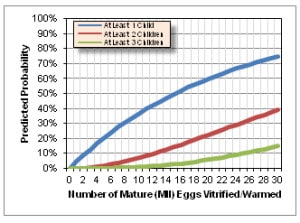
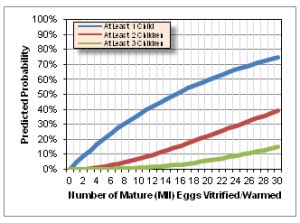
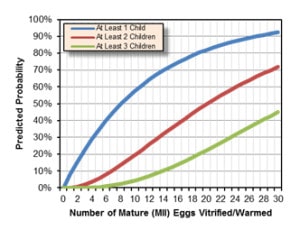
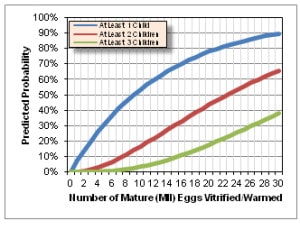
The charts below describe the predicted probability of having at least one, two, and three live-born children according to the number of eggs frozen for elective reasons.
                   Women Ages 30-34                                        Woman Ages 35-37


 Women Ages 38-40                                                    Women Ages 41-42                                       


Notes on the Study

Shady Grove Fertility’s Joseph Doyle, M.D., along with Kevin S. Richter, Ph.D., Robert Stillman, M.D., James R. Graham, M.S., Joshua Lim, M.S., and Michael J. Tucker, Ph.D., comprised the study’s research and publication team. The study, “Successful elective and medically indicated oocyte vitrification and warming for autologous in vitro fertilization (IVF), with predicted birth probabilities for fertility preservation according to number of cryopreserved oocytes and age at retrieval” was published in the February edition of Fertility and Sterility.

The overall goal of this study was to measure the probability that women—according to their age at the time of egg retrieval and the number of eggs frozen—will go on to have at least one, two, or three children using their frozen eggs at a later date.

The study design included four different groups: women who electively froze their eggs, women who needed to freeze their eggs unexpectedly during a fresh IVF cycle, couples who electively chose not to fertilize all of their eggs, and women freezing prior to cancer treatment.

The study compared success rates based on the different stages of the process: from thawing the eggs, to fertilizing the eggs through intracytoplasmic sperm injection (ICSI), embryo and blastocyst formation, to implantation of the embryo, and then having a baby. Of the 128 IVF cycles from egg freezing, 32 cycles were for women who had electively frozen their eggs and returned with the desire to achieve pregnancy.

To learn more about the egg freezing success rates and process or for more information, call 1-877-411-9292 to speak with one of our New Patient Liaisons, fill out this form to schedule an egg freezing appointment, or register for one of our upcoming patient educational events.

References:
  1. Cobo A, Meseguer M, Remohi J, Pellicer A. Use of cryo-banked oocytes in an ovum donation programme: a prospective, randomized, controlled, clinical trial. Hum Reprod 2010;25:2239-46.
  2. Sole M, Santalo J, Boada M, Clua E, Rodriguez I, Martinez F et al. How does vitrification affect oocyte viability in oocyte donation cycles? A prospective study to compare outcomes achieved with fresh versus vitrified sibling oocytes. Hum Reprod 2013;28:2087-92.
  3. Trokoudes KM, Pavlides C, Zhang X. Comparison outcome of fresh and vitrified donor oocytes in an egg-sharing donation program. Fertil Steril 2011;95:1996-2000.

Filed Under: Treatment Tagged With: Egg freezing

April 15, 2016 by Shady Grove Fertility

Tammy Sun, founder of Carrot, a community created to deliver insights for women who are freezing eggs and advice about fertility health, discusses how she decided to freeze her eggs after finding out that her anti-Müllerian hormone (AMH) level was low for her age.

“I consider myself smart and capable. I go to the doctor, I take care of myself, and I do triathlons. But as soon as I started the process of my egg freezing cycle, I felt very disempowered. I was shocked at how little I knew about fertility,” says Tammy.

Egg freezing is an opportunity for women, typically 30 to 40, to capture their fertility before it starts to decline more rapidly. Some women may need to freeze earlier, depending on medical history and ovarian reserve.

The reason there are age guidelines for women interested in egg freezing is because the quality and quantity of a woman’s eggs decreases as she ages. At the same time, as a woman ages, the chance of miscarriage or a genetic abnormality increases. It’s important to note, in the context of these age guidelines, that we typically don’t recommend women freeze too young because the likelihood of them needing to use their frozen eggs is not as high.

How can we make egg freezing more accessible?

Regarding access to egg freezing technology, “women should have the freedom, the products, and the services to be smart about their fertility the way that we have products and services to be smart about our money or our careers, and other really meaningful things in our lives,” Tammy continues.

After talking to her friends and other women, Tammy discovered that she wasn’t the only one who felt in the dark when it came to reproductive health and preservation.

When searching for information about egg freezing, she explained that she, “ very quickly [ended] up in with the IVF community or a new mom or baby blog and that [didn’t] really speak to [her], and women like [herself]…who [wanted] to be prospective about their fertility health.”

Creating a Community for Women Who are Freezing Eggs

Tammy’s company, Carrot, seeks to provide advice, data, and recommendations for women who are “stuck in the middle.” Her mission is to help other women be smart about optimizing the chance that the preferred outcome will happen, even if the preferred outcome is to have more choices.

Her goal is to eventually increase access across all three dimensions: money, time, and identity, by removing the stigma and taboo. She also encourages women interested in freezing their eggs to check if they have insurance coverage for treatment—or at least the initial bloodwork and consultation fees—and to talk to their HR department about providing coverage (in cases where the employer doesn’t already offer fertility coverage).

Elective egg freezing is rarely covered by insurance, but diagnostic or ovarian reserve testing, as well as a physician consultation, is largely covered by Shady Grove Fertility’s 30+ participating insurance companies. In fact, 90 percent of our elective egg freezing patients have coverage for the initial part of the process, which includes diagnostic testing, physician consultation, nurse consultation, and a financial counselor consultation.

Advice from Tammy: Be a Smart Consumer

Tammy’s advice for women seeking answers is to be a smart consumer and ask the right questions, especially when an OB/GYN or fertility specialist is giving a certain protocol.

Shady Grove Fertility’s Egg Freezing Program recommends women under 37 with healthy ovarian function freeze between 15 to 20 mature eggs, while women over 38 or women at any age with diminished ovarian function freeze 25 to 30 mature eggs. We suggest these quantities in order to offer women multiple attempts to conceive and have a baby.

“We have the opportunity to be smart about this new technology and navigate it for ourselves, with the support, obviously, and the guidance of medical providers and professionals,” says Tammy.

Nobody should present egg freezing as a guarantee, but more of a decision to optimize a chance for a future preferred outcome especially since, as Tammy points out, “we make those decisions in every other area in life.”

To connect with Tammy, email here. To learn more about the egg freezing process or for more information about Shady Grove Fertility’s exclusive egg freezing financial programs, call 1-877-411-9292 to speak with one of our New Patient Liaisons, fill out this form to schedule an egg freezing appointment, or register for one of our upcoming patient educational events.

Filed Under: Treatment Tagged With: Egg freezing

April 8, 2016 by Shady Grove Fertility

On March 23rd, Shady Grove Fertility’s Medical Director, Eric A. Widra, M.D., joined journalist Brigid Schulte and author Rachel Lehmann-Haupt on the Diane Rehm Show to discuss the increasing scores of women who are exercising their economic and procreative power by freezing their eggs until they are ready to have a baby.

  • Read some of the highlights of the lively 45 minute discussion, “Why more and more women are choosing to freeze their eggs.”

“Nobody ever falls off a fertility cliff at a certain age. All women have a gradual decline in their fertility, but the real problem for us is that we don’t have a fertility test. We can’t tell whether a woman is fertile or not. What we can tell a woman is what her egg supply—what we call ovarian reserve —looks like.” Shady Grove Fertility Medical Director, Eric A. Widra, M.D.

During the discussion Widra stated that, “There is [no] bright line cutoff, no cliff to fall off, but it is a gradual decline. Nobody ever falls off a fertility cliff at a certain age. All women have a gradual decline in their fertility, but the real problem for us is that we don’t have a ‘fertility test.’ We can’t tell whether a woman is fertile or not. What we can tell a woman is what her egg supply—what we call ovarian reserve—looks like.”

During the broadcast, Dr. Widra reminded the live audience that, generally speaking, the optimal time to freeze eggs is in a woman’s early- to mid-30s while fertility potential is still near its peak. He explained, reproductive specialists really only have a select, few markers for determining who’s a good candidate to freeze their eggs, and those come from a measurement that involves ultrasound and blood testing of egg supply.

More Women are Choosing Egg Freezing at Shady Grove Fertility

Shady Grove Fertility’s Egg Freezing Program allows women between the ages of 30 and 40 the ability to freeze their eggs. Not every egg (frozen or not) will result in a pregnancy, but recommends that women 37 or younger with excellent ovarian function freeze 15 to 20 eggs, and for women over 38, or women with diminished ovarian function, freeze 25 to 30.

Widra further explained how reproductive specialists have taken years of data to create very measurable and scientific guidelines for how many eggs to freeze based on age and ovarian reserve; however, to put it simply, “if you have 20 eggs at a particular age, some of them will be normal, some of them will be abnormal,” explains Widra. He asks women who are considering egg freezing, “What is our long-term goal here and how do we come up with a strategy,” explains Widra.

Egg Freezing as an Insurance Policy

Egg freezing has become a technological solution to a bigger problem, and, “as technology matures, we’re going to start to feel differently, maybe better, maybe worse, about the choices that women are making and what it means from a cultural, societal standpoint,” says Widra.


He says that women don’t come into his office expressing that they want to climb the corporate ladder, “[they’re] saying, well, I haven’t found the right life situation to have kids. And I’m really worried about what that means for my future.”

While egg freezing doesn’t guarantee a baby in the future, it is the best option to extend a woman’s current fertility potential. Women who choose to freeze their eggs should feel confident that they’ve proactively done what they need to in order to have more options for the future.

To discover why more women are choosing egg freezing, or to learn more about Shady Grove Fertility’s exclusive egg freezing financial programs, call 1-877-411-9292 to speak with one of our New Patient Liaisons, fill out this form to schedule an egg freezing appointment, or register for one of our upcoming patient educational events.
 

Filed Under: Treatment Tagged With: Egg freezing

March 23, 2016 by Shady Grove Fertility

Rachel Lehmann-Haupt, author of “In Her Own Sweet Time: Egg Freezing and the New Frontiers of Family”


Rachel Lehmann-Haupt, author of In Her Own Sweet Time: Egg Freezing and the New Frontiers of Family is telling a new story very publicly and is catching the interest of many, such as Refinery29 and the Toronto Sun. Lehmann-Haupt, as she explains, is a DIY mom. She took her dreams of one day having a biological child and froze her eggs and then used an anonymous sperm donor to have a baby. Not only is she raising the topic of using a sperm donor and becoming a “DIY” mom, Lehmann-Haupt has become an inspiring voice for scores of women who are freezing fertility.

Freezing Fertility to Find the Right Timing

Like many women, Lehmann-Haupt explains that her decision to freeze her eggs came after she spent a huge chunk of her 20s and 30s pursuing her career, living on her own, travelling, and entering different relationships. At 32, her long-time boyfriend broke up with her, “I wasn’t as heartbroken about the guy as about the fact that I wasn’t going to have a child soon and that my biological clock was ticking. I’m really happy the relationship ended—I don’t think anybody should marry the wrong person just to have a child.”

A few years later she found herself pondering, “God, did I forget to have a baby?” Lehmann-Haupt adds, “I was nearing the age of 35 and I was single and I had not yet had a child…and then I started looking at all these statistics and realized that I was just one among many many women — millions — having children later, because we are putting our economic power ahead of our procreative power.”

She says that she’s a part of a growing group that has uncertain feelings towards being parents even as the inevitable timing of their biological clock ticks away.

“We’re postponing marriage, [and] the age of first-–time motherhood and fatherhood is naturally rising, especially in cities,” says Lehmann-Haupt. She’s right, the average age of first-time moms is increasing.  But as women age, their egg quantity and quality decreases, affecting certain women’s ability to conceive.

Take Advantage of Your Fertility Now

Wherever you are in life, or if you’re even thinking about kids, take charge by having your ovarian reserve (egg supply) tested. If you are under 35, you are at the optimal age to freeze your eggs, which has become a way to extend your current fertility. And although your body will age, the eggs that you freeze in this safe and effective way will be available if you need them when you decide to start a family. Ovarian reserve testing can be performed through a simple blood test and ultrasound at Shady Grove Fertility.

  • As women of a post-boomer generation, we are used to being in control of our lives, professionally and financially. The fact that we do not have control over the duration of our fertility is incredibly frightening, something many of us would like to ignore for as long as possible. But I have learned that no matter how scary some information was at first, it’s ultimately liberating to understand my own body’s reproductive possibilities—as well as its impossibilities. We have more options than ever; understanding them can empower us and, perhaps most importantly, turn panic into peace, she says.

Your Options to Freeze Fertility at Shady Grove Fertility

On average, the optimal time to freeze your eggs is in your early- to mid-30s while your fertility potential is still near its peak. However, Shady Grove Fertility’s Egg Freezing Program allows you to freeze your eggs between the ages of 30 and 40. So women like 35-year-old Rachel Lehmann-Haupt can, “keep the possibility of having children on the back burner indefinitely…”

“You may end up dramatically changing your mind about not wanting kids at 37, and by preparing for this possibility you’ll be in a much better place if you run into challenges,” Lehmann-Haupt adds.

To learn more about the egg freezing process or for more information about Shady Grove Fertility’s exclusive egg freezing financial programs, call 1-877-411-9292 to speak with one of our New Patient Liaisons, fill out this form to schedule an egg freezing appointment, or register for one of our upcoming patient educational events.

Filed Under: Treatment Tagged With: Egg freezing

  • « Go to Previous Page
  • Page 1
  • Interim pages omitted …
  • Page 9
  • Page 10
  • Page 11
  • Page 12
  • Page 13
  • Interim pages omitted …
  • Page 22
  • Go to Next Page »

Company

  • About SGF
  • About US Fertility
  • Our Doctors
  • Fertility Equity
  • Careers
  • Newsroom
  • SGF College Scholarship
  • Contact Us
  • Voice Your Feedback

Treatments

  • Egg Freezing
  • Intrauterine Insemination (IUI)
  • In Vitro Fertilization (IVF)
  • Frozen Embryo Transfer (FET)
  • LGBTQIA+ Family Building
  • Shared Risk 100% Refund Program
  • All Treatments

Resources

  • Patient Portal
  • Online Bill Pay
  • Library
  • Support Groups & Events

Locations

  • California
  • Colorado
  • Delaware
  • Florida
  • Georgia
  • Maryland
  • North Carolina
  • Pennsylvania
  • Texas
  • Virginia
  • Washington, D.C.

2026 Shady Grove Fertility

  • Policies & Notices
Also of interest
  • In Vitro Fertilization IVF
  • Fertility Tests
  • Research Publications