• Skip to primary navigation
  • Skip to main content
  • Skip to footer
Shady Grove Fertility
  • Become an Egg Donor
  • Referring Physicians
  • 1-888-761-1967
  • Schedule Appointment
  • Get Started
        • Get Started
          • Causes of Infertility
          • Fertility Tests
          • When to Seek Help
          • Find a Doctor
          • Preconception and prenatal vitamins 
          • Schedule an Appointment
        • Personalized Care For
          • Single Parents
          • LGBTQIA+ Family Building
          • People with Cancer
          • Known Genetic Diseases
          • Egg Donors
  • Treatments
        • Fertility
          • Timed Intercourse
          • Ovulation Induction
          • Intrauterine Insemination (IUI)
          • In Vitro Fertilization (IVF)
          • Frozen Embryo Transfer (FET)
        • Donation & Surrogacy
          • Donor Sperm
          • Donor Egg
          • Donor Embryo
          • Gestational Carrier
          • LGBTQIA+ Family Building
          • Single Parents
          • Find a Donor
        • More Treatments
          • Center for Male Fertility
          • Egg Freezing
          • OncoFertility
          • Preimplantation Genetic Testing
          • MIGS
          • All Fertility Treatments
  • Resources
    • Resource Library
    • Events Calendar
    • Patient Stories
    • Mental Health
    • Wellness Center
  • Insurance & Savings
    • Insurance & Benefits
    • Shared Risk 100% Refund Program
    • 100% Refund for Donor Egg
    • Discounts
    • Egg Freezing Costs
    • Financing & Grants
    • Clinical Trials
  • About
    • Find a Doctor
    • About SGF
    • Our Care Team
    • Advanced Practice Providers
    • Fertility Equity
    • Philanthropy
    • Newsroom
    • Careers
    • Contact Us
    • Voice Your Feedback
  • Locations
        • Find a Location
        • California
        • Colorado
        • Delaware
        • Florida
        • Georgia
        • Maryland
        • North Carolina
        • Pennsylvania
        • Texas
        • Virginia
        • Washington, D.C.
        • Chile
        • International & Out of State
        • SGF at Walter Reed National Military Medical Center
  • Patient Hub
    • Online Bill Pay
    • Patient Forms
    • Patient Portal
  • Call your care team
  • Become an egg donor
  • Referring physicians
  • search-icon
  • Schedule appointment 1-888-761-1967

Home / Shared donor egg

Shared donor egg

January 2, 2020 by Shady Grove Fertility

Jordan and Josh of Uniontown, PA, knew it wouldn’t be easy to start a family of their own. At the young age of 26, Jordan was diagnosed with premature ovarian failure (POF), also known as primary ovarian insufficiency (POI)—a condition in which ovulation and menses end before the age of 40. Women who develop this have a severely diminished or depleted egg supply in their ovaries.

“Prior to my diagnosis, it was always my biggest dream to have children,” says Jordan. “When I initially learned I would need an egg donor, I was absolutely devastated. Years went by and I saw various doctors, but none of them seemed inclined to help me or give me any hope. After I married my husband, Josh, we got more serious about starting a family, and decided to go straight to the best. We sought out treatment with Dr. Jason Bromer at Shady Grove Fertility.”

“SGF offers truly compassionate, personalized care. We understand the intimate nature of fertility treatment and try to exhibit compassion and empathy at every turn. When it comes to premature ovarian failure, donor egg treatment is the only effective infertility treatment,” said Jason Bromer, M.D., who sees patients in SGF’s Frederick and Hagerstown, MD, locations.

Donor egg treatment is intended for women who are unable to use their own eggs for conception but can still carry a child. Through an egg donor, an individual or couple at SGF can select a fully medically, genetically, and psychologically prescreened egg donor who best suits their family and is ready to cycle and donate, without the wait. While SGF’s donor registry de-identifies the donors, the donor registry provides prospective recipients (the intended parents) with a wealth of information about the donor, including, in many cases, adult photos.

SGF is one of only a few centers in the nation that selects and prescreens its own egg donors prior to making them available on their donor registry. Much more commonly, fertility centers rely on an agency to select donors, which adds significant costs, passed on to the intended parents. “While neither recipients nor donors are given any identifying information about one another, at SGF the recipients are given a wealth of information about the donor, such as medical and family history, education, physical characteristics, in order to aid in the selection process,” says Michele Purcell, MHA, RN, Director, Specialty Programs at SGF.

Once Dr. Bromer explained the donor egg process, Jordan and Josh said they felt encouraged to move forward with their treatment plan and the support of the SGF team. They were thrilled to find out that their first cycle was a success.

“I sobbed with happiness; I could barely believe it. We had our miracle baby girl, and plan on using another of our three remaining embryos to give her a sibling in the future. She is the light of our lives, our greatest gift from God, and our reason for existing,” said Jordan.

Jordan reflected on her experience and how having a child via donor egg treatment was the best decision she has ever made.

“If I could go back in time years earlier, hopeless and beside myself with sadness, I would tell myself that there’s nothing to be sad about because the greatest joy you’ve ever known is just ahead. I would tell myself to hang in there and have faith. I would never trade our story for another. Our little girl is perfect in every way, and I am SO happy that we had this beautiful chapter in our lives. I am grateful every single day, and never take it for granted,” adds Jordan.

Thousands of SGF patients have become parents thanks to the generosity of egg donors, whom are compensated generously by SGF for their time, effort, and commitment, not for their actual oocytes/eggs. SGF compensates its donors at various points throughout the prescreening and donation process.

“As I was contemplating donating my eggs, friends and family reminded me to never underestimate the impact that I could have on someone else’s life. Funny, as now, I feel like my life has also been forever changed. By giving something so precious away to someone in need, I felt immeasurable, indescribable joy in return,” adds one former SGF egg donor.

Under SGF’s stringent screening requirements, any woman between the ages of 21-32 who meets certain criteria and has knowledge of her family history may be considered for egg donation. A short online application with a prompt reply identifies if a candidate is pre-qualified to become an egg donor at SGF. Once pre-qualified, all egg donor candidates must complete a comprehensive personal and family medical history questionnaire. “We take our screening process very seriously and are intentionally selective in order to try and protect the health of the baby and the intended mother,” adds Purcell.

SGF, a pioneer in offering an IVF treatment financial guarantee for donor egg, makes treatment affordable through their exclusive Shared Donor Egg Program and Shared Risk 100% Refund Program for Donor Egg Treatment. The Shared Risk 100% Refund Program offers patients up to six donor egg cycles and any subsequent frozen embryo transfers (FETs) for one flat fee. In the event the attempts are unsuccessful, the patient may be eligible for a 100% refund. SGF’s Donor Egg Program provides patients with a highly effective treatment to overcome infertility, with a 60% clinical pregnancy rate per embryo transfer.

To learn more about SGF’s Donor Egg Treatment Program, information seekers and/or current SGF patients may attend a free patient seminar in SGF’s newest Manhattan, NY office on Thursday, January 23, 2020. Dr. Anate Brauer, board certified reproductive endocrinologist, will provide an in-depth look into donor egg treatment at SGF. Attendees can ask questions one-on-one with Dr. Brauer following the seminar, and all attendees will be entered into a raffle to win $1,000 off their donor egg treatment cycle.

Schedule an Appointment

To learn more or to schedule an appointment with an SGF physician, please speak with one of our New Patient Liaisons at 877-971-7755 or fill out this brief form.

For international patients, to learn more about SGF’s International Donor Egg Treatment Program or for help choosing an egg donor, please reach us by phone at 0208 003 0827 or email Amanda Segal, International Patient Liaison, at Amanda.Segal@sgfertility.com.

Watch SGF’s International Donor Egg On-Demand Webinar, hosted by Joseph Doyle, M.D. and International Patient Liaison, Amanda Segal. Attendees will learn about SGF’s internally renowned Donor Egg Treatment Program, which offers concierge-level coordination of care, high success rates, and innovative financial options. Viewers will also learn more about our donor egg registry, the donor recruitment process, and tips for selecting an egg donor, in addition to receiving temporary access to the database.

Filed Under: About SGF Tagged With: Donor egg, International donor egg, Shared donor egg

April 30, 2015 by Shady Grove Fertility


By Mia Joelsson, LCSW/LCSW-C

“Worry does not empty tomorrow of its sorrow. It empties today of its strength.” – Corrie Ten Boom

Everyone worries sometimes. And infertility is an experience that lends itself easily to worry. There are just so many aspects of infertility to worry about:

  • Can we/I afford the treatment?
  • How will I survive the two week wait?
  • Are the shots going to hurt?
  • What if I have to see another pregnant friend or coworker?
  • Will my partner be able to understand how I feel about all of this?
  • What if I have side effects from the treatments?
  • And the BIG ONE…..what if this never works out for me?

So, why do people worry? 

Worry is a very normal, natural process that we all experience. There are many common reasons we worry:

  • To try to find a solution to a problem
  • To try to prevent ourselves from overlooking something important
  • To avoid being surprised by something negative
  • To try to be responsible or prepared
  • To prevent something scary from happening
  • And so on …

Can worry be a good thing?

Absolutely. Worry can be productive and useful in certain situations. If worry is productive in nature and we can use it to move quickly toward action that solves a problem, then it can be useful to worry a bit. For example: if you are planning a trip and feel worried about making it to the airport on time, or getting directions to the hotel and packing the right items, then you are experiencing productive worry and the worry will be useful in preparing well for your trip. Productive worry during infertility treatment might lead you to follow through with your nurse about a question you have about your protocol, or preparing a list of questions to discuss with your doctor at your next consultation.

How do I know if I’m worrying too much?

In contrast to productive worry, unproductive worry is less useful and often unhealthy for us.  Unproductive worry involves dwelling on possible negative outcomes, worrying until you have complete control of the situation, and feeling unable to tolerate any amount of uncertainty.

Worrying about questions that have no answers (“Why is this happening to me?”), assuming that the worst-case scenario will always happen to you (“I will be the only person I know who never gets to have a baby”), or consistently rejecting potential solutions because they aren’t perfect (“If I don’t have X mature follicles this cycle, there’s no way this is going to work”) are unproductive types of worry.

If you are worrying most of the day, nearly every day each week, AND the worry is causing considerable distress and impairing your ability to function in your daily life, it’s probably time to address it.

How can I stop worrying so much?

Let’s think of it as trying to reduce worry in healthy ways, or even to “worry better.” Here are some really good (and fun!) ways to work on identifying and reducing worry:

“Worry Time:” Assign yourself a mandatory “worry time” each day where you will set a timer for 20 minutes and think or write about your worries until the time is up. At all other times of the day, when worries pop up, remind yourself that you will have time to worry later at your designated “worry time” and write down a quick note to remind yourself to worry about this issue. Then distract yourself with other activities and wait until your “worry time.” What this helps to do is reduce the amount of time you spend worrying and its potential invasiveness into your thoughts so that you can remain productive and focused the rest of the day.

Identify and challenge negative thoughts: We all have constant thoughts running through our minds that we aren’t even aware of. When we feel frequently worried, these thoughts often have a very negative tone. Here are some examples of negative thought patterns:

  • Thinking in all-or-nothing terms (“Either I get pregnant this cycle or it will never happen.”)
  • Catastrophic thoughts (“If I ever get pregnant, I’m sure I’ll have a miscarriage.”)
  • Over-generalizing (“I’ll never be able to be around other pregnant people.”)
  • Discounting positive outcomes (“So what if I had a good retrieval? That doesn’t mean this is going to work.”)
  • Fortune telling (“I’ll never have a baby.”)

When you notice these themes popping up in your thinking, work on gently examining the thoughts and ask yourself the following questions:

  1. Is this thought true or logical?
  2. Is this thought helping me right now?
  3. Is there another way of thinking about this?

By putting these thoughts into true perspective, you can help to reduce their negative impact.

Practice mind-body techniques: Practicing yoga, meditation, mindfulness, guided imagery, and deep breathing daily can help you feel what is happening in your body. Try to engage in mini-mindfulness sessions every day. Choose something you do several times a day and mindfully “tune in” deeply to the activity. Setting reminders on your phone might help you remember to do it regularly. Some smartphone apps to try are Calm, Headspace, and The Mindfulness App. Repetitive, quiet activities like knitting and coloring have also been shown to help with reducing worry since they focus your mind on the task at hand.

Prioritize self-care: We all know we should take good care of ourselves, but experiencing a profound stressor like infertility can make it challenging to remember the basics. Make it a priority to eat healthy, exercise regularly, get enough sleep, drink lots of water, utilize your support network, set healthy boundaries with others, and connect meaningfully with your partner. This foundation will allow you extra emotional energy to manage the stress of infertility.

Try therapy and/or a support group: Having a confidential place to feel heard and get your feelings out can be really important. Therapy and support groups can also help you normalize your worries and find new ways to cope better with your situation. Visit this link for more information about finding emotional support: https://www.shadygrovefertility.com/support.

Worry is a normal response to infertility. Using these tools should help you manage your worry about the journey ahead.

Mia Joelsson is a licensed clinical social worker in Pennsylvania and Maryland. She has a special interest in working with individuals and couples facing reproductive challenges of infertility, pregnancy, pregnancy loss, and postpartum adjustment. Joelsson is passionate about helping “infertility graduates” who are adapting to the new realities of pregnancy and parenting after struggling with infertility. She sees clients primarily in Shady Grove Fertility’s Harrisburg, PA, office.

References:

Leahy, R.L. (2005).  The Worry Cure:  Seven Steps to Stop Worry from Stopping You.  New York:  Random House.

Blitzer, B. (2011). The Infertility Workbook:  A Mind-Body Program to Enhance Fertility, Reduce Stress, and Maintain Emotional Balance. Oakland, CA: New Harbinger Publications.

If you would like to learn more about Shady Grove Fertility’s support services or to schedule an appointment, please speak with one of our New Patient Liaisons at 877-971-7755.

Filed Under: Treatment Tagged With: Donor egg, Shared donor egg

May 8, 2014 by Shady Grove Fertility

Financial Options: Insurance Coverage

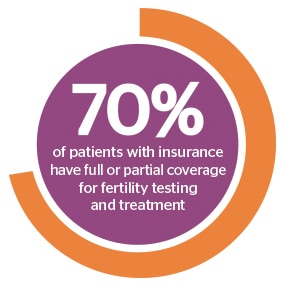
Shady Grove Fertility participates with over 30 insurance providers, making fertility treatment more accessible to patients. 90% of insured patients have coverage for their initial consultation.

  • Adventist Healthnet
  • Aetna
  • Amerihealth HMO
  • Anthem
  • Berkshire Health Plan
  • Capital BC/BS
  • Carefirst BC/BS of Maryland
  • Carefirst Blue Choice
  • Carefirst National Capital Area
  • Choice Care Network
  • CHP/Informed
  • Cigna
  • Coventry Healthcare National Network (Formerly First Health)
  • GreatWest Healthcare
  • Health America
  • Highmark BC/BS
  • Highmark BC/BS Premier
  • Health Keepers
  • Independence BC/BS
  • Intergroup
  • Kaiser
  • Keystone Health Plan East
  • Keystone Health Plan Central
  • MAMSI Life & Health
  • MDIPA/Optimum Choice
  • MultiPlan Network
  • OneNet PPO (Formerly Alliance PPO)
  • Parent Steps
  • Private Healthcare Systems
  • Tricare
  • United Healthcare
  • United Resource Network

Financial Options: Unique Fertility Programs

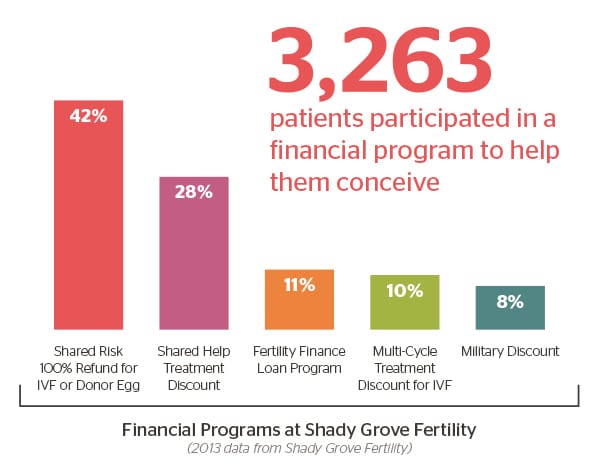
Shady Grove Fertility currently provides several financial programs to help ease the cost of treatment when insurance isn’t an option. In 2013, over 3,000 patients participated in one these unique programs.

100% Guarantee Programs

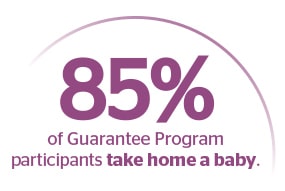
  • Shared Risk 100% Refund for IVF offers qualified patients up to six fresh cycles of IVF treatment as well as any resulting frozen embryo transfers. If the patient does not take home a baby or stop the program at any time, 100 percent of the fee is refunded. It’s that simple.
  • Shared Risk 100% Refund for Donor Egg is similar to the IVF program, with the exception that the patient will be using donated eggs for treatment. If the patient does not take home a baby or stop the program at any time, 100 percent of the fee is refunded.

Financing Options

  • Fertility Finance, LLC specializes in providing loans for all fertility treatments. An easy application process and competitive rates provide assistance with the financial aspects of care.

Discount Programs

  • Shared Donor Egg allows patients to share a donor with one or two other recipients  and therefore shares the cost of those donated eggs. Shared Donor Egg can reduce the cost of donor egg treatment by up to 50 percent.
  • Shared Help Discount Program offers a discount on all testing and treatment provided at Shady Grove Fertility.
  • Multi-Cycle Discount Program offers close to a 40 percent discount on multiple IVF cycles.
  • Military Discount offers active duty and reservists a 25 percent discount.

Financial Options – Fertility Grants

There are several organizations that offer grants for men and women going through fertility treatment. The Family Building Grant available through the Cade Foundation offers patients up to $10,000 towards fertility treatment. In recent years Shady Grove Fertility has helped raise over $500,000 for Cade Foundation and the Family Building Grants. The next deadline is quickly approaching – get more info on the Family Building Grant.

Foundations & Fertility Grants

  • Tinina Q. Cade Foundation – Family Building Grant
  • Pay it Forward Fertility Foundation
  • Baby Quest Foundation

If you would like to learn more about the financial options for fertility treatment available at Shady Grove Fertility or would like to schedule an appointment at Shady Grove Fertility, please speak with one of our New Patient Liaisons at 877-971-7755.

Filed Under: Insurance & Savings Tagged With: Cade Foundation, Shared donor egg, Shared Risk 100% IVF Refund Program

April 29, 2014 by Shady Grove Fertility

WMAR-ABC2 A Child at Any Cost: One Maryland couple’s journey from infertility to parenthood.

Last week, during National Infertility Awareness Week, Baltimore’s WMAR – ABC2 put a spotlight on infertility and all of the challenges associated with it: emotional, financial, and the different ways families are built. Trang Do shares the journey of Shady Grove Fertility patients, Tina and Jimmy Stone, and their long road to parenthood. In the interview, the Stones share their story and experience using donor egg for other couples who are dealing with the same struggles, to let them know that they are not alone. Watch the interview. 

“Never give up if you want a family, you’ll find a way.”  

The Stones began trying to conceive about one year after marriage, and like many couples, their journey was not as easy as anticipated. Filled with loss and heartache, their story has three very happy endings.

After a miscarriage and year of trying to conceive naturally, the Stones came to Shady Grove Fertility where their physician, Gilbert L. Mottla, M.D., diagnosed Tina with endometriosis. With this new diagnosis and previous surgeries and complications leaving Tina with one ovary, the Stones went straight to IVF. Determined to have children, the Stones overcame various financial and emotional hurdles utilizing the Maryland Mandate to cover 3 rounds of IVF. Unfortunately, each of were failed cycles so the couple turned to adoption. After adopting their daughter, Ella, they returned to Shady Grove Fertility to use the Shared Donor Egg Program and Shared Risk 100% Refund Program, fulfilling their dream of having children.

Watch the Stone Interview

Shared Donor Egg and Shared Risk

The Shared Donor Egg Program offers up to 6 cycles for a 100% money-back guarantee for the same cost as a traditional donor egg cycle. The pregnancy rates for patients who have selected this program are equal to the pregnancy rates of traditional egg donation. Shared Donor means that two or three recipient couples will be matched with one egg donor. The Shared Donor Egg Program, paired with Shared Risk essentially cuts the cost of donor egg treatment in half. Together, these programs gave the Stones confidence to try again knowing if it failed, they would get all of their money back to adopt again. Their message: One way or another it’s going to work out. Never give up if you want a family, you’ll find a way.

Learn more about financial options at Shady Grove Fertility:

  • Shared Risk 100% Refund Program for IVF & Donor Egg
  • Shared Donor Egg
  • Multi-Cycle Discount Program
  • Shared Help Fertility Treatment Discount
  • Insurance Participation
  • Fertility Finance
  • Fertility Grants

Want to Share Your Story? Fill out this form.

If you have questions about fertility or are ready to schedule an appointment at Shady Grove Fertility, please speak with one of our New Patient Liaisons at 877-971-7755.

Filed Under: Insurance & Savings Tagged With: Shared donor egg, Shared Risk 100% IVF Refund Program

August 21, 2013 by Shady Grove Fertility

Dr. Ricardo Yazigi

Every month, Shady Grove Fertility hosts a series of live webcasts to discuss topics such as Getting Started at SGF, Financial Programs, and Inside the IVF Lab. Last night, Dr. Eric Levens presented information about the Donor Egg Program. Here are some of the top audience questions from the presentation.

  • View an archived Donor Egg Program Webcast

Are you able to see pictures of the donors?

Yes, recipients are able to view childhood photos of all available donors as well as their adult photographs, if consented by the donor.

For the Shared Donor Egg Program, how are the eggs divided?

In the Shared Donor Egg Program, Shady Grove Fertility will divide the eggs between all of the recipients equally. For example, if you are the tertiary position in 1:3 match, you will receive the same amount and quality of eggs as the recipients in the primary and secondary positions. It is the goal for each recipient to receive at least four mature eggs per cycle.

Does every recipient in all of the three programs (1:1, 1:2 and 1:3) view all of the same donors in the database or does it depend on the program that you select?

Once you complete your pre-screening and select your program, you will then receive an access code to review and select your donor.
Some recipients want their donor to choose their program for them. Meaning, they will view all the available donors and when they find the donor that they like, whichever program the donor is in, that will be the program that they move forward with.
Otherwise, depending on the program you select, you could be looking at different donors. I have listed the breakdown below.

  • 1:1 Program: Views all donors in all of the 1:1, 1:2 and 1:3 program with the exception of any donors that have been selected by another recipient in the Shared Donor Egg Program
  • 1:2 Program: View donors in the 1:2 and 1:3 program with the exception of the donors in the 1:3 program that have already been reserved by a recipient in the 1:3 program
  • 1:3 Program: View all of the donors in the 1:3 program

How do you prioritize recipients for their positions in the 1:2 and 1:3 programs?

The recipients are placed in their match positions based on their history at Shady Grove Fertility. For example, if the following recipients are in a 1:3 match together:

  • Patient A has done two unsuccessful donor egg cycles with Shady Grove Fertility
  • Patient B is brand new to Shady Grove Fertility
  • Patient C has done one unsuccessful IUI cycle

Therefore, in this case, Patient A would be primary, secondary would be Patient C and tertiary would be Patient B since Patient B has not done any treatment at SGF.
If you are brand new to the Practice and starting the Shared Donor Egg Program, you should prepare yourself to be in the tertiary position. Again, the eggs are divided evenly and all three recipients are provided with the same quality eggs. The only downside to being the tertiary recipient is that you would be the first recipient to be cancelled if the donor does not produce enough eggs.

  • Sign up for a webcast!

If you would like to schedule an appointment to discuss your fertility treatment options, please speak with one of our New Patient Liaisons at 877-971-7755.

Filed Under: Treatment Tagged With: Donor egg, Shared donor egg

June 25, 2013 by Shady Grove Fertility

Shady Grove Fertility’s Donor Egg Program continues to grow and produce high success rates for patients. It is important to understand donor egg success rates and the implications it might have on your fertility treatment. Read the FAQs about our donor egg success rates.

What is the difference between the donor egg success rates and IVF success rates?

Depending on your age, the difference in success between the In Vitro Fertilization (IVF) and Donor Egg Program can be significant. In order to understand why the success rates are different it is important to understand how each treatment works.

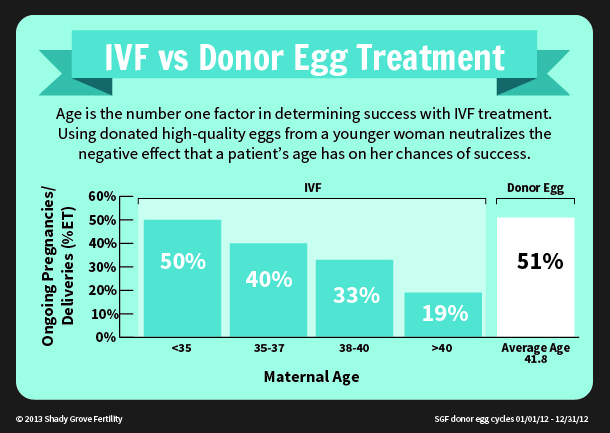
IVF uses the intended parents own eggs which are stimulated and matured through treatment. As a woman ages so do her eggs and with age we see decreased egg quality and quantity. A woman’s fertility potential decreases steadily from her mid 30s onward. The chart below shows a continual decrease in ongoing pregnancy and delivery rates after this point in a woman’s reproductive life. In 2012, a woman over the age of 40 had a 19% live birth rate with IVF treatment.

Donor egg treatment however, relies on the donated eggs from another woman between the ages of 21-32. Using the eggs from a younger woman cancels out the effect that a patient’s age has on her chances of success, explaining the overall absolute increase of 32%. Last year, women of all ages achieved a 51% live birth rate when using donor egg treatment.

What is the Shared Donor Egg Program and how does it impact my chances of getting pregnant?

Over the past 6 years, the Shared Donor Egg Program has significantly reduced the cost of donor egg treatment. Since its introduction, this program has increased the availability of donors, reduced the cost of treatment, and when paired with the Shared Risk 100% Refund Program brought an affordable guarantee of either a baby or a full refund.

After reviewing traditional donor egg treatment cycles – one donor to one recipient – the data began to show donors developed more mature eggs than one recipient would ever be able to use. With donors producing 18 eggs on average, there was recognition that recipients could share the eggs from a single donor.


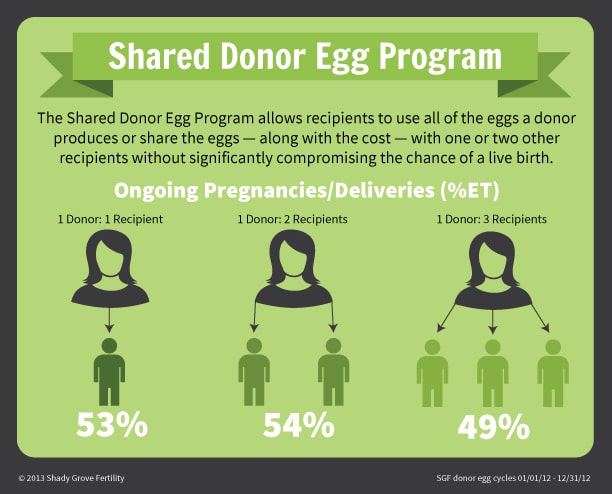
With the Shared Donor Egg Program recipients can either use all of the eggs a donor produces or share them along with significant cost savings between one or two other couples.

One of the many questions patients considering the Shared Donor Egg program have is “If I share donated eggs with another couple, will it decrease my chances of taking home a baby?” Since the start of Shared Donor Egg Program in 2007, the rate of ongoing pregnancy or delivery, whether or not you are sharing a donor’s eggs have remained very similar. This new donor egg treatment option is increasing access to fertility treatment without compromising the chances of taking home a baby

How many embryos should I transfer? Will transferring two or more increase my chances of taking home a baby?

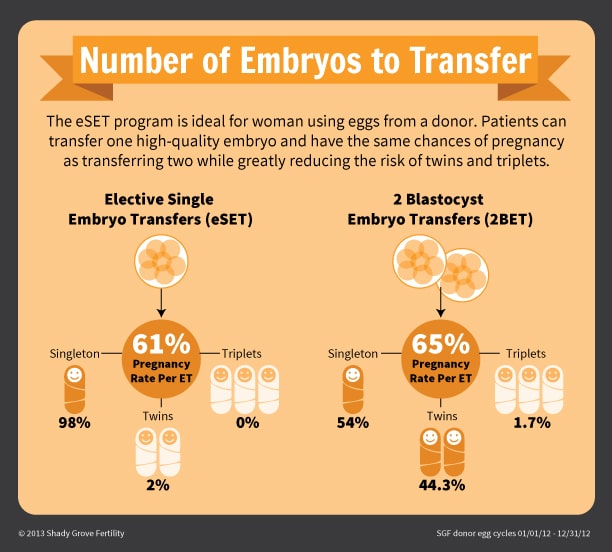
Shady Grove Fertility’s Donor Egg Program requires donors to be between the age of 21-32. Many women using donated eggs will find their physician recommending the transfer of 1 blastocyst stage embryo, when you may be used to transferring 2, 3 or maybe even 4 when you were using your own eggs. Deciding to transfer only one may feel very conservative. For a women in her late 30’s and into her 40’s where egg quality has declined, transferring more embryos is often the best decision but since recipients are using the high quality eggs from a young donor the data has shown that transferring more than one high-quality embryo only increases the chance of high-risk multiples, and only has a slight increase in pregnancy rates.


Deciding to move to donor egg treatment is not usually an easy choice. It is important to carefully consider the psychological issues and be well aware of the increased success rates attained with egg donation. Being well informed will help you make the decision that is right for you.

  • View Shady Grove Fertility’s complete donor egg success rates, including the use of frozen donor eggs and a gestational carrier.

If you would like to learn more about donor egg and other fertility treatment options, please request a consultation or call 1-877-971-7755.

Filed Under: Treatment Tagged With: Donor egg, Shared donor egg

  • Page 1
  • Page 2
  • Go to Next Page »

Company

  • About SGF
  • About US Fertility
  • Our Doctors
  • Fertility Equity
  • Careers
  • Newsroom
  • SGF College Scholarship
  • Contact Us
  • Voice Your Feedback

Treatments

  • Egg Freezing
  • Intrauterine Insemination (IUI)
  • In Vitro Fertilization (IVF)
  • Frozen Embryo Transfer (FET)
  • LGBTQIA+ Family Building
  • Shared Risk 100% Refund Program
  • All Treatments

Resources

  • Patient Portal
  • Online Bill Pay
  • Library
  • Support Groups & Events

Locations

  • California
  • Colorado
  • Delaware
  • Florida
  • Georgia
  • Maryland
  • North Carolina
  • Pennsylvania
  • Texas
  • Virginia
  • Washington, D.C.

2026 Shady Grove Fertility

  • Policies & Notices
Also of interest
  • In Vitro Fertilization IVF
  • Fertility Tests
  • Research Publications