• Skip to primary navigation
  • Skip to main content
  • Skip to footer
Shady Grove Fertility
  • Become an Egg Donor
  • Referring Physicians
  • 1-888-761-1967
  • Schedule Appointment
  • Get Started
        • Get Started
          • Causes of Infertility
          • Fertility Tests
          • When to Seek Help
          • Find a Doctor
          • Preconception and prenatal vitamins 
          • Schedule an Appointment
        • Personalized Care For
          • Single Parents
          • LGBTQIA+ Family Building
          • People with Cancer
          • Known Genetic Diseases
          • Egg Donors
  • Treatments
        • Fertility
          • Timed Intercourse
          • Ovulation Induction
          • Intrauterine Insemination (IUI)
          • In Vitro Fertilization (IVF)
          • Frozen Embryo Transfer (FET)
        • Donation & Surrogacy
          • Donor Sperm
          • Donor Egg
          • Donor Embryo
          • Gestational Carrier
          • LGBTQIA+ Family Building
          • Single Parents
          • Find a Donor
        • More Treatments
          • Center for Male Fertility
          • Egg Freezing
          • OncoFertility
          • Preimplantation Genetic Testing
          • MIGS
          • All Fertility Treatments
  • Resources
    • Resource Library
    • Events Calendar
    • Patient Stories
    • Mental Health
    • Wellness Center
  • Insurance & Savings
    • Insurance & Benefits
    • Shared Risk 100% Refund Program
    • 100% Refund for Donor Egg
    • Discounts
    • Egg Freezing Costs
    • Financing & Grants
    • Clinical Trials
  • About
    • Find a Doctor
    • About SGF
    • Our Care Team
    • Advanced Practice Providers
    • Fertility Equity
    • Philanthropy
    • Newsroom
    • Careers
    • Contact Us
    • Voice Your Feedback
  • Locations
        • Find a Location
        • California
        • Colorado
        • Delaware
        • Florida
        • Georgia
        • Maryland
        • North Carolina
        • Pennsylvania
        • Texas
        • Virginia
        • Washington, D.C.
        • Chile
        • International & Out of State
        • SGF at Walter Reed National Military Medical Center
  • Patient Hub
    • Online Bill Pay
    • Patient Forms
    • Patient Portal
  • Call your care team
  • Become an egg donor
  • Referring physicians
  • search-icon
  • Schedule appointment 1-888-761-1967

Home / General / Page 25

General

January 13, 2015 by Shady Grove Fertility

At Shady Grove Fertility, we are 100% committed to showing you respect … and this includes respect for your time. That’s why we’ve made the investment to increase our hours, expand our locations, and hire three new physicians – among the best in the country – to better serve you.

Choosing the largest and most successful fertility practice in the nation – with 22 offices in the Mid-Atlantic region and 32 reproductive endocrinologists – means that you will receive truly exceptional care. Our continued growth has not made us lose sight of our goals. In fact, with every new office we open and every new physician we welcome, we reiterate our commitment to you. All of our patients will receive the same extraordinary care, whether you are visiting one of our three accredited laboratories or one of our satellite locations. We will invest in you. The depth and breadth of our experience and commitment in you is something you can count on.

The following changes will help our patients have greater access to care in 2015:

    • A new monitoring suite in our expanded K Street location in Washington, D.C. This monitoring suite offers state-of-the-art technology with an additional exam room and a more comfortable waiting area to help patients move through the monitoring process with greater ease. The endocrinology and andrology labs will be expanding as well. In addition to this remodeled space, the K Street office is extending its hours and will open for weekend monitoring beginning in late January/early February 2015.
    • In the last two years we have opened six new locations in the Mid-Atlantic region in order to provide patients with increased accessibility and shorter travel times, including our Hagerstown, MD satellite location which has just reopened. Jason Bromer, M.D., will see patients in this location.
    • Renovations at our Rockville, MD office will begin in early 2015 and feature a larger waiting room.
    • SGF recently hired three new reproductive endocrinologists: Sunita Kulshrestha, M.D., practices in the Bala Cynwyd, PA office and was recently recognized as a “Top Doctor” by Main Line Today; Shruti Malik, M.D., practices in the Fair Oaks, VA office; and Kate Devine, M.D., will begin practicing in mid-January at the K Street and Sibley locations in Washington, D.C.

What does this mean for you? Shorter commute times? We hope. Reduced wait times for appointments? Ideally, yes. Access to the nation’s best in terms of fertility care? Absolutely.

“It’s important for Shady Grove Fertility as a practice to adapt and evolve with the needs of our patients. Our 2015 growth initiatives are examples of this evolution, increasing convenience and comfort for our patient community,” said Eric A. Widra, M.D., medical director of Shady Grove Fertility.

Patients can now schedule appointments for the Hagerstown, MD, location and the expanded schedule for our K Street location in Washington, D.C. To schedule a new patient appointment, please call 888-761-1967.


Filed Under: General Tagged With: Dr. Jason Bromer, Dr. Kate Devine, Dr. Shruti Malik, Dr. Sunita Kulshrestha

December 23, 2014 by Shady Grove Fertility

Medical Contribution by Rachana V. Garde, M.D.

The end of the year represents a period of reflection for many people, which leads into the time-honored tradition of making New Year’s resolutions. For infertility patients, they have a greater motivation than most, because making even the smallest lifestyle changes can make a big difference in helping them conceive.

Losing 5% of Your Body Weight Has Been Shown to Increase Chances of Conception

A woman’s BMI (body mass index) is strongly connected to her fertility potential. While not every woman who is underweight or overweight will have difficulty conceiving, there are many that do. In order for a woman’s reproductive system to function correctly, a healthy amount of fat needs to be present. Many underweight women lack the fat needed for reproduction, causing their bodies to ovulate infrequently or not at all. Even a modest weight gain can help restart the reproductive system.

Many overweight women will experience insulin resistance, which makes managing their weight difficult. Unbalanced insulin levels can cause the ovaries to produce excess amounts of male hormones and to stop releasing eggs. In both instances, ovulatory dysfunction caused by weight can make conception challenging.

Don’t forget about the male partner either. Overweight men have been shown to have abnormal semen, which manifests as low sperm count and low sperm motility. They are also at risk for impaired spermatogenesis (the process by which sperm are formed) because of increased scrotal temperatures.

In many women and men with a BMI that is above or below ‘normal’, diet, exercise, and lifestyle changes have been shown to make a significant difference in fertility potential. Studies have shown that women losing as little as five to ten percent of body weight can dramatically improve the chances of pregnancy occurring.

  • Pulling Down the Moon offers holistic health services to patients trying to conceive, including nutritional counseling and yoga.

You May Not Have to Wait as Long as You Think to Get Answers

We suggest that you come to a fertility specialist if you are struggling to conceive, as a woman’s natural chances of conception decline as she ages. In couples in which the woman is under 35, we recommend that she should have a complete infertility work-up if she has had 12 months of unprotected intercourse without conceiving. Women over 35 should have this evaluation after six months of trying to conceive and women over 40 should see a fertility specialist after three months of trying.

Everyone has known friends who aren’t “actively trying to conceive” but are having unprotected intercourse. When it comes to infertility, that time period should be considered when determining how long conception has been attempted. Additionally, if a woman doesn’t have regular periods, she should seek help sooner since she will likely have difficulty getting pregnant on her own.

We cannot control the effects of aging on fertility, but the sooner a patient meets with a fertility specialist, the better chances they will have for reproductive success.

Smoking Can Lead to Infertility for Both Men and Women

While everyone knows that smoking presents risks to your overall health, many do not realize the effect that it can have on their fertility. Studies have shown that women who smoke have a 54% chance of taking a year or longer to conceive compared to non-smokers. The delay in conception correlates with the daily quantity of cigarettes smoked. The more cigarettes a woman smokes, the more chemicals enter her body, increasing the rate of follicular depletion and reducing estrogen levels in the body.

Smoking cigarettes can also affect a man’s sperm quality. Men who smoke regularly have been found to experience a 22% decrease in sperm count. The shape of the sperm and its resulting ability to penetrate the egg (morphology) and the sperm’s ability to swim in a forward progression (motility) have also been seen to be effected in men who smoke regularly.

Studies have shown though that damage is not necessarily permanent for smokers and that it may be reversed, especially for males. Sperm regenerates every 74 days, enabling sperm generated after smoking has ceased to be unharmed. Smoking cessation is suggested at least two to three months prior to attempting pregnancy to improve overall sperm quality.

  • Counseling, education, and encouragement are essential for those that need to kick the habit. Read the Guide to Quitting Smoking.

Reduce Your Alcohol Intake

If you’re trying to get pregnant, you may consider cutting back on alcohol consumption. Alcohol can impact a couple’s ability to conceive more than one might think. Compared to women who consume no alcohol, women who consume a moderate amount (up to five drinks per week) have shown a decrease in fertility. Women who consume 10 alcoholic drinks per week show an even greater decrease in their chances of conceiving in a given cycle. Since there is no confirmed safe threshold of consumption, the U.S. Surgeon General recommends complete abstinence in women planning pregnancy, at the point of conception, and during pregnancy.

Excessive alcohol consumption in men may also impact fertility. Men who consume large quantities of alcoholic drinks (five or more daily) may experience lower testosterone levels and reduced sperm quality and quantity. As with smoking, reducing the amount of alcohol consumed can reverse these side effects since sperm regenerates every 74 days.

Cut Down on Stress by Focusing on Your Own Well-Being

For many women, their stress level may already be high when coming into treatment. To put yourself into the best frame of mind when you begin seeing a fertility specialist, we recommend joining a support group or trying more holistic therapies like yoga, acupuncture, or meditation. While these alternative therapies have not been proven to increase conception rates, it is important to control your stress when you are going through the treatment process. The better that you feel, the easier it will be.

Persistence with treatment does pay off. In women 35 years or younger who didn’t conceive on the first try, 50% of those will become pregnant with another cycle of IVF and another 30% of those remaining will have success on the third cycle, making the cumulative results for women in their IVF cycle to be 75%.

No matter what resolutions you decide to make for 2015, be sure to perform them in a way that’s comfortable for you. Don’t set too many goals at once if you think they’ll be insurmountable. The goal is to put yourself into the best possible state – both mentally and physically – for conception. Your health and well-being is what comes first – the rest will follow.
Happy New Year from Shady Grove Fertility!

If you would like to schedule an appointment with a fertility specialist, please speak with one of our New Patient Liaisons at 877-971-7755.

Filed Under: General

November 13, 2014 by Shady Grove Fertility

Medical Contribution by: Shruti Malik, M.D., FACOG
When people think about how weight affects their health, they focus on diseases and disorders. Diabetes, heart disease, and thyroid dysfunction aren’t the only health concerns that can exist though. Physicians have found that body mass index (BMI) can have a profound effect on a person’s fertility. Both men and women can be affected by their BMI when trying to conceive, whether they are underweight or overweight. For some, BMI might even be the cause of their infertility, which has led Shady Grove Fertility to increase patient education about the role that weight plays in trying to conceive. The following facts can help patients better understand how their BMI is affecting their fertility and what they can do to improve their chances of conception – as well as their own health.

What is the ideal BMI if I’m trying to conceive?

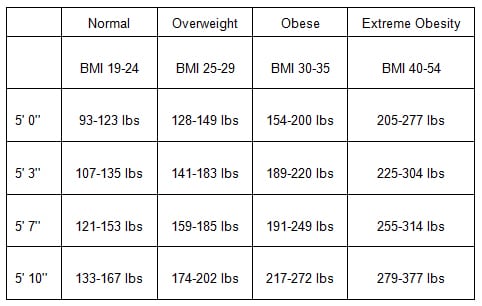
Body mass index (BMI) is a measure of your body fat based on height and weight. This measurement allows physicians to determine what sizes constitute being underweight, overweight, obese, or extremely obese. A normal (or “ideal”) BMI falls between 19 and 25. While women can be under or overweight and still conceive, the ideal BMI is what is recommended for a healthy pregnancy for both mother and baby.

  • Want to discover your BMI? Use the National Institute of Health’s (NIH) online BMI calculator.

BMI Weight Conversion Table

How is fertility affected by BMI?

A woman’s BMI is strongly connected to her fertility potential. While not every woman who is underweight, overweight, or obese will have difficulty conceiving, there are many that do. “Epidemiological data confirms that obesity accounts for the primary cause of infertility in 6% of infertility patients; additionally, low body weight in women also accounts for the primary cause of infertility in another 6% of patients [1],” says Shruti Malik, M.D., of Shady Grove Fertility’s Fair Oaks, VA office.

Weight becomes an issue at the very outset for some women due to ovulatory dysfunction. Women who are underweight are not getting enough nutrients, which can cause their bodies to ovulate infrequently or not at all. In overweight women, an increase in insulin levels may cause the ovaries to reproduce male hormones and stop releasing eggs. In both instances, ovulatory dysfunction can make conception very difficult.

In many women with a BMI that is above or below normal, diet, exercise, and lifestyle changes have been shown to make a significant difference in a woman’s fertility potential. In patients whose infertility is specifically due to weight, correction of the underlying disorder will lead to spontaneous conception in up to 70% of women [2]. Underweight patients who bring their weight up to the ideal level, and overweight patients who undergo significant weight loss, can often (though not always) begin to ovulate again. Studies have shown that losing as little as five-ten percent of body weight can dramatically improve the chances of pregnancy occurring [3].

Does BMI affect fertility treatment success rates?

While some women can gain or lose weight to achieve the ideal BMI for conception, this is not the case for everyone. Many patients will enter treatment when they are overweight (see “Do fertility centers have BMI restrictions for patients who need to undergo treatment?” below to find out SGF’s weight guidelines for treatment). Additionally, some patients have more factors affecting their fertility than just weight, making fertility treatment necessary irrespective of weight gain or loss.

For under or overweight patients, BMI can affect treatment as early as the stimulation phase. Women with a higher BMI are typically seen to have a lower response to medication used to regulate or initiate ovulation, which can lead to cancelled cycles.

“When women are under or overweight, their BMI has been found to impair successful outcomes for in vitro fertilization (IVF) cycles. During the egg retrieval procedure, it can be technically difficult to reach the patient’s eggs, so that consequently, chances of conception are decreased. Patients who are above or below normal range are also more likely to produce immature eggs during IVF cycles, which then leads to a lower chance of a successful embryo transfer,” Dr. Malik explains. “As a patient’s obesity increases, conception and pregnancy rates decrease as well.”

For patients with an above normal BMI who do conceive, they can have the following pregnancy complications:

  • Higher frequency of early pregnancy loss (miscarriage)
  • Greater anesthesia and surgical complications if any surgery required
  • Greater frequency of hypertension, gestational diabetes, pre-eclampsia, stillbirth, and other pregnancy complications. (Rates of stillbirth are twice as high in obese patients compared to those patients who have a normal BMI.)
  • Increased risks of requiring caesarean section delivery. The caesarean section rate is almost 50 percent higher in obese women and the postoperative complications following C-sections are significantly higher.
  • Due to larger babies, there is a greater delivery complication rate for those delivering vaginally.

In addition to these complications, we have also seen that obesity can affect outcomes in donor egg treatment. In 2013, SGF’s research department performed a study to see how obesity levels affected birth rates when a woman was the recipient of an egg from a donor. Donor egg treatment traditionally has the highest success rates in our IVF Program, but study results showed that an increase in recipient BMI was associated with a decrease in live birth. Live birth rates were reduced by 21 percent in those recipients with BMI greater than 35 compared to recipients with a lower BMI. There were no significant differences seen in recipients with BMI between 25-30 and 30-35 [4].
It is important to note that reducing BMI through weight loss has been demonstrated to significantly improve fertility treatment outcomes and to lower both treatment and pregnancy complications.

How is male fertility impacted by BMI?

As with women who have fertility complications related to BMI, men suffer from similar complications, since being under or overweight creates a body that is out of balance. When the body is out of balance, normal functions are affected. In men, abnormal semen parameters (i.e. low sperm counts and low sperm motility) have been seen to increase with obesity. “Obese men who are infertile have also been found to have a hormonal imbalance – characterized by decreased levels of testosterone and elevated levels of estrogen – which is an issue that may impair signals from the brain that regulate sperm development,” states Dr. Malik. Obese men are also at risk for impaired spermatogenesis, the process by which sperm are formed, due to increased scrotal temperatures.

Do fertility centers have BMI restrictions for patients who need to undergo treatment?

“At Shady Grove Fertility, we recognize that risks exist at elevated BMIs at or around 35, but that risks increase substantially at a BMI at or above 40 for patients undergoing IVF or a BMI at or above 44 for any patients conceiving through low-tech treatment. Thus, at SGF, patients must have a BMI less than 40 before initiating an IVF cycle and a BMI of less than 44 before initiating IUI cycles,” says Dr. Malik. IVF cycles have a lower weight threshold due to the increased surgical complications that can arise with greater BMI levels.

How can I modify my weight to improve my chances of conception?

iStock_000017754649XSmall

If you have been trying to conceive for more than one year, it is recommended that you meet with a fertility specialist. Through a review of your medical history and your diagnostic testing, it can be discerned if weight is the primary factor impacting your fertility or if there are other underlying causes. No matter the diagnosis though, patients are encouraged to maintain a healthy body weight when trying to conceive. We have seen remarkable improvements in treatment success in patients who are able to gain or lose weight, depending on their BMI designation. Balancing diet and limiting exercise was seen to help in underweight patients, and undergoing significant weight loss – which often led to the resumption of ovulation – helped overweight patients.

At SGF, our physicians provide many resources to help patients on their path to parenthood. This help may come in the form of a weight loss program with nutritional counseling, dietary modification, or an exercise program begun prior to treatment. “Our goal is for the patient to be in the best possible overall health before beginning treatment, which will ultimately help the expectant mother have the greatest chance of conception,” Dr. Malik says.

Ideal Weight and Fertility Success

There are many ways in which fertility specialists can help their patients overcome infertility. The majority of these treatment options involve medicinal stimulation, regular monitoring appointments, and for some, surgical procedures. In the case of BMI though, patients and physicians can work together to non-invasively help a woman or man reach an optimal weight for conception. Being aware of the importance of body weight on reproduction can enable couples to maintain their ideal body weight before they begin fertility treatment. When patients have their weight at the ideal level, it can greatly increase their chances of reproductive success and reduce potential risks and complications.

  • Pulling Down the Moon offers holistic health services to patients trying to conceive, including nutritional counseling and yoga.

References:

1. Green BB, Weiss NB, Daling JR: Risk of ovulatory infertility in relation to body weight. Fertil Steril  50:721, 1988.
2. Bates GW, Bates SR, Whitworth NS: Reproductive failure in women who practice weight control. Fertil Steril 37:373. 1982.
3. Clark AM, Ledger W, Galletly C, Tomlinson L, Blaney F, Wang X, Norman RJ: Weight loss results in significant improvement in pregnancy and ovulation rates in anovulatory obese women. Hum. Reprod. (1995) 10 (10): 2705-2712. 1995.
4. Zarek, Shvetha M., Mitchell, Emily M., DeCherney, Alan H., Richter, Kevin S., Devine, Kate, Browne, Paulette E., & O’Brien, Jeanne E. (2014). The effect of donor oocyte recipient obesity on live birth: an analysis of 3,922 shared donor oocyte assisted reproductive technology (ART) cycles. Abstract retrieved from Fertility and Sterility Sept. 2014: Volume 102, issue 3, e4.
5. “The Effect of Weight on Fertility.” Shady Grove Fertility Medical Update (n.d.) Web. 11 November 2014. (https://www.shadygrovefertility.com/sites/default/files/WeightNews_0.pdf)
6. “Weight and Fertility.” www.asrm.org, revised 2011. Web. 11 November 2014. (http://www.asrm.org/FACTSHEET_Weight_and_Fertility/)
7. Bates, G. William, M.D. “Abnormal Body Weight: A Preventable Cause of Infertility.” www.asrm.org, n.d. Web. 11 November 2014. (http://www.asrm.org/Abnormal_Body_Weight/)

Filed Under: General

November 12, 2014 by Shady Grove Fertility

“The purpose of this event was for women to have the knowledge to ultimately decide if egg freezing was the right choice for them. By educating and informing women, we are providing them with the opportunity to make a decision that they may not have known was possible before.” – Shruti Malik, M.D.

On Saturday, November 8, 2014, Shady Grove Fertility’s Dr. Malik was joined by four other presenters: Sarah Richards, New York Times contributor and author of Motherhood, Rescheduled; Eric Widra, M.D., SGF medical director and physician; Joseph Doyle, M.D.; and Candice Brown, egg freezing patient liaison; to discuss all aspects of egg freezing. The goal of the Egg Freezing Conference hosted by Shady Grove Fertility was to address the growing need in the Washington, D.C. area for an educational symposium on this revolutionary option for women. To achieve this goal, we covered all aspects of egg freezing in an open setting that let women know that they are not alone. One attendee noted:

It was refreshing to see other women who are in the situation and are young and attractive – it helps to know that I am not the only 32-year-old who is concerned about fertility.

At the very modern, yet comfortable and intimate, District Architecture Center in Washington D.C., we were very pleased with the high turn-out of the 50+ women and men who attended to learn about egg freezing. Sponsored by Ferring Pharmaceuticals, Freedom Fertility Pharmacy, and ReproSource, conference guests had the opportunity to hear from keynote speaker Sarah Richards, who provided a first-hand perspective of egg freezing and described how this growing movement has been shaped from a cultural and societal standpoint. Following Richards, Dr. Widra explained female reproductive physiology and how egg freezing can help to preserve a woman’s fertility.

“Ten years ago I wouldn’t have believed that I would be presenting to the community about egg freezing, but the technology has advanced in such a significant way that we can now provide verifiable cycle data and success rates,” said Dr. Widra.

Joseph Doyle, M.D., of Shady Grove Fertility’s Rockville, MD office, expanded further on Dr. Widra’s presentation, describing the science of vitrification technology and detailing how and why the program has seen such growth in the past few years, and how this technology has led to remarkable success rates, with over 200 babies being born from frozen eggs at the practice. Shruti Malik, M.D., of Shady Grove Fertility’s Fair Oaks, VA office, then went on to provide attendees with a comprehensive look at the clinical process that the patient would undergo in the Egg Freezing Program, covering the medications they would have to take and how the egg retrieval and egg transfer procedures would be performed.

The conference program closed out with an explanation of financial options available to egg freezing patients and an in-depth question and answer panel. Attendees were gratified to discover that there were options available to them and that they had the opportunity to meet with other women who were considering egg freezing.

The view the presentation covered at the 2014 Egg Freezing Conference hosted by Shady Grove Fertility, please visit: 2014 Egg Freezing Conference Slide Presentation

  • View the financial options available for egg freezing
  • Learn more about the clinical process

If you would like more information about egg freezing or would like to schedule an appointment, please fill out this brief form or call 1-877-411-9292 to talk with egg freezing patient liaison Candice Brown.

Filed Under: General Tagged With: Dr. Eric Widra, Egg freezing, In the news

November 6, 2014 by Shady Grove Fertility

“1 in 8 couples will struggle with infertility, and while the causes may vary, there are ways to make those dreams come true.”

ABC27 in Harrisburg, Pennsylvania recently interviewed Shady Grove Fertility patients Stephanie and Kenny Myers about their experience with donor egg treatment. Stephanie and Kenny began their family in their 20s and had their first son, Gavin. Soon after, they began trying for their second child, but they experienced unexpected adversity, with Stephanie having five miscarriages and ultimately having to remove both ovaries. The couple was devastated, but their physician, Dr. Melissa Esposito of Shady Grove Fertility’s Harrisburg, PA office, was able to give them hope:

“When using donor egg treatment, we can transfer one embryo and have a 55-65% success rate. For some of our patients, it’s so sad to see what they’ve gone through for years and years, feeling so hopeless and helpless. But with donor egg, you’re then able to help make their dreams come true.”

Stephanie and Kenny began looking for a donor on SGF’s donor database. They selected a woman who had very similar features to Stephanie. After the donor’s eggs were retrieved, a single embryo was transferred to Stephanie. She became pregnant with her second son and he was born in January. “It was the best feeling in the world,” said Stephanie.

Donor Egg Treatment: The Great Equalizer

Donor egg treatment is needed by women who are unable to use their own eggs to conceive, but are still able to carry a child in their uterus. While women in their 20s and 30s may need donor egg treatment, it becomes more common as women increase in maternal age, as a woman’s ovarian reserve decreases in quantity and quality. In SGF’s Donor Egg Program, donors are between the ages of 21 and 32 and have been thoroughly screened, both medically and psychologically. When a patient (known as the recipient) selects a donor from our database, she gives herself the greatest opportunity for a successful pregnancy due to a donor’s young age – which should yield better quality eggs and a greater quantity of eggs. The Donor Egg Program has the highest of all success rates in our In Vitro Fertilization (IVF) Program.

  • Read an in-depth look at donor egg treatment at SGF
  • View 2013 success rates for the Donor Egg Program

If you have been having trouble conceiving or would like to learn more about donor egg treatment, please call our new patient liaisons at 877-971-7755 or click to schedule an appointment.

Filed Under: General Tagged With: Donor egg

October 28, 2014 by Shady Grove Fertility

With Shady Grove Fertility’s inaugural Egg Freezing Conference less than two weeks away, we are excited to unveil our event program and announce our keynote speaker Sarah Richards. Sarah is a New York Times contributor and the author of Motherhood Rescheduled, and she has extensively documented her own egg freezing journey in several publications.

The 2014 Shady Grove Fertility Egg Freezing Conference will take place on Saturday November 8, 2014 from 9:30 a.m. – 12:30 p.m. at District Architecture Center in Washington, DC. The conference will feature a series of discussion panels on egg freezing; networking time with vendors, physicians, and other attendees; and breakfast will be served. The program* will proceed as follows:

9:30 a.m. – Welcome Address 

    Michele Purcell, the Director of the Egg Freezing Program at Shady Grove Fertility, delivers the conference opening address.

9:55 a.m. – Keynote Speech

Sarah Richards, New York Times contributor and author of Motherhood Rescheduled, provides conference attendees with a national perspective of egg freezing, where it has been and where it is going, as well as the long term benefits and implications of making the decision to freeze.

10:30 a.m. – Fertility 101

Shady Grove Fertility’s medical director, Eric Widra, M.D., presents an overview of a woman’s fertility, from a biological and physiological perspective.

Eric Widra, M.D.

11:10 a.m. – An Introduction & Overview of Egg Freezing

Joseph Doyle, M.D.
Shruti Malik, M.D.

Joseph Doyle, M.D. of Shady Grove Fertility’s Rockville, MD office, and Shruti Malik, M.D. of Shady Grove Fertility’s Fair Oaks, VA office, walk attendees through the egg freezing process, covering the technology, the necessary testing, and the success rates.

11:30 a.m. – Financial Options

Candice Brown, the new patient liaison for the Egg Freezing Program, explains the costs of treatment and medication, as well as the many unique financing options that Shady Grove Fertility has to offer.

11:45 a.m. – Q&A Panel with Conference Presenters

Attendees will have the opportunity to address Michele, Sarah, Candice, Dr. Doyle, and Dr. Malik in a half-hour Q&A panel.

Upon conclusion of the Q&A Panel, attendees will have the opportunity to meet one-on-one with physicians, visit our sponsor booths, and network with one another.

If you are interested in attending this one-of-a-kind conference, please register as soon as possible. Attendance is free, but space is limited. We look forward to seeing you there!
* Program content is subject to change

Egg Freezing Events and Resources:

  • Archived Egg Freezing Webcast: An overview of our program
  • Financial Information
  • Register for the Upcoming Egg Freezing Conference on November 8th
  • Discuss your questions and/or concerns with a New Patient Liaison by filling out this form or calling 1-877-411-9292.

Filed Under: General Tagged With: Dr. Eric Widra, Egg freezing

  • « Go to Previous Page
  • Page 1
  • Interim pages omitted …
  • Page 23
  • Page 24
  • Page 25
  • Page 26
  • Page 27
  • Interim pages omitted …
  • Page 46
  • Go to Next Page »

Company

  • About SGF
  • About US Fertility
  • Our Doctors
  • Fertility Equity
  • Careers
  • Newsroom
  • SGF College Scholarship
  • Contact Us
  • Voice Your Feedback

Treatments

  • Egg Freezing
  • Intrauterine Insemination (IUI)
  • In Vitro Fertilization (IVF)
  • Frozen Embryo Transfer (FET)
  • LGBTQIA+ Family Building
  • Shared Risk 100% Refund Program
  • All Treatments

Resources

  • Patient Portal
  • Online Bill Pay
  • Library
  • Support Groups & Events

Locations

  • California
  • Colorado
  • Delaware
  • Florida
  • Georgia
  • Maryland
  • North Carolina
  • Pennsylvania
  • Texas
  • Virginia
  • Washington, D.C.

2026 Shady Grove Fertility

  • Policies & Notices