

• Skip to primary navigation
  • Skip to main content
  • Skip to footer
Shady Grove Fertility
  • Become an Egg Donor
  • Referring Physicians
  • 1-888-761-1967
  • Schedule Appointment
  • Get Started
        • Get Started
          • Causes of Infertility
          • Fertility Tests
          • When to Seek Help
          • Find a Doctor
          • Preconception and prenatal vitamins 
          • Schedule an Appointment
        • Personalized Care For
          • Single Parents
          • LGBTQIA+ Family Building
          • People with Cancer
          • Known Genetic Diseases
          • Egg Donors
  • Treatments
        • Fertility
          • Timed Intercourse
          • Ovulation Induction
          • Intrauterine Insemination (IUI)
          • In Vitro Fertilization (IVF)
          • Frozen Embryo Transfer (FET)
        • Donation & Surrogacy
          • Donor Sperm
          • Donor Egg
          • Donor Embryo
          • Gestational Carrier
          • LGBTQIA+ Family Building
          • Single Parents
          • Find a Donor
        • More Treatments
          • Center for Male Fertility
          • Egg Freezing
          • OncoFertility
          • Preimplantation Genetic Testing
          • MIGS
          • All Fertility Treatments
  • Resources
    • Resource Library
    • Events Calendar
    • Patient Stories
    • Mental Health
    • Wellness Center
  • Insurance & Savings
    • Insurance & Benefits
    • Shared Risk 100% Refund Program
    • 100% Refund for Donor Egg
    • Discounts
    • Egg Freezing Costs
    • Financing & Grants
    • Clinical Trials
  • About
    • Find a Doctor
    • About SGF
    • Our Care Team
    • Advanced Practice Providers
    • Fertility Equity
    • Philanthropy
    • Newsroom
    • Careers
    • Contact Us
    • Voice Your Feedback
  • Locations
        • Find a Location
        • California
        • Colorado
        • Delaware
        • Florida
        • Georgia
        • Maryland
        • North Carolina
        • Pennsylvania
        • Texas
        • Virginia
        • Washington, D.C.
        • Chile
        • International & Out of State
        • SGF at Walter Reed National Military Medical Center
  • Patient Hub
    • Online Bill Pay
    • Patient Forms
    • Patient Portal
  • Call your care team
  • Become an egg donor
  • Referring physicians
  • search-icon
  • Schedule appointment 1-888-761-1967

Home / General / Page 23

General

December 4, 2015 by Shady Grove Fertility

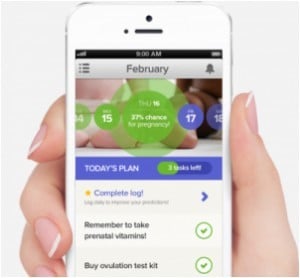
Almost three years ago PayPal co-founder Max Levchkin introduced the free fertility app Glow with the goal of helping more couples achieve their dreams of parenthood. On its site, Glow describes its mission as, “Womanhood: demystified by data.” For millions of women around the world, GLOW offers more than just comprehensive menstrual and fertility calendars. People can connect through the forums, asking and answering each other’s questions. Similarly, partners can connect and log their individual daily health information including their mood, medications, exercise regimen, and a range of physical symptoms. In the newest version, 5.2.0, users can even upvote and downvote topics and comments in the community section to quickly access useful, relevant content.

Glow Fertility App Wins Best Health and Fitness App Award

As the winner of the 2014 Webby award for best health and fitness app, Glow helps users forecast their ovulation and upcoming periods with period tracker predictions that get smarter over time. With its built-in sophisticated data analysis, Glow’s personalized reproductive health and fertility insights offer users a trove of helpful information, even medication reminders. Its daily health log helps users track over 40 different health signals, including basal body temperature, sleep, stress, weight, exercise, and more.

Shady Grove Fertility Physicians Recommend Glow Fertility App to Patients

Last week in the Chicago Tribune, Shady Grove Fertility’s Isaac Sasson, M.D., Ph.D., of the Chesterbrook, PA, office, remarked that the app helps women, “become much more aware and in tune with their body;” therefore he (and many other SGF physicians) recommends this app to patients. The Tribune article goes on to say that the app can also help women feel more in control of their fertility.

Sasson considers GLOW, and other fertility apps, helpful because patients can bring the data directly to their doctors, who can in turn work with them to decide the best treatment plan; however, he advises the app should not replace the interaction between physician and patient.

Shady Grove Fertility Physician Provides Expert Commentary within Glow Fertility App

Shady Grove Fertility has partnered with Glow since 2014 and we are pleased to announce that one of our physicians, Shruti Malik, M.D., of the Fair Oaks, VA, office will begin participating regularly in Glow’s “The Doctor is in” conversation. Like the co-founders of Glow, Shady Grove Fertility believes that by working together as a community, we will help inform and educate the public about fertility.

In addition to physician support like Dr. Malik’s, Shady Grove Fertility works with Glow in a number of ways, sharing and collecting information. On Glow, Shady Grove Fertility provides general fertility information and creates user polls. Shady Grove Fertility also announces fertility events and provides guidance for patients who are navigating through financial and insurance.

Click to read the entire Want to boost (or reduce) your chance of getting pregnant there’s an app for that article. You can download the Glow app here, or on itunes.

Visit our website to learn more about fertility health. If you wish to speak with someone, please call (888) 761-1967 or fill out this form to schedule an appointment.


Filed Under: General

December 2, 2015 by Shady Grove Fertility

For over two decades we have harnessed the power of the internet to help in every facet of life, from dating, to shopping, to medical questions. When it comes to fertility, a topic not generally discussed at dinner parties or lunches with friends, looking for information online prior to a doctor’s visit can provide either helpful reassurance or added stress. But either way, researched information does not necessarily hold the answers for fertility questions. Last week, Shady Grove Fertility’s Isaac Sasson, M.D., Ph.D., told the Chicago Tribune, “There is lots of good information out there but also lots of myths and unproven remedies.” Adding to the potential confusion is the recent flurry of apps that have replaced hand-written calendars and notebooks to help track physical indications of fertility. While this data can be helpful, there are many generalities that can lead to misconceptions about your fertility before you have stepped through your doctor’s front door.

With help from Dr. Sasson and fertility specialists around the country, the Chicago Tribune’s Alison Bowen rounded up the most common fertility myths and facts.

Fertility Myth #1: Day 14 is not always the target number.

Since high school health class we’ve been taught that a woman’s menstrual cycle is 28 days long, which (divided in half) makes day 14 the right day to try to conceive. The truth is that most women don’t ovulate on a 28-day cycle, so longer or shorter cycles will change the ideal date for conception. According to the article, 65 percent of women ovulate outside of days 13 to 15.

Fertility Myth #2: Wait a year before seeing a doctor.

At Shady Grove Fertility, we advise couples to learn as early intervention leads to the most favorable outcomes. When a woman is under 35, we recommend couples try for 1 year before consulting a physician. Sasson told the Tribune that couples 35 and older should check in at 6 months, and even sooner for over 40. Women with previously known conditions such as polycystic ovary syndrome (PCOS), frequently irregular periods, or recurring miscarriages should see a specialist immediately; along with men who have known lower testosterone levels.

Fertility Myth #3: I’m in good shape so my fertility must be too.

Your healthy diet and strict workout routine won’t affect your ovarian reserve or indicate how long it’ll take to get pregnant. “I think the common myth that I hear is, ‘I’m young, and I’m healthy; I’m not going to have any trouble,'” Sasson said. One of the best indicators of a woman’s fertility is her anti-Müllerian hormone (AMH) level. This hormone level provides insight into a woman’s current egg supply, or how many eggs a woman has. At Shady Grove Fertility, we recommend women who are either trying to conceive or who are considering freezing their eggs for future use, to have their AMH tested.

Fertility Myth #4: Taking testosterone helps produce more sperm.

For men who are diagnosed with low testosterone, physicians caution that artificial testosterone—whether in the form of a gel, injection, or long-acting pellet—can “trick” the brain into thinking the production of testosterone from the testicle is higher than it actually is. Thus, with testosterone supplements, the natural response is for the pituitary to start reducing the “charge” to the testicle that normally leads to sperm production. Over a few months, this under stimulation effect actually leads to significantly lower sperm production. Bottom line for men, during their most fertile years, physicians advise to avoid low testosterone products completely.

Fertility Myth #5: It’s ok if I wait to start a family until I’m 35.

The reality is, a woman’s age is the number one indicator of fertility potential. However, the common misunderstanding is that fertility potential does not change until much later in life. Often, Sasson said, “women think that their fertility will continue until menopause. The truth is that it’s not easy to have a baby for anybody at any age. We talk about 35 as an important number, because at 35, egg quality significantly starts to decline.”

Age is an important factor for both men and women. As men age, their testosterone levels decrease, affecting the quality and quantity of their sperm. As a woman ages, both her egg quantity and quality decreases. At 20 weeks gestation, women have about 6 million eggs; by the time a woman reaches puberty, she will only have about 200,000 eggs left. This decrease is steady until about the age of 35, when the decline in fertility starts to expedite.  For example, “At 35 years old, I would expect about 50 percent of the eggs to be normal, compared with about 75 percent of eggs in a 25-year-old,” Sasson explains.

With many couples trying to conceive in their mid-to-late 30s, conception has become more difficult. The good news is that vitrification, the most reliable flash-freeze technology, is available for couples who wish to freeze embryos or women who wish to freeze their eggs for future conception.

Click to read the entire 5 Common Fertility Myths article.

Visit our website to learn more about fertility health. If you wish to speak with someone, please call (888) 761-1967 or fill out this form to schedule an appointment.

 

Filed Under: General

November 10, 2015 by Shady Grove Fertility

This week the Washington Post took an in-depth look at male infertility, asking what role men play in conceiving healthy children and addressing long-held assumptions about the effect the age of both parents has on children. Since the arrival of birth control and the rise of women in the workforce over 40 years ago, the focus on fertility has been squarely on women. Countless studies show that once a woman reaches 35 her fertility decreases markedly and, traditionally, most people erroneously consider fertility—or infertility—a female problem.

Beginning with the baby boomers (who will begin turning 70 in 2016), the age of parenthood has steadily risen. A hundred years ago it was common for couples to begin having children in their late teens and early 20s. That number has dramatically declined and more men and women are waiting until their 30s and 40s to start families. Culturally this shift has largely been attributed to the wide availability of birth control that coincided with the baby boomer women entering the work force en masse in the 1970s. It was only then that the term “biological clock” entered into our cultural lexicon to describe the condition of women who were putting off having children. However, this term has not been applied to men until recently.

As a society many have assumed that men don’t face the same struggles or risks as they age as women do.  This is beginning to change.

The Impact of the Male Biological Clock

In 2005, New York-based urologist Harry Fisch, M.D. popularized the idea of the male biologic clock in his book, “The Male Biological Clock,” stating that both men and women suffer from declining fertility as they age. For women, this decline begins in their 30s while men’s fertility appears to change in their 40s and 50s. Like women, factors like smoking, stress, and weight all have an effect on men of all ages.

Recent research suggests that older paternal age can play a more significant role in a couple’s infertility than previously thought. Natural declines in hormone levels and sperm counts, as well as higher rates of obesity and sexual dysfunction pose significant obstacles to older men building their families. Conditions like autism, schizophrenia, and early onset cancer also may be linked closer to advanced paternal age. The genetics behind these conditions are largely unknown and require much more scrutiny. The study of this linkage is also challenging because these disorders may present with varying levels of severity and may take years to manifest. It is important to note that the overall risks remain very low. While this new research is helpful, there is still much more to learn about how a father’s age affects conception, pregnancy, and the overall health of an offspring.

Paul R. Shin, M.D., reproductive urologist with Shady Grove Fertility adds, “Lifestyle changes are a matter of common sense. We all know the things we should be doing. Healthy nutrition, regular exercise, weight management, and discontinuing harmful habits such as smoking and excess alcohol or drug consumption are all key components of maximizing a man’s ability to build his family.”

Treating Male Factor Infertility & Genetic Conditions

While male factor infertility can happen at any age with many causes, there are often steps a man can take to proactively combat male infertility. For many men, improving diet and maintaining a healthy lifestyle, including quitting smoking, can resolve issues within a few months. Also, men should review medications and supplements with their physician to see if any may have an impact on sperm count or quality.

For patients where a genetic mutation may be a concern, preimplantation genetic diagnosis (PGD) with in vitro fertilization (IVF) may be an option. PGD involves testing embryos for an assortment of genetic conditions. A reproductive endocrinologist can then select only an embryo(s) that does not present with genetic abnormalities for transfer.

Check out the full post at The Washington Post: Why men should also worry about waiting too long to have kids

Shady Grove Fertility’s team of dedicated New Patient Liaisons is available to answer your questions regarding the male biological clock. Call 877-971-7755 or click to schedule an appointment. 

Filed Under: General

October 13, 2015 by Shady Grove Fertility

As of September 2015, Shady Grove Fertility patients can now keep track of their fertility testing and treatment cycles through Glow, a mobile app. In addition to this new function, the app now offers a private forum for Shady Grove Fertility patients. By taking advantage of both new features, SGF patients can connect and engage with each other as well as take advantage of a useful and functional tool to help manage the clinical aspects of their treatment.

What is Glow?

The winner of 2014 Webby for best Health & Fitness app, Glow is a free mobile application available for iOS (iPhone, iPad, etc) and Android 4.0 and up users that offers women and (as of April 2015) men the ability to track 40+ different health signals, including basal body temperature, cervical mucus, sleep, weight, and stress, in order to receive insights about their reproductive health. By having women track their ovulation, and men track more lifestyle-related activities such as sleep, fitness, and scrotal proximity to heat, Glow can inform couples of their fertile window and other helpful insights about conception.

Along with the app, Glow First is a not-for-profit fund for women trying to conceive. Qualified participants contribute $50 per month over the course of 10 months. This money goes into a pool that Glow First will equally divide among any participants who did not achieve a natural pregnancy after 10 months while using the Glow app. Glow’s founder, Max Levchin, co-founder and former Chief Technology Officer of PayPal, has personally donated $1 million to Glow First.

How is Shady Grove Fertility connected to Glow?

Glow works with some of the best physicians and teams in the fertility community—including Shady Grove Fertility. SGF’s physician team has provided the app with medically sound content about fertility options, how to interpret success rates, common causes of infertility, when to seek help from a fertility specialist, and much more. Shady Grove Fertility is proud to be working with an organization dedicated to helping increase access to elective healthcare, such as fertility treatment.

Learn more about Glow:

  • Read about Glow at Time.com
  • Glow’s Press Release Announcing New App

 If you would like to schedule an appointment with a fertility specialist, please speak with one of our New Patient Liaisons at 877-971-7755.

Filed Under: General

July 14, 2015 by Shady Grove Fertility

Weight gain is one of the most common side effects associated with polycystic ovary syndrome (PCOS). Recently, Creating a Family Radio interviewed Sunita Kulshrestha, M.D., of Shady Grove Fertility’s Chesterbrook, PA, office, and Hillary Wright, a registered dietitian and Director of Nutrition Counseling for the Domar Center for Mind Body Health at Boston IVF in Boston, MA, to discuss how to identify and treat PCOS as well as dietary and lifestyle changes to improve PCOS symptoms.

  • Listen: Creating a Family – The PCOS Diet Plan

How does PCOS affect weight and metabolism?

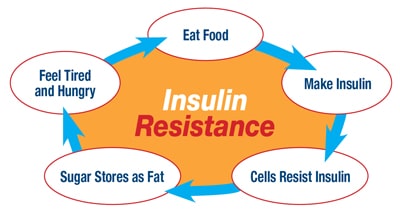
The main biochemical problem behind PCOS is insulin resistance. Insulin is a hormone that is critical in numerous metabolic roles that have to do with glucose and a body’s metabolism. In women who have PCOS, their body thinks there isn’t enough insulin, so the body tries to produce more. This increase sets off a chain reaction and tells the body to produce a higher level of male hormones. Obesity itself, separate from PCOS, is also associated with insulin resistance. Due to this, it’s easier for a woman with PCOS to gain weight and harder for her to lose it.

Is PCOS the same as metabolic syndrome or prediabetes?

In a sense, they share the same biochemical defect: the early stages of prediabetes show insulin resistance as seen in PCOS. As prediabetes worsens, insulin resistance can lead to glucose intolerance and eventually to diabetes. One of the risks of PCOS, apart from fertility issues, is that you are more likely to end up with diabetes—7.5 percent of women with PCOS have borderline glucose levels and/or diabetes.

How can diet ease symptoms of PCOS?

With PCOS, the goal is to manage insulin resistance rather than just weight loss. Insulin resistance as a condition—with or without PCOS—can make it easier to gain weight and harder to lose it. Managing insulin resistance will increase the likelihood that the weight loss will follow. Studies have shown that a reasonable amount of weight loss can make a woman with PCOS have a better response to fertility treatment.

Is there a type of food that women with PCOS or insulin resistance crave?

Credit: Whole Health Insider


If you ask most women with PCOS, they’ll tell you they frequently crave carbohydrates. This is part of the insulin resistance syndrome. Insulin is a hormone that regulates blood sugar levels. If your blood sugar goes down, your brain will know that carbs will bring your blood sugar back up. Carbs aren’t a dirty word, though. It’s about the quality of carbs and the quantity you’re consuming in any one sitting.

Is there a PCOS diet? What type of diet is best for a woman who has PCOS?

The bulk of evidence so far shows that the ideal PCOS diet is more moderate in carbs. You should have a balanced plate: take a plate, ideally a salad plate, and draw a line down the middle. Half of the plate should be non-starchy vegetables, a quarter of the plate should be healthy protein, and then the remaining quarter should be nutrient-rich starch like brown rice or sweet potatoes, legumes or beans or quinoa. With your diet, find that middle ground where you can go and live, not go and visit temporarily. Carbs are the primary fuel for the human body, but we are eating more than we need. Find a healthy balance that’s sustainable.

Quinoa-PlateIs it better to eat three healthy meals and not snack, or is better to spread eating throughout the day?

If you look at data for people who lose weight and keep it off, they eat an average of 4 to 5 times per day. If you have PCOS, spreading your carbs into smaller meals and snacks throughout the day can help lower your post-meal blood sugar levels. If you think of hunger on a scale of 1-10, research tells us that people are more mindful eaters and eat less if they address their hunger when they’re at a 5 or 6 and no more than that. Frequently we wait until we’re starving and then the central nervous system says you went too long and it’s getting under-fueled. Then you eat whatever is quickest and easiest with more carbs than you need, which shoots up your insulin levels and then knocks them back down again, making it more difficult to lose weight.

Is there any research that would indicate that exercise has a separate benefit for PCOS besides losing weight?

Yes. The vast majority of people who lose weight and keep it off utilize diet and exercise strategies. Exercise is important for weight loss and is critical to maintain weight loss and muscle mass. The more muscle mass people have, the more effectively they’ll be able to clear blood sugar.

Insulin resistance also improves naturally with physical activity. Even without weight loss, people with prediabetes are less likely to get diabetes if they exercise.

Do women with PCOS always have problems trying to conceive?

Not always, however, women with PCOS may have irregular periods or chronic anovulation that can affect fertility. Think of it in these terms: a woman who ovulates monthly has 12 opportunities a year to get pregnant, but a woman who ovulates 5 times per year (for example) has fewer opportunities. Thus, it can make trying to conceive more difficult.

What type of doctor does a woman need to see if she thinks she has PCOS?

It depends on whether or not she’s trying to get pregnant. If a woman has PCOS symptoms, she can start with a primary care physician or endocrinologist to manage the PCOS. But if she’s looking to become pregnant, she should seek help from an OB/GYN or a fertility specialist.

Are there any medications a woman with PCOS may consider if she’s trying to conceive?

For a woman actively trying to get pregnant, there are medications available to help her ovulate and achieve pregnancy. These medications include Clomiphene citrate (Clomid), letrozole (Femara), or hormone injections of follicle-stimulating hormone (FSH). These medications may also be taken in conjunction with intercourse at home or intrauterine insemination (IUI) or in vitro fertilization (IVF). In terms of other medications, there’s also metformin, a diabetes drug that can be used in women to help decrease insulin resistance.

If you would like to learn more about the PCOS diet, or to schedule an appointment, please speak with one of our New Patient Liaisons at 877-971-7755 to schedule an appointment.

Filed Under: General

July 9, 2015 by Shady Grove Fertility

Naveed Khan, M.D.

Medical contribution by Naveed Khan, M.D., of Shady Grove Fertility’s Leesburg, VA, office

When you hear the words ‘menstrual cycle,’ you may automatically assume that it’s just a more clinical way of describing your period. But your menstrual cycle is actually much more than that and has the potential to affect your fertility. Thus, when you are having trouble trying to conceive, it’s very important for your physician to gather information about your menstrual cycle in order to help establish an accurate diagnosis and treatment plan.

What is Your Menstrual Cycle?

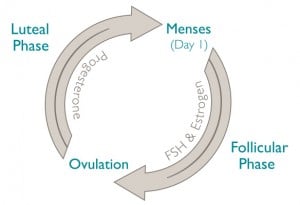
The menstrual cycle is a series of changes that a woman’s body goes through each month in which the ovary releases an egg and the uterus prepares for pregnancy. This cycle can be divided into two phases: the follicular phase and the luteal phase.

  • The follicular phase

The first day of your period (or menses) is day 1 of your cycle and the start of the follicular phase. During this time, the brain releases follicle-stimulating hormone (FSH) to stimulate the development of a single dominant follicle that contains one egg. While the follicle matures, it will release estrogen to stimulate the growth of the uterine lining. Once ovulation begins, the follicular phase has concluded. While this phase averages about 14 days, the length can vary, creating variations in total cycle length.

  • The luteal phase

The luteal phase begins with ovulation and continues until the onset of your period. During this phase, the ovary will release progesterone—a hormone that matures the uterine lining and prepares it for the implantation of an embryo. If pregnancy does not occur, the progesterone level drops and bleeding occurs. This phase can average 14 days.

Does Cycle Length Matter?

The length of your menstrual cycle is determined by the number of days from the first day of bleeding to the start of the next period. The length of your cycle—while not on any form of birth control—can be a key indicator of hormonal imbalances and whether or not ovulation is occurring in a regular manner. If ovulation does not occur, pregnancy is not possible.

  • Normal menstrual cycle

A normal menstrual cycle lasts from 21 to 35 days. If you have a normal menstrual cycle, regular ovulation should be occurring and all hormones should be in balance, making natural conception possible.

  • Short menstrual cycle

A short menstrual cycle is anything shorter than 21 days. Shortened cycles can be an indication that the ovaries contain fewer eggs and that menopause may be approaching. As the number of eggs in the ovaries decrease, the brain releases more FSH to stimulate the ovaries to develop a follicle. This results in earlier development of the follicle and earlier ovulation, creating shortened cycles. This can make conception more difficult.

  • Long or irregular menstrual cycle

A long menstrual cycle lasts more than 35 days. Longer cycles are an indicator that ovulation is not occurring or at least not occurring in a regular manner. This lack of ovulation is known as anovulation. There are many potential causes of anovulation, such as:

  • irregularities with the thyroid gland
  • elevations of the hormone prolactin that can disrupt the brain’s ability to communicate with the ovary
  • polycystic ovary syndrome (PCOS)

These hormonal imbalances lead to problems with ovulation and fertility, but they may also increase the risk of miscarriage.

  • Read about the most common cause of female infertility: problems with ovulation

What Does it Mean if Menstrual Bleeding Lasts More than 7 Days?

The normal length of bleeding for women is 2 to 7 days. Anything longer than 7 days is known as prolonged bleeding. Prolonged bleeding tells your physician that either ovulation is not occurring regularly or that there may be something disrupting the lining of the uterus. There also could be a problem forming blood clots. Prolonged bleeding can occur if the aforementioned ovulation is not occurring regularly. Additionally, prolonged bleeding can be caused by polyps, fibroids, or infection within the uterus or cervix. In these situations, if an embryo should enter the uterus, implantation can be compromised, resulting in lower pregnancy rates or an increased chance of miscarriage. Although rare, a problem with blood clotting can also cause prolonged bleeding, which would necessitate an evaluation from a specialist.

What if I Never Menstruate?

If you never menstruate, ovulation is not occurring and conception would be difficult without intervention. This can be common in women who are considered underweight by body mass index (BMI) standards. The body requires a certain level of body fat for menstrual cycles and reproduction to occur. Weight is not the only cause to consider, though. If a woman has never had menstrual bleeding, there may have been a problem with the normal development of the uterus or the vagina. If a woman had menstrual cycles previously, but then stopped, this could be due to a problem with the uterus itself, due to scar tissue inside the uterine cavity or premature menopause. If the uterus has not formed or if menopause has occurred, pregnancy is not possible. 

Can I Still Conceive if My Menstrual Cycle is Not Normal? 

Yes, even if your menstrual cycle is abnormal, you may still conceive on your own. However, it may be a little more challenging, especially if you’re trying to determine your most fertile window based on your menstrual cycle. It’s important to realize that there are many situations in which ovulation does not occur, and thus, conception cannot occur naturally. There are also instances in which scar tissue in the uterine cavity or premature menopause can be factors limiting conception. Despite these factors though, fertility treatment can help you conceive. There are basic treatment options and more advanced reproductive technologies—like in vitro fertilization (IVF) or donor egg treatment for premenopausal patients—that can help.

  • Learn about treatment options at Shady Grove Fertility

When Should I Seek Help?

If you suspect you are not ovulating and/or you’re experiencing abnormal periods, you should seek help from a specialist whenever you are ready to conceive. Often times, a Clomid regimen can help your body re-establish normal ovulation.

Even if you do have a normal menstrual cycle, though, you should seek help from a specialist if you have not conceived in the following time frames: if you are under the age of 35 and have been trying for more than 1 year; if you are over 35 and have been trying to conceive for 6 months; and if you are over 40 and have been trying to conceive for 3 months or less. Seeking help from a specialist will provide you with the answers you’ve been looking for.

If you would like to learn more about fertility and your menstrual cycle or to schedule an appointment, please speak with one of our New Patient Liaisons at 877-971-7755 to schedule an appointment.

Filed Under: General

  • « Go to Previous Page
  • Page 1
  • Interim pages omitted …
  • Page 21
  • Page 22
  • Page 23
  • Page 24
  • Page 25
  • Interim pages omitted …
  • Page 46
  • Go to Next Page »

Company

  • About SGF
  • About US Fertility
  • Our Doctors
  • Fertility Equity
  • Careers
  • Newsroom
  • SGF College Scholarship
  • Contact Us
  • Voice Your Feedback

Treatments

  • Egg Freezing
  • Intrauterine Insemination (IUI)
  • In Vitro Fertilization (IVF)
  • Frozen Embryo Transfer (FET)
  • LGBTQIA+ Family Building
  • Shared Risk 100% Refund Program
  • All Treatments

Resources

  • Patient Portal
  • Online Bill Pay
  • Library
  • Support Groups & Events

Locations

  • California
  • Colorado
  • Delaware
  • Florida
  • Georgia
  • Maryland
  • North Carolina
  • Pennsylvania
  • Texas
  • Virginia
  • Washington, D.C.

2026 Shady Grove Fertility

  • Policies & Notices