
Miscarriage
All these factors impact grief and may help you understand why this loss feels so profound.
1. Is the loss of a baby in pregnancy or shortly after birth an unusual occurrence?
Perinatal loss (miscarriage, stillbirth, infant death) is a far more common experience than people realize. More than one million families are affected by this tragic event every year. One of every five pregnancies ends in a miscarriage (before 20 weeks of pregnancy). Approximately, two babies are stillborn for every 100 live birth (between 20 weeks and term). And of every 100 live births, one baby will die in the first 28 days of life (neonatal death).
2. What are some of the normal feelings a mother and father experience after the loss of a baby?
The death of a baby, whether early in pregnancy or after birth, triggers a grief response similar to other deaths and losses. The feelings occur in a somewhat unpredictable and repetitive sequence. Initially, there is a phase of shock and disorganization. There is a feeling of numbness, disbelief, and a sense that this can’t really be happening. These feelings can last for a few hours or for a few weeks. Then there is a period of volatile emotions that occurs as the couple tries to understand why this has happened. They may experience intense feelings of anger, sadness and guilt. The anger may be directed towards those closest to them (spouse, family and friends) or those seen as having power and control over them (such as their doctor or God). Guilt can be overwhelming at times for, in trying to find answers, they often blame themselves. As intense emotions start to subside, a phase of loneliness and depression occurs. The reality of the loss sets in, along with feelings of sadness, fatigue and powerlessness. These feelings may peak between three to nine months following their baby’s death. Finally, reorganization occurs as their baby’s loss has become accepted—not in the sense of being right or fair, but only in that it happened. The loss is no longer consuming all their energy and emotion. Now only shadow grief remains. Feelings of sadness can be rekindled around significant days or events, such as their due date, conception date, and anniversary of their baby’s death. Special holidays, events, places, music, changes of seasons, and so on may also trigger memories of their baby and rekindle grief. Shadow grief is a reminder that their baby will always hold a special place in their hearts and will never be forgotten.
3. What makes it so difficult for couples to grieve the loss of their baby?
The loss of a baby early in pregnancy can be particularly difficult to mourn, primarily because the grief is prospective rather than retrospective. What this means is that parents are grieving over the hopes, dreams, and wishes for the future with their child rather than over real experiences and memories when someone older dies. With earlier pregnancy losses, there may be no tangible evidence of their baby’s existence, which adds to the sense of unreality. Other people may not have known they were pregnant and thus are not aware of the loss or the significance. In addition, when a baby dies during pregnancy or at birth, traditional mourning rites and rituals are not encouraged, as the baby is “know” only to the parents. There may be no viewings, funerals, or other religious services that help in the grieving process. Parents at times are encouraged to repress their feelings, forget their baby, and “move on”. Thus, couples can find themselves suffering intense emotions in virtual isolation.
4. Do fathers and mothers respond differently to the loss of a baby?
The loss of a baby can be a devastating experience for both mother and father. However, mothers and fathers have bonded to the baby in different ways and thus often experience feelings of loss differently. Women frequently feel that they are the ones hurting and feeling the greatest pain over the loss of their baby. Husbands often are put into the role of the strong protector, decision maker, and/or caregiver. Thus, men may not be encouraged to grieve and can fear that it will make things worse if they allow themselves to feel the pain. It is important for husbands and wives to understand that will feel and deal differently with this loss. They need to be patient with each other and keep communication open.
5. What are some suggestions for supporting couples and helping them cope after a pregnancy loss?
Mourning the loss of a baby can be hard work that takes time and drains energy. Further, grieving this loss takes far longer than most people recognize, from months to years. Couples need to know that their feelings are normal and there will be many ups and downs while they grieve. To help in the healing process, couples will first need to find ways to acknowledge the death of their baby as a significant and real loss. To acknowledge this loss, they may want to name their baby; give a donation or gift to a special charity; have a memorial service or funeral; or maybe plant a tree in their baby’s memory. You can help by taking similar actions that memorialize this life. Secondly, couples need to have the opportunity to talk about their experience, not only immediately following the loss, but for many months later. Research has shown that a couple’s ability to satisfactorily resolve their grief is in direct proportion to their finding suitable avenues to express their feelings. Give mothers and fathers the chance to talk about their baby and their grief, if they chose to. Know that if they cry it is not because you made them cry, but rather allowed them the chance to share emotions that are close to their heart. Lastly, couples need to be given adequate opportunity to grieve. They need to understand that they may feel worse before they will feel better. They also need to give sufficient time for physical and emotional healing before attempting another pregnancy.
6. What can friends, family, and colleagues do to help someone who has experienced a pregnancy loss?
As mentioned, you need to help the couple find ways to acknowledge the loss as significant, real, and worthy of grieving. Expressions that tend to diminish the loss, however good intentioned, are best avoided. For example, statements such as “it was for the best”, “you can have another baby”, “at least you didn’t really know the baby”, “maybe this happened because you were under too much stress” or “you can always adopt”, only cause pain and hurt. Simple heartfelt expressions of sadness and emotions such as, “I am so sorry that this happened and can only imagine your sadness, but want you to know I care” are often most appreciated. In addition, you can communicate your sympathy by sending notes or through thoughtful gestures like preparing a meal or giving a small gift such a book on perinatal loss. Remember that special events in this couple’s life, like their due date, anniversary of their loss, or even holidays are often difficult times. Helping the couple talk about their feelings and finding meaningful ways to remember their baby at these times can be helpful. Last and most important, couples need to know that they can talk about their baby and this experience long after the event has occurred. Knowing that other people care and understand this tremendous loss is a gift and can help in healing.
Contributed by:
Sharon N. Covington, MSW, LCSW-C
Director, Psychological Support Services
Shady Grove Fertility’s Director of Psychological Services, Sharon Covington, joined NPR’s Here & Now podcast to discuss the emotional impact of suffering a miscarriage or miscarriages. Read the transcript below or listen to the interview by clicking the link below.
Listen to the full podcast episode: link
Host: “In 2015, Facebook CEO Mark Zuckerberg announced that he and his wife, Priscilla Chan, had experienced three miscarriages, an admission that led to an outpouring of stories from women and families who had faced the same thing—a public mourning that would have been unthinkable just decades ago. There has been a sea change in the way we as a society mourn miscarriages, which is estimated in one in four pregnancies, and the hopes and dreams that went with them. At one time couples were told things like, “thank goodness you can have another one” or “these things happen for a reason.” In the 1980s, things changed. Couples were encouraged to join support groups, name the child they’d imagined, hold a funeral, maybe even hold the child if it was fully formed to say goodbye. But today, not everyone knows that they can do these things. And our next guest says men in particular aren’t getting the attention they need. Sharon Covington is the Director of Psychological Services at Shady Grove Fertility. Sharon, you say men are the forgotten mourners in a miscarriage. Can you explain that?”
Sharon Covington: “When a pregnancy loss or miscarriage occurs, it typically focuses on the mother and the woman and what she’s going through. They’re frequently put in this role of certainly looking after her, being the strong one, and often being concerned about her health and well-being too.”
Host: “Irving Leon, who’s a psychologist at University of Michigan, says that sometimes men are afraid if they do show their hurt or their sadness, they will bring their wife down.”
Sharon Covington: “I think that’s true. I think that, again, they get in that protector role where they feel that her feelings are what is most paramount and what’s most concerning, so they tend to bury their feelings. In reality, wives often long to hear that their husbands are experiencing the grief and the loss in the same sort of way.”
Host: “Let’s explain a little bit about what we’re talking about because there is some confusion and I have heard people say, ‘oh, how early in the pregnancy was it? Oh, just a few weeks or couple of months? Oh, well then that doesn’t matter.’ That’s so hurtful to parents for whom a miscarriage was shattering. But on the other hand, people who’ve had late pregnancy losses sometimes balk at the notion that it’s the same as an early loss. So, what are we talking about?”
Sharon Covington: “Well, a miscarriage is termed an involuntary loss of a pregnancy before 20 weeks. That being said, I think commonly we think of it before 12 weeks of pregnancy. After 20 weeks of pregnancy, it can either be a preterm birth or a stillbirth. So, people do get the terms confused. In fact, sometimes it can be hurtful for someone who has had a full-term stillbirth and people are calling it a miscarriage because they feel that somehow it minimizes what they went through.”
Host: “On the other hand, when people say others who have an early pregnancy loss after just a month, ‘Oh, it’s a good thing you didn’t get attached. Well, of course she did.’”
Sharon Covington: “Research has shown that the grief can be just as profound early in a pregnancy as it is at birth. Whether it’s early or whether it’s late, it can really have a profound effect. Recently, I was working with a couple and she had multiple miscarriages. By the time they came to me, she had nine miscarriages and they were having a terrible time. In the course of us working together, this last Mother’s Day, she decided that she was going to get a necklace for herself. She got a necklace that had nine little tiny beads on it. She said she didn’t want anything that looked like there were babies or something that would really bring attention to her, but each of those nine little beads reminded her of the babies that she lost.”
Host: “My mother back in her day, women just were told to buck up and move on. I don’t think she ever got over it possibly because she wasn’t allowed to get through it. But to the men – I mean if women feel, and they often do, that somehow their bodies had failed them, what has been your experience with men?”
Sharon Covington: “What happens when they come to either a group or to the counseling, it often just gives them the opportunity to talk about things that they didn’t really feel that they were allowed to talk about.”
Host: “And what were some of their feelings?”
Sharon Covington: “First and foremost, they’re usually concerned about their wife and what their wife is going through and the pain that she is experiencing. When they see her hurting and feel that they can’t make her better, it really increases those feelings of helplessness. That being said, they are also dealing with their own feelings of sadness and loss because they can be equally as attached to the baby into the pregnancy just as she’s experiencing.”
Host: “In the reading, one man said, ‘you know when you lose a dog, people give you a card. Nobody gives you a miscarriage card.’ Although I think it’s a good idea to express your sorrow for someone, but he said you know there’s not a birth or a death certificate in some cases.”
Sharon Covington: “I think in our society, we do a very poor job of helping people grieve and mourn in general. And when it comes to the loss of a pregnancy or a baby at birth, it’s even worse. So, when that person gives the example of not sending cards, well, why don’t we send cards? We really need to help people find socially acceptable avenues for mourning, as we do with other kinds of losses.”
Host: “What are some of the other tools that you give them?”
Sharon Covington: “Well, they want to find something that is going to make this baby real and tangible because there’s really nothing there. I mean they’re left with nothing afterwards. If it’s a later loss, you might be able to have a funeral or a memorial service, but if it’s an earlier loss, you don’t have anything. Another thing that can be very useful and this is something that I do when I’m seeing people in counseling, is to write a letter of goodbye to their baby—to be able to talk about what their hopes and dreams and wishes had been, and about the reasons they need to say goodbye to their baby. Then to take that letter in their hands and to do something with it—take it to a river and let it go downstream. But to do something tangible that allows them to release those words and those feelings.”
Host: “I mean even just saying it is very profound. They could put the letter in a frame—as you say, do something tangible. What else?”
Sharon Covington: “They’ve ended up doing poems, painting pictures. I had a dad one time make a memory box. He worked with his hands real well and had a hard time articulating his feelings. But the idea of making a box that he could somehow put these things into that they had accumulated, like a sonogram picture. If the baby’s a little older, a lock of hair or something like that they could put in there and then they can have it and hold onto it.”
Host: “Well, in particular, again we’re talking about men, addresses that need to do something. You were talking about how men want their partners to feel better and very often, the partner might not want to feel better just yet. You know it’s too soon. How have you seen this impact couples and their relationship?”
Sharon Covington: “The things that I really try to help couples understand, is that as men and women they’re different – they’ve grown up in different families, they had different experiences, and they will feel and deal with this differently. In a relationship, you have to be able to tolerate that and understand it. Now, different doesn’t mean one’s doing better and the other is doing worse. It just means it’s not the same. And so, you have to be able to kind of accept and understand this.”
Host: “Given how powerful this is and how shattering this is, where do you fall on this notion of keeping a pregnancy secret for the first 12 weeks? The thinking was always to get through 3 months and then if everything’s going OK, tell people because you don’t want to have to tell them if things don’t go well. But it seems that leaves people maybe shattered at 2.5 months with a miscarriage and no one knows.”
Sharon Covington: “That’s a hard question to answer because I think it can go either way for people. I have people working in a reproductive medical practice where people are trying desperately to get pregnant and when they do, they want to tell the world. They’re so excited they’ve been waiting for this for so long. And then if they do and then they end up miscarrying, it adds to their sense of failure that they have been dealing with and often they say, ‘gosh, I wish I hadn’t said anything to anyone before.’ So, they share it because they want to share the joy. And it’s so much harder to share in the despair. I think it goes both ways that if people don’t know, they can’t support you. If people do know, then you feel like you’re dealing with their feelings and a sense of shame that is really profound with a pregnancy loss.”
Host: “Certainly something to think about. What’s the best thing to say to someone who has told you? We don’t want to say what was said 50 years ago, which was ‘oh, move on.’”
Sharon Covington: “Well, you don’t want to say anything that’s going to minimize what they have been through. I think the best things to say are things that come straight from the heart. I’m so sorry this must be so hard. I feel so bad. If you’ve experienced it yourself, you can say I know how this feels. Anything that acknowledges and supports the feelings that they have, as opposed to minimizing it or diminishing it. There’s nothing that’s more off putting than that.”
Host: “And for guys too?”
Sharon Covington: “Absolutely for men too. Men will sometimes say they don’t talk about it because it’s too hard to talk about. Because they’re afraid that if they start to talk about it, that their emotions will really come through and they don’t want to look that vulnerable to other people. You know with men, it can be something maybe simpler. Take your buddy out for a beer and sit and say, ‘what’s it like?’ ‘How have you been feeling?’ ‘How’s Sally been feeling?’ You know, make it kind of general, but doing it in a time and place that allows someone to talk. It usually doesn’t work too well if you’re passing in the hallway at work. That’s not a time people want to be vulnerable. The best hope is the help can be done at a time where people can really open up and share those feelings.”
To learn more about Shady Grove Fertility’s Psychological Support Services, click here.
For additional information or to schedule an appointment at Shady Grove Fertility, please contact our New Patient Center at 1-877-971-7755 or click here to complete this brief online form.
A miscarriage is a common experience, but that doesn’t make it any less heartbreaking. October is Pregnancy and Infant Loss Awareness Month, and SGF reminds you we are there for you at every turn providing support services and community resources to help and encourage you on your road to parenthood.
Having a Miscarriage Doesn’t Mean You Won’t Deliver a Healthy Baby
Since miscarriages are quite common, one miscarriage is not considered cause for exceptional concern. In fact, 70 to 75 percent of those with unexplained causes for a miscarriage will go on and successfully carry their next pregnancy to full term. Chances of a successful pregnancy after a miscarriage are almost greater than the risk of another failure, especially if you find the significant problem. “Patients should feel reassured overall that it’s far more likely they’ll have a successful pregnancy and healthy baby,” stated Jeffrey L. McKeeby, M.D., of Shady Grove Fertility’s Annapolis, MD, office.
If a woman has had two or more miscarriages, determining the underlying cause becomes necessary. “We recommend a fertility evaluation after two miscarriages,” reminds Jason Bromer, M.D., of SGF’s Frederick and Hagerstown, MD locations.
It is important, as well as stressed, that women should not be worried about a certain cause of miscarriage until the testing and evaluation are complete. After having an evaluation with a physician, he/she will then work with you in getting the proper care and treatment that you need in order to have a successful pregnancy in the future.
If a genetic condition is causing the miscarriage, a physician may recommend preimplantation genetic screening (PGS) with in vitro fertilization (IVF) treatment. PGS determines if any genetic abnormalities are present by examining the chromosomes to determine a normal copy number. If a genetic disease is found, the disease can be prevented from passing onto the child through IVF treatment. If it is an anatomic problem with the shape and size of a woman’s uterus, surgery is often recommended depending on the structural problem. For a medical condition, your physician may order testing and recommend treatment of the condition prior to, or in conjunction with, infertility treatment.
It is essential to live a healthy and active lifestyle to the best of your ability in order to have a successful pregnancy. Smoking, certain recreational drugs, excessive alcohol, excessive caffeine, and obesity are all linked to an increased risk of recurrent miscarriage. Many couples experience decreased risk of miscarriage when they address certain lifestyle factors. A physician can provide guidance on addressing these lifestyle changes if necessary.
Shared Risk 100% Refund Program
Shady Grove Fertility developed the Shared Risk 100% Refund Program to help make fertility treatment more affordable. Shared Risk offers up to 6 IVF or donor egg cycles and any subsequent frozen embryo transfers for one flat fee.
For many couples who have experienced pregnancy loss, Shared Risk can act as an “insurance” in the unfortunate event of a miscarriage. It is our hope that this program allows patients to think a little less about the money and more about building a healthy family. Shady Grove Fertility recognizes that offering a refund in no way eases the pain of a loss but hopefully helps in the decision of whether to try another cycle.
Support after a Miscarriage
We understand that taking the step to try and have a successful pregnancy after a miscarriage can be challenging. If you decide to take this step, we encourage you to take advantage of the resources that SGF makes available to you, including a full psychological support team who provides individual and couples counseling for SGF patients. In addition to our monthly support groups, there are online resources such as the SGF Facebook page where over 23,000 SGF Sisters share stories and inspiration.
Patient stories are also a wonderful resource to find support and hope, as these patients successfully overcame infertility. They shared their stories, struggles, journey, success, and words of encouragement.
Kat and Mike’s Story
Andreia and Thomas’s Story
At Shady Grove Fertility, we aim to provide resources and support from a medical, emotional, and financial perspective. Having support allows you to have a safety net; a net that grows stronger with more connections. A strong support network lifts us up when we get low and provides the strength we need to keep moving forward in the direction of our dreams.
To learn more about miscarriage or to schedule an appointment, please call our New Patient Center at 1-877-971-7755 or click here to complete this brief online form.


by Jason G. Bromer, MD
Are miscarriages considered a fertility issue?
It is a common misconception that women who have miscarriages are just fine because they “can get pregnant.” In fact, having multiple miscarriages is a very specific type of fertility problem that affects 1-3% of all couples.
Why exactly and how many miscarriages are considered a fertility issue?
A key part of the definition of infertility is being able to achieve a successful pregnancy, meaning delivering a healthy child. Pregnancies that result in miscarriages may not always signal an underlying fertility issue, but sometimes they do. Recurrent pregnancy loss (RPL) is defined as having two or more miscarriages consecutively. In some cases, fertility specialists will start looking for underlying causes after just one loss.
What are the factors that can cause miscarriage?
The majority of miscarriages are due to genetic abnormalities in the embryo, which can be either spontaneous or acquired from one of the parents in the case of a chromosomal translocation. Other causes include hormonal problems like diabetes, hyperprolactinemia, and thyroid disease, structural problems in the uterus like a uterine septum or scar tissue, and certain acquired blood clotting disorders like the anti-phospholipid syndrome.
> VIDEO: Dr. Jason Bromer discuss the advances in surgery for fertility treatment.
Does age play a part in miscarriage?
Age definitely plays a role in the risk of miscarriage. As women age, the percentage of genetically normal eggs they have decreases significantly. In fact, by the age of 43, over 90% of the remaining eggs in the ovaries are abnormal, and the risk of miscarriage exceeds 50% in each pregnancy. It is important to note, however, that the age of the uterus does not have the same impact, such that age related miscarriages can often be treated through use of a donor egg.
What, if anything, can be done to limit risk of miscarriage?
The treatment for recurrent miscarriages depends on the underlying cause.
- Hormonal problems can and should be treated prior to trying to conceive again and progesterone support is frequently helpful.
- Uterine problems can often be treated with a very minor surgical procedure called a hysteroscopy.
- Blood clotting disorders can be overcome by using blood thinners like aspirin or heparin.
- Genetic abnormalities can sometimes by prevented with in vitro fertilization in conjunction with a procedure called pre-implantation genetic diagnosis. This procedure involves removing one or more cells from an embryo to test the genetic make-up of the whole embryo prior to placing it back in the mother’s uterus. This way, we can assure that only genetically normal embryos have a chance to implant.
> Read more on Recurrent Pregnancy Loss.
If you are experiencing recurrent pregnancy loss, please schedule an appointment, or speak with one of our New Patient Liaisons at 877-971-7755.
Studies show miscarriages are fairly common, 1 in 4 pregnancies will result in a miscarriage. What are less common are the number of couples that experience multiple miscarriage or recurrent pregnancy loss. According to the American Society of Reproductive Medicine (ASRM), only about 5% of couples will have 2 miscarriages and only about 1% will experience 3 or more miscarriages. While a predisposing factor is not identified in up to half of miscarriages, a significant number caused by factors that can be addressed.
Multiple Miscarriages = Recurrent Pregnancy Loss
Recurrent pregnancy loss, defined as 2 or more miscarriages, can be very mentally and physically draining as your try to build a family. For Amy and Brian who experienced an ectopic pregnancy on their first IVF cycle and then lost their daughter just moments after birth via an emergency c-section at 24 weeks, dealing with the loss of a pregnancy and child was almost more than they could take.
Amy says, “I’m not really sure if I would have been able to continue at this point, financially, physically, and even emotionally. But knowing we still had cycles available through the Shared Risk program and that we were able to get pregnant twice gave us hope. We decided to take a break and then try again. The decision to continue was hard, but after some time to heal we wanted to continue.”
Shared Risk 100% Refund Program – Insurance Against Miscarriage
Shady Grove Fertility developed the Shared Risk 100% Refund Program for IVF and Donor Egg to help make fertility treatment more affordable. Shared Risk offers up to 6 fresh IVF or donor egg cycles and any subsequent frozen embryo transfers for one flat fee.
For couples, like Amy and Brian, who experienced pregnancy loss, Shared Risk can act as an insurance against miscarriage. While patients still will have to cope with the loss and make the decision if they want to attempt another pregnancy, Shared Risk enables patients to think a little bit less about the money they have to spend, and a little more about building their family.
Amy and Brian – A Happy Ending
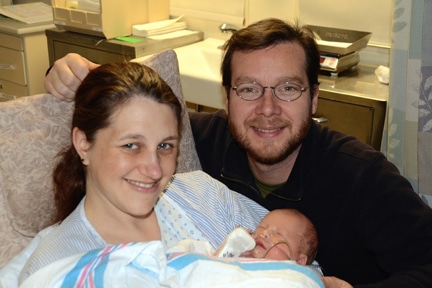
Amy and Brian did try another cycle after the loss of their daughter. On their 5th IVF cycle, Amy and Brian got the good news that they were once again pregnant. And this time they were able to deliver a healthy baby boy.
Amy and Brian will be sharing their complete fertility story on The Dr. Oz Show on Thursday, December 13th. Check your local listings for time and channel.
For more information or to schedule an appointment with one of our physicians, please speak with one of our New Patient Liaisons by calling 877-971-7755.
