
Recurrent pregnancy loss
All these factors impact grief and may help you understand why this loss feels so profound.
1. Is the loss of a baby in pregnancy or shortly after birth an unusual occurrence?
Perinatal loss (miscarriage, stillbirth, infant death) is a far more common experience than people realize. More than one million families are affected by this tragic event every year. One of every five pregnancies ends in a miscarriage (before 20 weeks of pregnancy). Approximately, two babies are stillborn for every 100 live birth (between 20 weeks and term). And of every 100 live births, one baby will die in the first 28 days of life (neonatal death).
2. What are some of the normal feelings a mother and father experience after the loss of a baby?
The death of a baby, whether early in pregnancy or after birth, triggers a grief response similar to other deaths and losses. The feelings occur in a somewhat unpredictable and repetitive sequence. Initially, there is a phase of shock and disorganization. There is a feeling of numbness, disbelief, and a sense that this can’t really be happening. These feelings can last for a few hours or for a few weeks. Then there is a period of volatile emotions that occurs as the couple tries to understand why this has happened. They may experience intense feelings of anger, sadness and guilt. The anger may be directed towards those closest to them (spouse, family and friends) or those seen as having power and control over them (such as their doctor or God). Guilt can be overwhelming at times for, in trying to find answers, they often blame themselves. As intense emotions start to subside, a phase of loneliness and depression occurs. The reality of the loss sets in, along with feelings of sadness, fatigue and powerlessness. These feelings may peak between three to nine months following their baby’s death. Finally, reorganization occurs as their baby’s loss has become accepted—not in the sense of being right or fair, but only in that it happened. The loss is no longer consuming all their energy and emotion. Now only shadow grief remains. Feelings of sadness can be rekindled around significant days or events, such as their due date, conception date, and anniversary of their baby’s death. Special holidays, events, places, music, changes of seasons, and so on may also trigger memories of their baby and rekindle grief. Shadow grief is a reminder that their baby will always hold a special place in their hearts and will never be forgotten.
3. What makes it so difficult for couples to grieve the loss of their baby?
The loss of a baby early in pregnancy can be particularly difficult to mourn, primarily because the grief is prospective rather than retrospective. What this means is that parents are grieving over the hopes, dreams, and wishes for the future with their child rather than over real experiences and memories when someone older dies. With earlier pregnancy losses, there may be no tangible evidence of their baby’s existence, which adds to the sense of unreality. Other people may not have known they were pregnant and thus are not aware of the loss or the significance. In addition, when a baby dies during pregnancy or at birth, traditional mourning rites and rituals are not encouraged, as the baby is “know” only to the parents. There may be no viewings, funerals, or other religious services that help in the grieving process. Parents at times are encouraged to repress their feelings, forget their baby, and “move on”. Thus, couples can find themselves suffering intense emotions in virtual isolation.
4. Do fathers and mothers respond differently to the loss of a baby?
The loss of a baby can be a devastating experience for both mother and father. However, mothers and fathers have bonded to the baby in different ways and thus often experience feelings of loss differently. Women frequently feel that they are the ones hurting and feeling the greatest pain over the loss of their baby. Husbands often are put into the role of the strong protector, decision maker, and/or caregiver. Thus, men may not be encouraged to grieve and can fear that it will make things worse if they allow themselves to feel the pain. It is important for husbands and wives to understand that will feel and deal differently with this loss. They need to be patient with each other and keep communication open.
5. What are some suggestions for supporting couples and helping them cope after a pregnancy loss?
Mourning the loss of a baby can be hard work that takes time and drains energy. Further, grieving this loss takes far longer than most people recognize, from months to years. Couples need to know that their feelings are normal and there will be many ups and downs while they grieve. To help in the healing process, couples will first need to find ways to acknowledge the death of their baby as a significant and real loss. To acknowledge this loss, they may want to name their baby; give a donation or gift to a special charity; have a memorial service or funeral; or maybe plant a tree in their baby’s memory. You can help by taking similar actions that memorialize this life. Secondly, couples need to have the opportunity to talk about their experience, not only immediately following the loss, but for many months later. Research has shown that a couple’s ability to satisfactorily resolve their grief is in direct proportion to their finding suitable avenues to express their feelings. Give mothers and fathers the chance to talk about their baby and their grief, if they chose to. Know that if they cry it is not because you made them cry, but rather allowed them the chance to share emotions that are close to their heart. Lastly, couples need to be given adequate opportunity to grieve. They need to understand that they may feel worse before they will feel better. They also need to give sufficient time for physical and emotional healing before attempting another pregnancy.
6. What can friends, family, and colleagues do to help someone who has experienced a pregnancy loss?
As mentioned, you need to help the couple find ways to acknowledge the loss as significant, real, and worthy of grieving. Expressions that tend to diminish the loss, however good intentioned, are best avoided. For example, statements such as “it was for the best”, “you can have another baby”, “at least you didn’t really know the baby”, “maybe this happened because you were under too much stress” or “you can always adopt”, only cause pain and hurt. Simple heartfelt expressions of sadness and emotions such as, “I am so sorry that this happened and can only imagine your sadness, but want you to know I care” are often most appreciated. In addition, you can communicate your sympathy by sending notes or through thoughtful gestures like preparing a meal or giving a small gift such a book on perinatal loss. Remember that special events in this couple’s life, like their due date, anniversary of their loss, or even holidays are often difficult times. Helping the couple talk about their feelings and finding meaningful ways to remember their baby at these times can be helpful. Last and most important, couples need to know that they can talk about their baby and this experience long after the event has occurred. Knowing that other people care and understand this tremendous loss is a gift and can help in healing.
Contributed by:
Sharon N. Covington, MSW, LCSW-C
Director, Psychological Support Services
We have all heard more about “genes,” “DNA,” and “chromosomes.” These are terms your doctor may use when explaining tests that may be ordered, problems that may explain a patient’s difficulty getting pregnant or why some patients have miscarriages. Without any background knowledge genetics can be confusing! Understanding genetics can be simplified into a library analogy…
We each are made up of a library of bookshelves, books and words that determine our individual characteristics. In general, we all got 23 bookshelves from our mother and 23 bookshelves from our father so that each of us has a total of 46 bookshelves. Bookshelves are like chromosomes. On each bookshelf are a unique set of books, or genes. These books are made of words, or the genetic code. Our library is neatly organized in the cells of our body. When cells grow and divide, this entire library has to be duplicated by a sophisticated typewriter.
When there is a mutation, it means there is a typo, missing sentence, or extra sentence in one of the books. Sometimes those mutations go unnoticed and cause no problems. Sometimes the mutation causes a critical change and the gene or book doesn’t make sense. These mutations cause diseases. In conditions such as cystic fibrosis, a person can simply have a typo in one book and it causes no problem but if a person inherited 2 typos in the same book from both their mother and father it causes the disease. Mutations in the cystic fibrosis gene are so common (1 in 24 Caucasians) that it is recommended to have pre-pregnancy genetic screening to see if a patient is a carrier of cystic fibrosis mutations before conceiving to determine their risk of having an affected child.
Medical contribution by Kara Khanh-Ha D. Nguyen, M.D., MPH
Kara Nguyen, MD, MPH, FACMG, FACOG, is board certified in obstetrics & gynecology, reproductive endocrinology and infertility, and medical genetics. Her professional areas of expertise include oncofertility, preimplantation genetic diagnosis, polycystic ovary syndrome, in vitro fertilization, donor egg, donor embryo, and fertility preservation.
Shady Grove Fertility is an advocate of genetic screening when planning for pregnancy, and offers genetic screening for more than 100 different diseases and syndromes. We strongly recommend pre-pregnancy genetic screening due to its benefits to patients and their future children. The insights gained by testing both partners offer the ability to identify possible genetic diseases that may be passed on to future offspring. If a genetic disease is found, the couple has the option to use in vitro fertilization (IVF) with preimplantation genetic diagnosis (PGD) to avoid passing that disease onto their child(ren).
The most common genetic disorders are when there are extra or missing bookshelves. This is the cause of the majority of miscarriages. Some however are viable such as Trisomy 21, or Down syndrome. In Down syndrome, the baby inherited an extra copy of the entire “bookshelf 21.” Missing bookshelves are much more severe and don’t generally survive. Chromosomally abnormalities can sometimes be linked to a woman’s age. As women age, so do their eggs. As the eggs age, they become more resistant to fertilization, resulting in lower pregnancy rates and miscarriages. More of the eggs also tend to have chromosomal abnormalities, which can make miscarriage more likely.
If a patient has experienced recurrent pregnancy loss, it is common to do genetic testing to see if the pregnancy was chromosomally imbalanced. The genetic testing usually done is a karyotype, which is a spread of all the chromosomes to make sure there is the right number and right arrangement. Chromosomal imbalances may mean missing bookshelves, extra bookshelves, or individual shelves that have been rearranged onto the wrong bookshelf. Karyotypes do not determine if there has been a typo in a book for example. Some patients have all the books needed in their library but they are arranged on different bookshelves. It causes few or no problems but when these rearranged bookshelves are shared to a pregnancy, the pregnancy inherits an unequal number of books and becomes imbalanced.
We all have typos, and it is normal to have typos and most don’t cause any problems. There is no genetic test that identifies all the typos a person may have. However, your doctor can determine the genetic tests that are most appropriate given your unique situation. If you prefer to take action based on your genetic testing results, patients now have access to one of the most significant advances in the field: preimplantation genetic diagnosis (PGD) also known as preimplantation genetic testing (PGT-M) for monogenic or single gene diseases. This is a technique utilized with IVF that involves a biopsy of a few embryonic cells in order to differentiate healthy embryos from genetically abnormal embryos. In this way, we can identify embryos destined to express disease, allowing the transfer of only a genetically normal embryo(s) to the uterus. This technique has allowed thousands of couples to successfully carry to term and deliver healthy babies.
To learn more about genetics and preimplantation genetic diagnosis, or to schedule an appointment, please call our New Patient Center at 1-887-971-7755 or click here to complete this brief online form.
Editor’s Note: This post was originally published in January 2018 and has been updated for accuracy and comprehensiveness as of November 2018.


by Jason G. Bromer, MD
Are miscarriages considered a fertility issue?
It is a common misconception that women who have miscarriages are just fine because they “can get pregnant.” In fact, having multiple miscarriages is a very specific type of fertility problem that affects 1-3% of all couples.
Why exactly and how many miscarriages are considered a fertility issue?
A key part of the definition of infertility is being able to achieve a successful pregnancy, meaning delivering a healthy child. Pregnancies that result in miscarriages may not always signal an underlying fertility issue, but sometimes they do. Recurrent pregnancy loss (RPL) is defined as having two or more miscarriages consecutively. In some cases, fertility specialists will start looking for underlying causes after just one loss.
What are the factors that can cause miscarriage?
The majority of miscarriages are due to genetic abnormalities in the embryo, which can be either spontaneous or acquired from one of the parents in the case of a chromosomal translocation. Other causes include hormonal problems like diabetes, hyperprolactinemia, and thyroid disease, structural problems in the uterus like a uterine septum or scar tissue, and certain acquired blood clotting disorders like the anti-phospholipid syndrome.
> VIDEO: Dr. Jason Bromer discuss the advances in surgery for fertility treatment.
Does age play a part in miscarriage?
Age definitely plays a role in the risk of miscarriage. As women age, the percentage of genetically normal eggs they have decreases significantly. In fact, by the age of 43, over 90% of the remaining eggs in the ovaries are abnormal, and the risk of miscarriage exceeds 50% in each pregnancy. It is important to note, however, that the age of the uterus does not have the same impact, such that age related miscarriages can often be treated through use of a donor egg.
What, if anything, can be done to limit risk of miscarriage?
The treatment for recurrent miscarriages depends on the underlying cause.
- Hormonal problems can and should be treated prior to trying to conceive again and progesterone support is frequently helpful.
- Uterine problems can often be treated with a very minor surgical procedure called a hysteroscopy.
- Blood clotting disorders can be overcome by using blood thinners like aspirin or heparin.
- Genetic abnormalities can sometimes by prevented with in vitro fertilization in conjunction with a procedure called pre-implantation genetic diagnosis. This procedure involves removing one or more cells from an embryo to test the genetic make-up of the whole embryo prior to placing it back in the mother’s uterus. This way, we can assure that only genetically normal embryos have a chance to implant.
> Read more on Recurrent Pregnancy Loss.
If you are experiencing recurrent pregnancy loss, please schedule an appointment, or speak with one of our New Patient Liaisons at 877-971-7755.
Studies show miscarriages are fairly common, 1 in 4 pregnancies will result in a miscarriage. What are less common are the number of couples that experience multiple miscarriage or recurrent pregnancy loss. According to the American Society of Reproductive Medicine (ASRM), only about 5% of couples will have 2 miscarriages and only about 1% will experience 3 or more miscarriages. While a predisposing factor is not identified in up to half of miscarriages, a significant number caused by factors that can be addressed.
Multiple Miscarriages = Recurrent Pregnancy Loss
Recurrent pregnancy loss, defined as 2 or more miscarriages, can be very mentally and physically draining as your try to build a family. For Amy and Brian who experienced an ectopic pregnancy on their first IVF cycle and then lost their daughter just moments after birth via an emergency c-section at 24 weeks, dealing with the loss of a pregnancy and child was almost more than they could take.
Amy says, “I’m not really sure if I would have been able to continue at this point, financially, physically, and even emotionally. But knowing we still had cycles available through the Shared Risk program and that we were able to get pregnant twice gave us hope. We decided to take a break and then try again. The decision to continue was hard, but after some time to heal we wanted to continue.”
Shared Risk 100% Refund Program – Insurance Against Miscarriage
Shady Grove Fertility developed the Shared Risk 100% Refund Program for IVF and Donor Egg to help make fertility treatment more affordable. Shared Risk offers up to 6 fresh IVF or donor egg cycles and any subsequent frozen embryo transfers for one flat fee.
For couples, like Amy and Brian, who experienced pregnancy loss, Shared Risk can act as an insurance against miscarriage. While patients still will have to cope with the loss and make the decision if they want to attempt another pregnancy, Shared Risk enables patients to think a little bit less about the money they have to spend, and a little more about building their family.
Amy and Brian – A Happy Ending
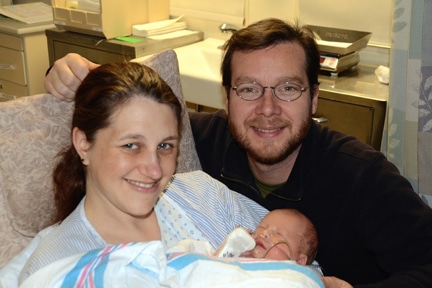
Amy and Brian did try another cycle after the loss of their daughter. On their 5th IVF cycle, Amy and Brian got the good news that they were once again pregnant. And this time they were able to deliver a healthy baby boy.
Amy and Brian will be sharing their complete fertility story on The Dr. Oz Show on Thursday, December 13th. Check your local listings for time and channel.
For more information or to schedule an appointment with one of our physicians, please speak with one of our New Patient Liaisons by calling 877-971-7755.
Fertility Fact: Ectopic Pregnancy can be life threatening if not treated.
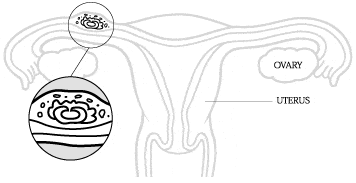
What is an Ectopic Pregnancy?
An ectopic pregnancy is a pregnancy anywhere outside the uterus (where the pregnancy normally develops). In a healthy pregnancy, the egg is released from the ovary into the fallopian tube to be greeted by the sperm. Once fertilization occurs, the newly formed embryo will travel the rest of the way to the uterus over about four to five days, where it implants for the next 9 months. However, in about 1 out of every 50 pregnancies, once the sperm has fertilized the egg, the embryo does not travel to the uterus, but instead implants somewhere else, most typically in the fallopian tubes, rarely in other locations. This is an ectopic pregnancy.
Who is at Risk for Ectopic Pregnancy?
There are a range of risk factors that could increase the likelihood of ectopic pregnancy, including:
- Scarring of the fallopian tubes from sexually transmitted diseases
- History of Pelvic Inflammatory Disease or Endometriosis
- Surgery in the pelvis, abdomen, or on the fallopian tubes
- Smoking
- Conception that occurs when an IUD (intrauterine device) in place
- Congenital abnormality of the fallopian tube
- Prior tubal ligation or tubal ligation reversal
- History of Ectopic Pregnancy
What are Symptoms of Ectopic Pregnancy?
Symptoms of ectopic pregnancy may seem mild at first and then become more severe as the pregnancy progresses. These symptoms include:
- Abdominal pain on one side of the body
- Vaginal bleeding
- Pain in the pelvis, rectum, neck, and/or shoulders
- Fainting or dizziness
How is an Ectopic Pregnancy Diagnosis and Treated?
A pelvic exam, blood test to determine the pregnancy hormone level, and ultrasound are typically the first steps to confirm an ectopic pregnancy. Since a pregnancy located outside the uterus will never turn into a healthy baby, and only endangers the mother’s life (before treatment improved, many women died as the result of untreated ectopic pregnancies), it is important to receive treatment quickly with either medication or surgery.
Women who lose a pregnancy because it is ectopic will have many of the same feelings as women who have experienced a miscarriage. Often times, women may need to heal from the emotional loss as much as the physical trauma before trying to conceive again.
- Resolve and Shady Grove Fertility offer support groups for women dealing with pregnancy loss. Find a group near you.
- Read the emotional effects of Recurrent Pregnancy Loss.
Why is an Ectopic Pregnancy Dangerous?
Left untreated, the pregnancy will continue to grow in a location other than the normal uterine environment. If in the fallopian tube, growth of the embryo will cause the tube to rupture – usually within the first trimester – and lead to significant internal bleeding. If your fallopian tube bursts, it is a serious medical issue that needs to be treated immediately as it can be life threatening – ectopic pregnancy is the leading cause of pregnancy-related death in the first trimester in the United States.
Can I have a Healthy Pregnancy after an Ectopic Pregnancy?
Ectopic pregnancy may damage your fallopian tube, reducing your ability to have a normal pregnancy in the future. Your physician can assess the condition of your fallopian tubes to determine if you are at a higher or lower risk of having another ectopic pregnancy. There are treatment options that you can discuss with your physician to ensure your next pregnancy develops in the right place.
If you have had an ectopic pregnancy in the past and interested in fertility treatment options, please click here to call 1-877-971-7755 to learn more.
