
• Skip to primary navigation
  • Skip to main content
  • Skip to footer
Shady Grove Fertility
  • Become an Egg Donor
  • Referring Physicians
  • 1-888-761-1967
  • Schedule Appointment
  • Get Started
        • Get Started
          • Causes of Infertility
          • Fertility Tests
          • When to Seek Help
          • Find a Doctor
          • Preconception and prenatal vitamins 
          • Schedule an Appointment
        • Personalized Care For
          • Single Parents
          • LGBTQIA+ Family Building
          • People with Cancer
          • Known Genetic Diseases
          • Egg Donors
  • Treatments
        • Fertility
          • Timed Intercourse
          • Ovulation Induction
          • Intrauterine Insemination (IUI)
          • In Vitro Fertilization (IVF)
          • Frozen Embryo Transfer (FET)
        • Donation & Surrogacy
          • Donor Sperm
          • Donor Egg
          • Donor Embryo
          • Gestational Carrier
          • LGBTQIA+ Family Building
          • Single Parents
          • Find a Donor
        • More Treatments
          • Center for Male Fertility
          • Egg Freezing
          • OncoFertility
          • Preimplantation Genetic Testing
          • MIGS
          • All Fertility Treatments
  • Resources
    • Resource Library
    • Events Calendar
    • Patient Stories
    • Mental Health
    • Wellness Center
  • Insurance & Savings
    • Insurance & Benefits
    • Shared Risk 100% Refund Program
    • 100% Refund for Donor Egg
    • Discounts
    • Egg Freezing Costs
    • Financing & Grants
    • Clinical Trials
  • About
    • Find a Doctor
    • About SGF
    • Our Care Team
    • Advanced Practice Providers
    • Fertility Equity
    • Philanthropy
    • Newsroom
    • Careers
    • Contact Us
    • Voice Your Feedback
  • Locations
        • Find a Location
        • California
        • Colorado
        • Delaware
        • Florida
        • Georgia
        • Maryland
        • North Carolina
        • Pennsylvania
        • Texas
        • Virginia
        • Washington, D.C.
        • Chile
        • International & Out of State
        • SGF at Walter Reed National Military Medical Center
  • Patient Hub
    • Online Bill Pay
    • Patient Forms
    • Patient Portal
  • Call your care team
  • Become an egg donor
  • Referring physicians
  • search-icon
  • Schedule appointment 1-888-761-1967

Home / Ectopic pregnancy

Ectopic pregnancy

November 16, 2012 by Shady Grove Fertility

Fertility Fact: Ectopic Pregnancy can be life threatening if not treated.

What is an Ectopic Pregnancy?

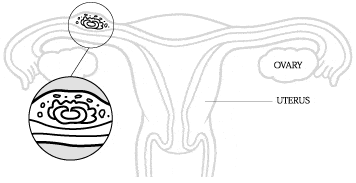
An ectopic pregnancy is a pregnancy anywhere outside the uterus (where the pregnancy normally develops).  In a healthy pregnancy, the egg is released from the ovary into the fallopian tube to be greeted by the sperm.  Once fertilization occurs, the newly formed embryo will travel the rest of the way to the uterus over about four to five days, where it implants for the next 9 months.  However, in about 1 out of every 50 pregnancies, once the sperm has fertilized the egg, the embryo does not travel to the uterus, but instead implants somewhere else, most typically in the fallopian tubes, rarely in other locations.  This is an ectopic pregnancy.
SGF Nurse

Who is at Risk for Ectopic Pregnancy?

There are a range of risk factors that could increase the likelihood of ectopic pregnancy, including:

  • Scarring of the fallopian tubes from sexually transmitted diseases
  • History of Pelvic Inflammatory Disease or Endometriosis
  • Surgery in the pelvis, abdomen, or on the fallopian tubes
  • Smoking
  • Conception that occurs when an IUD (intrauterine device) in place
  • Congenital abnormality of the fallopian tube
  • Prior tubal ligation or tubal ligation reversal
  • History of Ectopic Pregnancy

What are Symptoms of Ectopic Pregnancy?
Symptoms of ectopic pregnancy may seem mild at first and then become more severe as the pregnancy progresses. These symptoms include:

  • Abdominal pain on one side of the body
  • Vaginal bleeding
  • Pain in the pelvis, rectum, neck, and/or shoulders
  • Fainting or dizziness

How is an Ectopic Pregnancy Diagnosis and Treated?
A pelvic exam, blood test to determine the pregnancy hormone level, and ultrasound are typically the first steps to confirm an ectopic pregnancy.  Since a pregnancy located outside the uterus will never turn into a healthy baby, and only endangers the mother’s life (before treatment improved, many women died as the result of untreated ectopic pregnancies), it is important to receive treatment quickly with either medication or surgery.

Women who lose a pregnancy because it is ectopic will have many of the same feelings as women who have experienced a miscarriage. Often times, women may need to heal from the emotional loss as much as the physical trauma before trying to conceive again.

  • Resolve and Shady Grove Fertility offer support groups for women dealing with pregnancy loss. Find a group near you.
  • Read the emotional effects of Recurrent Pregnancy Loss.

Why is an Ectopic Pregnancy Dangerous?

Left untreated, the pregnancy will continue to grow in a location other than the normal uterine environment. If in the fallopian tube, growth of the embryo will cause the tube to rupture – usually within the first trimester – and lead to significant internal bleeding. If your fallopian tube bursts, it is a serious medical issue that needs to be treated immediately as it can be life threatening – ectopic pregnancy is the leading cause of pregnancy-related death in the first trimester in the United States.

Can I have a Healthy Pregnancy after an Ectopic Pregnancy?
Ectopic pregnancy may damage your fallopian tube, reducing your ability to have a normal pregnancy in the future. Your physician can assess the condition of your fallopian tubes to determine if you are at a higher or lower risk of having another ectopic pregnancy.  There are treatment options that you can discuss with your physician to ensure your next pregnancy develops in the right place.

If you have had an ectopic pregnancy in the past and interested in fertility treatment options, please click here to call 1-877-971-7755 to learn more.
Filed Under: Diagnosing Infertility Tagged With: Ectopic pregnancy, Recurrent pregnancy loss

October 5, 2012 by Shady Grove Fertility

Fertility Fact:  Of the 750,000 women who experience pelvic inflammatory disease (PID) each year in the United States, it is estimated that 10-15% will have trouble conceiving.

However, with some help, most women with a history of pelvic inflammatory disease can go on to have a healthy pregnancy and delivery.

What is Pelvic Inflammatory Disease?

SGF Nurse
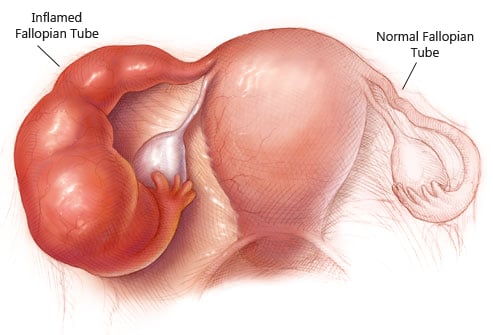
Fallopian Tubes can become enlarged with Pelvic Inflammatory Disease (PID).


Pelvic Inflammatory Disease (PID) is an infection of the uterus, fallopian tubes, and other reproductive organs. The infections can cause symptoms such as lower abdominal pain, fever, vaginal discharge, painful intercourse or urination. However, since many of these symptoms are vague and can be contributed to other causes, PID often goes undiagnosed.
Pelvic inflammatory disease occurs in women when bacteria move upward to her reproductive organs from her vagina or cervix. While many different types of bacteria can cause PID, most often it is associated with bacterial sexually transmitted diseases – primarily chlamydia and gonorrhea.

Complications with Pelvic Inflammatory Disease

PID can cause permanent damage to the female reproductive organs and scarring in the fallopian tubes. Scarring in the fallopian tubes can interfere with the egg traveling to the uterus. This can result in the sperm not being able to reach the egg or the egg fertilizing in the tube causing an ectopic pregnancy. As a result of the damage and complications, the risk of infertility continues to increase with the number of episodes. According to Dr. Joseph Doyle, “After one episode of PID, infertility from blocked fallopian tubes will occur in up to 12% of women.  After two episodes, it will affect more than one third of women.  With three episodes, up to 75% of women will have blocked fallopian tubes.”

Diagnosing and Treating Pelvic Inflammatory Disease

Since the symptoms for PID are often mild and there is no test for PID, a diagnosis for PID is typically based on the clinical findings. Your health care provider may also need to identify the type of organism causing the PID and order a test for chlamydia and/or gonorrhea. An ultrasound might also be used to see if the fallopian tubes show evidence of an infection.

PID is treated with antibiotics; however, the antibiotics will not reverse any damage already occurred, making it important for women to seek care immediately if she is experiencing any symptoms. A woman’s sexual partner(s) should also be treated if a sexually transmitted disease is the cause of infection.

Becoming Pregnant after Pelvic Inflammatory Disease

For women that have had PID and have had damage to their reproductive organs, they will likely have to consult with a fertility specialist to maintain a healthy pregnancy. “The risk of an ectopic pregnancy is increase 6-7 times as a result of pelvic infection,” explains Dr. Doyle.  To address this risk and the inability to conceive due to scarring in their fallopian tubes, in vitro fertilizaition (IVF) is often the advised therapy to help achieve pregnancy because with IVF the tubes are bypassed completely.

Annual gynecological exams with STD testing and practicing safe sex is advised to help prevent pelvic inflammatory disease and limit the damage that can be caused by the disease.

If you have had PID and need to consult with a physician in order to achieve pregnancy, please call 1-877-971-7755 or click here to request an appointment.

Filed Under: Diagnosing Infertility Tagged With: Ectopic pregnancy, Pelvic inflammatory disease

Company

  • About SGF
  • About US Fertility
  • Our Doctors
  • Fertility Equity
  • Careers
  • Newsroom
  • SGF College Scholarship
  • Contact Us
  • Voice Your Feedback

Treatments

  • Egg Freezing
  • Intrauterine Insemination (IUI)
  • In Vitro Fertilization (IVF)
  • Frozen Embryo Transfer (FET)
  • LGBTQIA+ Family Building
  • Shared Risk 100% Refund Program
  • All Treatments

Resources

  • Patient Portal
  • Online Bill Pay
  • Library
  • Support Groups & Events

Locations

  • California
  • Colorado
  • Delaware
  • Florida
  • Georgia
  • Maryland
  • North Carolina
  • Pennsylvania
  • Texas
  • Virginia
  • Washington, D.C.

2026 Shady Grove Fertility

  • Policies & Notices
Also of interest
  • In Vitro Fertilization IVF
  • Fertility Tests
  • Research Publications