
• Skip to primary navigation
  • Skip to main content
  • Skip to footer
Shady Grove Fertility
  • Become an Egg Donor
  • Referring Physicians
  • 1-888-761-1967
  • Schedule Appointment
  • Get Started
        • Get Started
          • Causes of Infertility
          • Fertility Tests
          • When to Seek Help
          • Find a Doctor
          • Preconception and prenatal vitamins 
          • Schedule an Appointment
        • Personalized Care For
          • Single Parents
          • LGBTQIA+ Family Building
          • People with Cancer
          • Known Genetic Diseases
          • Egg Donors
  • Treatments
        • Fertility
          • Timed Intercourse
          • Ovulation Induction
          • Intrauterine Insemination (IUI)
          • In Vitro Fertilization (IVF)
          • Frozen Embryo Transfer (FET)
        • Donation & Surrogacy
          • Donor Sperm
          • Donor Egg
          • Donor Embryo
          • Gestational Carrier
          • LGBTQIA+ Family Building
          • Single Parents
          • Find a Donor
        • More Treatments
          • Center for Male Fertility
          • Egg Freezing
          • OncoFertility
          • Preimplantation Genetic Testing
          • MIGS
          • All Fertility Treatments
  • Resources
    • Resource Library
    • Events Calendar
    • Patient Stories
    • Mental Health
    • Wellness Center
  • Insurance & Savings
    • Insurance & Benefits
    • Shared Risk 100% Refund Program
    • 100% Refund for Donor Egg
    • Discounts
    • Egg Freezing Costs
    • Financing & Grants
    • Clinical Trials
  • About
    • Find a Doctor
    • About SGF
    • Our Care Team
    • Advanced Practice Providers
    • Fertility Equity
    • Philanthropy
    • Newsroom
    • Careers
    • Contact Us
    • Voice Your Feedback
  • Locations
        • Find a Location
        • California
        • Colorado
        • Delaware
        • Florida
        • Georgia
        • Maryland
        • North Carolina
        • Pennsylvania
        • Texas
        • Virginia
        • Washington, D.C.
        • Chile
        • International & Out of State
        • SGF at Walter Reed National Military Medical Center
  • Patient Hub
    • Online Bill Pay
    • Patient Forms
    • Patient Portal
  • Call your care team
  • Become an egg donor
  • Referring physicians
  • search-icon
  • Schedule appointment 1-888-761-1967

Home / In vitro fertilization (IVF) / Page 7

In vitro fertilization (IVF)

May 1, 2014 by Shady Grove Fertility

TIME Magazine names Kristen Gillibrand Top 100 Leaders.  According to TIME  she is the U.S. Senate’s rising Democratic star. For Shady Grove Fertility, she is a hero fighting to improve patient access to fertility treatment.
Her tenacious spirit is one to admire and respect, previously fighting hard on issues like sexual assault in the military. An advocate for families and women, Gillibrand is currently supporting the Family Act as a part of her “American Opportunity Agenda.”  

The Family Act is an evolution of the 1993 Family and Medical Leave Act that will enable workers and families to afford care for their loved ones when family and medical needs arise, as well as provide monetary support for couples or individuals needing in vitro fertilization (IVF) or Fertility Preservation prior to cancer treatments.
Read the TIME article.

The Family Act: Improving Access to Fertility Treatment

The Family Act was introduced to the U.S. Senate and U.S. House of Representatives with a Tax Credit Bill for Infertility Treatments for the out-of-pocket costs associated with in vitro fertilization (IVF) and fertility preservation. This bill will help thousands of people access medical treatment for infertility that otherwise would be unavailable to them due to lack of insurance coverage. Currently, 40% of all cycles at Shady Grove Fertility are IVF for infertility treatments.

The key provisions of the Family Act House and Senate Bill provided by RESOLVE:

  • The Family Act covers the out-of-pocket costs associated with in vitro fertilization (IVF) including medical procedures, prescription medications, professional charges, the transfer of an embryo and other necessary costs.
  • The Family Act covers the out-of-pocket costs of fertility preservation procedures if the man or woman is diagnosed with cancer and the cancer treatment or disease itself may result in infertility.
  • The Family Act provides an approximately $12,000 tax credit to eligible tax payers. The tax credit is available in part or in whole on an annual basis until the taxpayers reaches the aggregated limit of $12,000. Eligible taxpayers may carry the credit forward for five years.
  • Eligible taxpayers may claim the credit for up to one-half of their expenses: a person who spends $10,000 out-of-pocket on IVF will be eligible for a $5,000 tax credit.
  • The tax credit carries over into the next tax year if you do not reach the limit in the first year.
  • The credit is available to taxpayers with an adjusted gross income of approximately less than $189,000 and phases out for those whose income reaches $229,000.

For this bill to become a law, The Family Act must pass the House and Senate by December 2014.  ‘Don’t ever underestimate her. She can go as far as she likes. If Kirsten Gillibrand wants to be a rock star, she’ll be a rock star.’ We are glad to have her on our team, fighting to support women and couples struggling with infertility.

Other Issues Being Addressed by Proposed Changes 

The current Family and Medical Leave Act of 1993, provides unpaid job-protected leave for serious health events. Gillibrand is working to amend the current bill because:

  • Approximately half of the workforce qualifies for unpaid leave
  • Many who qualify cannot afford to take it because it is unpaid
  • Almost 50% of working mothers are unable to take time off to care for a sick child

As workers with care responsibilities withdraw from the workplace or limit their time at work, they bring home less income in the short run, are less likely to earn promotions, have more restricted access to workplace requirement benefits, earn less Social Security retirement benefits, and accumulate lower lifetime earnings.

Making Leave Available for Every Individual

The Family Act would create an independent trust fund within the Social Security Administration to collect fees and provide benefits. This fund would be funded by employee and employer contributions of 0.2% of wages, with a maximum weekly payroll deduction of $4.36. While on paid leave, workers would receive up to two-thirds of their regular pay. A maximum weekly benefit also would apply. The proposal makes leave available for every individual regardless of the size of their current employer. It is also available for self-employed or currently unemployed, as long as the person has sufficient earnings and work history. This act would benefit and apply to young, part-time, and low-wage workers. Read more about the Family Act.

Help the Family Act Become a Law

  • Send letter to your two U.S. Senators: Link to Letter
  • Send a letter to your U.S. Representatives: Link to Letter
  • Join the Cause: Become an Advocate

If you have questions about fertility or are ready to schedule an appointment call 877-971-7755.
Filed Under: General Tagged With: In vitro fertilization (IVF)

May 1, 2014 by Shady Grove Fertility

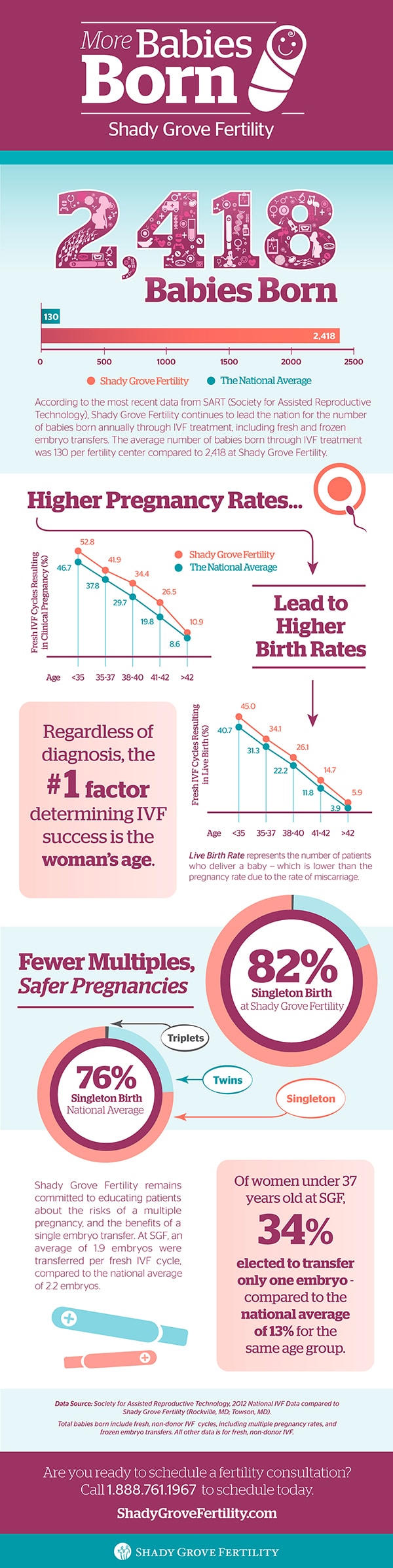
Click here to enlarge the image

  • View the National Success Rates for IVF and Donor Egg at SART.org
  • View Success Rates by Fertility Center

What Are the Chances of Achieving a Pregnancy and Delivery?

Success rates can be broken into various categories including age. Success is defined in two ways, clinical pregnancy and live birth. A clinical pregnancy rate is determined when a blood test and ultrasound show a pregnancy. Live birth rate is slightly lower due to a small percentage of miscarriages.

Success Rates Using Frozen Embryos Give Patients Additional Hope

Fortunately, over the past few years, advances in laboratory technologies have allowed us to provide an additional highly successful treatment option as part of the IVF process. Now, patients with quality embryo(s) remaining at the time of the fresh embryo transfer, have the option to freeze those embryos for future use. FET cycles, or Frozen Embryo Transfer cycles are much easier because they require less time, less medication, no surgery or anesthesia, and they are a fraction of the cost of a fresh IVF cycle. The pregnancy and live birth rates for FETs are very comparable to fresh IVF pregnancy rates. It is not uncommon for patients to have enough frozen embryos from their first fresh cycle to give them the opportunity to try again if they were unsuccessful, or if successful, to use the frozen embryos later for a second or even third baby.

Our Goal is To Help Patients Have One Healthy Baby at a Time

Shady Grove Fertility continues to lower the incidence of multiple pregnancies while maintaining strong pregnancy and live birth rates. Since 2002, Shady Grove Fertility physicians have encouraged patients to transfer a single embryo (eSET) to lower the risk associated with multiple pregnancies.  These patients now have the best of both worlds: an uncompromised chance of pregnancy combined with a very low risk of twins or triplets.

Insights into How Treatment Success is Calculated

Shady Grove Fertility continues to lead in the field of reproductive medicine with IVF success rates remaining higher than the national average. Success can take more than one treatment cycle. The for every fertility center is reported in a uniform format through SART. While comparisons among centers are difficult to make, the data can offer insight into how treatment success is calculated.

  • Understanding Your Fertility: Back to Basics
  • The Best Time to See a Fertility Specialist

If you have questions about fertility treatment or to schedule an appointment call 877-971-7755. We are here to help. 
Filed Under: Treatment Tagged With: In vitro fertilization (IVF)

April 8, 2014 by Shady Grove Fertility

today show

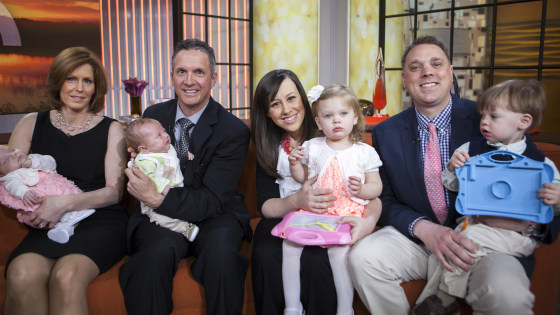
“We couldn’t believe it was happening after so long,” Sandi told TODAY. “It was just amazing.”

After years and several failed IVF cycles, Sandi and Phil were told they would need a gestational carrier to conceive a child. Their friends, Andrea and Marc, who they met on the SGF Facebook page, were pregnant with twins at the time but jumped at the opportunity to be the couple’s gestational carrier.

Watch Part 1 of TODAY Show: Shady Grove Fertility Patients Overcoming Infertility

After one failed attempt, Andrea was able to conceive – with twins! Andrea delivered the twins this February, making Sandi and Phil a very proud mama and papa. Baby boy Grayson weighed in at 6 pounds, and EmmaLee at 7 pounds.

The TODAY Show brought all four parents and both sets of twins to the set to share their story.

Watch Part 2 of TODAY Show: Shady Grove Fertility Patients Overcoming Infertility

The Shady Grove Fertility Family is so excited for Sandi & Phil, as well as Andrea & Marc, and all their little bundles of joy!

 If you have questions about fertility or are ready to schedule an appointment at Shady Grove Fertility, please speak with one of our New Patient Liaisons at 877-971-7755.

Filed Under: General Tagged With: In vitro fertilization (IVF)

March 27, 2014 by Shady Grove Fertility

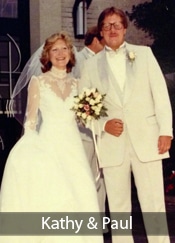
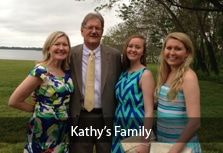
Over 25 years ago, Kathy and Paul met working in an emergency room at a local hospital where they fell in love and married a few years later. In their early 20s and shortly after marriage, they decided to have a child. After 3 years of trying, they had their daughter, Kiersten; however, knowing they wanted a sibling for their daughter, they decided to try again!

Five years later, with no success, Kathy and Paul found themselves at the OBGYN learning they had secondary infertility. The OBGYN didn’t seem as concerned as Kathy felt, and she still didn’t understand what was preventing them from conceiving. So, she and Paul ventured to a local fertility center where they hoped to find answers. With limited information about fertility treatment available and vague success rate explanations from the fertility center, Kathy was determined to learn about the unknown – she was on a quest for knowledge. Unlike today, in the early 90s, there wasn’t a lot of information available about this ‘new’ form of fertility treatment, so the young ER nurse found a way to understand the disease affecting her life; she found a clinical nursing position at the new fertility center, Shady Grove Fertility.

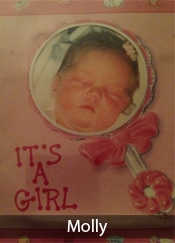
Amazed with the patient care, transparency of success rates, treatment options, and affordability, Kathy felt she and Paul could have success at Shady Grove Fertility.  Just 1 IVF cycle later, Molly was born!

Looking back now, Kathy has seen a lot of changes in the world of infertility, both personally and professionally. From new technologies such as ICSI to new physicians and fertility programs, Kathy has been with Shady Grove Fertility through it all. Today she can be found in the Rockville, MD office mentoring and assisting each nurse as they care for patients/couples who dream of having a family. Molly, their beautiful IVF baby is now a Junior at the University of Maryland. Ready Kathy’s complete story.

Want to share your patient story? Click here!

Check out more #tbt on our Facebook page – over 12,000 women and men sharing their experiences.

If you are having trouble trying to conceive, it may be time schedule an appointment at Shady Grove Fertility, please speak with one of our New Patient Liaisons at 877-971-7755.

Filed Under: About SGF Tagged With: In vitro fertilization (IVF)

December 31, 2013 by Shady Grove Fertility

Taking a look back at the most popular fertility videos Shady Grove Fertility uploaded this year.

Best Fertility Videos of 2013

1. Shady Grove Fertility Staff Shares Words of Wisdom
Shady Grove Fertility staff members share words of wisdom to current and future patients. Simon Kipersztok, MD and Gilbert Mottla, MD are featured in this video and offer patients tips for a smooth fertility journey.

2. Inside the IVF Lab: Embryo Cryopreservation
This video shows an embryo being exposed to cryo-protectant, exchanging inter-cellular water molecules with CPAs (cryo-protectant agents).  Then the embryo is frozen via a fast-freeze process known as vitrification.

3. EmbryoScope – New IVF Technology
Shady Grove Fertility offers new IVF technology in our Philadelphia area fertility center. The EmbryoScope develops a time-lapse movie from thousands of images as the embryo is developed inside the IVF lab.

4. How to Diagnose Infertility
Isaac E. Sasson MD, PhD with Shady Grove Fertility Center in Chesterbook, PA near Philadelphia discusses how to diagnose infertility. After your initial consultation with a fertility specialist, patients will undergo a fertility work-up including a blood test, hysterosalpingogram (HSG), and other diagnostic testing.

5. Physiology of Human Reproduction – Fertility
Isaac E. Sasson MD, PhD with Shady Grove Fertility in Chesterbrook, PA shares the physiology of human reproduction. From the egg and sperm to the hormones and follicles, Dr. Sasson offers a quick look at reproduction.

If you are ready to schedule an appointment at Shady Grove Fertility, please speak with one of our New Patient Liaisons at 877-971-7755.

Filed Under: General Tagged With: Dr. Gilbert Mottla, Dr. Simon Kipersztok, In vitro fertilization (IVF)

October 17, 2013 by Shady Grove Fertility

Many women and men having trouble conceiving often have similar questions about fertility treatment, the associated costs, and if they will ultimately be successful. A panel of successful Shady Grove Fertility patients answer these questions about fertility which have been submitted from other patients and those interested in learning more about fertility treatment.

Question: What was the hardest part of your IVF cycle? How did you afford your IVF cycle? Was it successful on the first cycle?

Questions About Fertility – Answered by Fertility Patients

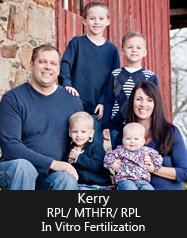
Kerry: The hardest part of our IVF cycle was the emotional part of waiting and thinking about what if this doesn’t work, then what do we do? When you get to the point of having to do IVF, you have already been through so much emotionally with trying to get pregnant. The good thing about going through it is that you have a hope that your dreams of having a child will come true. We have been fortunate to have 4 wonderful children through IVF but we have had a lot of heartbreak too which comes with infertility. We had 8 miscarriages before my 1st son was born, lost another baby that was a twin of my second son and just very recently had a miscarriage at 19 weeks from a frozen embryo transfer. Those are the hardest parts of being a fertility patient and learning how to get through that.

We all know that IVF is very expensive. We went through 3 fresh cycles and were very fortunate that all were successful on the first try. We used frozen embryos in between our 1st and 2nd sons and none took. We did have a successful frozen embryo that took after our 3rd son and we had a daughter. Before we had to go to fertility treatments, I never would have imagined spending this much money on having kids and we are not people that have a ton of money either. To do our IVF cycles, we took out loans and a line of credit on our mortgage as well as borrowed from our 401K. To do our frozen embryo transfers, we used my husband’s flexible spending from his work. We are still paying back all of our loans but we have never thought about the money because we feel so fortunate to have our kids. I think when you go through as much as people do with infertility; you are able to gain a different perspective about what is truly important in life. Don’t let money deter you if you can find a way to do it. We do put a lot of faith in God because sometimes that is all you have to hang on to. Good luck on your journey!

  • Read more questions submitted by patients.

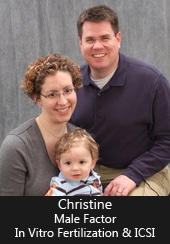
Christine: By far the hardest part for me was the emotional side and the wait after retrieval and before transfer. I did not have very many eggs retrieved and worried that I would not even get to the embryo transfer (but I did twice, and have a 22 month old and am 9 weeks pregnant with our second). The two week wait was also hard but I felt a little more in control of things at that point because the embryo(s) were in me. We did the Shared Risk program for our first cycle (and got pregnant on the first try) but felt better about choosing that program as we knew what the costs were and did not have to stress over additional money if it did not work the first time. Both of my IVF cycles were successful on the first try. We have male factor infertility and did IVF with ICSI.

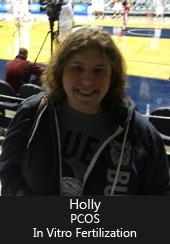
Holly: Before I started this process, I would have thought that 100% of the answers would be all the shots, blood work, and ultrasounds. But to be honest, my hardest part was the 2 weeks wait. After transfer, not knowing if your miracle is growing inside of you or not, if it’s healthy, etc… is hard to go through. During this time, you NEED to make time for yourself, time for you and your partner, and take care of yourself!! I cried every night during those two weeks while getting my shots.. .always questioning if it worked. Our first two IVF cycles failed (one failed at 7 weeks of pregnancy). We will be back at Shady Grove Fertility in 2014 to try again. I can say we were extremely lucky and our place of business gave us $15,000 towards treatment and after that we were only responsible for 10%.

  • Submit Your Questions About Fertility to the Panel

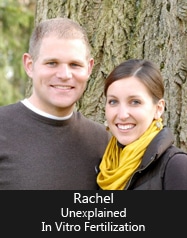
Rachel: The hardest part of the IVF cycle was the fact that you were actively thinking about it all of the time, surprisingly even more than just trying to conceive the traditional way. IVF requires that you be monitored frequently, give yourself shots, have egg retrieval etc. There was something, almost daily that you had to do or have done to you to ensure that the process went smoothly. I think having those to-do items on my list each day made me feel even more emotional and strung out than I had in previous cycles where I was perhaps just trying to have sex during certain times, or even just taking meds by mouth. Never before had I been so invested in an uncertain outcome!

My husband and I were always invested emotionally each month as we tried to get pregnant. However, with IVF, all of the things we had to do to get to the final embryo transfer made us feel even more emotionally invested.

Financially, we could not afford it without taking out a loan. We used Fertility Finance and took out a loan to help pay for IVF. We didn’t feel like we were gambling with our money, as we participated in Shady Grove Fertility’s Shared Risk program (essentially guaranteeing we would get our money back if our IVF cycles did not eventually result in a baby).

We were very fortunate – we did get pregnant as a result of our first IVF cycle. If you would want to read more specifically about our step by step of the IVF cycle with Shady Grove Fertility, feel free to read some of my blog posts, detailing our experience: http://inconceivablefaith.blogspot.com/search/label/IVF

Kathleen: We had a small amount of insurance coverage and used Fertility Finance to pay for the majority of the costs.

Jessica: The hardest part for me was the weight gain. Not everyone experiences weight gain from the hormones but my body retained fluid right from the start. During the entire process it was really hard to see my weight increase so much from where I started. It wasn’t until after my daughter was born that I was truly okay with the weight gain. My husband and I paid for part of the treatment with cash and used a 0% interest credit card for the rest. Our insurance covers fertility but my husband had a vasectomy when he was married to his first wife so it negated all insurance coverage. Be prepared to spend a little more than you are quoted. My estrogen levels were not high enough so we had to get another $1,700 worth of medication halfway through the treatment cycle.  We did the Shared Risk program with Shady Grove Fertility. We were lucky and were successful on our first attempt. We had a grade A embryo and just transferred one. We have two frozen embryos for future use :).

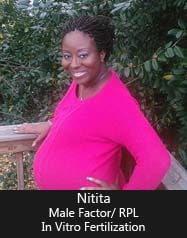
Nitita:  The hardest part for me was the thought of giving myself the injections, being that both my husband and I are terrified of needles. I remember when I first gave myself one of the many injections, I thought I was going to pass out but it wasn’t that bad once I followed all the instructions and I can honestly say I became a pro at it. My husband and I were able to afford the IVF cycle because insurance covered us at 50%. We paid out of pocket for the rest, and thank goodness for us we only did one round of IVF after two failed IUI’s and it worked. Best of luck and well wishes!

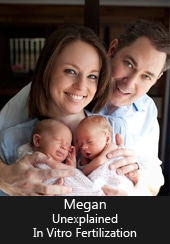
Megan: The hardest part of the IVF cycle is the constant shots and of course the unknown of if it will work or not. Staying positive and making the shots as part of your daily routine makes it a little easier. My first IVF cycle did result in a pregnancy but then ended a few weeks later in miscarriage. My second cycle was a Frozen Embryo Transfer was also successful and that was the pregnancy that lasted and I now have 2 beautiful twin daughters.  Always have faith that you will in the end get the outcome you want.

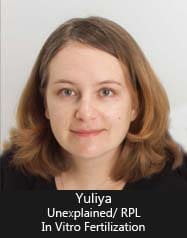
Yuliya: The hardest part was the uncertainty of the outcome. We had insurance coverage for just one try. There was lots of pressure. I found that talking to friends, to a psychologist specializing in infertility, and online TTC communities was very helpful. Yoga, reiki, massage, and swimming, and a diet change helped too. I did get pregnant on the first try, but I miscarried at 8 weeks. In our case, we were able to freeze 3 embryos. I took 3 months off from treatment and came back for a FET. A FET only costs a fraction of a fresh IVF. We transferred 2 embryos, and one of them became my beautiful baby girl!!!

  • Read Mandy & Dave’s Story About Frozen Embryo Transfer (FET)

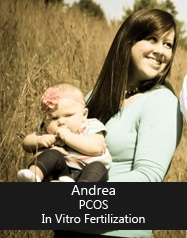
Andrea: The hardest part of my IVF cycle was definitely the emotional aspect of wondering if it was going to work for us or not. We ultimately decided to utilize Shady Grove Fertility’s Shared Risk program to maximize our chances of success while paying a flat fee. We also had the peace of mind of knowing that if we didn’t bring home a baby that we would get a 100% refund of the money we spent.

We decided to use Fertility Finance to assist us with financing the cost of Shared Risk. It was a great option for us since it allowed us to make monthly payments rather than pay for our treatment in full up front. Our first fresh cycle of IVF was unsuccessful. It was very disappointing but since we were in the Shared Risk program, we didn’t have the added financial stress of paying for another cycle. We then moved on to a frozen embryo transfer to transfer our frozen embryos that we had leftover from the first cycle. We made the decision with our doctor to transfer both of our frozen embryos and we now have 20-month old boy/girl twins.

  • Read more questions submitted by patients.
  • Submit Your Questions About Fertility to the Panel

If you have questions about fertility or are ready to schedule an appointment at Shady Grove Fertility, please speak with one of our New Patient Liaisons at 877-971-7755.

Filed Under: General Tagged With: In vitro fertilization (IVF)

  • « Go to Previous Page
  • Page 1
  • Interim pages omitted …
  • Page 5
  • Page 6
  • Page 7
  • Page 8
  • Page 9
  • Interim pages omitted …
  • Page 12
  • Go to Next Page »

Company

  • About SGF
  • About US Fertility
  • Our Doctors
  • Fertility Equity
  • Careers
  • Newsroom
  • SGF College Scholarship
  • Contact Us
  • Voice Your Feedback

Treatments

  • Egg Freezing
  • Intrauterine Insemination (IUI)
  • In Vitro Fertilization (IVF)
  • Frozen Embryo Transfer (FET)
  • LGBTQIA+ Family Building
  • Shared Risk 100% Refund Program
  • All Treatments

Resources

  • Patient Portal
  • Online Bill Pay
  • Library
  • Support Groups & Events

Locations

  • California
  • Colorado
  • Delaware
  • Florida
  • Georgia
  • Maryland
  • North Carolina
  • Pennsylvania
  • Texas
  • Virginia
  • Washington, D.C.

2026 Shady Grove Fertility

  • Policies & Notices
Also of interest
  • In Vitro Fertilization IVF
  • Fertility Tests
  • Research Publications