In light of Mark Zuckerberg, Chairman and Chief Executive Officer of Facebook, and wife, Priscilla Chan, opening up about their struggles with miscarriage, there has been a very positive increase in conversation around the all-too-often hushed topic of miscarriage. Author of the TIME magazine article, “Men Are the Forgotten Grievers in Miscarriage” Sarah Elizabeth Richards, had it right when she said, “Even more astonishing: It was a man sharing his emotions.”
In Zuckerberg’s public post on Facebook announcing the exciting news that he and Chan are expecting a baby girl, he opened up about the three miscarriages they had experienced, and how they grieved:
You feel so hopeful when you learn you’re going to have a child. You start imagining who they’ll become and dreaming of hopes for their future. You start making plans, and then they’re gone. It’s a lonely experience. Most people don’t discuss miscarriages because you worry your problems will distance you or reflect upon you—as if you’re defective or did something to cause this. So you struggle on your own.
The Reality of Miscarriages and Grieving
Up to one in four of all pregnancies end in miscarriage. While there’s been an increase in openness focused on women’s suffering, according to Sharon Covington, MSW, LCSW-C, director of psychological support services at Shady Grove Fertility, “Men are the forgotten grievers.” Women often get the attention. They have the physical loss and, often times, women are more open about grieving and showing their emotions.
On the other hand, typically, men don’t express their emotions as openly, even though studies have found that men also suffer from anxiety and depression as a result of miscarriage. Even though men don’t express loss in the same way, according to the article, “Not only is their own mental health at risk, their isolation can hurt their partners’ well-being and destroy their relationships.”
Hopefully, as more articles like this and as more men like Zuckerberg come forward and open up about their struggles, miscarriage will become less of a solitary struggle. “In today’s open and connected world, discussing these issues doesn’t distance us; it brings us together. It creates understanding and tolerance, and it gives us hope,” remarked Zuckerberg.
Shady Grove Fertility offers co-ed support groups for infertility and pregnancy loss where men can feel comfortable attending with their partners. If you or someone you know has struggled with miscarriage, we have several upcoming support groups available. View the SGF Support Group Schedule.
To learn more about what causes miscarriage or to discuss infertility treatment options that may be effective after recurrent miscarriage, schedule a new patient appointment by calling our new patient center 877-971-7755.
By Naveed Khan, M.D., of Shady Grove Fertility’s Leesburg, VA, office When a woman experiences a miscarriage, there are many feelings of loss and sadness, but there is also a need to know why. What’s important for women and their partners to know is that you are not to blame for miscarriage. Nearly 1 in 4 pregnancies end in miscarriage, regardless of the woman’s age, and in some cases before she even realizes she is pregnant. Sadly, miscarriage is a more common occurrence than people think, and one that is often difficult to understand.
Common Causes of Miscarriage
In about 50 percent of miscarriage cases, a cause can be determined. The cause usually falls into two categories:
Genetic abnormalities: Genetic abnormalities represent the most common cause of miscarriage. Sometimes the genetic syndrome is inherited from the parents, which we can test for through preimplantation genetic screening (PGS), and sometimes it occurs naturally within the embryo itself while it’s developing.
Uterine abnormalities: In these cases, there may be structural issues with the uterus, fibroids, endocrine issues, or immunological issues that can make a woman predisposed to miscarriage.
In either case, your physician will work with you to treat these diagnoses in order to help you have a healthy pregnancy.
For the other 50 percent of miscarriages, there is not an explanation unfortunately. This can understandably be very frustrating, but it should also be reassuring because it tells you that there isn’t anything majorly wrong, and that down the line you will likely be able to deliver a healthy baby.
Common Myths
While potential miscarriage causes were mentioned earlier, the internet is filled with information that is often incorrect regarding miscarriage. Far too many people believe that the following items led to their miscarriage:
Too much stress
Lifting heavy objects
History of sexually transmitted disease
Having used IUDs for birth control in the past
Engaging in intercourse while pregnant
It is important to note that none of the above reasons cause miscarriage.
Preventing Future Miscarriage
For women that have experienced recurrent pregnancy loss—two or more consecutive miscarriages—there is now an option to help prevent future loss. Preimplantation genetic diagnosis (PGD)—in which cells from the embryos are biopsied—can determine if chromosomal abnormalities are present. If embryos have chromosomal abnormalities, they will not be transferred back to the female partner. PGD has been proven to reduce the risk of miscarriage in women.
Finding Support
It is important that people who experience miscarriage get emotional support, whether it is from family, friends, or professional counselors or groups. This helps to counteract the feelings of isolation that come from pregnancy loss. The more you talk to people, the more you will realize that many others have been in the same situation and that you are not alone.
If you’ve experienced a miscarriage and you’d like to consult with a physician, please speak with one of our New Patient Liaisons at 877-971-7755 to schedule an appointment.
One of the most common questions infertile patients and couples ask is: will the treatment my physician recommends work? It is perhaps little known to many that the majority of infertility sub-specialists ask themselves a very similar question: what will the fertility treatment success rates be if I use different treatment options available to a specific patient or couple?
The Patient Predictor Using National Data
The Society for Assisted Reproductive Technology, or SART, recently published a Patient Predictor on their website. They base their predictions on information gathered from close to half a million assisted reproductive technology (ART) cycles (i.e., in vitro fertilization [IVF] and donor egg) from more than 320,000 women performed in the United States since 2006. To obtain a result, the patient must provide specific information, including:
age, height, weight
number of pregnancies and deliveries
diagnosis of their infertility
if she is seeking to conceive with her own eggs or with donated eggs
For patients interested in conceiving with their own eggs, the Patient Predictor produces the probability of achieving a live birth after one, two, or three ART treatment cycles. For those considering conceiving with donated eggs, the predictor will produce the probability of a live birth and compare it with the one that the patient would have if she were to use her own eggs.
Much like when predicting weather, the results from the Patient Predictor cannot be 100 percent accurate since such a perfect prediction must be based on many more parameters than the ones the patient is asked to provide. The resulting predictions are based on data from many patients with varying medical circumstances, not to mention varying protocols, laboratory techniques, and fertility treatment success rates that come with different infertility centers. Yet, in spite of the differences, the Patient Predictor gives a very good probability of live births within a relatively narrow scale of probabilities—for the majority of patients who fit the parameters required to make the calculations.
Shady Grove Fertility’s Unique Prediction Instrument
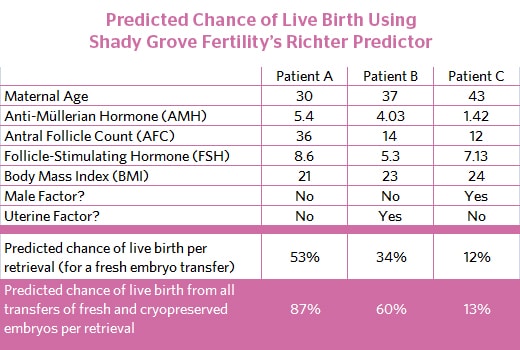
Many years ago, Shady Grove Fertility created its own predictor instrument, which is commonly known as the “Richter Predictor.” Named after Dr. Kevin Richter, Shady Grove Fertility’s Chief Statistician and Director of Research, the Richter Predictor is a more accurate predictor of success for SGF patients, specifically, not only because it leverages our own outcomes to determine probability, it also incorporates more clinically relevant parameters, such as:
the presence or absence of uterine and sperm abnormalities
Shady Grove Fertility’s research team used a few different patient populations for various components of our prediction models. Altogether, we based our modeling on analysis of nearly 15,000 treatment cycles from nearly 10,000 patients since 2009. Unlike the SART Patient Predictor, Shady Grove Fertility’s model also includes predictions of the likelihood of having good quality surplus embryos available for vitrification and subsequent frozen embryo transfer (FET), and the potential increase in live birth rates per egg retrieval that could be achieved by using these vitrified embryos.
For many patients seeking infertility therapy, it is now possible to predict with a high degree of probability a live birth after treatment with ART. When using other low-tech treatments such as ovulation induction or intrauterine insemination (IUI), it is reasonable to estimate that the probability of a live birth after one treatment cycle is between a fourth to a fifth of that of an ART treatment cycle.
Richter Predictor Offers Tremendous Value and Insight to Patients Faced with Difficult Decisions
This tool provides outstanding value to our patients. Navigating through the many decisions patients have to make along their journey can be challenging. It’s our philosophy to not only inform our patients but to also take an active role and strong, encouraging voice to help them navigate better in a pretty uncertain place.
We’ve invested tremendous resources to help patients feel more confident in their decision making and increase their baseline knowledge. In fact, Shady Grove Fertility is one of the few fertility centers in the country to employ a full-time dedicated research staff, under the leadership of Dr. Richter. As part of our ongoing commitment to excellence in patient care, we continuously analyze our statistics and devote significant resources in order to stay at the forefront on research to make sure our success rates are the best they can be.
We encourage our patients to have a conversation with their physician about their own success probability. No prediction method can offer a guarantee, and conditions—especially female age if she’s using her own eggs—affect outcomes significantly. The advantage to patients at Shady Grove Fertility is, because of our vast experience having performed more than 65,000 ART treatment cycles (fresh autologous IVF, donor egg, FET) since our practice began in 1991, we can fine tune and personalize the treatment protocol with amazing precision to maximize effectiveness. It is advisable for each fertility center to assess their success rates the way that Dr. Richter has done to more accurately estimate the probability of success.
If you would like to learn more about Shady Grove Fertility or are ready to schedule an appointment, please speak with one of our New Patient Liaisons at 877-971-7755.
Every person follows their own process in working through fertility struggles. Each individual and each couple has a unique journey in getting “through” it. Thankfully, we can feel united with others who also have dealt with–or are dealing with–infertility diagnoses. The experience of infertility can make you want to seek out other people who understand the emotional, medical, and physical aspects of it.
While there are commonalities in relating to others who have struggled with fertility, there are also differences that can make even the shared experience seem isolating. Approximately one in five couples who are struggling to conceive will experience unexplained infertility, despite completing a full infertility work-up. It is hard enough to have a reason to attribute to having trouble conceiving, but NOT having a reason has inherent liabilities and difficulties. You may feel different from other couples with infertility who know the cause of their problem and are concentrating their efforts and energy on finding the best treatment for that identifiable issue.
The Quest to Know Why
The following statements are often made by women and men coping with an unexplained infertility diagnosis: “I am so healthy yet feel so defective.” “I have beautiful eggs/embryos, my fallopian tubes are clear, the hormone levels are fine, and/or my sperm count is good, yet pregnancy is still not happening.” “So many tests and exams, but there is still no answer.” “If I/we could just find an answer then it could be fixed.”
It starts to become essential to know WHY and the belief becomes that if you just knew why then it would be better. This leaves a never-ending quest for “the” reason, which demands a great deal of mental and physical energy. Finding THE answer becomes the focus and we can often lose ourselves in that quest.
The common belief in society is that if you work hard enough, you can get what you want. Yet fertility difficulties, despite your best effort, time, and attempts at treatment, sometimes don’t always yield overt answers to the question of “why?” Trying to find a reason can be time-consuming, financially draining, and emotionally exhausting. The emotional response to hearing “there is no apparent reason for your infertility” is often one of hopelessness and frustration. Well-meaning friends and family members may start sending you articles about some cutting-edge treatment or state-of-the-art fertility clinics. The underlying message is that if you go to the “right” clinic or the “right” doctors, they will find out what is wrong and fix it. Or you may be told you are too “stressed” or too “uptight,” which only makes you feel more uptight and stressed.
“You may feel you are entering a state of limbo.”
Facing an unexplained reason for not conceiving a pregnancy can often result in feelings of sadness, helplessness, and anger. The realization that one has had to struggle to get pregnant can result in a sense of a loss of innocence. More specifically, most people assume that when they decide to have a baby that they just will. It is believed that wanting to get pregnant is a conscious choice and when it doesn’t happen we can feel bewildered, cynical, and/or confused.
Guilt can also become a pervading feeling. Some of these guilt feelings may go unspoken because of previous reproductive health choices, because you believe you took so long to even begin trying to have children, or because you are convinced that your anxiety and obsession with your infertility may be complicating it further. People often feel as if they have failed as a man/woman and/or husband/wife. The difficulties can be generalized to the individual or couple as “I/we are a failure.”
You may feel you are entering a state of limbo. One of the most challenging aspects of struggling with infertility is the ambiguity. It is difficult to be in a situation in which we have no control and have no idea how long that out of control feeling will even last. You may feel stuck–unable to grieve and get on with other options because you hold onto the hope that the cause of your infertility will be revealed in the next test or treatment. Your sadness may intensify as time passes and you find no medical or emotional resolution.
It can be essential to figure out what we CAN control. No one likes to feel as if they are in a never-ending state of medical free fall. We can control our body in how we treat it while going through infertility treatment. Acupuncture, massage, yoga, meditation, exercise, and an overall healthy lifestyle makes our body, and the mind, its most optimal, in order to tolerate that small aspect of our bodies that we seemingly don’t feel like we can control.
We can also control our mood by talking with others who understand, or at the very least those who will validate or support our thoughts and feelings. Support groups and counseling can help you process your thoughts and feelings to make you feel more in control of your emotions as you proceed forward or take a break.
You are not a failure—there just fails to be an answer as to why you are having difficulty conceiving. There is a big difference between the two.
Dr. Tara Simpson is a licensed psychologist in Maryland. Her special interests include providing counseling to individuals with issues related to reproductive health, including infertility and pregnancy loss/miscarriage. Dr. Simpson sees clients in her Towson, MD and Columbia, MD private practice offices.
If you would like to learn more about Shady Grove Fertility’s support groups or to schedule an appointment, please speak with one of our New Patient Liaisons at 877-971-7755.