• Skip to primary navigation
  • Skip to main content
  • Skip to footer
Shady Grove Fertility
  • Become an Egg Donor
  • Referring Physicians
  • 1-888-761-1967
  • Schedule Appointment
  • Get Started
        • Get Started
          • Causes of Infertility
          • Fertility Tests
          • When to Seek Help
          • Find a Doctor
          • Preconception and prenatal vitamins 
          • Schedule an Appointment
        • Personalized Care For
          • Single Parents
          • LGBTQIA+ Family Building
          • People with Cancer
          • Known Genetic Diseases
          • Egg Donors
  • Treatments
        • Fertility
          • Timed Intercourse
          • Ovulation Induction
          • Intrauterine Insemination (IUI)
          • In Vitro Fertilization (IVF)
          • Frozen Embryo Transfer (FET)
        • Donation & Surrogacy
          • Donor Sperm
          • Donor Egg
          • Donor Embryo
          • Gestational Carrier
          • LGBTQIA+ Family Building
          • Single Parents
          • Find a Donor
        • More Treatments
          • Center for Male Fertility
          • Egg Freezing
          • OncoFertility
          • Preimplantation Genetic Testing
          • MIGS
          • All Fertility Treatments
  • Resources
    • Resource Library
    • Events Calendar
    • Patient Stories
    • Mental Health
    • Wellness Center
  • Insurance & Savings
    • Insurance & Benefits
    • Shared Risk 100% Refund Program
    • 100% Refund for Donor Egg
    • Discounts
    • Egg Freezing Costs
    • Financing & Grants
    • Clinical Trials
  • About
    • Find a Doctor
    • About SGF
    • Our Care Team
    • Advanced Practice Providers
    • Fertility Equity
    • Philanthropy
    • Newsroom
    • Careers
    • Contact Us
    • Voice Your Feedback
  • Locations
        • Find a Location
        • California
        • Colorado
        • Delaware
        • Florida
        • Georgia
        • Maryland
        • North Carolina
        • Pennsylvania
        • Texas
        • Virginia
        • Washington, D.C.
        • Chile
        • International & Out of State
        • SGF at Walter Reed National Military Medical Center
  • Patient Hub
    • Online Bill Pay
    • Patient Forms
    • Patient Portal
  • Call your care team
  • Become an egg donor
  • Referring physicians
  • search-icon
  • Schedule appointment 1-888-761-1967

Home / General / Page 28

General

October 1, 2014 by Shady Grove Fertility

By Breea Johnson, MS RD LDN
Nutritionist, Pulling Down The Moon

As a nutritionist, I mostly consult with women who are undergoing fertility treatments or trying to conceive naturally. Quite often, one of my clients will ask “My husband has been told he has poor sperm quality, what should he eat and what vitamins or minerals should he take?” They know it’s important for their husbands to also jump on the nutrition bandwagon (and they could often use the moral support) – but just like fertility nutrition for women, fertility nutrition for men can be quite a confusing topic. Just searching “sperm quality” on Google leads to over 6 million websites with information ranging from specific vitamins and herbs to take to enhance sperm quality to “shocking” news articles about how increasing fruit and vegetable intake can improve sperm quality. It can be so overwhelming (and sometimes ridiculous) that many men just tell their wives, “Just tell me what to do and I’ll do it.” Thus, their frustrated wives turn to me.

Like female infertility, male infertility is also on the rise, worldwide. Similar factors of trying to conceive at older ages, being under high stress, smoking, obesity, poor nutrition, chemical toxicities and genetic predisposition are also being correlated with poor sperm quality. Even further – sperm quality is affected by oxidative stress (from low antioxidant intake), inflammation (from high sugar, high processed fat diet), and some specific nutritional deficiencies. And there’s even some research now linking poor sperm quality to increased miscarriage and poor IVF outcome rates.

The topic of sperm quality often gets lumped together; it’s rare where I see a case where the overall sperm quality is poor. It’s more common to see “poor morphology” or “low concentration” or “low motility” or a combination of two. So, even if a man is advised to take some supplements to help sperm quality, are they the right supplements to help with their specific sperm quality issue? And are they prescribed at a therapeutic dosage so that it will have an impact on sperm quality? Utilizing nutrition to improve sperm quality can do wonders – but utilizing the “most effective” nutrition is absolutely essential.

So, what’s a guy to do? Start by improving diet with a focus on minimally processed whole foods – the ones loaded with nutrients. Reduce exposure to chemicals and pesticides – learn the Dirty Dozen and avoid household chemicals. Stop smoking and reduce alcohol intake. Take a high-quality Multivitamin to cover baseline nutrition. Don’t start training for a marathon or the Tour de France – make sure you aren’t overtraining and incurring increased oxidative stress. Learn how to reduce and balance stress – try weekly massages or walks with your wife. You can also meet with a nutritionist that specializes in fertility to learn about specific nutrients and recommended dosages to help with sperm quality focusing on low concentration, morphology, and motility.

Undergoing fertility treatments can be frustrating and trying – for both people involved. While a woman undergoing fertility treatments due to her partner’s poor sperm quality may have some resentment, most men often feel helpless in the outcome. Since up to 50% of infertility is related to male infertility, it’s important for the guys to play their part and take charge of their nutrition, not only to support their partners in this journey but to also have a beneficial impact on a successful pregnancy.

To learn more about services provided by Pulling Down the Moon, please call  301-610-7755 or visit www.pullingdownthemoon.com.

Filed Under: General

October 1, 2014 by Shady Grove Fertility

For many patients, moving into the New Year means starting over with their insurance plans and finding new and innovative ways to pay for fertility treatment. Shady Grove Fertility offers a variety of programs that make affording treatment easier for our new and current patients.

One of the greatest resources for new patients considering fertility treatment is Shady Grove Fertility’s New Patient Center. This dedicated team can give patients a general idea of the cost of treatment and insurance coverage when scheduling new patient appointments, although ultimately the cost will depend on the treatment recommended by your physician after your first visit and initial work-up is complete. For current patients our dedicated team of financial counselors will work one-on-one with you to explore the best options for you based on your specific insurance coverage and financial situation.

Read the top 6 ways to afford treatment in 2013.

You might be surprised to learn about 90% of our patients with insurance have coverage for the initial consultation and diagnostic testing. Currently, Shady Grove Fertility accepts 33 different Insurance Plans.

We find that 70% of patients will have some level of insurance coverage for thetreatment they need. If you have insurance, you will likely have some form of coverage for your pre-screening, medications, and potentially treatments including IUI and IVF. Patients should expect some out-of-pocket expenses when utilizing their insurance plan including traditional deductibles, co-pays, and cycle deposits.

A Flexible Spending Account (FSA) is a special savings account provided by your employer that is funded with pre-tax money deducted from your paycheck. The funds can be used to pay for out-of-pocket medical expenses not paid for by insurance, such as deductibles, co-pays, and treatment not covered. Be aware that most FSAs are use-it-or-lose-it. Money that is left in the account at the end of the year won’t be refunded to you, so you want to be conservative when you choose how much to put in the account.

Last year, over 1,100 patients were approved and participated in the Shady Grove Fertility Shared Risk program. The Shared Risk 100% Refund for IVF & Donor Egg is an extremely popular program that takes the guesswork out of paying for treatment. Patients receive up to six (6) IVF cycles and subsequent frozen embryo transfers (FETs) for one flat fee with the added peace of mind that 100% of your money will be refunded if you decided not to proceed with treatment or if you do not take home a baby.

This plan is ideal for patients planning to pay out of pocket, under the age of 39 or using donor egg treatment, and that are considered a good candidate for IVF. Click here to contact us about Shared Risk.

Shady Grove Fertility currently offers three discount programs for qualifying patients. The first is theMulti-Cycle Discount Program for IVF . This program is designed primarily for patients with no insurance coverage, and whose doctor recommends IVF treatment using their own eggs. This includes patients of any age and/or those not eligible for Shady Grove Fertility’s Shared Risk 100% Refund Program.

By prepaying for multiple treatment cycles, this option provides up to a 40% discount off the cost of two fresh IVF cycles and subsequent FET (frozen embryo transfers) cycles. The Multi-Cycle Discount Program does not offer a refund of fees if a baby is not born, however, benefits include:

  • Medical and laboratory fees for two (2) IVF Cycles
  • Subsequent frozen embryo transfer cycles (FET)
  • Cryopreservation & cryo storage fees for one (1) year
  • Minimizes patient’s financial risk by fixing the cost of treatment and offering more than one chance at a successful pregnancy for a discounted rate

The second discount program we offer patients is the Shared Help Fertility Treatment Discount Program. This income based program, offers a discount off services and treatments to those patients whose household income is $95,000 or less and do not have insurance coverage for treatment.
Introduced in early fall 2012, the Military Discount Program was created for our members of the military that are currently on active duty or in the reserves.

This discount program was designed to help make fertility testing and treatment more affordable by offering a 25% discount to active military who have no insurance coverage for fertility treatment. The Shared Help Discount Program and Military Discount Program are designed to work in conjunction and complement all of our financial programs.

Patients not able to conceive using their own eggs may need to consider the use of a donor’s eggs.Donor egg treatment has traditionally been an expensive option that frequently required an extensive wait. Shady Grove Fertility has one of the largest Donor Egg databases making the process of selecting the right donor fast. With Shady Grove Fertility’s unique Shared Donor Egg Program, a recipient can choose to keep all of the eggs from a donor (1:1, unshared) or share the eggs anonymously with another recipient (1:2) or two other recipients (1:3). The chance of a successful delivery is nearly identical in all three programs (63% success rate).

Currently 75% of donor egg patients utilize the Shared Donor Egg Program which can cut the cost of treatment by up to 50%. If you choose to pair the shared donor program with Shared Risk, you will have a 6 cycle 100% money-back guarantee for the same cost as one traditional donor egg cycle.

Shady Grove Fertility works exclusively with Fertility Finance, LLC which specializes in providing patient financing services for all fertility treatment options. Last year, several hundred patients received loans from Fertility Finance. These loans, on average, provided patients with $15,000 dollars to help them realize their dream of becoming a parent. Fertility Finance has an easy loan process and competitive rates making them a great resource for patients.

Shady Grove Fertility supports the Tinina Q. Cade Foundation; a non-profit organization whose mission is to promote awareness of infertility and serve the needs of couples struggling with infertility. Each year, the Cade Foundation provides grants of up to $10,000 to infertile families to assist them with the cost of infertility treatment or domestic adoption. The Cade Foundation also established theSavannah Grant, a family building grant that will provide support to Shady Grove Fertility patients pursuing IVF.

This grant, specifically designated for a Shady Grove Fertility patient, is in honor of Savannah Caroline Pereira, a SGFC baby who tragically died in March 2010. All Shady Grove Fertility patients are eligible to receive the Savannah Grant. To apply for these grants, submit an application here. Application Deadline for this year is June 1, 2012.

Filed Under: General

October 1, 2014 by Shady Grove Fertility

Jessica was only 22 years old when she married Zak, who was 26. As young as they were, they were sure they wanted to be parents, and the sooner the better. In the two years since their wedding, their ideas about how they would conceive have changed a lot, and they’ve had experiences they never imagined.

Through it all, they have grown more resilient and more patient. They’ve met other couples in the same situation and learned the value of a supportive community. Though they had hoped pregnancy would happen sooner and with less effort, they’ve grown in ways that will serve them well when they become parents for the first time.

A Difficult Start

Jessica and Zak got married in May of 2009 and by November of that year, they were pregnant. This was exciting news for the young couple who had started planning for pregnancy three months before their wedding.

Sadly, on Christmas Eve, Jessica had a miscarriage. She says, “I kept thinking, couldn’t my body have waited a couple more days? It was really terrible timing.” Jessica and Zak spent New Year’s Eve at a friend’s party, but Jessica says she was staring into space, “feeling numb.” Slowly, they recovered and started to try again.

By November of the following year, Jessica began to feel that something was wrong. “It was so easy to get pregnant the first time and it happened so fast, I just couldn’t understand why it wasn’t happening again,” she says.

Searching for Answers

Jessica did some research about fertility issues online and then went to see her ob/gyn to ask for infertility testing. “Because I was so young, my doctor was reluctant to test me or put me on any medications. She thought I was rushing things. Finally,” Jessica says, “I convinced her to, at least, order a semen analysis.” The semen analysis showed a low sperm count, so the doctor suggested that Jessica and Zak see a fertility specialist.

Jessica had a friend who was a patient at Shady Grove Fertility and highly recommended it. So, Jessica and Zak made an appointment with Dr. Naveed Khan in the Leesburg, VA office. During their consultation, they agreed they would start treatment with Intrauterine Insemination or IUI once their diagnostic testing was complete.

Getting to the Starting Line

Dr. Khan started by doing a thorough evaluation of both Jessica and Zak. During their work-up, Zak’s sperm count came back higher than it had in his first test, but they experienced a few other unexpected bumps in the road. Jessica remembers, “Every time I came in for my Day 3 bloodwork and ultrasound, there was something not quite right – my estrogen was too high or too low, and then I had a cyst.” Dr. Khan suggested that Jessica have surgery to remove her ovarian cyst before they began treatment.

This was not the beginning that Jessica had imagined. Jessica says, “I had this idea that once we went into Shady Grove Fertility, we would be pregnant right away and here I was having to go have a surgery before we could even get started. It was hard to accept.” Once Jessica had the surgery, she got the OK from Dr. Khan to start IUI on her next cycle. “I was so anxious to get going. It felt like forever waiting for that cycle to start.”

After the Starting Gun

During their IUI cycle, Jessica didn’t have any trouble with her injections or medications and the sperm sample they provided was good. When she left the office after her insemination, she was 100% sure it would work.

When her beta test came back negative, she was shocked and disappointed. She says, “I remembered that Dr. Khan had originally mentioned the possibility of doing 3-4 cycles of IUI, but I was convinced it would only take one.” They decided to try again.

On their second cycle, they got a positive beta test at first, but then the numbers went down. This phenomenon, called a chemical pregnancy, meant that the pregnancy would not continue. On their third cycle, their sperm count came back very low. “Dr. Khan thought we should finish the cycle anyway, but we had very little hope that it would work.” When it didn’t, they went back to Dr. Khan to talk about their options.

Making Course Corrections

Dr. Khan suggested that Jessica and Zak consider moving to In Vitro Fertilization (IVF). Jessica says, “He said he would support a decision to do another IUI cycle if that’s what we wanted, but he thought our chances of success would be better with IVF.”

The idea that they might need IVF was a serious blow to Jessica and Zak. Jessica recalls, “It was all I could do not to burst into tears in his office.” Because of their age, they had never considered that they might need to do IVF. She explains, “In our initial consultation with Dr. Khan, we didn’t even ask him to explain IVF because we never thought we would need it.”

Searching for Answers Again

Jessica knew she needed support and was anxious to get more information. Most of her friends her age were not married or not trying to have kids, and she felt they didn’t really understand. So, once again, Jessica took to her computer and started researching: How do you know when to switch to IVF? How is IVF different? Would it be more invasive or difficult? Would it take longer? How much did it cost?
Jessica says she really went “Google crazy.” She jokes, “I do not recommend it!” The problem, she says, is that you read things online from so many sources and there’s no way to know if they are accurate. “You also come across these dramatic accounts of women who had major problems and there’s no way to know if that is the norm. It wasn’t helpful. It really just made me more anxious.”

Finding the Right Kind of Support

Unsettled by her Internet searches, Jessica decided to go back to her most trusted source, Dr. Khan. She says Dr. Khan was excellent at answering her medical questions, “I really trust Dr. Khan. He has always given us great information, and he has never sugar-coated any of it.”

She also credits her nurse, Chris Bishop, and the other staff in the Leesburg office with making her feel cared for and at ease. “Chris is so compassionate and so honest with me. In fact, the entire office is amazing. Every time I walk in, they all know who I am, and they make me feel so comfortable.”

Even though Jessica was satisfied that all her medical and logistical questions were answered, she still wanted more personal, first-hand accounts of what IVF would be like. It was then that she discovered the Shady Grove Fertility Facebook page. She posted a question and couldn’t believe all the responses she got from Shady Grove Fertility staff and patients.

She says, “There are so many amazing women on there and such a great sense of community. I was really able to connect with women who had gone through this, with the same fertility center and similar treatment protocols, so we were all on the same page.”

The Facebook page provided her with the kind of interactions she was hungry for, and she became a regular user.

Moving Forward

Jessica started to feel more accepting of the transition to IVF. She learned that many couples move on to IVF after three cycles of IUI. And best of all, she found out that her insurance would cover her IVF treatments up to $30,000. With this new information, she was able to support Zak through his doubts about the new treatment plan.

Jessica recently started her injections for her first cycle of IVF. She is hopeful that this treatment will work, but she has come a long way in terms of her attitude toward treatment and her expectations. Now, she says, she is prepared for the fact that unexpected issues can come up along the way. She is more patient, and she plans to use the Shady Grove Fertility Facebook page throughout her cycle when she needs support.

Jessica and Zak now have a realistic and hopeful attitude toward treatment. Her advice to other couples starting this journey: “Don’t Google yourself into a frenzy. Relax. Trust your doctors and find the support you need.”

And, ultimately, she says what helps the most in terms of staying positive – “Every time you go through a new treatment or experience, just remember, you are one step closer to your goal – having a baby.”

Read Part Two of Jessica and Zak’s Story and see where they are today.

Filed Under: General

October 1, 2014 by Shady Grove Fertility

Whether you conceive naturally or with the assistance of reproductive technology, you want to do everything possible to ensure the normal development and success of your pregnancy. Women who’ve undergone fertility treatment are often more conscious of the things that can go wrong with what was so difficult to achieve in the first place.

Many women routinely give up the use of substances that they worry will hurt their unborn baby, sometimes with, but sometimes without scientific proof of their harm. In fact, because it’s difficult and even sometimes unethical to test research hypotheses with women who are pregnant, some of what is believed is based on less than solid evidence.

A few pregnant women will pare their lifestyles down to the bare minimum, for example, giving up cosmetics and toiletries that are suspected to have embryo-harming chemical ingredients. Many will stop pumping their own gasoline and many more (fortunately) will cease smoking cigarettes. Some will avoid eating certain foods and drinking alcohol.

While we know for certain that some of these life-enhancing (though not always essential) substances can indeed be toxic to pregnancy, many others are still a mystery. Caffeine has long been considered of concern of things to be avoided by pregnant women.

Now, a new study published in the January 2008 American Journal of Obstetrics and Gynecology provides further clarity by demonstrating the impact of caffeine on pregnancy. The study concludes with strong evidence that women who drink 200 mg or more of caffeine per day, whether in coffee, tea, soda, or chocolate form, have twice the risk of miscarriage when compared to women who consume no caffeine. (200 milligrams is roughly equivalent to two or more cups of regular coffee or five 12-ounce cans of caffeinated soda.)

Many researchers believe that caffeine is harmful because it stresses the fetus’ immature metabolism. Caffeine has already been proven to cross through the placenta and it could, theoretically, have a negative impact on embryonic cell development and/or decrease blood flow in the placenta.

To us at Shady Grove Fertility, this new research serves to strengthen the evidence from dozens of other studies, and supports our position that the safest level of caffeine during pregnancy is zero.

Women who plan their pregnancies and are aware of their time of conception inherently have a time-based advantage in their babies’ favor. Though the “ why’s” of embryo implantation or its failure are not fully understood, there are some areas that are a matter of choice and can be controlled by the mother-to-be.

With this latest information, we can add the reduction or elimination of caffeine intake to the list of things you can do to promote a successful pregnancy.

It can be hard to give up things we enjoy, but knowing that small sacrifices may add up to a healthier baby is plenty of motivation.

Filed Under: General

October 1, 2014 by Shady Grove Fertility

Celebrity news and occasional stories about older first-time moms can make it seem like getting pregnant later in life is a possibility for everyone. The truth is that the media’s efforts at attracting readers’ attention can be misleading. The reality about fertility for the average woman is that it peaks in her 20’s. From that point, her fertile potential declines slowly as she enters her 30’s, and there’s abundant research to indicate that by age 45, most women are unable to conceive naturally.

Fortunately, today’s woman is increasingly savvy about fertility. Thanks to the Internet and numerous books by experts, women are learning about the optimal timing and treatments for fertility. They also know where to turn for hard facts that help make sense of sensational news items. One of the best sources is the Society for Assisted Reproductive Technology (SART), an organization that represents more than 85 percent of U.S. ART clinics. Each year, SART gathers data from its members on the type and number of in vitro fertilization (IVF) procedures performed and their outcomes.

Shady Grove Fertility is proud to maintain success rates that are consistently comparable or better than the national averages as reflected in SART’s most recently published data from 2005.
Specifically, Shady Grove Fertility’s percentages were better than the national average in the following areas:

  • Pregnancies and live births to women aged younger than 35 to 40 years, using fewer than average fresh embryos from non-donor eggs. The results included significantly lower number of triplets or more, and a low twin rate that was comparable to national average.
  • Live births to women ages 38 to 40 years old resulting from IVF with their own eggs, transferring fewer than average frozen/thawed embryos.
  • Live births to women of all ages resulting from IVF with donor egg, using fewer than average fresh embryos.

Treatment Varies By Age and Diagnosis

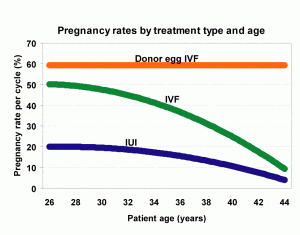
The media can make it seem like IVF is the answer to all fertility problems. In fact, treatment options vary based on the patient’s particular cause of infertility, her age and health. IVF is indeed the most targeted treatment available with substantially higher pregnancy rates than intrauterine insemination (IUI). However, because IVF is more expensive and invasive than IUI, a younger woman’s typical treatment path may start with IUI and superovulation. Women in their 20’s and up to mid-30’s can see pregnancy rates as high as 20 percent per IUI cycle, again, depending on several variables. If several cycles are unsuccessful, the best option then may be IVF either with the patient’s own eggs or donor eggs, depending on several factors.

Because women who are older have statistically lower fertility rates, time becomes a more crucial issue. IVF is often therefore recommended earlier in the treatment journey. Additionally, rates of pregnancy from donor eggs are so much higher; it enables even women with little to no chance of pregnancy with their own eggs to finally achieve the longed-for experience. Shady Grove Fertility’s SART statistics demonstrate that live birth rates per embryo transfer can go from a low of 3.4 percent for women ages 43-44 (with their own eggs) to as high as 56.7 percent of embryo transfers in all age groups using donor egg.

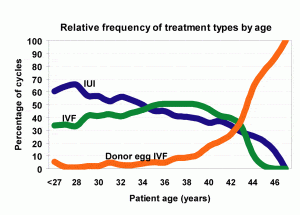
The table to the right illustrates how the types of treatment used at Shady Grove Fertility vary with the patients’ ages. As women age, the use of IUI becomes less effective for achieving pregnancy. Most IVF cycles are used by patients in their mid to upper 30s, accounting for about half of the treatment cycles in this age range. In addition, women in their 40’s are more likely to use donor eggs rather than their own egg cells.

People who are anxious to become parents yet struggling to conceive are learning to resist believing everything they hear about sensational fertility news items. The facts alone about treatment are encouraging enough, especially when the data is specific to your clinic of choice. A woman’s age at onset of treatment remains one of the biggest factors in choosing which technique is optimal. Statistics can help you zero in on the providers with superior expertise in providing guidance on those choices.


Figure 1. Shady Grove Fertility 2002-2005 (10,490 IUI cycles and 10,039 IVF cycles, 2,548 Donor Cycles)
Figure 2. Percentage of IUI, IVF, and Donor Egg among all treatment cycles (22,987) according to patient age. Shady Grove Fertility 2002-2005

Filed Under: General

September 16, 2014 by Shady Grove Fertility

As always, at SGF our goal is to do what is best for the patient. With that in mind, back in 2008, we realized something was missing – a place for our patients; current, past and perspective, to share their experiences. We turned to Facebook in hopes of creating a ‘safe place’ for patients to discuss and learn more about infertility, share experiences, and seek advice. Over the years, our patients have exceeded our expectations and have transformed the SGF Facebook Page into an interactive, patient-driven community of over 15,000 members.

Supportive Community

Infertility is very personal. It is often described as a journey that can be challenging at times, and gratifying at others. It requires support, hope, motivation, determination, and at times, encouragement from others to take the next step or remain positive when it seems a positive outlook is impossible.

“The Facebook Page – or our Facebook Community – offers a  safe place for patients to seek advice and share experiences with others who have walked the same path, overcoming the isolation felt by many patients.”
–Michael J. Levy, M.D.

Through positive stories and testimonials about overcoming infertility, past patients encourage other women to keep the end goal in mind – a baby – which is exactly what has happened for Kristen:

“Prior to my first cycle, it was comforting to be able to talk to other women who were walking the same path and see the success stories. I’ll be undergoing my second cycle late this fall (we became pregnant on the first attempt, but lost him at 21 weeks and five days due to an issue with my cervix) and have received so much support from women I’ve connected with through the SGF Facebook page. I’m hopeful and optimistic that I’ll be one of the women sharing a photo of my Shady Grove Fertility miracle, soon.” – Kristen, SGF patient and FB Community Member

Dynamic Education

The online community offers men and women the opportunity to learn from a reliable medical resource  about diagnosis, treatment, informational events, latest technologies, or general infertility awareness.

In addition to the education we are able to provide, members of the Facebook Community are able to provide a two-sided conversation with other community members.  As a result patients  have the ability to learn from each other about their experiences and seek help when making crucial decisions. While it is imperative to listen to your physician and nurse, we understand how important it is to hear from others who have had to make similar decisions. For example, often times, women seek advice from others regarding how many embryos to put back. This was the case for anonymous SGF sister:

“I’ve had two previous and unsuccessful IUIs, does anyone have advice on what to expect using IVF?” – Anonymous SGF patient and Community Member
Post by Shady Grove Fertility Center.

What is the benefit?

From Facebook, to friends, to motherhood. Read Sandi and Andrea’s story.

We know that the women who come to Shady Grove Fertility are strong and brave openly discussing their experiences no matter how trying their journey may be.


  • Sandi was so open with her situation, and through her openness, she not only found a life-long friend through Facebook, but a friend who later volunteered to be her gestational carrier! Read their story.
  • A place for all patients – current, past and perspective – to celebrate infertility milestones: pregnancies, tranferversaries, and birthdays.
    “After 6 infertility treatments (4 IUIs and 2 IVFs) I was ready to give up but Dr. McKeeby wouldn’t let me. He gave me hope. Lucky #7 gave us our miracle. Thank you Dr. McKeeby and the entire Shady Grove Fertility Family!” – Jena Lynn Lentz, SGF Patient and Community Member
  • You are braver than you believe!

    Encouragement. Everyone needs positive encouragement every once in awhile. Facebook community favorites are quotes about hope, faith, and never giving up.

  • Tameenah used Facebook as a support group while struggling with weightless in order to conceive.  In addition to utilizing My Fitness Pal, she relied on the SGF Facebook page – where “SGF Sisters” would post their steps in the infertility journey and cheer each other on. Read Tamenah’s Story.

  • Join the Shady Grove Fertility Facebook Community

    If you are ready to schedule an appointment at Shady Grove Fertility, please call 1-877-971-7755 to talk with one of our New Patient Liaisons. 

    Filed Under: General Tagged With: Emotional support

    • « Go to Previous Page
    • Page 1
    • Interim pages omitted …
    • Page 26
    • Page 27
    • Page 28
    • Page 29
    • Page 30
    • Interim pages omitted …
    • Page 46
    • Go to Next Page »

    Company

    • About SGF
    • About US Fertility
    • Our Doctors
    • Fertility Equity
    • Careers
    • Newsroom
    • SGF College Scholarship
    • Contact Us
    • Voice Your Feedback

    Treatments

    • Egg Freezing
    • Intrauterine Insemination (IUI)
    • In Vitro Fertilization (IVF)
    • Frozen Embryo Transfer (FET)
    • LGBTQIA+ Family Building
    • Shared Risk 100% Refund Program
    • All Treatments

    Resources

    • Patient Portal
    • Online Bill Pay
    • Library
    • Support Groups & Events

    Locations

    • California
    • Colorado
    • Delaware
    • Florida
    • Georgia
    • Maryland
    • North Carolina
    • Pennsylvania
    • Texas
    • Virginia
    • Washington, D.C.

    2026 Shady Grove Fertility

    • Policies & Notices