

• Skip to primary navigation
  • Skip to main content
  • Skip to footer
Shady Grove Fertility
  • Become an Egg Donor
  • Referring Physicians
  • 1-888-761-1967
  • Schedule Appointment
  • Get Started
        • Get Started
          • Causes of Infertility
          • Fertility Tests
          • When to Seek Help
          • Find a Doctor
          • Preconception and prenatal vitamins 
          • Schedule an Appointment
        • Personalized Care For
          • Single Parents
          • LGBTQIA+ Family Building
          • People with Cancer
          • Known Genetic Diseases
          • Egg Donors
  • Treatments
        • Fertility
          • Timed Intercourse
          • Ovulation Induction
          • Intrauterine Insemination (IUI)
          • In Vitro Fertilization (IVF)
          • Frozen Embryo Transfer (FET)
        • Donation & Surrogacy
          • Donor Sperm
          • Donor Egg
          • Donor Embryo
          • Gestational Carrier
          • LGBTQIA+ Family Building
          • Single Parents
          • Find a Donor
        • More Treatments
          • Center for Male Fertility
          • Egg Freezing
          • OncoFertility
          • Preimplantation Genetic Testing
          • MIGS
          • All Fertility Treatments
  • Resources
    • Resource Library
    • Events Calendar
    • Patient Stories
    • Mental Health
    • Wellness Center
  • Insurance & Savings
    • Insurance & Benefits
    • Shared Risk 100% Refund Program
    • 100% Refund for Donor Egg
    • Discounts
    • Egg Freezing Costs
    • Financing & Grants
    • Clinical Trials
  • About
    • Find a Doctor
    • About SGF
    • Our Care Team
    • Advanced Practice Providers
    • Fertility Equity
    • Philanthropy
    • Newsroom
    • Careers
    • Contact Us
    • Voice Your Feedback
  • Locations
        • Find a Location
        • California
        • Colorado
        • Delaware
        • Florida
        • Georgia
        • Maryland
        • North Carolina
        • Pennsylvania
        • Texas
        • Virginia
        • Washington, D.C.
        • Chile
        • International & Out of State
        • SGF at Walter Reed National Military Medical Center
  • Patient Hub
    • Online Bill Pay
    • Patient Forms
    • Patient Portal
  • Call your care team
  • Become an egg donor
  • Referring physicians
  • search-icon
  • Schedule appointment 1-888-761-1967

Home / Your Care Team / Page 18

Your Care Team

January 9, 2015 by Shady Grove Fertility

Isaac E. Sasson, M.D., Ph.D., FACOG, and Sunita Kulshrestha, M.D., FACOG, of Shady Grove Fertility’s Chesterbrook, PA and Bala Cynwyd, PA locations are named 2014 “Top Doctors” in Reproductive Medicine according to Main Line Today. Selected by the medical community, Drs. Sasson and Kulshrestha are among 12 physicians recognized as “Top Doctors” in Reproductive Medicine for the Main Line region of Philadelphia.
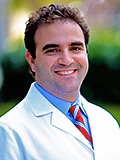
Dr. Isaac E. Sasson, M.D., Ph.D., FACOG, of SGF’s Chesterbrook, PA office.

“It’s an honor to receive this recognition from my peers and to be named among such esteemed physicians, including my dedicated colleague Dr. Kulshrestha. We’re both very passionate about our practice and our patients, and we are grateful for this distinction,” said Dr. Sasson.

Main Line Today’s “Top Doctors” compiles its listing based on peer balloting. Voting is open to physicians throughout Pennsylvania, and only physicians in the Main Line area and surrounding suburbs are eligible for inclusion.

“Shady Grove Fertility is relatively new to the Philadelphia region, making Main Line Today’s recognition a testament to the incredible work that Drs. Kulshrestha and Sasson have performed and the many patients they’ve been able to help,” said Eric A. Widra, M.D., medical director of Shady Grove Fertility.

Dr. Sunita Kulshrestha, M.D., FACOG, of SGF’s Bala Cynwyd, PA office.

Shady Grove Fertility has four offices in Pennsylvania, including Reading, Harrisburg, Bala Cynwyd, and a full-service state-of-the-art center and laboratory in Chesterbrook.

Congratulations to our physicians!

If you have questions regarding infertility treatment or would like to schedule a new patient appointment, please call our New Patient Center at 877-971-7755 or click to schedule an appointment.
Filed Under: Your Care Team

October 2, 2014 by Shady Grove Fertility

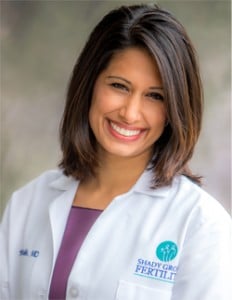
Shady Grove Fertility is proud to welcome Shruti Malik, M.D. to our physician team. In mid-October, Dr. Malik will be joining Drs. Browne and Greenhouse in the Fair Oaks office in addition to performing procedures in our Rockville location. Dr. Malik sat down with us to talk about why she became a reproductive endocrinologist, her inspirations, and even her musical playlists:

Why did you become a doctor?

Well, my parents told me I wanted to be a doctor ever since I started carrying around a Fisher Price medical bag when I was about four years old.  While I don’t fully recall that, I do remember really admiring my pediatrician growing up.  He was a wonderful doctor who really cared about our family and watched me mature.  As I grew up, I just gravitated towards helping others.  I loved volunteering in the community and at the nearby hospitals.  It was such a wonderful feeling to make someone else’s day just a little brighter.

Why did you become a reproductive endocrinologist (REI)?

I actually had never heard of a reproductive endocrinologist until a friend suggested it to me as an elective rotation in medical school. The more I learned, the more intrigued I became. I spent two weeks immersed in the field. It was the first time in my medical career that I felt like the physicians and the patients worked so hard towards a common goal. The couples I met were such wonderful people and I wanted nothing more than to help them complete their dream of a family. From that moment on, I knew this was exactly what I was meant to do. I truly cannot imagine doing anything else. 

What drew you to Shady Grove Fertility? 

I absolutely love the dynamic of the entire team here at SGF. Every person from the moment you walk in the door plays an integral role and is so dedicated to the patients.  It is easy to think that a group this size would feel impersonal, but it’s the complete opposite. Even though I have just started here, I feel like I already have a new family. It is such a wonderful feeling and I hope our patients feel the same way.

Who inspires you?

My parents have always been my inspiration. They have been there for me in every facet of my life, no matter how big or small. They are wonderful and caring people who never hesitate to lend a helping hand to those around them. They were always there to help me with everything from math homework or a science project to trying to help me study for medical exams, despite not being physicians themselves.  Their unconditional love and support inspires me and is a constant reminder of how strong a parent’s love can be.

What’s on your bucket list?

I would love to keep traveling and maybe plan a trip to Australia, Thailand or Peru.  I’m determined to hike the Inca Trail to Machu Picchu soon!

What are your hobbies?

I love photography! My friends and family know me for always having a camera in hand. I think it’s a great way to preserve memories. I am usually toting around a large DSLR camera at weddings and other events.  I also like to draw and will do a bit of charcoal drawing. I decided to pick up painting lately but I wouldn’t say I am good at that just yet!

I enjoy playing tennis, running and biking.  I’m looking forward to exploring the beautiful trails here in the area.  I also really enjoy exploring new places and restaurants and I think the DC area will keep me pretty busy there too!

What artists are on your iPhone?

Honestly, there is not a single song on my phone.  However, I do love listening to Pandora when I go running or biking, especially the Black Eyed Peas station. It always keeps me going during a long run!

Dr. Shruti Malik is currently available for new patient appointments in our Fair Oaks, VA office. To schedule your appointment, call 1-877-971-7755 or click here.

Filed Under: Your Care Team

October 1, 2014 by Shady Grove Fertility

Over the past few years, stigmas regarding infertility have been quickly disappearing and patients are speaking out more everyday in support of each other.  In preparation of National Infertility Awareness Week we reached out to successful patients for their “Words of Wisdom” to share with our current patients. As the advice started rolling in we were thrilled with the number of ideas and words of support we would have to share with you. We hope that you find hope and support in these ‘Six Tips to Help You Survive Fertility Treatment’ provided by a former Shady Grove Fertility patient who now has two of children.

1. Expect people to say insensitive things.
At some point, someone will tell you you’ll get pregnant when you stop worrying about it so much, or that you should just adopt, or that maybe you should stop trying so hard. Don’t let these kinds of comments get the best of you! The general public is subject to tons of misinformation about infertility, and usually they have no idea what they are talking about. Try to remember that they mean well—in spite of how hurtful their comments might feel to you. As hard as it is, try to be generous with your forgiveness. Plus, if you are prepared to expect these kinds of comments, you might even be able to have a sense of humor about them. We are all only human, and after all, how many times in your life have you said something well-intentioned, trying to be supportive, only to end up putting your foot in your mouth? Eventually, at some point, you might feel ready to talk more openly with these people and educate them about your journey—and about infertility in general. Until then, try to let these comments roll off your back and move on.

2. Have faith in the process but expect setbacks.
Sometimes treatments work on the first try, but usually there are setbacks. Try not to pin all your hopes onto one attempt. Instead, have faith that you are engaged in a process that gives you the best chance of having a baby. In other words, you are doing all you can. When you have a setback, it can feel devastating, but try not to look at it as a failure. There may be many steps in your journey to parenthood, but try to have faith in the journey you have chosen.

3. Resist the temptation to over-analyze every detail of your treatment cycle.
Fertility treatment can make you more than a little crazy! Before you know it, you start reading into every little detail like magical tea leaves. (e.g., I only got x# eggs—that must be a sign that they are poor quality! Oh no, I’m getting a yeast infection—surely that will decrease my chances of implantation at my transfer tomorrow! And so on…) To allay your fears—however irrational they might be—ask your doctor and nurse as many questions as you need to. They are very smart! Listen to what they tell you about your cycle, and believe them when they tell you what you do and don’t need to worry about. Then you can focus your energy on relaxing and thinking positive thoughts.

4. Keep living your life.
So much of infertility treatment is out of our control and unpredictable. There will be long periods of tedious waiting, followed by periods when you are consumed with monitoring visits, medication schedules, and worry. Don’t let all the uncertainty paralyze you from making plans and living your life. For example, if you want to plan a trip to the Bahamas next winter, do it! When the time comes, if that vacation ends up conflicting with your cycle dates, or—even better—if you are pregnant and cannot travel, you can cancel the vacation. Infertility treatments might take years, and in the meantime you need to continue being a whole person with interests and hobbies and a life. You’ll be much happier if you work your treatments around your life, not the other way around.

5. Talk about your journey to the right people.
Think of someone who will be open to hearing about the highs and lows your journey and validate your feelings. Someone who will say things like, “Wow, that sounds so difficult, you must be so frustrated,” or “That’s so exciting!” or “I can tell you are really struggling with this.” What you usually won’t need is advice—unless you are specifically asking for it—so avoid talking about it with people who love to solve your problems for you. Also, before you start telling people about your journey, think about how you will feel later on when those people ask you questions to “check in” with you about how your treatments are going. A true friend will appreciate hearing something like this up front: “I really appreciate your support, but please understand that I am not always going to be in the mood to talk about this. If I need to talk, I will bring it up. You don’t need to ask me about it.” Shady Grove support groups can be an excellent place to talk out your feelings and get a reality check, e.g., “I totally felt the same way, and no, you are not crazy for feeling that way!” I found that when I got the validation I needed in the context of a support group, I felt less of a need for validation from my friends/family, which in turn removed some of the strain from those relationships and allowed me to just be my normal self with those people.

6. Learn to strike a balance between positive thinking and letting go.
This is so basic but so elusive. No amount of positive thinking will ensure that a cycle is successful, but for the sake of your mental health, you owe it to yourself to try to stay positive. It helps if you can find a way to be realistic and optimistic simultaneously. On the one hand, you can accept that you cannot control the outcome of your treatment, and know that you will be OK no matter what happens (try repeating this to yourself several times a day). On the other hand, feel positive about the fact that you are doing everything you can to achieve your goal. Remember that it is a blessing just to have the chance to try another cycle—lots of couples never have that chance.

For more words of wisdom, visit Shady Grove Fertility’s blog at https://www.shadygrovefertility.com/blog/  for a graphic representation of the advice from our “SG Graduates.”  For more support during Infertility Awareness Week and beyond, visit our Psychological Support Staff’s calendar of events and groups at https://www.shadygrovefertility.com/calendar
For more information or to schedule an appointment with one of our physicians, please speak with one of our friendly New Patient Liaisons by calling 888-761-1967.

Filed Under: Your Care Team

October 1, 2014 by Shady Grove Fertility

Part two of our IVF overview series takes you inside the embryology laboratory and describes step-by-step how an egg becomes an embryo, how the embryos are cared for, how you and your clinical team are updated daily, and how the transfer date is determined.

In Vitro Fertilization (IVF) treatment requires a substantial level of dedication from patients during the first half of the treatment cycle. During the ovarian stimulation phase, patients do daily injections, morning monitoring appointments and frequent follow-ups with their clinical team. Once the patient’s eggs are retrieved, the focus of the cycle shifts into the embryology laboratory where the eggs are fertilized and developed until it’s time for the embryos to be transferred. Because this part of the cycle happens behind the laboratory doors, most patients aren’t familiar with the level of organization, detail and skill that goes into developing each embryo and preparing it for transfer.

Keeping Embryos Safe Inside the Laboratory

For the convenience of patients living in both the Baltimore and Washington regions, Shady Grove Fertility has two embryology laboratories, one in Rockville, MD and another in Towson, MD. These offices are where all IVF patients have their egg retrievals, fertilization and embryo development, and embryo transfer procedures done.

These embryology laboratories are filled with state-of-the-art incubators, microscopes, and highly skilled technicians to ensure patient’s sensitive eggs have the best chance of growing into healthy embryos.

The equipment within the laboratories is what really sets the Shady Grove Fertility laboratory apart from any other. At our largest laboratory in Rockville, the embryology laboratory is ISO-certified Level 1000 clean rooms. This means that the space within the laboratory is so clean, it has less than 1,000 particles per cubic meter. To put this in perspective, the environment outside has over 35,000,000 particles per cubic meter. The filtered air within the entire laboratory is replaced 30 times per hour. Air re-entering the laboratory is filtered through both HEPA filtration for particulates and carbon filters for volatile organic compounds (VOC’s). This prevents nearly all contaminates from interrupting the growth of embryos.

Embryos are developed and cultured in one of 43 incubators, which act as artificial wombs. The environment within each incubator is carefully controlled; the temperature is set to a constant 98.6 degrees Fahrenheit, and the incubator interior is kept dark to further emulate the womb environment.

Several of the procedures within the embryology department take place under one of the laboratory’s five inverted microscopes. These microscopes allow light from above the Petri dish to illuminate down through the sample into the lenses located at the bottom of the microscope. Each microscope magnifies up to 400 times and provides high resolution views of the sperm, eggs, and embryos, allowing embryologist to make precise movements when doing procedures.

Along with the inverted microscopes, the laboratory also has 14 stereo microscopes and 2 phase microscopes. These are used to evaluate a embryo’s development, growth, and quality. These assessments monitored daily and entered into each patient’s electronic medical record for the clinical team to review and share with their patients.

In addition, forty-five liquid nitrogen storage vessels containing patients’ frozen sperm, eggs, and embryos are monitored around the clock. At Shady Grove Fertility, many patients have extra embryos after their transfer that are stored in these vessels to be used at a later date.

Highly Trained Embryologists

Behind each piece of equipment is an embryologist. The principal functions of these specially trained staff are to verify the identification of individual patient specimens, carefully handle sperm, eggs, and embryos and to guarantee appropriate distribution of all materials.

All staff involved in the handling of sperm, eggs, and embryos must follow what is known as a Chain of Custody protocol. Chain of custody refers to the way each specimen is identified during every step of the process to ensure the integrity of each patient’s specimens. Shady Grove Fertility’s chain of custody protocol requires that two embryologists verify the identification of samples at each stage of the process to ensure, for example, that the correct sperm is paired with the correct eggs. Patients also take an active role in the protocol when they are asked to verify their identification verbally at several points.

Because of our commitment to these procedures, Shady Grove Fertility has never had an incorrect identification in our 20-year history. Making sure the right sperm ends up with the right eggs or that the right embryo is transferred to the right patient is the absolute most important thing to our Practice.

Keeping each embryologist proficient in all aspects of laboratory work is another important facet of our Practice. To this end, the laboratory is divided into several different stations and the embryology staff are divided into teams. Each team is assigned to a different task each day to allow every member of the team to remain proficient in all tasks. For example, one team will work with the fertilization, culturing, and micromanipulation of eggs and sperm. Another team will work on embryo selection and transfers, and yet another will work to cryopreserve, or freeze, remaining embryos that patients wish to use at a later time. No matter what station the team is working at, everyone is always doing intensive Quality Assurance, Quality Control and Quality Improvement.

The Sperm’s Journey

In an IVF cycle, the work of the embryology laboratory staff starts on the morning of the egg retrieval. The embryology team accepts a semen sample, collected either at home or on-site, from the male partner.

If the male partner cannot attend the egg retrieval, which can be the case for international and out-of-state patients, a sample can be processed and frozen in advance. Frozen samples are then thawed and prepared on the day of the egg retrieval.

After the laboratory takes possession of the semen sample, it is transferred into a tube and placed in one of four centrifuges where it is “washed.” During the “washing” process, it is spun so that the sperm with the best shape and motility are concentrated at the bottom. These sperm, which are the healthiest in the sample, are separated out and prepared for fertilizing the eggs.

That same morning, the female partner undergoes her egg retrieval. As the fluid in each egg follicle is removed, it is passed to an embryologist to examine. Under a powerful microscope, the embryologist can see and isolate the retrieved eggs and put them into culture. Culture is a media or liquid where embryos are developed. The media mimics the conditions of the fallopian tubes by controlling the pH level and ultimately optimize embryo development. Before the patient leaves the surgery center, she will be told how many eggs were retrieved.

Fertilization: Conventional and ICSI

After the eggs and sperm are sorted and prepared, the next step is fertilization – a process that starts later that same day. There are two ways that fertilization can take place. One is called Conventional Fertilization and the other is called Intracytoplasmic Sperm Injection or ICSI (“ick-see”). The decision about which method to use is based on the quality of the sperm. To test sperm, an analysis is completed as part of the initial basic fertility work up for diagnosis before treatment and then again when the semen sample is provided on the day of the egg retrieval.

In Conventional Fertilization, the embryologist takes the prepared sperm sample and isolates the healthiest sperm. That sperm is introduced to the mature eggs in a Petri dish and fertilization occurs naturally.

Intracytoplasmic Sperm Injection or ICSI is a more controlled process, which is frequently used for Male Factor infertility, in which an embryologist injects a single, healthy sperm into the cytoplasm, or center, of each egg. Since fertilization only requires one healthy sperm, ICSI has become one of the most incredible advances in fertility treatment because it allows for fertilization even in cases of severe male factor infertility.

ICSI is also recommended for milder forms of male factor infertility such as low sperm count, poor motility, or poor morphology, for patients using a frozen sperm sample or those who have not had success with fertilization in previous cycles.

Usually, ICSI is planned in advance, but sometimes it is unanticipated. The embryologist may see that semen parameters for Conventional Fertilization are not being met. In this case, the embryologist will make the decision to switch to ICSI so that the cycle can still produce embryos and increase the chances of success for the patient. Your Clinicial team will let you know if an “emergency” ICSI procedure is recommended.

Embryo Development

Once fertilization occurs, the embryos begin to develop. Within just five or six days, the cells of the embryo divide and prepare to become different parts of the fetus from placenta to internal organs.
Embryo development begins when the fertilized eggs are placed in an incubator overnight. An embryologist examines each patient’s developing embryos and makes notes in the patient’s electronic record. The embryologist will do a fertilization check on day 1 and again on day 5,
and monitor for progressive embryo development using a system we call embryo grading. Rapid cell division continues as the embryo enters the blastocyst stage around days 5 or 6. The blastocyst has a protective jelly-like shell called a zona pellucida and defined areas of cells within it. The organization of what is called “the inner cell mass” is a key indicator of how likely the embryo is to implant.

When and How Many?

Choosing embryos that will implant is the main goal of the embryologist since these are the ones most likely to result in a pregnancy and ultimately a baby. Embryos are evaluated by appearance and by how they have progressed through the stages of development during the few days they have been in the laboratory.

The embryologist will do a fertilization check on day 1 and again on day 5. Embryos are left in the incubator from day 2 to 4 of growth to encourage continued growth and development. Embryos are usually transferred into the uterus on Day 5 of growth when they have reached the blastocyst stage. Remaining embryos that were not transferred will be cryopreserved upon reaching the blastocyst state – which can occur on Day 5, 6, or 7.

In some cases, specialized testing may be done on the embryos to aid in their choice. This process is called Pre-implantation Genetic Screening or PGS. PGS provides the ability to choose embryos for transfer that are free of chromosomal abnormalities and specific genetic disorders. PGS is sometimes recommended for patients who have had recurrent miscarriage or unsuccessful IVF cycles and for couples who are at risk for passing on an inherited genetic disease to their offspring such as Cystic Fibrosis.

PGS involves removing a few cells from each embryo. After the embryos are biopsied, they are either frozen or held in culture depending of the day of the biopsy. The biopsied cells are then sent to an external laboratory to be reviewed and tested. Embryos can be screened for aneuploidy (abnormal chromosome number) or specific genetic diseases such as Sickle Cell Anemia or Cystic Fibrosis. Unaffected embryos can then be identified and transferred, increasing the chances of an on-going pregnancy and nearly eliminates the chance of passing on a severe genetic disease.

Improving the Likelihood of Implantation

Once the embryo or embryos are chosen for transfer, some are given an additional nudge toward implantation with Assisted Hatching. Each embryo needs to escape or “hatch” from its shell, the zona pellucida, before it can implant in the uterus. With Assisted Hatching, an optical laser is used to dissolve part of the zona pellucida to facilitate the hatching process.
This technique is used with patients over the age of 38 and/or those who have done previous unsuccessful IVF cycles. It is also used with embryos that have a thickened zona pellucida and those that have been previously frozen, since freezing can lead to zona hardening. Sometimes, Assisted Hatching is unanticipated, which means that the embryologist decides to do it because of his or her observations of the embryo even in cases where none of the usual indications exist.

Freezing Extra Embryos

After the embryo transfer, many patients have additional, healthy blastocysts remaining in the laboratory. Patients have the option of having these embryos frozen through a process called vitrification. Frozen embryos are then stored in the laboratory under exacting conditions so that if a patient is not successful with her first embryo transfer, she can come back for a frozen embryo transfer cycle (FET) without having to complete a full cycle of IVF. Many patients also use frozen embryos to have a second or third child years after their initial IVF cycle.

Vitrification is a relatively new technology that has improved the way embryos are frozen. The vitrification process consists of rapidly cooling the embryo(s) so that little or no damage is done to them. When these embryos are thawed, they are virtually identical to their original state.

The technology for vitrifying and thawing embryos has become so good that the pregnancy rates for FET cycles are nearly identical to those for fresh IVF cycles. Shady Grove Fertility now performs over1,200 FET cycles each year making it a commonplace form of fertility treatment. FET cycles are much more cost-efficient and slightly shorter than fresh IVF cycles because there is no ovarian stimulation, which means less medication, no egg retrieval, and the fertilization and embryo development has already been completed. For an FET cycle, the patient uses injectable medications to thicken the lining of her uterus so that it will accept an embryo for implantation. However, there are fewer injections and only 2-3 monitoring appointments involved.

With pregnancy rates remaining high and the FET cycle being simple, there is no longer any downside to freezing and saving embryos. They simply give patients another chance at pregnancy without the cost and time commitment of a complete IVF cycle.

Growing Families

While embryologists are focused on the science of their jobs, the embryologists in our laboratories are always keeping the human element, the patient, in mind. They know how precious every embryo is to the couples that are hoping and praying that a child results from their work. They work closely with the clinical team to make the best decisions possible for every patient – and the clinical team, in turn, makes sure that what’s happening in the laboratory is communicated to their patients every day.

Up next in our IVF overview series is a detailed description of the embryo transfer, pregnancy testing and early prenatal care that concludes an IVF cycle. The final part of the series will share the latest published success rates for all IVF cycles performed at Shady Grove Fertility Center.

Read our IVF Treatment Series:
Part One of the IVF Treatment Series- Cycle Start to Egg Retrieval
Part Two of the IVF Treatment Series- In the Embryology Lab
Part Three of the IVF Treatment Series- Final Steps of IVF Treatment

For more information or to schedule an appointment with one of our physicians, please speak with one of our friendly New Patient Liaisons by calling 888-761-1967.

Filed Under: Your Care Team

October 1, 2014 by Shady Grove Fertility

Medical Contribution By Dr. Sharon Covington

Which came first? Stress? Infertility? Does it matter?

“It’s something we’ve always wondered about,” says Tami Quinn of Pulling Down the Moon, “and the general consensus has been that there’s a connection. Everyone agrees that infertility causes stress – you stop eating right, you feel anxious… But hard data is now coming to light that shows a real biochemical link between stress and fertility problems.”

Quinn, whose business provides complementary medicine services to Shady Grove Fertility patients, is referring to a recently published National Institutes of Health study that demonstrated women with higher levels of an enzyme known as alpha-amylase were 12% less likely to get pregnant. The enzyme is referred to by the study’s lead researcher as “a real-time measure of stress.”

Dr. Sharon Covington, Program Director of Shady Grove Fertility’s Psychological Support Services, says the stress related to trying to get pregnant can begin even before couples seek fertility treatment.

Overcoming the Stresses of Infertility“For some, not having gotten pregnant after three months of trying may raise a question in their minds,” Dr. Covington explains, “while others may have a physical stress response early in their journey. For someone who’s already anxious, trying to get pregnant quickly becomes another thing to worry about.”

That individuality of response has also been documented with research. Quinn describes a study in which monkeys were stressed out by way of things like a treadmill, diet, and social isolation. The result was that some subjects ceased ovulating or menstruating, some continued to menstruate but no longer ovulated, and some showed no change.

Once someone has made the choice to consult a fertility specialist, Dr. Covington says, their stress is often reduced slightly by simply taking action. “Getting more information can be stress-relieving for some people. “

Dr. Covington and her support team prefer to meet with a couple for a one-time session when that first decision to seek treatment is made. In the privacy of a professional office, counselors will prepare couples for what’s to be expected from the fertility treatment process.

Fertility counseling can be more than simple educational discussion or a place for patients to spill their worries. Dr. Covington and the Shady Grove Fertility support staff use techniques such as guided imagery, cognitive restructuring, and meditation to help patients first identify their stress triggers and then strategize to deal with them.

She says that one of the most stressful period for many fertility patients is what’s referred to as “the two-week wait,” when there’s nothing to do, no appointments to attend, and generally not even need for a phone call to the office staff. “At that point, the patient has been engaged in some intense and very regular clinic contact for weeks prior, and now, all they can do is wait to see if they’re pregnant.”

Most of the time, though, patients seek support only after several unsuccessful treatment cycles. “By the time they come in for either private or group counseling, they feel emotionally defeated and distressed,” Covington says.  Another common time for patients to inquire about counseling services is at what Dr. Covington calls “the treatment crossroads, when it’s time to consider either different types of treatment or possibly adoption.”

That delay in seeking help with stress reduction is also seen by Tami Quinn, who remarks, “We’re always advocating for patients to come in earlier on that path to pregnancy. We’d like to consult with women while they’re still seeing a regular gynecologist or following their initial consultation with the fertility specialists. Optimally, three months before they start treatment would give their bodies time to respond positively to the stress reduction techniques.”

The services offered by Pulling Down the Moon include nutritional counseling, yoga, massage, andacupuncture. Rather than prescribing any one modality to patients, Quinn encourages women to “start wherever you’re at – if you hate yoga, maybe you’d like acupuncture; or people who are hesitant to change their diet may find yoga once a week to be refreshing.” The important thing is to make a plan for stress reduction and act on it. The company’s name is a reference to the challenges that some feel when trying to conceive. “We really think that just acknowledging the fact of this tremendous life challenge is the first step in achieving an inner calm, and with that, enhanced fertility.”

Both Dr. Covington and Tami Quinn agree there is no magic pill or one-time action to alleviate stress. It takes making some adjustments, adding some activities to your way of life, and learning new ways of thinking about your struggle.

Shady Grove Fertility holds many support groups and workshops dedicated to helping our patients deal with the stress of infertility. Please check our event calendar to find out dates and times of support groups you may find beneficial to your fertility journey.

Additionally, if you would like to learn more about our individual psychological support services offered through Shady Grove Fertility, please call Sharon Covington at 301-279-9030. For more information about Pulling Down The Moon’s services, please call 301-610-7755 or visit www.PullingDownTheMoon.com.

Filed Under: Your Care Team

October 1, 2014 by Shady Grove Fertility

Mothers Day 2009 will be one that Corey Gant never forgets. The new mother of twins says she has many to thank to be able to celebrate her first holiday as a mom – her husband, the doctors and nurses at Shady Grove Fertility Center, but most of her thanks goes to a familiar partner: her mother.

“My mother is the unsung hero of it all,” said Gant. “I can’t thank her enough for her patience, love and understanding through everything. She was my cheerleader, my support group, my pseudo RE, and research guru. I couldn’t have done any of this without her. Thank you Mom!”

Not an Infertility Patient
Corey and her husband Billy were nearing the end of their journey without the child for which they longed. If it weren’t for a meeting of earth-bound angels on their behalf, the couple might never have had the strength to continue on the final leg of their path, all the way from Alabama to Shady Grove Fertility.

Now in their early 30’s, the Gants had tried to have a baby for five years. First, they tried Clomid (through her OB/Gyn’s recommendation) without results. Corey’s mother, Melinda Hawkins, an educator and avid Internet researcher, was concerned that the couple was wasting time. She urged them to seek the advice of a fertility specialist. She wondered if Corey had endometriosis. Corey resisted her mother’s advice until deciding to consult a reproductive endocrinologist (RE) “just to please her.”

Corey wrote in her blog — billyandcorey.blogspot.com — “I remember sitting in the waiting room, slightly embarrassed, thinking ‘This is ridiculous, I’m not like these people. I don’t need this.” In the end, the appointment and resulting diagnosis of an endometrioma, confirmed by ultrasound, was enough to make the young woman wonder if her mother was “psychic.”

Once her severe endometriosis was surgically removed, Corey and Billy spent a year and a half trying to conceive. She endured more Clomid, intrauterine inseminations (IUI), and injectable fertility medications, yet no pregnancy. Corey did conceive three times, but lost all three pregnancies early in the first trimester.

Corey recalls in her blog, “It finally stared to sink in — I am an infertility patient. Wow. It was very hard to finally admit it to myself, but there I was facing in vitro fertilization.”

Angels in Trying Times
Corey underwent two rounds of IVF at home in Birmingham and both times produced a good number of eggs and embryos. The first round ended with a “chemical pregnancy” – the term for a positive pregnancy test achieved before the woman’s period was due but a miscarriage occurs before a heartbeat was able to be seen on an ultrasound. The second one resulted in a terrifying and painful ectopic pregnancy. Corey became despondent. She questioned her faith, her intentions, and her entire life.

Meanwhile, her mother was becoming something of a reproductive expert via her constant Web searches. She pushed Corey to consider another doctor in Tennessee, but the depressed young woman did not feel a good connection at that clinic.

Melinda recalls how helpless she felt, trying to pull her daughter through her misery on the long drive home from Nashville. “I was frantic but had to appear calm, a pose that I‘m sure many mothers of the young women you treat must adopt,” she said in a letter to Shady Grove Fertility physician Michael Levy.

On one of her many nights perusing the Internet for answers to her daughters’ great sadness, Melinda visited a chatroom for the first time. There she met two women, both of whom not only lived in Birmingham, but who had finally become mothers with the help of Dr. Levy at Shady Grove Fertility’s Rockville Office.

“One of the women had earlier in the conversation wondered aloud why she was even [in the chatroom] since she’d already had her baby,” said Melinda. She describes the chatroom experience as “serendipitous.” Corey, initially “angry and broken” in spite of the unfolding positive news, now looks upon the chance meeting between her mother and these women as “the hand of God.”

While her mother continued to speak with the women about Shady Grove Fertility and their impressive lab reputation, delving further on the Internet with research on statistics and history of the clinic and its physicians, Corey and Billy used their one frozen embryo for a last attempt in Birmingham — and another chemical pregnancy.

A Mother’s Determined Intuition
Melinda booked a flight to Maryland. She and Corey set off to talk directly to Dr. Levy for consultation. It was the turning point in the Gant’s long journey.

As they sat in Dr. Levy’s office with him for more than an hour, Melinda recalls the change that came over Corey. “I watched her relax. I saw her trust return. I felt hope creep back in.” She credit’s the expert’s unhurried manner and attention to the details of Corey’s reproductive history. By the time they left, “Corey was over the moon, in project mode, telling Billy exactly what needed to be done before she, and eventually he, left for Maryland.”

“It was incredible to find someone like Dr. Levy who was willing to do the tests and procedures to get the answers to the questions,” said Corey. “We felt that he wanted those questions answered as much as we did.”

In her final blogpost about their long journey, Corey describes her transformation from depression to amusement with Dr. Levy to elation. “We left there almost in tears, not because we were disappointed, but because we were elated. Mom and I both felt as though a ton of bricks had been lifted from our shoulders. Every question Mom had was answered. Every procedure Birmingham had refused to do was standard protocol in Maryland. THIS was our answer; these were the answers we had been screaming for. Mom said she felt as though she could let go now….all her trust was in Dr. Levy.”

The logistical details for the long-distance IVF cycle fell into place with the coordination of her husband, the nursing team from Shady Grove Fertility, and her beloved friends.

Corey took advantage of Shady Grove Fertility’s Shared Risk 100% Refund Guarantee program knowing that if she did not successfully have a baby with Shady Grove Fertility, she would have her money refunded for other family building options.

“Dr. Levy accepted us into their Shared Risk program, where you pay a flat fee, but there would be a 100% money back guarantee after six IVF tries,” Corey said. “I would be free to pursue adoption or any other IVF protocol somewhere else if he was not successful.”

On August 29, 2008, after just one IVF cycle at SGFC, Corey had another positive pregnancy test. This time, it was “very positive,” Melinda says. On April 21, 2009, Henley Louise Gant and Davis Hawkins Gant were born, healthy, “precious and perfect.”

Corey Gant looks forward to sharing the story of how they came to be with her son and daughter. She has made sense of her years of sadness with hindsight and deep reflection.

“Hold onto hope because it is out there,” she said. “Going through fertility treatment can be a very dark place, but Shady Grove Fertility provided hope for us. I had confidence that with Dr. Levy and the Shared Risk program, I was going to achieve my dreams of parenthood with Shady Grove Fertility Center.”

In her blog, Corey wrote, “I needed to see pain from the other side so that I might be more sympathetic to people and the problems we all face as human beings. I learned I need more patience. I learned to accept the forks in the road. I know I’ll face so many more challenges in my life and I feel like I’m more equipped to handle those challenges. I feel closer to our God.”

Her mother, Melinda, shared with Dr. Levy her own gratitude. “I just wanted to tell you that the work you do goes beyond giving a couple the chance to have a family; it actually spans the generations because it has also, in essence, given us our daughter back.”

For more information or to schedule an appointment with one of our physicians, please speak with one of our friendly New Patient Liaisons by calling 888-761-1967.

Filed Under: Your Care Team

  • « Go to Previous Page
  • Page 1
  • Interim pages omitted …
  • Page 16
  • Page 17
  • Page 18
  • Page 19
  • Page 20
  • Interim pages omitted …
  • Page 22
  • Go to Next Page »

Company

  • About SGF
  • About US Fertility
  • Our Doctors
  • Fertility Equity
  • Careers
  • Newsroom
  • SGF College Scholarship
  • Contact Us
  • Voice Your Feedback

Treatments

  • Egg Freezing
  • Intrauterine Insemination (IUI)
  • In Vitro Fertilization (IVF)
  • Frozen Embryo Transfer (FET)
  • LGBTQIA+ Family Building
  • Shared Risk 100% Refund Program
  • All Treatments

Resources

  • Patient Portal
  • Online Bill Pay
  • Library
  • Support Groups & Events

Locations

  • California
  • Colorado
  • Delaware
  • Florida
  • Georgia
  • Maryland
  • North Carolina
  • Pennsylvania
  • Texas
  • Virginia
  • Washington, D.C.

2026 Shady Grove Fertility

  • Policies & Notices