
• Skip to primary navigation
  • Skip to main content
  • Skip to footer
Shady Grove Fertility
  • Become an Egg Donor
  • Referring Physicians
  • 1-888-761-1967
  • Schedule Appointment
  • Get Started
        • Get Started
          • Causes of Infertility
          • Fertility Tests
          • When to Seek Help
          • Find a Doctor
          • Preconception and prenatal vitamins 
          • Schedule an Appointment
        • Personalized Care For
          • Single Parents
          • LGBTQIA+ Family Building
          • People with Cancer
          • Known Genetic Diseases
          • Egg Donors
  • Treatments
        • Fertility
          • Timed Intercourse
          • Ovulation Induction
          • Intrauterine Insemination (IUI)
          • In Vitro Fertilization (IVF)
          • Frozen Embryo Transfer (FET)
        • Donation & Surrogacy
          • Donor Sperm
          • Donor Egg
          • Donor Embryo
          • Gestational Carrier
          • LGBTQIA+ Family Building
          • Single Parents
          • Find a Donor
        • More Treatments
          • Center for Male Fertility
          • Egg Freezing
          • OncoFertility
          • Preimplantation Genetic Testing
          • MIGS
          • All Fertility Treatments
  • Resources
    • Resource Library
    • Events Calendar
    • Patient Stories
    • Mental Health
    • Wellness Center
  • Insurance & Savings
    • Insurance & Benefits
    • Shared Risk 100% Refund Program
    • 100% Refund for Donor Egg
    • Discounts
    • Egg Freezing Costs
    • Financing & Grants
    • Clinical Trials
  • About
    • Find a Doctor
    • About SGF
    • Our Care Team
    • Advanced Practice Providers
    • Fertility Equity
    • Philanthropy
    • Newsroom
    • Careers
    • Contact Us
    • Voice Your Feedback
  • Locations
        • Find a Location
        • California
        • Colorado
        • Delaware
        • Florida
        • Georgia
        • Maryland
        • North Carolina
        • Pennsylvania
        • Texas
        • Virginia
        • Washington, D.C.
        • Chile
        • International & Out of State
        • SGF at Walter Reed National Military Medical Center
  • Patient Hub
    • Online Bill Pay
    • Patient Forms
    • Patient Portal
  • Call your care team
  • Become an egg donor
  • Referring physicians
  • search-icon
  • Schedule appointment 1-888-761-1967

Home / Becoming an Egg Donor / Page 2

Becoming an Egg Donor

October 6, 2017 by Shady Grove Fertility

When Cosmopolitan.com wanted to answer commonly ask questions about donating eggs, they looked to the experts. Kate Devine, M.D. and Michele Purcell, R.N. answered some of the most important questions women ask when considering egg donation.

What does SGF look for when screening potential egg donors?

SGF looks for all types of healthy women. While there is no “perfect” type of donor, each donor who applies is given equal consideration during evaluation and prescreening. By completing the Egg Donor Profile, the overall goal is to help women who need a donor egg build a healthy family.

There are basic criteria women need to meet in order to donate to protect her own health and adhere to the guidelines set forth by the FDA and ASRM for egg donation; such as body mass index (BMI), recent travel, or sexually transmitted infection (STI) history. Michele Purcell noted that “[BMI] can impact the ease of the egg retrieval…and it can impact how you metabolize drugs, and also impacts your overall selectability by a recipient—if a recipient is looking at a donor’s profile and wants to identify a donor that they view as healthy.” SGF’s program does allow for women to be deferred and re-apply when their BMI is within the accepted range. Similarly, women can re-apply if it’s been a year or more since their STI was successfully treated.

Is it all about the money?

No. While SGF does offer a generous compensation package for women who choose to pursue donating eggs, Dr. Devine said, “Appropriate compensation for eggs donors should be based on the local cost of living and should cover her lost wages, mileage, parking, and other expenses.” At SGF we know that your time is valuable and we make sure to compensate you for all of your time with us as egg donor. We have found that most of our donors do it for more than money. Michele Purcell said, “It’s kinda like when you go and donate blood and you leave, and you’re like, ‘That feels really good. I hope someone was able to use it, and benefit from it’, and I think our donors have that same type of feeling of being grateful for the experience.” Dr. Devine agreed, “The money helps, but the altruism is the driving factor.”

Why is pre-screening important?

 All egg donors in our program undergo an intensive pre-screening process before being fully accepted into the program. From the very beginning of your egg donation process at SGF, egg donors are our patients. Women go through a medical and psychological screening to help determine their eligibility to donate. Medically, we look for healthy ovaries and hormone levels. Psychologically, we want to check in and make sure donors understand how their generosity makes a tremendous impact on both their life and that of the recipients. Dr. Devine explained that the screening process for an egg donor is usually mutually beneficial. “This [info] may serve that egg donor very well, whether or not she’s ultimately accepted to donate her eggs, because she gets information on her own fertility and reproduction that she otherwise might not have.”

Why wouldn’t I be accepted to donate my eggs?

It’s important to keep in mind the requirements for egg donors are incredibly strict and not every woman applying will qualify to donate. SGF has a 3 to 4% acceptance rate for our program. Michele Purcell says “the majority of potential donors are washed out between the application process and the second stage. Sometimes women don’t meet the age requirements for donation, sometimes they don’t live locally enough (a person from California applying for an East Coast based fertility clinic), and BMI requirements are also responsible for a lot of drop outs.” Considering egg donation is admirable for any woman regardless of whether or not she ends up donating her eggs. SGF does offer a referral program for women who have been through our application process and choose to refer a friend.

Apply

 Should you need help uploading pictures, completing your profile, or getting your questions answered, please contact sgfdonorliaisons@sgfertility.com.
Filed Under: Becoming an Egg Donor Tagged With: Become an egg donor

September 8, 2017 by Shady Grove Fertility

Egg donors make motherhood possible for many women who are unable to use their own eggs to conceive; helping more than 5,000 patients become parents through egg donation. The Egg Donor Program at SGF values each donor and her choice to donate in hopes of helping a couple. We also know that the egg donation process can seem intimidating and egg donors want to be informed about the process. At SGF, egg donors are our patients and we want to help our donors feel confident in their care.

Our Egg Donor Team receives many questions about the egg donation process but most questions surround the medications used during the egg donation process and the potential side effects.

Stimulation Cycle

Did you know that your body produces a certain number of egg follicles each month? Naturally, your body only recruits one egg each month for ovulation; as our donor nurse Kathleen Shumake likes to say, the “queen bee.” The rest of the follicles that “stood in line” (so to speak) are not used and your body naturally discards them during your next menstrual cycle. With the stimulation process, instead of your body recruiting just one and denying the rest, we will grow, stimulate, and “keep” all the egg follicles on your ovaries and retrieve all of them. We encourage follicle growth through self-administered injections of fertility medications.

We know that administering injections, mixing medications, and handling needles are tasks most of egg donor patients have never experienced before. During you Donor Day orientation SGF offers its egg donors a hands-on injection training lesson lead by a member of our nursing team. During this lesson, a nurse will educate you about injectable medication self-administration and provide you with additional resources. When it is time for you to administer your medications, you can request an additional lesson from your nurse or use our online library of injection videos.

What are the risks of egg donation?

The Egg Donor Program at SGF has been performing egg retrievals for over 15 years. Through our experience we know that some egg donors want to be educated about the risks.

Ovarian Hyperstimulation (OHSS)

A possible side effect of medically induced ovulation just before your egg retrieval, ovarian hyperstimulation is characterized by swollen, painful ovaries and, in some cases, the accumulation of fluid in the abdomen and chest. In our own patients, OHSS occurs very infrequently, in less than one in 200 cycles

Infertility

There is no research to suggest that donating your eggs has any effect on your own fertility and many donors go on to have their own children. Should you have any concerns about your own fertility, we will offer you a free consult with one of our physicians to set your mind at ease.

Cancer

Over the past 35 years, an estimated 35 million women have undergone stimulated in vitro fertilization (IVF), and the vast data supports no increase in cancer risk.
 
We know that the egg donation process can seem intimidating, but at SGF you are our patient and we provide support and resources through the entire process.
Should you have more questions, please email sgfdonorliaisons@sgfertility.com.

Apply

Filed Under: Becoming an Egg Donor Tagged With: Become an egg donor

August 10, 2017 by Shady Grove Fertility

Egg donors make motherhood possible for many women who are unable to use their own eggs to conceive; helping more than 5,000 patients become parents through egg donation. The Egg Donor Program at SGF values each donor and her choice to donate in hopes of helping a couple. We also know that egg donation is a time commitment and we will compensate you for your time and effort during your time as a patient with SGF.

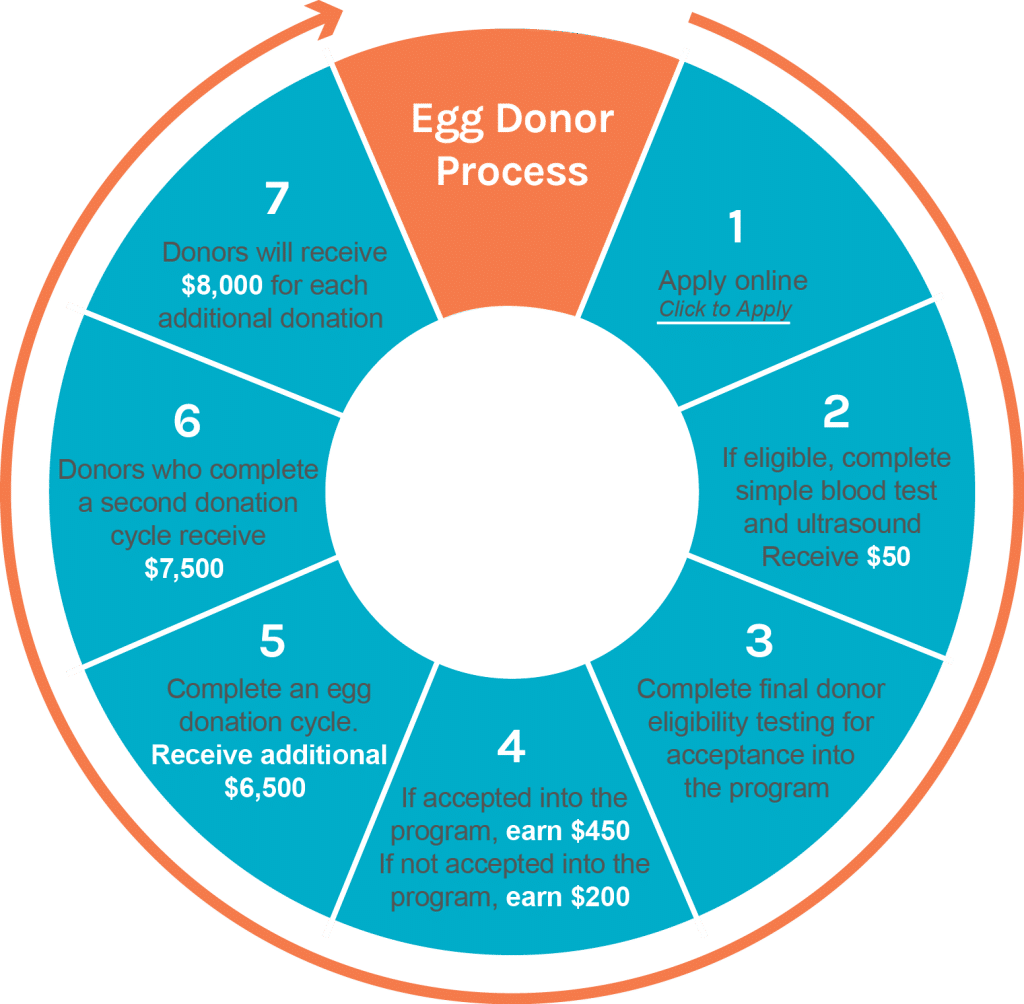
Our Egg Donor Team receives many questions from women about how egg donors will be compensated during and after the egg donation process. Our donors are paid at select steps throughout the pre-screening process, as well as after the egg retrieval. We understand the significant amount of commitment that is put into the pre-screening of our donors and want to be sure that we are optimizing the egg donor candidate’s experience from a physical, emotional, and financial perspective.

How Compensation Works

Step 1: Submit an Initial Application.

Step 2: Complete your Egg Donor Profile.

Step 3: Schedule your baseline appointment and receive $50 after your appointment.

Step 4: Upon the completion of the final donor eligibility testing and acceptance into the program, you will receive $450. If you’re not accepted for any reason, you’ll still receive $200 at this point.

Step 5: At the completion of your donation cycle, at the egg retrieval, you will receive $6,500. This brings the total compensation for one cycle to $7,000.

Step 6: After 6 to 8 weeks, our team will invite you, assuming you are eligible, to donate again. Donors who complete a second donation cycle will receive another $7,500 upon completion of the donation cycle. For cycles 3 through 6, you will receive $8,000 each cycle (lifetime donation max is six donations).


Should you need help uploading pictures, completing your profile, or getting your questions answered, please email sgfdonorliaisons@sgfertility.com.

Apply Now

Filed Under: Becoming an Egg Donor Tagged With: Become an egg donor

July 14, 2017 by Shady Grove Fertility

Are you considering egg donation but have questions? Each month our egg donor specialist and two-time egg donor, Joanna, hosts a live informational webinar to explain the basics of egg donation, share from her experience, and answer questions. In the most recent webinar, there were many questions that pertained to all women who are first learning about egg donation, so we thought we would share:

What are the best kind of photos to submit to become an egg donor?

With two sets of photos that we require from our donors, there are two different sets of criteria to consider. With regards to your childhood photos, we would like five photos from age 4 to 12. This age range typically describes preschool to middle school, so therefore a great option would be to use your yearbook photos, which you could then scan or take a picture of. When taking a picture of a printed out picture, it is important to avoid a glare.

While it may be tempting to use an adorable “Throwback Thursday” shot that you have posted to Instagram, we ask that you refrain from using pictures that have been posted to social media. This rule applies to your adult photos as well—we ask for simple, clear pictures that clearly display your developed features (hair color, eye color, complexion, etc.). Appropriate pictures can simply be a photo of just you taken on a smartphone with a solid background.

Does being on birth control affect the egg donation process?

Yes, birth control can affect the egg donation process depending on the type. Most birth controls are generally accepted during the process, however, birth control methods like Implanon or Nexplanon (implant in upper arm) or the Depo-Provera shot cannot be used during the process as they can skew hormonal testing results.

While it is not suggested to abandon your birth control method immediately (as there are many factors that contribute to donor selection), if you do choose to have your implant removed, you will be able to be considered for donation after you have had three regular periods post-removal. If you choose to stop your Depo-Provera shots, we are able to consider you for donation 10 to 12 months after your last shot and after three regular periods.

Are you taking all of my eggs – can I still have a baby later on?

There is a common myth that egg donation can result in the inability to have your own children because you are losing all of your eggs—this is false! When eggs are donated, we simply take the eggs that would have naturally been discarded by your body that month.

Are the medications painful?

The medications are administered through a very small needle that is injected into the fatty tissue of your midsection. It is relatively quick, easy, and manageable.

Can you still have sex during the egg donation process?

The short answer is no, you cannot have sex during the process of egg donation. This is because you will not be on birth control, and your eggs will be stimulated, primed, and ready for pregnancy. Even with protection such as male or female condoms, the risks are too high.

Can you still exercise during the process?

You can exercise regularly for the majority of the egg donation process, however, during the 2 weeks of your egg donation cycle, for your own safety, we ask that you refrain from any heavy exercise (essentially anything more than walking) to avoid negative side effects that may come from the increase in ovary size due to stimulation. The general rule is to withhold from exercise for the 2 weeks during the egg donation cycle and for 2 weeks after donation.

How long will it take to know if you’ve been accepted? 

After submitting your initial application, it will take about 15 to 20 minutes to receive a response. However, if we have any follow up questions, it make take up to 12 business hours.

Your egg donor profile will be reviewed in 24 to 48 business hours. After your baseline appointment, donor day, and social work appointment, you will be informed if you have been accepted into the program or not. The entire screening and evaluation process takes about 1 to 2 months.

What happens after you become an active egg donor?

As we are a fresh cycle database, you are only stimulated once an egg donor recipient selects you. It is a very exciting experience to know you have been selected—this way you know that your eggs are going to be used to help a family (or families) have a child.

What should you include in your egg donor application essays and personal statement?

Much like a college application, these essays require some humble bragging. Play up your skills and traits that can allow you to connect to another person, such as your favorite TV shows or that you’ve played the piano since your childhood. Ask yourself, how am I unique? The essays allow the recipients to see you as a real person, so let them get to know you.

How often can you donate your eggs?

It takes about 6 to 8 weeks for a physician to review your donation (whether it was safe, the quality and quantity of your eggs, etc.) before you may donate again. You may donate your eggs three times in a year, but according to the governing body of infertility, the American Society for Reproductive Medicine (ASRM) standards, there is a maximum of six donations in your lifetime. For tax purposes, we recommend donors cautiously choose how frequently they donate in 1 year.

About 66 percent of donors will repeat the donation process, so talk to your physician when they call you for a follow up for more information about the next steps to take if you would like to donate again.

Have more egg donor questions?

Please email sgfdonorliaisons@sgfertility.com.

Apply To Donate

If you are interested in learning more about egg donation or to have some of your egg donor questions answered and want to speak with a former egg donor, call 1-888-312-4499. If you would like to get started, apply today!

Filed Under: Becoming an Egg Donor Tagged With: Become an egg donor

April 20, 2017 by Shady Grove Fertility

“5 Things I’d Love to Tell My Egg Donor.”
An Open Letter from SGF Ireland Egg Donor Recipient

At the age of 36, Niamh Mulhall started trying for her first child. After failed rounds of IVF, she was told she would need to use an egg donor. “For me, it was a time of loss and grief. I knew no one in a similar situation and I felt alone.” She tried two cycles of donor egg treatment in Spain and two rounds in Greece, transferring a total of 18 embryos and was still childless. Five years had passed in a haze of disappointments. Niamh then learned of the collaboration between Shady Grove Fertility and Cork Fertility Centre and decided to travel to America for donor egg treatment.

A Letter to Egg Donors from a Donor Egg Recipient

Dear donor,

  1. Thank you a million, million, million times for giving him, and us, life. Thank you for the better life we have being his parents. Thank you for allowing for us to be Santa, have birthday parties, and be called ‘mom and dad.’ Thank you for the opportunity to see life through the eyes of our child; the hugs, the love, the chaos, the crisis over a missing toy and the messy car… we love it all. Honestly, we couldn’t love and cherish him any more than we do. We are proud to be his parents.
  2. We have told him the story of his conception. It is something that he can tell himself now. It goes like this ‘To make a beautiful little boy like me, you need a mommy bit and a daddy bit. But the mommy bit wasn’t working very well. So mom and dad went all the way to America where a very kind lady gave the mommy bit to mix with the daddy bit and made me! She was a very kind lady.’

Read all 5 reasons Niamh is grateful and how her egg donor changed her life.

SGF Egg Donors Help Families from All Over the World

Niamh’s story is not unlike the many stories of our egg donor recipients. They try to have a baby. They try again, and again, and it doesn’t work. They feel as though they have run out of options until they learn they haven’t—that egg donation exists, and in America, and specifically at SGF, recipients can select from a registry of prescreened egg donors and have a guarantee of taking home a baby or they receive a 100% refund. Among a few of the things that make this process truly amazing for so many donor egg recipients:

  1. Donor egg recipients are able to select their egg donor. In some countries, they have egg donors, but the fertility center matches them with an anonymous egg donor that they don’t get to choose. Our program allows recipients the opportunity to select their egg donor—an anonymous egg donor that they connect with on some level—whether it be their egg donor resembles the parents, or they share common interests, dreams, and goals.
  2. Donor egg recipients are able to select from a registry of prescreened egg donors. We screen each egg donor applicant medically, psychologically, and physically (regarding their fertility), prior to designating them as an egg donor qualified for selection. The alternative is to have a database of women who are interested in donating, but likely not medically eligible. This ensures our egg donors are selected quickly—there is no ambiguity or waste of time for both donors and recipients.
  3. SGF offers a Shared Risk 100% Refund Program. This Program is unique to SGF, which is why couples travel from all over the world to see a physician at SGF. Egg donation is not an inexpensive way to have a baby—but for many, it is the best and only option for them. In the rare case, donor egg treatment doesn’t work, adoption remains an amazing option, which is why the Shared Risk Refund exists—so patients don’t have to limit their choice based on financial reasons alone.

SGF Egg Donors in America Help Change Lives

Because our egg donor program is anonymous, recipients never have the chance to meet their egg donor (unless it is a known egg donor, typically a friend or family member). Like Niamh, they are incredibly grateful for their egg donor but aren’t able to express their sincere gratitude. To say ‘thank you’ to her egg donor, Niamh wrote an open letter to her, to express how her donor impacted her life, and how much she was given.

Apply Today


If you want to change the life of a family, apply today or call 1-877-DONATE-EGGS to learn how to start your journey. Egg donation is an amazing gift.

Filed Under: Becoming an Egg Donor Tagged With: Become an egg donor

August 25, 2016 by Shady Grove Fertility

Who are egg donors? Often egg donors are thought to be young women, maybe in college, looking for some extra cash but the reality is often quite different. Melissa (name changed to protect her anonymity) is a mother of a young boy who experienced all the joy that motherhood can bring but also someone who witnessed the emotional struggle caused by infertility. She knew the love of having a baby and wanted to help someone she would never meet be able to experience the joy of holding a baby, their baby, for the first time. Here’s how Melissa learned about egg donation, why she decided to donate her eggs, and her advice for other women who might consider egg donation.

Donating Her Eggs: Two Heart-Warming Reasons Melissa Wanted to Donate

There were two reasons that led me to want to become an egg donor. First, I have an 8-year-old son, so I know how amazing it is to be a mother and I knew that I wasn’t going to have any more children (since I wasn’t using my eggs, why not help someone else?). I also have family members who struggled with infertility and while they ended up adopting, I saw how much pain they went through in the process. They are some of the most deserving people to be parents, as are so many other people with fertility issues.

It made sense to me to really consider donating my eggs, and even if it wouldn’t help someone I knew, it would still help someone achieve the goal of being a parent. The first time I held my son is a feeling I will never forget and I think everyone who wants children should have the experience of getting to hold their brand new baby in their arms.

While considering donating my eggs, I had an idea that there would be a selection process (little did I know the extent), and I wasn’t sure if I would be selected. My boyfriend, who is unbelievably supportive, researched a little and sent me some links of stories people had written about their own donation process. It seemed very organized and straightforward, so I filled out the application and submitted it.

Apply To Donate Your Eggs

My Advice for Women Thinking of Donating Their Eggs

  • Put yourself in their shoes and have a lot of patience: I quickly learned that there’s a reason it’s called a selection process: You are passing your genes onto someone you will never know. Be as thorough as you can in answering your questions. When filling out the Egg Donor Profile, I tried to put myself in the recipient’s shoes and think, “what would I look for if I had to select someone else to contribute half my child’s genes?” I think that helped a lot in answering the questions.
  • Ask questions: The staff at Shady Grove Fertility really are second to none. They are all so supportive and understanding, and are always there to help. My nurse Kathleen answered any question or concern I had, so I would really suggest to anyone considering donating to not hesitate to ask your nurse questions.
  • Eat your protein: Before your FDA panel, make sure you eat a lot of food with protein in it. I also found drinking Propel and coffee with sugar helped a lot. I actually passed out when getting my blood drawn, and finally figured out that I needed to eat even more than what I thought was enough. I also laid down and I didn’t have any more problems.
  • Know you will get through the medications: Egg donors have to give themselves medication to help with their egg development. Going through the injections is something that I will admit that I was nervous about. I don’t think anyone is truly a fan of having to inject themselves, but something that helped me was exhaling right before I did it and remembering it only hurts for a literal second and then you’re done. It’s only for about 2 weeks. That’s nothing in the grand scheme of things.

Coming soon: Learn about Melissa’s two very different egg donation cycles and learn what to expect if you are selected to become an egg donor. Click to learn more about egg donation, or call 1-877-DONATE-EGGS.

Apply To Donate Eggs

Filed Under: Becoming an Egg Donor Tagged With: Become an egg donor

  • « Go to Previous Page
  • Page 1
  • Page 2
  • Page 3
  • Page 4
  • Page 5
  • Go to Next Page »

Company

  • About SGF
  • About US Fertility
  • Our Doctors
  • Fertility Equity
  • Careers
  • Newsroom
  • SGF College Scholarship
  • Contact Us
  • Voice Your Feedback

Treatments

  • Egg Freezing
  • Intrauterine Insemination (IUI)
  • In Vitro Fertilization (IVF)
  • Frozen Embryo Transfer (FET)
  • LGBTQIA+ Family Building
  • Shared Risk 100% Refund Program
  • All Treatments

Resources

  • Patient Portal
  • Online Bill Pay
  • Library
  • Support Groups & Events

Locations

  • California
  • Colorado
  • Delaware
  • Florida
  • Georgia
  • Maryland
  • North Carolina
  • Pennsylvania
  • Texas
  • Virginia
  • Washington, D.C.

2026 Shady Grove Fertility

  • Policies & Notices