Uterine fibroids are one of the most common conditions impacting reproductive health. While some fibroids may not produce any symptoms, others can result in changes in your menstrual cycle or cause infertility. If you’ve been experiencing heavy or prolonged periods, pelvic pressure, or difficulty conceiving, fibroids may be part of the picture. Here’s a look at what fibroids actually are, how they affect fertility, and what fertility-preserving treatments SGF has to offer.
“Fibroids are incredibly common—and the symptoms are often dismissed or normalized for years before someone gets a real answer,” shares Janet Bruno-Gaston, M.D. an SGF Houston fertility specialist. “Sharing your symptoms with your provider can be the first step in your evaluation and what it can change is significant.”
FAQ: Uterine fibroids and fertility
What are uterine fibroids?
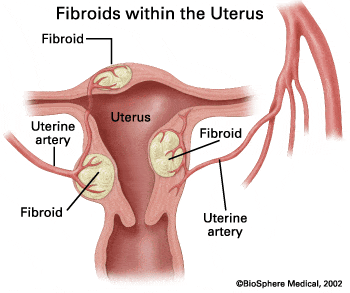
Uterine fibroids—also called leiomyomas—are usually noncancerous growths that develop in or on the uterus. They’re made of smooth muscle tissue and can range from the size of a seed to larger than a grapefruit. Some people have one; others have several.
Fibroids are extremely common. By age 50, more than 70 percent of people with a uterus will develop them. They’re even more prevalent among Black women—an estimated 8 in 10 Black women are affected by uterine fibroids, often earlier in life and with more severe symptoms. That disparity is complex and highlights a real gap in early diagnosis and care, and it’s something our team takes seriously.
Do fibroids affect fertility?
It depends on the type, size, and location. Not everyone with fibroids will experience fertility challenges—but fibroids are present in about 5 to 10 percent of people diagnosed with infertility, and for some, they’re a significant contributing factor.
There are three main types, each with different implications:
- Submucosal fibroids grow inside the uterine cavity. These have the greatest impact on fertility—they can interfere with embryo implantation and increase the risk of early miscarriage. Removal is almost always recommended.
- Intramural fibroids develop within the muscular wall of the uterus. Smaller ones may not require intervention, but larger ones can distort the uterine cavity and affect implantation or early pregnancy development.
- Subserosal fibroids grow on the outer wall of the uterus. They’re less likely to directly affect fertility, but can cause significant symptoms like pelvic pressure and pain.
Common symptoms that may indicate fibroids include heavy or prolonged menstrual bleeding, pelvic pain or pressure, frequent urination, painful intercourse, and difficulty conceiving. Some people have no symptoms at all and only learn they have fibroids during a fertility evaluation.
How are fibroids diagnosed?
Fibroids are typically identified through a pelvic exam or ultrasound. Additional diagnostic tools may include a hysterosalpingogram (HSG), a sonohysterogram, an MRI for surgical planning, or a hysteroscopy—a minimally invasive procedure in which a small camera is inserted into the uterus to directly visualize the cavity. SGF’s minimally invasive gynecologic surgery (MIGS) surgeons can perform hysteroscopy in-office at select locations.
What are the fibroid treatment options at SGF?
Not every fibroid requires treatment. Your physician will evaluate the size, location, and number of your fibroids alongside your symptoms, your family planning goals, and your overall health before recommending a plan.
- Hysteroscopic myomectomy—removal of submucosal fibroids through the cervix using a hysteroscope. No incisions required.
- Laparoscopic myomectomy—minimally invasive surgical removal of intramural or subserosal fibroids. Shorter recovery than open surgery, with fertility preserved.
- Abdominal myomectomy—reserved for larger or more complex cases. Open surgical approach, uterus intact.
- IVF—for some patients, in vitro fertilization (IVF) is the most effective path to pregnancy, either alongside fibroid treatment or independently.
If you’ve been experiencing symptoms—or simply want to understand whether fibroids might be affecting your fertility—our team is here.
Can I get pregnant with fibroids?
Yes—many people conceive and carry healthy pregnancies with fibroids. Whether fibroids are affecting your fertility depends on their type, size, and location. The best way to know is a thorough evaluation with your fertility specialist, who can review your imaging and discuss whether treatment makes sense before you pursue conception.
How do I know if my heavy periods might be related to fibroids?
Heavy bleeding—soaking through a pad or tampon in an hour or less, or bleeding for more than seven days—can all be signs of submucosal fibroids near the uterine lining. Pelvic pressure, pain during intercourse, or difficulty conceiving alongside heavy periods are all reasons to come in for an evaluation. You don’t need a referral.
Does insurance cover fibroid treatment?
Coverage varies by plan. About 90 percent of our patients have their initial consultation covered by insurance, and approximately 70 percent have some coverage for testing and treatment. A Financial Educator on our team will review your benefits at no cost before you begin.
Is July Fibroid Awareness Month?
Yes. July is Fibroid Awareness Month—a dedicated moment to close the gap between how common fibroids are and how often they go undiagnosed. If you’ve been living with symptoms and haven’t had an evaluation, this is a good time to start that conversation.
Medical contribution by Janet Bruno-Gaston, M.D., MSCI
Janet Bruno-Gaston, M.D., MSCI, is board certified in obstetrics and gynecology and in reproductive endocrinology and infertility (REI). Dr. Bruno-Gaston received her medical degree from Morehouse School of Medicine, where she was recognized as a Community Health Honors Scholar for her work with health care disparities.