
Editors Note: This post has been updated for accuracy and comprehensiveness as of October 2026.
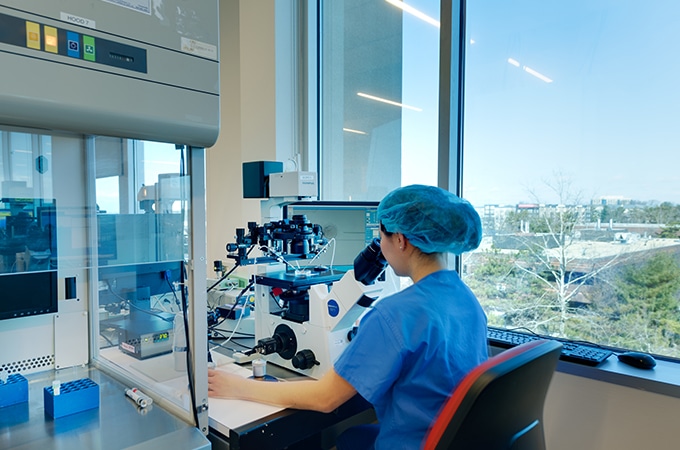
Your eggs, sperm, and embryos spend some of the most important hours of treatment in our embryology and andrology labs. We run three specialized labs that operate under some of the most rigorous, verified protocols in the field, so every sample is identified, handled, and monitored with care from start to finish.
Our labs are led by board-certified physicians Michael J. Tucker, Ph.D., Chief Scientific Director of SGF’s IVF and Embryology Laboratories, and James Graham M.S., ELD, Senior Director of SGF Laboratory Services.
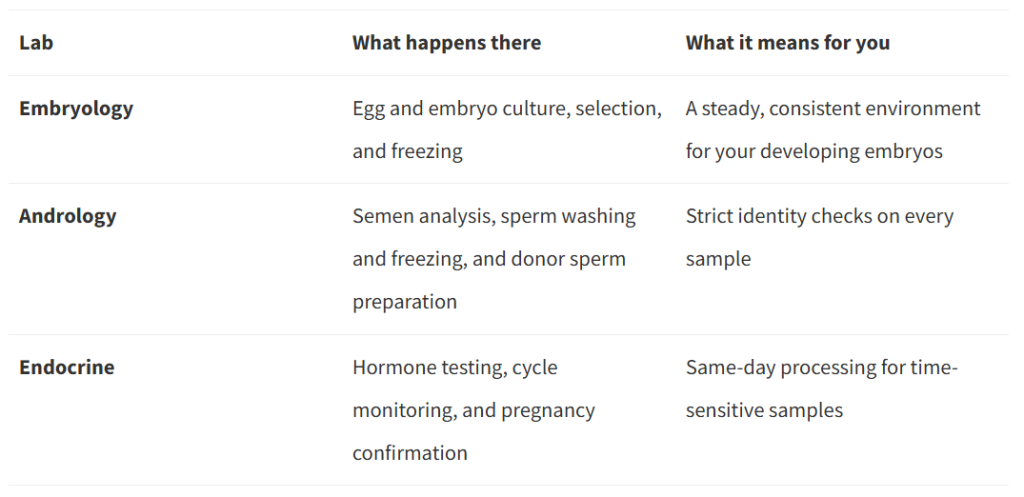
1. Three specialized labs, one standard of care
Each lab handles a different part of your care, and all three follow the same rigorous protocols.
2. Two-person identity checks at every stage
Every specimen in our care moves through a chain-of-custody protocol built on both human and electronic verification. Two embryologists confirm the identity of samples at each stage, for example, making sure the correct sperm is paired with the correct eggs.
You’re part of the process too. We’ll ask you to confirm your identity out loud at several points during treatment.
3. Electronic witnessing that tracks every step
We also track the chain of custody electronically with an electronic witnessing system, RI Witness. This assisted reproductive technology (ART) enables every sperm sample, egg, embryo, test tube, and dish to be electronically linked to the right patient.
Our system creates a detailed, time-stamped log of each step and alerts the embryologist to any possibility of a mismatch before one can occur. The physician or embryologist performing the procedure gives final approval.
4. Carefully controlled air quality
When creating and developing embryos, maintaining an environment with exceptionally clean air is essential. Embryo development is sensitive to its surroundings, and research has linked poor air quality in IVF labs with lower fertilization and embryo development rates.
Our IVF labs use HEPA filtration that removes both airborne particles and gases known as volatile organic compounds (VOCs). Humidity is held at precise levels throughout the lab, too. By maintaining a clean room in which we perform delicate procedures, we eliminate the possibility of poor air quality negatively impacting our work. Instead, we increase the likelihood of successful fertilization, embryo development, and, ultimately, pregnancy.
5. A private incubator space for your embryos
Early embryos benefit from a stable environment with as few disruptions as possible. In older lab setups, several patients’ embryos often shared incubator space, so opening it for one patient changed conditions for everyone’s.
The use of isolated chambers represents a major improvement in the IVF process. Previously, spaces were shared by multiple patients — meaning the environment for one patient’s developing embryos would impact another each time an embryologist needed to access the embryos of another patient using the same space.
Now, each patient’s space is only accessed when an embryologist is doing an assessment or performing a procedure for that particular patient. Because we can keep embryos in a more controlled, consistent environment, we can ensure optimal success rates for our patients.
6. Accredited labs that report outcomes every year
All Shady Grove Fertility labs are accredited by The Joint Commission, an independent, nonprofit organization whose accreditation is recognized nationwide as a mark of quality. Our embryology labs also meet the stringent criteria required for membership in the Society for Assisted Reproductive Technology (SART), the organization that sets standards for assisted reproductive technology (ART) care in the U.S.
We report birth outcome data to SART every year, so our results are available for anyone to review.
View our success rates
7. Embryologists with years of training
SGF embryologists complete a 4- to 5-year training pathway of mentorship, on-the-job training, and supervised practice. They learn each procedure individually, often over several months, before they’re cleared to perform it on their own. Competency is verified every year after that.
Our embryologists also arrive with strong scientific backgrounds. Each holds a bachelor’s, master’s, or doctoral degree, and many come from research or the biological sciences.
8. Research that moves fertility care forward
Every year, our physicians and scientists contribute research to the American Society for Reproductive Medicine (ASRM) annual meeting and publish in leading journals, including Fertility and Sterility and Human Reproduction.
Have questions about our labs?
Bring them to your consultation. Our team is happy to explain exactly how your eggs, sperm, and embryos are cared for in the lab.
To schedule an appointment, call a New Patient Liaison at 1-877-971-7755 or request an appointment online.
To schedule an appointment, please contact one of our New Patient Liaisons at 1-877-971-7755 or click here to complete this brief form.