Blastocyst Culture And Transfer

Read About More Medical Perspectives

by Robert J. Stillman, MD and Michael J. Tucker, PhD

New IVF Technique Promises to Maximize Safety and Success Rates

Blastocyst culture and transfer is a important technique developed for in vitro fertilization (IVF) that maximizes pregnancy rates while minimizing the risk of multiple pregnancy. The ability to grow embryos for five or six days to the blastocyst stage of development in the laboratory, rather than the traditional three days, allows Shady Grove Fertility's embryology team to determine, with greater certainty, which embryos are really the "best" in terms of their potential for implantation.

Consequently, blastocyst culture makes it possible to select the best one or two blastocysts vs. two or three (or rarely four) early embryos to transfer back to the mother. This reduces the occurrence of potentially risky multiple births.

"Shady Grove constantly strives to improve IVF success rates through the steady refinements of clinical and laboratory techniques. Clinical blastocyst culture and transfer is an important step in that evolution," explains Robert Stillman, MD.

What is Blastocyst Culture and Transfer?

8 cell, Day 3 embryo

Traditionally, embryos have been transferred to the uterus on the second or third day of development after in vitro fertilization and initial embryo cell division. This day of embryo transfer has been a balance between maximizing the degree of embryo selection available through longer culture in the IVF Lab versus minimizing the exposure of the embryos to culture media which, in the past, could only sustain growth for 2-3 days.

Michael Tucker, PhD explains, "the dynamic processes of embryo development were not taken into account by the static nature of the "one size fits all" culture media that has been used prior. Because of this, blastocyst growth in vitro had always been suboptimal." But culture media now are designed to take into account the myriad and changing needs of the developing embryo in vitro.

Day 5 Blastocyst Embryo

After five days of growth, the cells of the embryo should have divided many times over, and have begun to differentiate by function. The embryos that survive to this stage of development are more likely to be strong, healthy, and robust. They are now called blastocysts.

Three important factors had limited the number of embryos that will survive to this stage:

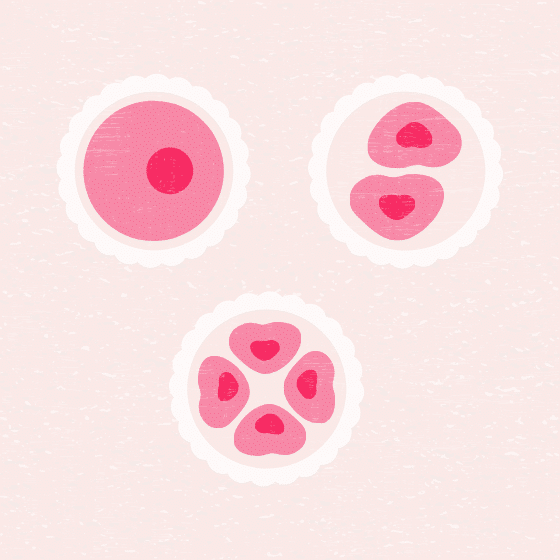
First, the inherent "health" of any embryo will dictate its ability to continue to grow and divide. Several eggs may have initially fertilized, but only a few will progress to the four-cell stage on day two in culture, fewer still to the eight-cell stage on day three in culture, and even fewer will develop into blastocysts. Simply put, this self-selection can be viewed as "survival of the fittest".

The second limiting factor in preventing continued growth of embryos in culture had been the culture media itself. Researchers have identified shortcomings of the in vitro culture environment and have developed new culture solutions called Blastocyst Media. These are rich in life sustaining nutrients that give the embryos every chance to reach there full inherent potential.

"From egg collection onward, the embryo will now be exposed to specific media that are designed to meet the nutritional requirements of each stage of development," says Dr. Tucker.

Third, even with embryos of good growth potential and optimal culture media, the experience and expertise of the laboratory embryologists doing this important work is critical to achieving good blastocyst development. It is here that the embryologists at Shady Grove Fertility excel. They, as opposed to many other laboratories who have tried but then abandoned the rigors of blastocyst culture, have optimized the opportunities for patient success in their IVF cycles and in their quest to build their families.

What Are the Benefits of Blastocyst Transfer?

Let's use an example. Historically, if a woman has 15 eggs retrieved, an average of 10 will fertilize by day one of observation. It is impossible to determine at this point which of these 10 are most likely to implant and develop into a baby. Perhaps all will, but perhaps not. On the traditional day of embryo transfer (day three), 5 of the 10 embryos may be developing into vibrant, growing embryos. The others may have slowed or stopped their development altogether as naturally many eggs and embryos are abnormal.

In this example, we are left with several embryos that still look like they may have excellent potential. Which ones to transfer? Which ones are really the "best"? Two additional days in the blastocyst culture medium allows the natural winnowing process to continue. Thus, after 5 or 6 days of growth in the laboratory, only 2 or 3 of the original ten embryos may remain viable, showing their inherent potential. We now know the best embryo(s) to transfer.

Embryos transferred at the blastocyst stage have made it through key growth processes and typically offer a greater chance of implanting. Without compromising pregnancy rates, we need only return 1 or 2 blastocysts to the mother instead of the typical 2 or 3 early embryos. In addition, the fewer embryos transferred the more may available for cryopreservation for future use.

A significant benefit of blastocyst culture and transfer is the reduction of multiple births that can result from in vitro fertilization. This means that the many obstetrical complications that may arise from multiple pregnancies can be minimized. It is especially important in helping patients avoid having to make the difficult personal and ethical decisions regarding selective reduction.

Is Blastocyst Culture and Transfer for Everyone?

“Decidedly not”, says Dr. Stillman. “In thinking of the example above, patients who have fewer oocytes retrieved, fewer fertilized or fewer dividing embryos by day three in culture have no advantage using blastocyst culture, since little is to be gained in further embryo "self selection".

He emphasizes, “Unfortunately the new blastocyst culture media does not improve the health or viability of an individual embryo which is not otherwise able to sustain five days of growth and then implant; rather it allows embryos capable of sustained growth to continue in culture and reach their maximum inherent capability."

He states that it is great to get to blastocyst transfer since that means that there were a larger number of eggs retrieved, a larger number fertilized and growing on day 2 and 3 of culture that we want to follow. However, a large proportion of patients with fewer eggs and/or fewer embryos do very very well with a transfer day 3 when we can recommend to them which embryos for transfer earlier. Like culture media, ‘one size does not fit all’ for the day of embryo transfer. That should be individualized to give the best outcome for each individual couple.

About half of the embryo transfers at Shady Grove Fertility are currently day 3 and half day 5 or day 6. (The later day 6 blastocyst transfer is recommend when, on day 5, the embryos still may not have revealed which are the best of the group for transfer, and one more day is recommended). Many many patients undergoing Day 3 embryo transfer still have very good pregnancy success rates.

Helping Patients

In this field of medicine, continued refinements and change offer greater opportunity for infertile couples. Blastocyst culture is one important step and one at which Shady Grove Fertility excels.

"It is exciting for us to be able to offer our patients this promising state-of-the-art technique, as it provides us the ability to further tip the balance of success versus risk in favor of couples when we assist them in their pursuit of parenthood," explains Dr. Stillman.

But, he adds, “be most assured that whether day 3 or day 5 or 6 transfer is recommended for you, it is a decision made by the experienced and expert clinical and laboratory teams aligned to give you the best individualized advice for a safe and successful outcome.”


In The IVF Lab
IVF Success Rates


 Read About More Medical Perspectives