
Prepregnancy genetic screening
Today, it is customary for OB/GYNs to recommend prepregnancy genetic screening (also called carrier screening) to their patients as part of routine prepregnancy counseling. Shady Grove Fertility advocates for genetic screening when planning for pregnancy, and offers genetic screening for more than 100 different diseases and syndromes.
Genetic screening enables you to examine your genetic background for recessive genes that could possibly affect your future children. Thanks to this advanced technology and procedures such as PGT-M, you now have the ability to prevent passing on mutations that can affect your offspring. Ultimately, it is your choice as to whether or not you want to undergo prepregnancy genetic screening, but we firmly believe that the best decision is a well-informed one.
Genetic testing on embryos
Preimplantation genetic testing allows for patients to detect a range of abnormalities including recessive disorders discovered during genetic screening.
Diseases identified by genetic or carrier screening
Prepregnancy genetic screening tests gene mutations that fall into each of these three categories:
- Those mutations that are common in a certain ethnic group
- Recessive mutations (because dominant genes often show symptoms and are typically known already)
- Those mutations that have some likelihood of causing serious disease in affected offspring
Even if you’re healthy and have never had a family member affected by these diseases, you could be a carrier of a genetic mutation(s), which can put your future offspring at risk. This makes screening all the more important. At Shady Grove Fertility, we offer screening to our patients that searches for more than 100 recessive genes and fragile X syndrome.
| CONDITION/DISEASE | CARRIER FREQUENCY |
|---|---|
| Tay-Sachs Disease | 1 in 31 |
| Canavan Disease | 1 in 41 |
| Cystic Fibrosis | 1 in 25 |
| Niemann-Pick Disease | 1 in 90 |
| Gaucher Disease | 1 in 18 |
| Fanconi Anemia | 1 in 89 |
| Bloom Syndrome | 1 in 107 |
| Familial Dysautonomia | 1 in 31 |
| Mucolipidosis Type 4 (ML4) | 1 in 127 |
| Glyogen Storage Disease Type 1A | 1 in 71 |
| Maple Syrup Urine Disease | 1 in 81 |
Genetic screening at SGF
Before your new patient consultation, you will receive a packet of new patient paperwork in the mail that includes a genetic questionnaire and information about prepregnancy genetic screening, should you choose to participate. Your physician will review your family history at the consultation and select the appropriate testing. You’ll receive a testing kit and you’ll need to arrange to return to our center in order for us to test both partners during day-3 bloodwork or at a specially scheduled appointment. The testing kit can use DNA obtained through either blood or saliva. Once both the male and female provide a sample, we will send the kit to the lab, with results arriving to you and your physician within 2 to 3 weeks.
In the past genetic screening was very expensive and as a result out-of-reach for most patients. Over the last few years, advances in screening technology have allowed patients the ability to be screened for over 100 genetic diseases at a low out-of-pocket cost to patients. As a result, more are taking advantage of this testing.
Testing positive as a carrier
Due to how vast the prepregnancy genetic screening panel is, it is quite common for men and women to test positive for genetic mutations. But even if both partners test positive for the same mutation, that does not always guarantee that your embryos will be affected. Additionally, many mutations will not lead to a severe disease, which often results in couples not taking further action.
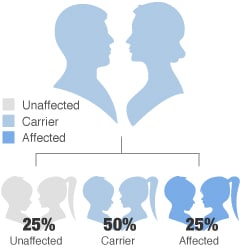
When both genetic parents are carriers of a recessive disorder, there is a 25% chance that a child will not be affected, a 50% chance the child will be a carrier, and a 25% chance the child will have the disease.
Patients who test positive will receive genetic counseling that will present them with their options. This counseling is typically provided by the outside company performing the genetic screening at no additional cost.
If you wish to keep your original treatment protocol after completing counseling, options include choosing not to undergo any additional testing or to wait and test during pregnancy to determine whether your child will be affected.
If you prefer to take action based on your genetic testing results, you now have access to one of the most significant advances in the field: Preimplantation Genetic Testing for Monogenic/Single Gene Defects (PGT-M), previously known as preimplantation genetic diagnosis (PGD). This is a technique utilized with IVF that involves a biopsy of a few embryonic cells in order to differentiate healthy embryos from genetically abnormal embryos. In this way, we can identify embryos destined to express disease, allowing the transfer of only a genetically normal embryo(s) to the uterus. This technique has allowed thousands of couples to successfully carry to term and deliver healthy babies.
